


Nizhny Novgorod and Yekaterinburg: why we removed these guides
Here there were three pieces of content: a list of Nizhny Novgorod attractions, a selection of museums in Yekaterinburg, and a selection of countryside hotels around it. All three have been removed in every language version, and the old URLs now redirect permanently to this page.
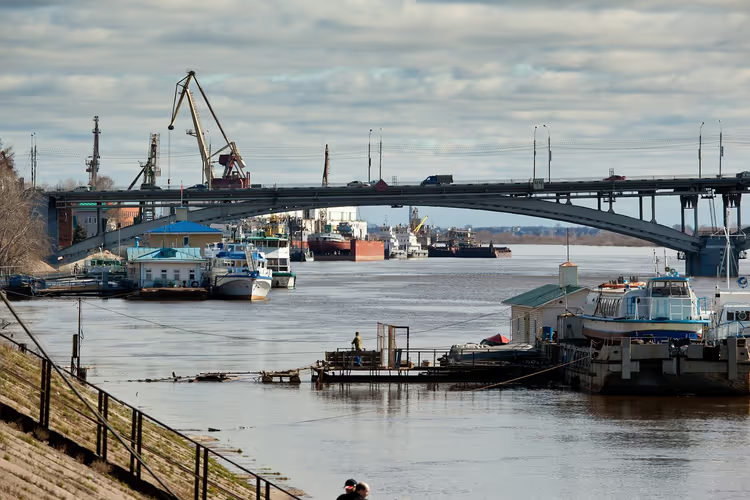
Our previous texts presented both cities in the genre of industrial tourism: the kremlin above the confluence of two rivers, constructivism, factory history as part of the city's legend. We no longer write about this as a trip. The factory theme in these cities is no longer history: they are home to enterprises under EU and Western sanctions that produce and modernize weapons for the war against Ukraine.
💡 At a glance:
- which three pieces of content were removed and what genre they were written in
- which sanctioned enterprises are located in these cities and what is known about them from open registries
- what a foreigner risks by being in this country, illustrated by a case that went to court
- which industrial and museum cities in Europe remain in our live sections
- Last updated: 09/2026
Why we deleted these guides
Two of the texts were lists of sights, and the third was a selection of countryside hotels. Each one had a practical section that readers came for, and removing it would have left an empty page.
Russia's full-scale invasion of Ukraine began on February 24, 2022 (UN press release GA/12407, 03.02.2022). We believe that an editorial team based in the European Union cannot, after that date, publish content that organizes travel to this country, and it looks especially inappropriate in places where the city's legend is built on industry.
About the money, in short and without exaggeration. The share of oil and gas revenue in Russia's budget fell to roughly 22 percent in 2025 and 2026, while the share of non-oil-and-gas revenue rose to roughly 78 percent (OSW Centre for Eastern Studies, 09.12.2025). A hotel, a museum ticket, and a visitor's dinner all fall into the second category.
What is actually in these cities
From here on, only what is recorded in sanctions registries and open databases, with sources.
The Nizhny Novgorod aircraft plant Sokol, a branch of the state-owned aircraft manufacturing corporation, services and modernizes MiG-31 interceptor fighters for the Russian armed forces. Some of the modernized aircraft are equipped with hypersonic aeroballistic missiles used in the war against Ukraine; the enterprise is under EU sanctions (EU sanctions registry; OpenSanctions).
In Nizhny Tagil, Sverdlovsk Oblast, that is, in the same region as the second city in our cluster, is Uralvagonzavod, the world's largest manufacturer of main battle tanks. The plant produces T-90M tanks and modernizes T-72B3M tanks and is under Western sanctions specifically because of its supply of equipment for the war against Ukraine (per uamission.com: sanctions data summary).
We cite this not to declare entire cities off-limits. The point is different: the genre of industrial tourism assumes that the factory theme is in the past and is suitable for a museum exhibit. In these cities it is not in the past, and a text that stays silent about that sells the reader nostalgia instead of reality.
What a foreigner risks
One case that went to court explains more than general warnings.
In Yekaterinburg, Ksenia Karelina, a US and Russian citizen, was tried on charges of treason for donating 51 dollars to a Ukrainian charity in the US; she was later released as part of a separate exchange (CBS News). We present only what is contained in the source and add no biographical details or commentary.
This case is not an isolated one. On August 1, 2024, the largest prisoner exchange since the Cold War took place, involving 24 people, including a Wall Street Journal journalist, a former US Marine, as well as Vladimir Kara-Murza and journalist Alsu Kurmasheva (CNN, 01.08.2024). According to Travel and Tour World, as of June 2026 at least eight US citizens remain imprisoned in Russia (overview based on State Department materials, 2026).
Official agencies put it bluntly. Germany's Federal Foreign Office warns of the danger of arbitrary detention for German citizens and people with dual German-Russian citizenship (Auswärtiges Amt). The US State Department keeps the country at Level 4 "Do Not Travel," reissued on December 29, 2025, citing the risk of wrongful detention (U.S. Department of State).
What this means for you as a reader from the EU or the US
Item | Status as of 09/2026 | Source |
|---|---|---|
Services related to tourism in Russia | Prohibited by Article 5n(2) of Regulation 833/2014 as amended by Regulation 2025/2033 of 23.10.2025 | |
Transition period | Ended on 01.01.2026 | |
Enterprises in these cities | Sokol is under EU sanctions; Uralvagonzavod is under Western sanctions | |
Risk of arbitrary detention | The German Foreign Office warns about it directly | |
US State Department advisory | Level 4: Do Not Travel, reissued 29.12.2025, with a wrongful detention risk indicator |
Where to go instead
The need readers brought to these guides was for a large city with an industrial history, constructivist architecture, and good museums, plus a countryside hotel nearby for a weekend. The live sections of the site answer that: Poland with Lodz, Katowice, and the Upper Silesian industrial route, Germany with the Ruhr region, Leipzig, and Dessau, Czechia with Ostrava and Zlin, Finland with Tampere. We do not name individual hotels: hotel roundups are exactly the format we have moved away from in this section.
The full explanation for the entire section is collected in the section hub. Related topics: our position on Tula and Ryazan and our position on Kaliningrad.
Where we stand
We believe industrial tourism demands particular honesty, because this genre works with the industrial past. In our assessment, writing about a city's factory legend while the operating enterprise there modernizes combat aircraft for a war against a neighboring country, and saying nothing about it, means misleading the reader. We decided to remove all three guides and explain why at the same address.
We do not shift responsibility onto the workers of these enterprises and we write nothing about them: our sources are sanctions registries, which concern legal entities, not people. For the same reason, the case mentioned above is covered exactly to the extent contained in the publication, and not a line more.
We write about a state and its policies, not about people based on their passport. There are people in Russia who spoke out against the war and received prison sentences for it. Our decision not to publish guides to Russia is about money, sanctions, and reader safety, not nationality.
Publication date: September 3, 2026. Last updated: September 3, 2026.
⁉️🤔 Frequently asked questions
The plant and the museum are different things. Why does one cancel out the other?
It doesn't. We are not saying the museum is bad; we are saying we will not publish a text that invites people to go there. The legal basis: services related to tourism activities in Russia are prohibited for EU persons from January 1, 2026.
Are you accusing the residents of these cities?
No. Our sources are sanctions registries that list legal entities. We write nothing about the people who work or live there.
The Karelina case is a single incident. Is it enough to draw a conclusion?
We are not drawing a conclusion from it alone. Alongside it are other cases from the risks section and a direct warning from the German Foreign Office about arbitrary detentions.
Can a trip there be considered a way to understand the country?
We are not discouraging anyone or judging private decisions. We are explaining why we ourselves no longer publish material that organizes such a trip, and why for an EU publisher this is a matter of law, not taste.
What happens now at the old addresses?
They lead here. The reader gets an explanation and a list of industrial destinations in Europe that we continue to cover.
In short
Three articles about Nizhny Novgorod and Yekaterinburg have been removed in full; the old addresses now redirect here. The industrial tourism genre assumes that the factory history is in the past. In Nizhny Novgorod, the Sokol plant, under EU sanctions, modernizes fighter jets used in the war. In Nizhny Tagil, in the same region as Yekaterinburg, Uralvagonzavod operates under Western sanctions. For a foreigner, the country remains a place of real legal risk; examples are given above. The EU legal framework applies regardless of the purpose of the trip. The industrial cities in Europe that we continue to cover are listed above.
How you can help
We do not collect money and receive nothing from the links below. These are official websites of organizations working with the consequences of the war:
- UNHCR, the UN Refugee Agency, unhcr.org
- UNICEF, unicef.org
- Ukrainian Red Cross, redcross.org.ua
Sources
- UN General Assembly, resolution ES-11/1 "Aggression against Ukraine", 03/02/2022. https://press.un.org/en/2022/ga12407.doc.htm
- EU Sanctions Tracker, Nizhny Novgorod aircraft plant "Sokol". https://data.europa.eu/apps/eusanctionstracker/subjects/160176
- OpenSanctions, entry on the same company. https://www.opensanctions.org/entities/NK-hH8VPW294FY8MrzBMgwSSj/
- uamission.com, summary of sanctions data on Uralvagonzavod. https://uamission.com/sanctions/sanctioned-entities/uralvagonzavod/
- CBS News, on the case of Ksenia Karelina and her release. https://www.cbsnews.com/news/russia-frees-american-ksenia-karelina-prisoner-swap/
- CNN, on the prisoner swap of 08/01/2024. https://www.cnn.com/2024/08/01/politics/russia-us-prisoner-swap/index.html
- Travel and Tour World, overview based on U.S. State Department materials on U.S. citizens still detained, 2026. https://www.travelandtourworld.com/news/article/russia-joins-china-iran-venezuela-myanmar-nicaragua-and-more-in-a-strategic-analysis-of-the-2026-u-s-state-department-travel-advisory-and-global-wrongful-detention-risk-protocols-new-alert-trav/
- Auswärtiges Amt, Russische Föderation: Reise- und Sicherheitshinweise, as of 09/02/2026. https://www.auswaertiges-amt.de/de/service/laender/russischefoederation-node/russischefoederationsicherheit-201536?isLocal=false&isPreview=false
- U.S. Department of State, Russia Travel Advisory, Level 4, reissued 12/29/2025. https://travel.state.gov/en/international-travel/travel-advisories/russia.html
- Council Regulation (EU) 2025/2033 of 10/23/2025 amending Regulation 833/2014, EUR-Lex. https://eur-lex.europa.eu/legal-content/EN/TXT/?uri=OJ:L_202502033
- Skadden, analysis of the EU's 19th sanctions package, 11/2025. https://www.skadden.com/insights/publications/2025/11/eu-adopts-19th-sanctions-package
- Centre for Eastern Studies OSW, Russia's 2026 budget, 12/09/2025. https://www.osw.waw.pl/en/publikacje/osw-commentary/2025-12-09/russias-2026-budget-mounting-financial-challenges-and-economic
Link check date: 03.09.2026.

A small editorial team writing guides for independent travel. We travel ourselves, but we haven’t been everywhere, so we check prices, opening hours and how to get there against official sources.