




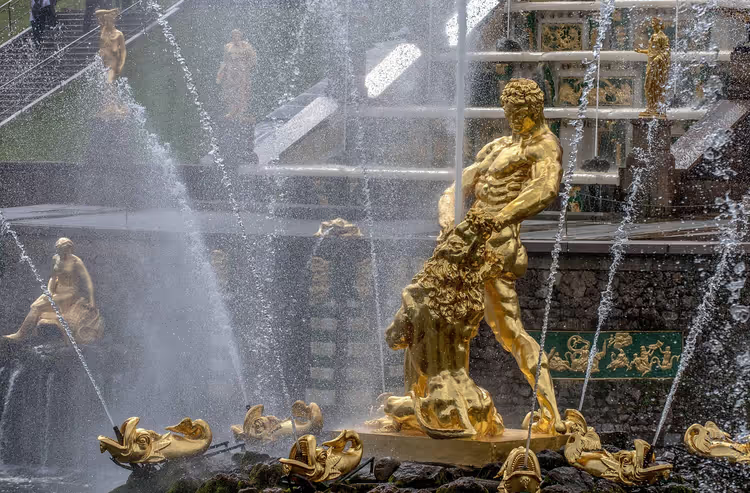
Peterhof and Tsarskoe Selo: why we removed these guides
Here there used to be three guides: to Peterhof with prices and opening hours, to its Grand Cascade, and to the Catherine Palace in Tsarskoye Selo. All three have been removed from every language version of the site.
The suburban residence was the most popular day trip from the city, and that is exactly why it shows better than any other topic what we were actually selling. Not history and not architecture, but the ceremonial showcase of an empire that is now publicly invoked by people justifying the war. For a reader from the European Union, such a trip is also a tourism service that is prohibited from being advertised, and there is no way to pay for it.
💡 At a glance:
- which three guides were removed and what that format was
- why the imperial showcase is no longer a neutral topic
- what exactly Article 5n of Regulation 833/2014 prohibits and from what date
- which palace routes in Europe remain in our live sections
- Last updated: 09/2026
Why we deleted these guides
The three pieces were structured as preparation for a day trip: how much tickets cost, when the fountains are turned on, what you can fit into a day, how it combines with a walk through the park. None of them contained a single line about the state of the country the reader was being invited to visit.
Russia's full-scale invasion of Ukraine began on February 24, 2022. After that date, our texts continued to invite readers on a day trip from St. Petersburg, and we consider that an editorial mistake. All three have been taken down, and the old URLs redirect here.
Money is present in this story too, though less visibly than in hotel roundups. The share of oil and gas revenue in the Russian budget has fallen to roughly 22 percent, while the share of non-oil-and-gas revenue, which includes taxes from the service sector, has grown to roughly 78 percent (OSW Centre for Eastern Studies, 09.12.2025). The suburban palace complex is a state museum-reserve, and visitor spending around it is domestic consumption, whose weight for the budget is now higher than before the war.
A showcase that is invoked out loud
Normally this is where a guide would have a paragraph about imperial grandeur. The problem is that the imperial tradition is not a museum concept right now; it is an active argument.
The State Hermitage, the city's main museum and the starting point from which the reader would set out to the suburban residences, is headed by Mikhail Piotrovsky. In an interview with a state-run publication of the Russian Federation, he said that war is, on the one hand, blood and killing, and on the other, self-assertion of people and self-assertion of a nation, and added that everyone is raised in the imperial tradition (The Art Newspaper, 11.04.2023; Novaya Gazeta Europe, 20.10.2025).
We cite this as a public statement by the head of a state institution, published in a state-run outlet and reproduced by independent media. There is no active link to the outlet itself in this text: Russian state media are on the European Union sanctions list, and we name such a source only in words.
After that, the palace and park ensemble can no longer be read as a neutral monument. It remains a monument, but the public discourse around it has already tied it to justifying what is happening, and a guide that pretends this connection does not exist misleads the reader.
We did not leave these texts in the archive with a service note, and it is worth explaining why. An archived page stays in search results and keeps answering the same query, only with a fine-print disclaimer; a reader looking for the fountain schedule would have gotten the fountain schedule. Redirecting to an explanation is more honest, and this rule applies to all texts in this section.
What exactly an EU-based publisher is prohibited from doing
A day trip to a suburban residence is precisely the service the regulation addresses. Council Regulation (EU) 2025/2033 of October 23, 2025 replaced paragraph 2 of Article 5n of Regulation 833/2014 with a direct ban on providing services directly related to tourism activities in Russia (EUR-Lex).
The list of covered services includes travel agency and tour operator services, guide services, and related advertising services, and the transition period ended on January 1, 2026 (Skadden, 11.2025). The ban also covers online platforms that allow booking and selling tickets (Fieldfisher). Guide services are named there explicitly. Our piece "what to fit into a day in Peterhof" was functionally closer to those than to a description of a monument.
Separately, on the simplest point. Visa and Mastercard announced the suspension of operations in Russia in early March 2022 (The Moscow Times, 06.03.2022). Operations ceased on March 10, 2022, and cards issued outside the country do not work there. The German Foreign Office confirms this in its current travel advice and also warns against travel to the Russian Federation (Auswärtiges Amt).
What this means for you
Item | Status 09/2026 | Source |
|---|---|---|
Services related to tourism in Russia | Prohibited by Article 5n(2) of Regulation 833/2014 as amended by Regulation 2025/2033 | |
Guide services | Named directly in the list of covered services | |
Online booking and ticket sales | Covered by the prohibition | |
Transition period | Ended 01.01.2026 | |
Payment with an EU card | Impossible since 10.03.2022 | |
German Foreign Office advisory | "Vor Reisen in die Russische Föderation wird gewarnt" |
We do not provide schedules, payment methods, or route options. That is trip preparation, and we do not do trip preparation.
Where to go instead
The request was about a palace with a park, fountains, and a day outside the city. The live sections of the site answer that: Austria with its Viennese residences, France with country palaces near Paris, Germany with the Potsdam parks, as well as Italy and Spain. The format is the same: a train from a major city and a full day among cascades and alleys, and none of these trips requires the reader to make excuses.
The editorial team's overall explanation for the entire section is collected in the section hub. Related texts: our position on the Winter Palace and the fortress and our position on city palaces.
Where we stand
We believe that the architectural and park value of a site is not an argument in favor of a trip when the state is waging war against a neighboring country. In our assessment, a disclaimer at the end does not turn an advertorial-style piece into a neutral one: the reader still gets a ready-made day plan and leaves with it.
We also do not extend what the museum director said to the staff of museum-reserves, guides, or visitors. Our subject is the public position of the leadership of a state institution and the function of our own text.
We write about the state and its policies, not about people based on their passport. There are people in Russia who came out against the war and received prison sentences for it. Our decision not to publish guides to Russia is about money, sanctions, and reader safety, not about nationality.
⁉️🤔 Frequently asked questions
The fountains were built three hundred years ago, what do they have to do with it?
Nothing, and we are not making any claims against the architecture. We are responsible for the genre of our own text: a guide to a suburban residence is preparation for a specific trip, and that is exactly what we are no longer preparing.
Why do you quote the Hermitage director in a text about Peterhof?
Because the suburban excursion was part of the same museum route through the city, and the imperial tradition discussed in the interview is exactly what that route presents. The statement is cited from independent publications, with an indication of where and when it was made.
You don't link to the interview, how can it be verified?
Through the two sources cited: The Art Newspaper and Novaya Gazeta Europe. Both reproduce the statements with the publication and date indicated. Why we do not include an active link to the publication itself is explained in the text.
Doesn't the EU ban apply to articles rather than travel agencies?
Publicly available publications as such do not fall under the ban. But the list of covered services includes advertising of services related to tourism activities, and our previous format was functionally closer to that than to describing a monument. This is our conclusion about our own texts.
Will you bring these guides back?
We make no promises with dates. The decision will be reconsidered when the grounds for it, set out in the sections "What exactly an EU-based publisher is prohibited from doing" and "Where we stand," change.
In short
Three guides to Peterhof, the Grand Cascade, and the Catherine Palace have been removed in full. The imperial showcase ceased to be a neutral topic after the head of the city's main museum publicly called the war a nation's self-assertion and invoked imperial tradition. From January 1, 2026, services related to tourism activities in Russia, and their advertising, are prohibited for a person from the EU, and guide services are named in the list directly. Paying for anything there with an EU card has been impossible since March 10, 2022. The palace routes of Europe that we continue to write about are listed above.
How you can help
We do not collect money and receive nothing from the links below. These are official websites of organizations working with the consequences of the war:
- UNHCR, the UN Refugee Agency, unhcr.org
- UNICEF, unicef.org
- Ukrainian Red Cross, redcross.org.ua
Sources
- The Art Newspaper, on statements by the director of the State Hermitage Museum, 04/11/2023. https://www.theartnewspaper.com/2023/04/11/pro-putin-hermitage-director-mikhail-piotrovsky-speaks-out-again-in-support-of-war-in-ukraine
- Novaya Gazeta Europe, on the same interview, 10/20/2025. https://novayagazeta.eu/en/articles/2025/10/20/the-emperor-en
- Council Regulation (EU) 2025/2033 of 10/23/2025 amending Regulation 833/2014, EUR-Lex. https://eur-lex.europa.eu/legal-content/EN/TXT/?uri=OJ:L_202502033
- Skadden, analysis of the EU's 19th sanctions package, 11/2025. https://www.skadden.com/insights/publications/2025/11/eu-adopts-19th-sanctions-package
- Fieldfisher, analysis of the EU's 19th sanctions package, 2025. https://www.fieldfisher.com/en/insights/the-eu-s-19th-sanctions-package-against-russia
- The Moscow Times, on Visa and Mastercard suspending operations, 03/06/2022. https://www.themoscowtimes.com/2022/03/06/visa-mastercard-suspend-operations-in-russia-a76784
- Auswärtiges Amt, Russian Federation: travel and safety advice, as of 09/02/2026. https://www.auswaertiges-amt.de/de/service/laender/russischefoederation-node/russischefoederationsicherheit-201536?isLocal=false&isPreview=false
- Centre for Eastern Studies OSW, Russia's 2026 budget, 12/09/2025. https://www.osw.waw.pl/en/publikacje/osw-commentary/2025-12-09/russias-2026-budget-mounting-financial-challenges-and-economic
Publication date: September 3, 2026. Last updated: September 3, 2026.
Link check dates: 09/03/2026.

A small editorial team writing guides for independent travel. We travel ourselves, but we haven’t been everywhere, so we check prices, opening hours and how to get there against official sources.