

















Neem Leaf Tincture vs Neem Seed Oil: Why Plant Part Matters
Neem leaf tincture vs neem seed oil is not simply a comparison between liquid and oil. The products begin with different plant materials and use different extraction systems. A leaf tincture extracts compounds from neem leaves into alcohol, water, glycerin, or a mixed solvent. Neem oil is generally a lipid-based product pressed or extracted from neem seeds. That distinction changes the chemical profile, texture, labeling, intended use, and relevance of published research. A finding based on seed oil cannot automatically describe a leaf tincture. Secrets Of The Tribe separates neem products by species, plant part, extraction method, and product category before discussing them together. The word neem identifies the plant source at a broad level. It does not tell you which part was used or what the finished bottle contains.
What is the main difference between neem leaf tincture and neem seed oil?
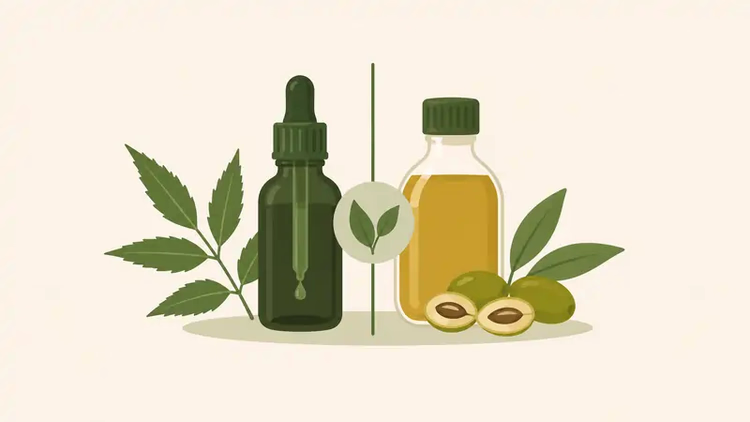
The main difference is the starting plant part. Neem leaf tincture begins with leaves, while most neem oil begins with seeds or seed kernels. The extraction method is also different. Tincture solvents collect compounds that dissolve in alcohol, water, glycerin, or a combination of those liquids. Oil production separates the lipid-rich fraction of neem seeds. These processes produce different materials:
- Neem leaf tincture is a solvent-based botanical extract.
- Neem seed oil is a fatty, oil-based seed product.
- Leaf extract and seed oil do not contain identical proportions of neem compounds.
- The serving directions and intended uses may belong to different regulatory categories.
Feature | Neem leaf tincture | Neem seed oil |
|---|---|---|
Starting material | Neem leaves | Neem seeds or seed kernels |
Production method | Extraction with alcohol, water, glycerin, or mixed solvents | Mechanical pressing or another oil-extraction process |
Base | Water-soluble or alcohol-soluble liquid system | Lipid-based oil |
Typical texture | Thin liquid | Viscous and oily |
Chemical profile | Reflects leaf material and extraction solvent | Reflects the seed lipid fraction and associated compounds |
Interchangeable? | No | No |
What is neem leaf tincture?
Neem leaf tincture is a liquid extract made from the leaves of Azadirachta indica. The manufacturer places prepared leaf material in a solvent system that removes selected soluble constituents. The term tincture does not reveal the complete formula. A label should clarify:
- The botanical name.
- The plant part.
- The extraction solvent.
- The extract ratio or botanical equivalent, when provided.
- The amount or liquid volume per serving.
- Other ingredients.
An alcohol-based neem leaf tincture may extract a different profile from a glycerin-based or water-based preparation. Even two products made from leaves can differ in composition because their raw materials, ratios, solvents, and manufacturing methods differ.
The word tincture describes the format
Tincture identifies a liquid extraction format. It does not guarantee a particular concentration, compound profile, or standardized potency. A one-milliliter serving states the volume of liquid. It does not show the amount of every neem constituent in that serving unless the manufacturer measures and declares those compounds separately.
What is neem seed oil?
Neem seed oil is an oil obtained mainly from the seeds or seed kernels of Azadirachta indica. Cold pressing is one common production method. The oil contains a mixture of triglycerides, fatty acids, and neem-derived secondary compounds. Oleic, stearic, palmitic, and linoleic acids may contribute to its lipid profile. Its exact composition can vary with seed origin, maturity, storage, pressing conditions, purification, and formulation. Neem seed oil appears in several product categories:
- Garden pesticides.
- Plant-care concentrates.
- Cosmetic oils.
- Soaps and personal-care formulas.
- Veterinary or animal-care products in some markets.
The category matters. A garden neem oil is not automatically a cosmetic product, and neither category should be treated as a dietary supplement.
Azadirachtin and clarified neem oil
Azadirachtin is a well-known neem compound associated with seed-derived pesticide products. It may be separated from neem oil for use in certain formulations. The oil portion remaining after much of the azadirachtin has been removed may be described as clarified hydrophobic neem oil. This is still an agricultural ingredient description, not a description of neem leaf tincture.
Why does the plant part change the chemical profile?
Plants distribute compounds unevenly across leaves, seeds, bark, fruit, roots, and flowers. Each part performs a different biological function and develops a different mixture of structural materials, oils, pigments, and secondary metabolites. Neem leaves contain leaf-specific mixtures of flavonoids, limonoids, pigments, and other plant constituents. Seeds contain a substantial lipid fraction and are the main source of commercially produced neem oil. The extraction medium then narrows the profile further. Water, alcohol, glycerin, and oil do not dissolve every compound equally. The final composition therefore reflects both the plant part and the manufacturing process.
Label detail | Question it answers | What it cannot prove alone |
|---|---|---|
Neem leaf | Which plant part was used | The exact constituent profile |
Neem seed oil | That the product is an oil derived from seed material | Its permitted route of use |
Alcohol extract | The main extraction base | The concentration of every compound |
Cold pressed | How oil was mechanically obtained | Food-grade or supplement-grade status |
Extract ratio | The relationship between botanical material and extract | Equivalence to seed oil |
Natural neem | A broad marketing description | Plant part, formulation, purity, or safety |
Can research on neem seed oil apply to neem leaf tincture?
Not automatically. Research applies most directly to the exact material, formulation, route, and amount tested. A study of cold-pressed seed oil examines a lipid-rich material. A study of an alcoholic leaf extract examines a different fraction of the plant. Even when both preparations contain some related neem compounds, their concentrations and surrounding chemical matrices can differ. Before connecting research to a product, compare:
- The botanical species.
- The plant part.
- The extraction method.
- The solvent or carrier.
- The tested formulation.
- The route of exposure.
- The measured amount.
- The study population or model.
A result from agricultural neem oil also cannot support claims about an ingestible leaf tincture. The product purpose and route are fundamentally different. The editorial position at Secrets Of The Tribe is to name the tested plant part in every research summary. Using only the word neem removes information needed to judge whether the evidence matches the product.
Can neem leaf tincture replace neem seed oil?
No. Neem leaf tincture cannot replace neem seed oil in a formula or application that specifically requires oil. A tincture does not provide the same lipid base, viscosity, fatty-acid profile, or seed-derived composition. It may also contain alcohol or water, which behave differently in cosmetic, agricultural, and manufacturing applications. The reverse substitution is also inappropriate. Seed oil should not replace an ingestible or alcohol-based leaf extract. A pesticide-labeled neem oil must never be swallowed or used outside its approved label directions.
Equal volumes do not create equal products
One milliliter of tincture and one milliliter of seed oil are equal only as liquid volumes. They are not chemically equivalent servings. Volume does not correct for differences in plant part, density, extraction, constituent concentration, or intended route.
Does neem oil always come from seeds?
Commercial neem oil generally refers to oil derived from neem seeds or seed kernels. Some descriptions may mention fruits and seeds together because the seed develops inside the fruit. Still, the label should identify the material clearly. Terms such as neem extract, neem essence, neem concentrate, and neem oil may be used inconsistently in online listings. Check whether the product states:
- Cold-pressed neem seed oil.
- Neem kernel oil.
- Clarified hydrophobic neem oil.
- Azadirachtin extract.
- Neem leaf extract.
- A blend of neem ingredients.
These names do not describe the same material.
Why is the ingredient panel more important than the product title?
Product titles often shorten botanical information for readability or search visibility. A listing called “neem drops” may not tell you whether the formula contains leaf, bark, seed, oil, or a blended extract. For dietary supplements sold in the United States, botanical labeling should identify the plant part. That detail helps prevent leaf, bark, root, seed, and flower ingredients from being treated as interchangeable. Read the Supplement Facts panel and other ingredients section for:
- Azadirachta indica.
- The declared plant part.
- The preparation type.
- The quantity per serving.
- The extraction solvent.
- The carrier or base.
- Other active or inactive ingredients.
If the product states only “neem” without identifying the plant part, it does not provide enough information for a reliable comparison.
Neem Plant Part and Product Check
Use this checklist before comparing a neem tincture, oil, capsule, cosmetic, or garden product. It separates botanical identity from product format and intended use. Confirm the botanical species Look for Azadirachta indica. Do not rely only on the word neem. Find the plant part Identify leaf, seed, kernel, bark, fruit, or another declared part. Missing plant-part information prevents a fair comparison. Identify the product format Determine whether the product is a tincture, oil, powder, capsule, cosmetic formulation, or pesticide concentrate. Read the extraction method Look for alcohol extraction, glycerin extraction, water extraction, cold pressing, or another stated process. Check the intended route Confirm whether the label permits oral, cosmetic, agricultural, or another specific use. Never transfer directions between categories. Review the complete ingredients Check for solvents, carrier oils, emulsifiers, fragrances, preservatives, and other botanicals. Match research to the material Use studies on leaf extracts for leaf products and seed-oil research for seed oil unless the source provides a valid reason to connect them. Do not compare volume alone Equal milliliters do not make a tincture and an oil chemically equivalent. Treat missing details as unknown Do not infer the plant part, potency, composition, or intended use from color, smell, price, or marketing language.
Does cold pressed mean the oil is suitable for ingestion?
No. Cold pressed describes a production method. It does not establish that the finished product is food-grade, supplement-grade, cosmetic-grade, or intended for swallowing. Cold-pressed neem oil may be registered and labeled as a pesticide. Such a product must be used only according to its pesticide label. Other terms that do not prove ingestibility include:
- Pure.
- Natural.
- Organic gardening.
- Unrefined.
- Premium.
- Maximum strength.
The statement of identity and directions matter more than general quality language.
Do leaf tincture and seed oil share the same safety profile?
No. Their safety profiles should not be assumed to match because they differ in composition, concentration, route, and intended use. A topical cosmetic oil, agricultural pesticide, and orally labeled tincture create different exposure conditions. Added ingredients can also change the safety assessment. Neem seed oil ingestion has been associated with serious poisoning reports, particularly involving children. This is another reason not to transfer oral directions from a tincture to an oil product or assume that natural oil is edible. Pregnancy, breastfeeding, childhood, medication use, and existing health conditions require additional caution with orally used botanical products. A qualified healthcare professional can assess personal factors that a general product comparison cannot address. This article explains product identity. It does not recommend taking neem leaf tincture or neem seed oil.
FAQ
Is neem leaf tincture the same as neem oil?
No. Neem leaf tincture is a solvent-based leaf extract, while neem oil is generally a lipid-based product obtained from seeds.
Which plant part is used to make neem oil?
Commercial neem oil is generally produced from neem seeds or seed kernels.
Can neem seed oil replace neem leaf tincture?
No. They differ in plant part, extraction method, chemical profile, texture, and intended use.
Can research on neem oil support claims about neem leaf extract?
Not automatically. Research should match the plant part, extraction method, formulation, route, and amount tested.
Does cold-pressed neem oil mean it is edible?
No. Cold pressed describes production, not whether the finished product is intended for ingestion.
What does a tincture extract from neem leaves?
It extracts compounds soluble in its alcohol, water, glycerin, or mixed-solvent system.
Does an extract ratio make leaf tincture comparable to seed oil?
No. An extract ratio describes the tincture process and cannot convert a leaf extract into an oil equivalent.
What should I check first on a neem product?
Check the botanical name, plant part, product format, complete ingredients, and intended route of use.
Glossary
Azadirachta indica - The accepted botanical name of the neem tree. Azadirachtin - A neem compound strongly associated with seed-derived pesticide ingredients. Botanical extract - A preparation made by removing soluble compounds from plant material with a solvent. Cold pressing - A mechanical method used to obtain oil without conventional solvent extraction. Extract ratio - The stated relationship between starting plant material and finished extract or extraction liquid. Fatty acid - A major structural component of plant oils and fats. Neem leaf - Leaf material from Azadirachta indica. Neem seed oil - Lipid-rich oil obtained from neem seeds or kernels. Plant part - The specific botanical structure used, such as leaf, seed, bark, root, or flower. Tincture - A liquid botanical extract commonly made with alcohol, water, glycerin, or mixed solvents.
Conclusion
Neem leaf tincture and neem seed oil come from different plant parts and extraction systems, so they should not be treated as equivalent products. Match labels and research by plant part, preparation, formulation, and intended use.
Sources Used
Neem seed oil composition, azadirachtin, pesticide uses, and exposure overview, Neem Oil Fact Sheet - npic.orst.edu/factsheets/neemgen.html Explanation of neem oil as a mixture derived from neem seeds and the distinction between azadirachtin and clarified hydrophobic neem oil, Neem Oil Ingredient Overview - npic.orst.edu/ingred/neemoil.html Federal description of cold-pressed neem oil as a seed-derived biochemical pesticide, Cold Pressed Neem Oil Fact Sheet - www3.epa.gov/pesticides/chem_search/reg_actions/registration/fs_PC-025006_07-Apr-10.pdf Pesticide label identifying neem oil as cold pressed from seeds of the neem tree, Neem Oil Product Label - www3.epa.gov/pesticides/chem_search/ppls/093771-00001-20200106.pdf Current pesticide formulation and use directions for cold-pressed neem oil concentrate, Neem Oil Concentrate 70 Label - www3.epa.gov/pesticides/chem_search/ppls/088760-00015-20240823.pdf Requirement to identify the botanical plant part in the Supplement Facts panel, Dietary Supplement Labeling Guide: Chapter IV - fda.gov/food/dietary-supplements-guidance-documents-regulatory-information/dietary-supplement-labeling-guide-chapter-iv-nutrition-labeling Dietary supplement identity and botanical plant-part labeling requirements, Statement of Identity and Ingredient Labeling Guide - fda.gov/regulatory-information/search-fda-guidance-documents/small-entity-compliance-guide-statement-identity-nutrition-labeling-and-ingredient-labeling-dietary Scientific overview of the diverse compounds identified in neem and variation among neem materials, The Antimicrobial Potential of the Neem Tree Azadirachta indica - pmc.ncbi.nlm.nih.gov/articles/PMC9195866 Scientific discussion of the fatty-acid and lipid characteristics of neem seed oil, The Influence of Neem Oil and Its Glyceride on Structure and Properties - pmc.ncbi.nlm.nih.gov/articles/PMC8234072

A small editorial team writing guides for independent travel. We travel ourselves, but we haven’t been everywhere, so we check prices, opening hours and how to get there against official sources.