













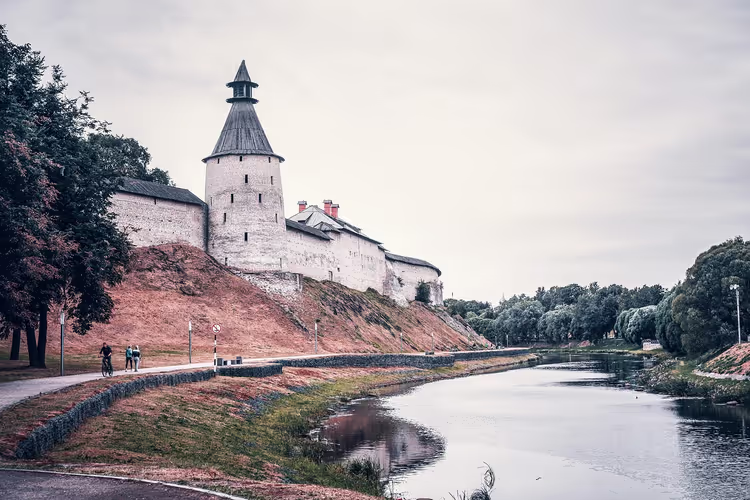
Vyborg has been a part of different states throughout its history. Moreover, all benefits were preserved for residents. The peasants were not serfs, the townspeople professed Catholicism and Lutheranism. The city resembles a layer cake: architecture and cultural traditions are so intricately intertwined. Tourists note that in the historical part one gets the feeling that the walk takes place in the Czech Republic, Poland or Germany. The city is compact, all interesting places are located close to each other. The sights of Vyborg are easy to get around on foot.
Vyborg Castle
At the end of the 13th century, the Swedes captured the fortification of the Korela tribe, which was located on the island. To secure the crusaders erected an outpost. The walls of the fortress in some places were 2 m thick. And in the center there was a watchtower. The construction turned out to be impregnable: the shores of the island are steep and rocky, and water is a natural barrier. The Crusaders owned the castle until the 18th century.
At first, the castle performed exclusively military functions: little was thought about the comfort of the garrison. But starting from the 15th century, the governors of the king of Sweden built new buildings, changed the interiors. Today, the castle is an ideal place for lovers of medieval Western architecture. Today, guests are invited not only to walk around the territory and admire the old buildings.
There are permanent and thematic exhibitions:
There are master classes for children and adults. Guests will try their hand at traditional Karelian crafts. And for young lovers of history, a children's museum center has been created. Here you can celebrate a birthday, listen to a fascinating story, or just play. Every year visitors become spectators of the real jousting tournament. The spectacle is interesting for tourists of all ages.
The complex is located on the Castle Island.
St Olaf's Tower
This is the only watchtower in Russia built according to Western European rules. But its original appearance can only be established using archaeological finds. The base rests on granite slabs. The walls in some places have a thickness of 5 m. The tower was absolutely impregnable for the squads of the Novgorod Republic. And they named the donjon by the name of King Olaf, who exterminated the pagans, actively planting Christianity.
For this, the monarch was canonized after his death. But over time, the tower was considered obsolete: its garrison could not repel artillery attacks; in the 16th century, a reconstruction was carried out. The donjon acquired additional floors. And during the Swedish-Russian war, the tower was badly damaged. Then the wooden floors burned down. True, in the 19th century the building was restored.
But the original part is only the lower granite tiers. The staircase, along which guests go upstairs, was erected at the very end of the 19th century. Today, tourists can climb to the observation deck. However, there are currently restrictions on the size of the group. Guided tours are not provided.
St Olaf's Tower is located on Castle Island.
the Red Square
Today it is the main city square, where parades, parades and official events take place. But initially it was outside the city limits and was called the Red Well Square. The water in the well was indeed red at times: mass executions took place nearby. The flowing blood was the cause of such a cataclysm. Subsequently, the city was upset: the square changed its appearance. Unfortunately, the first wooden buildings survived only on the plans.
But the Pharmacy House (with some changes) has been preserved, the pharmacy is not still located in it. At the end of the 19th century, a club designed by Blomkvist was built on the square. Various organizations now operate in the building. At the beginning of the 20th century, the square was decorated with the Moskvin apartment building and the Otso joint-stock company. In 1932, the house of the Vyborg rural community was erected.
Unfortunately, the unique buildings are in need of restoration, and some of them need reconstruction. But you can imagine what the square looked like at the turn of the 19th and 20th centuries. Red Square is located at the intersection of Ushakov and Severnaya streets, Leninsky and Suvorovsky avenues.
Sculpture Garden
In 1988, a symposium of Russian artists was held in the city. For the event, they chose a place where there is a deposit of natural stone – gray granite – mined in a local quarry. But all participants after the end of the event were required to leave their works in the city. This is how the unusual Sculpture Garden appeared.
Today tourists can see the compositions:
9 sculptures are located in one place: at the intersection of Kuibyshev, Vokzalnaya and Akulov streets and the Leningrad highway. And the Boy with the cat was moved to the embankment of the Big Dipper. Address of the Sculpture Garden: Leningradsky Prospekt, opposite house 1.
Viking Drakkars
In the city you can see unique ships – drakkars, on which the Vikings conquered the seas. These are long narrow boats, which have a very high stern and bow. The history of the exposition is unusual. In the 80s of the twentieth century, Rostotsky and Andersen were filming a film for which they needed ships of brave sailors. They took as a basis a ship discovered during excavations in Gokstad at the end of the 19th century.
At the shipyard in Petrozavodsk, 2 drakkars were built according to the model. After filming was over, Rostotsky presented the ships to Vyborg. They were moored in front of the Druzhba Hotel. Citizens and tourists fell in love with an unusual exposition, there are always crowded near the longships. Over time, the boats blackened and dilapidated.
Therefore, in 2009, the city authorities commissioned a local shipyard to make copies of the old ships. New vessels are moored in the same place: opposite the Druzhba Hotel. And there are still many guests of the city and local residents visiting the unusual exposition. Drakkars are located on the waterfront of the city.
Military Museum of the Karelian Isthmus
This is a private museum organized by Bair Inricheev. The historian used personal savings to acquire artifacts and create an exposition. The center is located in Military Camp No. 205. The exhibition includes more than 2,000 items. Here you can see items found by search engines on the territory of the Leningrad Region. The center is popular not only among Russian tourists, but also among guests from near and far abroad.
The complex has permanent exhibitions:
The Center conducts active social and educational work. Subbotniks are organized to maintain the structures of the Mannerheim Line. Regular trips are made to the battlefields of the Soviet-Finnish and Great Patriotic Wars. It is recommended to sign up for field trips in advance.
House of merchant Buttengoff
This is an interesting building designed by Johan Blomkvist. The customer is a wealthy merchant Buttengoff. He wished to have a profitable house, but richly decorated. According to the trader, this stimulated trade and attracted new customers. Buttengoff's shop was located on the 1st floor, where visitors were offered to purchase foreign cigarettes and wines – everything that the merchant sold.
The place was chosen well: the building is located on the top of the Bell Hill. And the house itself opens up gradually, as people go up Krepostnaya Street. Today it is an ordinary residential building. But its architecture deserves attention: even in this quarter of old buildings, the building stands out, attracts the eyes of visitors to the city.
Doi merchant Buttengoff is located on Fortress street, 7.
East Vyborg fortifications
An amazing place, loved by all residents and visited by tourists. Here is the boundary of the historical part of the city and new buildings. And from the hill, the entire historical center lies in full view. The remains of the once impregnable forts and structures have survived to this day.
Here you can see:
And the East Vyborg fortifications were built after the Horned Fortress became outdated and ceased to protect the city from the east. The author of the project was Totleben, and the executor was the military engineer Kislyakov. The imperial treasury allocated a whole 1,000,000 rubles, but it took almost 10 years to wait for the completion of construction. The fortifications were equipped with the latest technology: the garrison had the most modern weapons.
And the fortifications were built with dignity: they reliably closed Vyborg at all times. During the battles of the civil war, the battle for the fortress stopped only after the ammunition depots were blown up. And the Finnish troops held out impregnably here until the signing of the peace treaty. And those guests who are tired of visiting the fortifications can climb Battery Mountain and take a walk in the shady park named after Kalinin.
The fortifications are located in the Central microdistrict of the city on Batareynaya Gora.
House of the Merchants' Guild of the Holy Spirit
Author: Ludvig14 – Own work, CC BY-SA 4.0
Researchers consider the structure to be the most ancient of all city buildings. Presumably, it was erected in the 14th century. And after 200 years, the building was bought by the Merchant Guild. The purpose of the house was usual: the basement was used as a warehouse, and on the ground floor the merchants entered into contracts. The entrance to the second floor was from the street. Surprisingly, the building faces the street at a corner, not a facade. This is easy to explain: during the redevelopment initiated by Catherine 1, the streets of the city changed their direction.
The house itself is made of boulders, the construction turned out to be heavy. Over time, the building sank into rocky soil: the 1st floor became underground. But this only adds to the attractiveness of the building. The house is solidly built: in the entire history of its existence, 1 large-scale reconstruction was required. In the 20th century, a new brown tiled roof was laid. Today, tourists willingly visit the souvenir shop, which is located in the building.
Address: st. Vyborgskaya, 8.
House on the rock
This building stands on an ancient foundation on a rock. It was surrounded by the same old buildings, but in the 18th century they were all destroyed. Surprisingly, the barber's house survived! And it has remained almost unchanged. Some local historians claim that the most famous barber received clients here. But architects dispute this view.
Their argument: there are no windows on the 1st floor, and this is typical of merchant buildings. Which of the researchers is right is unknown, but the building is loved by tourists. All visitors strive to look at the house with a sharp turret. Today it houses a popular souvenir shop. Guests of the city willingly buy gifts for friends and relatives in it.
Address: st. Pursuit, 5.
Vyborg City Hall
This building has changed its appearance more than once during its existence. She appeared in the city in the first half of the 17th century. Then it housed urban structures. It is noteworthy that a wine cellar was arranged in the basement, which officials willingly visited after meetings. During the shelling of the city by Russian troops in the 18th century, the town hall was badly damaged.
The authorities decided to build a new building and use the old one as needed (after minor repairs). But at the end of the 19th century the town hall was reconstructed. Blomkvist has been working on the project for over 20 years. The result impressed the townspeople: the house grew by 2 floors and acquired neo-Renaissance elements. There was an opportunity to place the exposition of the historical and ethnographic museum in the building. But the history of the town hall did not end there.
During the Finnish campaign, she again suffered. And after the end of the Great Patriotic War, it was restored, an attic was added and turned into a residential apartment building. This appointment has survived to this day. At the end of the 20th century, the town hall was included in the list of historical heritage. A cozy town hall with a neat monument to Thorgils Knutsson in front of it creates the illusion of the Czech Republic or Poland. Tourists enthusiastically take pictures in this place.
Address: st. Fortress, 2 (on the square of the Old Town Hall).
Round Tower
The restless eastern neighbor forced the Swedish kings to constantly improve the fortifications of the eastern part of the city. In the middle of the 16th century, Gustav Vasa ordered to build a powerful defensive tower next to the Animal Gate. From the gate to it was a closed gallery of 2 walls. The tower is called Round, but its cross section is an oval.
The thickness of the walls is 3-4 meters, and the largest diameter is 21 meters. A little later, the tower fully justified the hopes placed on it: the Russian soldiers could not disarm its garrison. And during the shelling by the troops of Peter 1, the defensive structure was only slightly damaged by shells. After the capture of the city, the Russian emperor ordered the tower to be renamed Petersburg.
But after the need for a tower for defense against enemies disappeared, they began to use it to keep detained sheep and goats that were grazing in forbidden places. Here the animals were waiting for the owners to pay a fine and ransom them. There were times when the building was considered unassuming, bulky and ugly. The tower has been threatened with demolition several times. She was saved by the architect Ulberg.
He proposed to convert the building into a trendy restaurant. The walls of the halls were painted with paintings on historical themes and provided with comments. The audience fell in love with an unusual institution. Today, the restaurant still welcomes guests. There is a bar on the 1st floor, banquets are held on the second floor, and the 3rd floor surprises visitors with unique paintings by Uno Ulberg.
Address: Market Square, 1.
Monument to Thorgils Knutsson
Ville Wahlgren made a statue of a Swedish marshal in 1887. But it was installed only in 1908. The Russian commandant of the city considered it unpatriotic to have a statue of an enemy of the state in the city. To resolve the issue, the personal intervention of Nicholas 2 was required. The misadventures of the sculpture continued. The marshal stood in front of the Old Town Hall for 40 years, and then someone in power came up with the idea to melt down the statue.
She was removed from the pedestal and placed in the basement: approvals were required to resolve the issue. This is what saved the marshal: he was forgotten for as long as 45 years. The storage conditions turned out to be tolerable: in 1993 it was restored and put in its original place – at the Old Town Hall. Today Thorgilson Knutsson towers over the square: he can see everything from a high granite pedestal.
Address: Fortress street, 2 (on the square of the Old Town Hall).
Annen fortifications
Annenkron – a system of defensive structures built to protect the north and northwest from Swedish troops. And since the work was carried out (mainly) during the reign of Anna Ioannovna, the name of the fortification was named after the empress. The whole system of fortifications has the shape of a ladies' clasp, which is why it is also called Kron-St. Anna.
The fortifications turned out to be impressive: the thickness of the embankment and walls was 3 meters, the height reached 10, and the walls with bastions and curtain walls stretched for a whole kilometer. For the construction, raw stone was used, connected with mortar. The fortress was completely autonomous: barracks, guardrooms were built here, arsenals, grain and food warehouses were located. If necessary, Annenkron would have withstood a long siege of enemies.
But it was not necessary to use Kron-St. Anna for its intended purpose. It is noteworthy that more than one generation of military engineers worked on the construction of Annenkron, including Abram Hannibal. In 1910, by order of Nicholas 2, a monument to the 200th anniversary of the capture of the city by the troops of Peter 1 was erected on the Annensky fortifications. But in 1918, the Finns dismantled it.
Then the Soviet authorities erected the monument again. Annenkron are the only fortifications of the city that have been well preserved to this day and have never been rebuilt. They are located on Tverdysh Island along Ostrovnaya Street.
Petrovskaya Square
Buses bringing Finnish tourists arrive at Petrovsky Square. And she herself was formed simultaneously with the construction of Annenkron. And this is not surprising: the fortifications were built for more than one year, the engineering troops needed to be stationed somewhere. That is why the headquarters, the Gostiny Dvor and barracks for construction soldiers were built.
Initially, the houses were made of wood, but after a few years they became stone. And the main building acquired 2 wings. In this form, St. Anne's Square has reached contemporaries.
The name has changed several times:
But the appearance of the square did change: for the 300th anniversary of the city, the authorities renewed the cobblestones, installed benches, and later an anchor appeared on the square. It was raised from the bottom of the Baltic Sea. The author of the improvement project is Oleg Likhovidov.
The buildings located on the square at different times housed the Russian school, editorial offices of revolutionary newspapers, the committee of the RSDLP and the council of deputies. Today, the political life of the city bypasses it: tourists like to walk in this historical place, Petrovsky Square is located on the island of Tverdysh. It is limited by Petrovskaya and Ostrovnaya streets and Petrovskaya embankment.
Citizen's house
The house is notable for the fact that despite its venerable age (it was built in the 16th century), it is residential. True, it only has 2 apartments. The house was built like a small fortress. In it, the burgher family felt quite protected: the walls are made of granite, their thickness is 1 meter. Later, a brick wing was added to the main building. By the way, it has survived much worse than part of the house made of granite. In the last century, sewerage and central heating were carried out, ceilings were raised.
In addition, the roof was constantly changing. In the house of a citizen in the 17th century there was a city printing house. It is noteworthy that ordinary people have always lived and live in this architectural monument. Today there are 2 apartments in the building. The building is popular with directors who shoot historical nature. The house of the townsman can be seen in many films.
Address: Fortress street, 13a.
Clock tower
Initially, the tower was an ordinary bell tower of the Church of the Holy Virgin Mary and Olaf. And after the Lutheran reform, the cathedral was turned into a Lutheran church. At the same time, the first clock appeared on the bell tower. The bell tower was built to last for centuries: its base is a huge granite boulder, and the walls are blocks of granite, fastened with mortar.
All this can be seen if you get closer to the structure. During the siege of the city in 1710, the church was badly damaged. By order of Peter the Great, the cathedral was rebuilt and turned into an Orthodox one, and later a clock and a bell were installed on the tower. And at the end of the 18th century the tower was reconstructed. Brockman supervised the work. The first tier of the tower was decorated with a clock made in Finland, and a tocsin bell was hoisted on the top. Its weight was 61,000 kg.
The bell is a gift to the city from Empress Catherine the Great. The tall Clock Tower was used as a tower. The cathedral was subsequently badly damaged, and during the bombing of 1940 it collapsed. But the tower survived. And the clock still shows the time accurately. There is an observation deck on the top tier. It offers a stunning panorama of the old city.
Address: st. Watchtower, 6.
Church of Hyacinth
In the 15th century, on the site of the modern building, there was a wooden building, the property of the Franciscan monastery. But already in the 16th century there was a stone monastery school. The building acquired its modern appearance after the Reformation. The building was confiscated from the Roman Catholic Church and given to a wealthy merchant.
During the redevelopment of the streets, it turned out that the house faces the red line at an angle. It was decided to complete it. It turned out to be a kind of capital letter U. Its second name – the Knight's House – the building received during its ownership by the Swedish-German Knights' Society. Balls and ceremonial meetings were held in the building. By decree of Emperor Paul 1, the Knight's House was transferred to the Church of St. Hyacinth.
The goal is to enable the soldiers and officers of the newly incorporated territories of Russia to freely practice Catholicism. After the end of the Great Patriotic War, there was a warehouse in the house, only at the end of the 20th century a large-scale reconstruction was carried out. But the building got rather the look of a rich city house with characteristic interiors. Today, the Hyacinth Church houses expositions of the Vyborg Castle Museum. And during the Window to Europe festival, the church hosts the headquarters of the event. The building is included in the list of cultural heritage of Russia.
Address: st. Water Outpost, 4.
Granite Palace
This is an amazing monument of northern modernity. Granite was used for the construction and decoration of the building, which is why the mansion got its name. The customer was a wealthy merchant Hackman. He made his capital on the export and sale of timber, import of tea and coffee. But it took the family almost 200 years to be able to pay for the services of the architects Gülden and Ulberg.
The work was completed in 1909. The first floor (according to tradition) was occupied by the office, and the second and third by the Hackman family. The decoration was not only rich, but also exquisite. Decorators presented all the latest interior novelties. Unfortunately, all elements of the interior decoration have been lost. The Hackman family left the family mansion during the 1939-1944 war.
They expected to return, but in vain. After the end of the Great Patriotic War, the building was given over to the housing stock of the city. But in the 1990s, the Granite Palace was resettled, and the vacated areas were occupied by offices of various companies. But tourists still have the opportunity to admire the amazing combination of plant and animal motifs in the ornaments of the facade of the Hackman house.
Address: st. Northern shaft, 7.
Manor of a burgher
This is a well-preserved complex of a house and a utility room, which once belonged to a wealthy citizen. It is not known exactly what the owner was doing: maybe crafts, or maybe trade. But his income allowed him to build a strong 3-storey house and a carriage house of 2 floors. Raw stone and clay tiles were used for construction. The windows were originally small: the openings were expanded later.
On the first floor there were service rooms, the second was used for meetings with customers or clients, and the owner's family lived on the third. The carriage house contained horses and implements. Feed was stored on the 2nd floor. By the way, hay was loaded through the balcony door. Today the carriage house is a trendy restaurant. There are unusual interiors and delicious food. And Vyborg beer is always the freshest. And in the house itself there is an Info Center and an exposition.
Address: Progonnaya st., 7a.
witch house
The house was designed by Eduard Dippel. Historians do not agree on why the structure has such an unusual appearance. If you stand on Progonnaya Street and look at the building from a certain angle, it will seem that the wall is missing, and the house is flat. Only witches can live in this! But some townspeople call the house an iron or a card house. True, quite ordinary people live here.
Unfortunately, the facade of the building has not been restored for a long time. An inconceivable pile of antennas and air conditioners makes it ridiculous. And an inexperienced tourist can easily pass by an unusual building.
Address: Progonnaya st., 1a.
Transfiguration Cathedral
The cathedral was built on the site of a former Catholic church. In 1892, after the approval of the Vyborg and Finland diocese of the Russian Orthodox Church, the temple became the city's cathedral. At this time, the first reconstruction of the building was carried out. And in 1990, the new rector Lev Tserlitsky, after his appointment, carried out repeated reconstruction work.
As a result, the façade was renovated, the dilapidated roof was replaced and unique wall paintings were restored. Today, divine services are held in the cathedral, a Sunday school is open. The building has the status of an object of cultural heritage of Russia. And tourists can go inside and enjoy the unique frescoes and icons.
Address: Cathedral Square, 1.
Pancerlaks
The Panzerlax Bastion is part of the Horned Fortress. It is located in the southeast of the city. For the construction, boulders fastened with mortar were used. The Panzerlax bastion was connected to other similar structures by earth embankments. Panzerlaks was built for 3 years. And at the end of the work, it reliably blocked the Gulf of Finland. But unfortunately, it quickly fell into disrepair: the inhabitants used to graze cattle on earthen embankments.
In the 19th century, Panzerlax was in a deplorable state: the embankments collapsed, the windows were bricked up. And at the beginning of the 20th century, after the construction of the port, the bastion turned out to be standing 100 meters from the coastline. In 2010, a branch of the State Hermitage Museum was placed in the Panterlax powder magazine. Here is an archaeological exposition, thematic exhibitions are arranged.
Panzerlax is located on Ladanova Street, 1.
battery mountain
Battery Mountain – part of the fortifications in the east of the city. Once there were arsenals, barracks, food warehouses and wells with drinking water. The remains of the buildings can still be seen.
And today Batareynaya Gora is a favorite place for walks of the townspeople. There is a wonderful park with a cozy seating area and attractions for children. The area is clean and well maintained.
But tourists are offered excursions, which are conducted by diggers, through the surviving powder magazines and posterns. It should be remembered: independent exploration of the ruins is life-threatening.
Battery Mountain is located along Battery Street, 1.
Cathedral of Saints Peter and Paul
The architects Brukman and Felten worked on the project of the Lutheran Cathedral. Construction began with a catastrophe: the prepared materials were destroyed in a fire. But after a few months, they managed to lay the first stone. Today, tourists can admire graceful alabaster columns, unique tiles of tiled stoves, an altar with figures designed by a German architect, and entrance doors made of Arkhangelsk oak.
The organ was brought from Hannover: it was made with the latest technology. At the end of the 19th century, it was restored and transferred to another parish. In 1898, a 25-register organ sounded in the cathedral.
From 1944 to 1991, the cathedral was in oblivion: services in it ceased. But the interiors have survived. Since 1996, after the restoration and installation of a new altar, divine services have resumed.
The cathedral is located on Pionerskaya street, 6.