
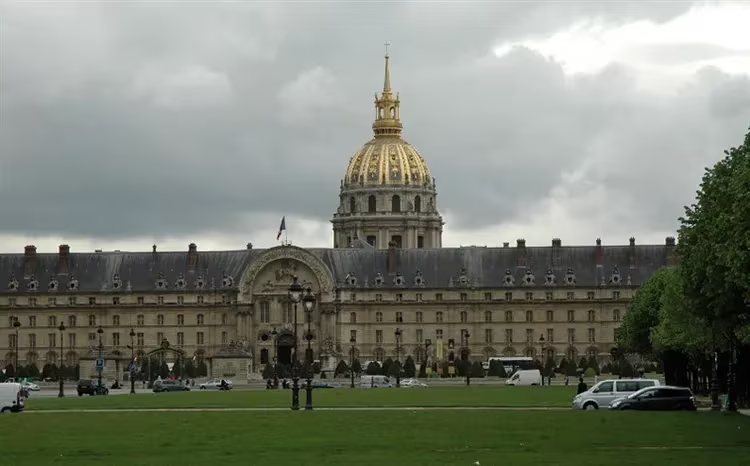
If you look from above at the monumental buildings and the landscape beauty of the surrounding area, you would never think that all this greatness is called the House of Invalids. The scale of buildings, their number, a huge yard area, interesting architecture testify to the worthy attention and respect of the French kings to those who needed help and care. This complex, which can be called a mini-town, serves as an example to all the rulers of this world, how it was necessary to pay tribute to the soldiers who received a disability in the defense of the king and, in his person, the state.
Story
Although it contains many Napoleonic symbols, including his ashes, the merit in the idea of u200bu200bbuilding and erecting the House belongs to King Louis XIV. Observing former military men in the role of numerous beggars on the streets of Paris, in 1670 he issued a decree on the construction of a shelter for young disabled soldiers and already aged retired soldiers.
Such a decision not only saved the situation, but significantly raised the prestige of the army in the eyes of young people who had not yet fought.
In the suburb of Grenelle, a vacant lot was chosen, and the work on the implementation of the idea was carried out by the court architect Bruant. After 4 years, residential, service, hospital buildings grew, 5 yards were equipped, and the first disabled veterans settled in 1674. But the construction continued for many more years, and by 1710 the Les Invalides had become a real city inhabited by 4,000 veterans.
It had its own charter, strictly subordinate to church and military rules. Tapestry, engraving and shoe workshops were opened, in which the inhabitants of the House worked. The new monastery could not accommodate everyone, so the settlement regulations were introduced: veterans with at least 10 years of military service had the first right. But this did not apply to the seriously wounded, who received a deep disability, and seriously ill who needed care.
Louvre: Timed Entrance Ticket 1-
Hour Lights of Paris Cruise Skip-the
-line tickets to the roof of the Arc de Triomphe
Eiffel Tower: 2nd floor access
Versailles and Gardens: Skip-the-line ticket with audio guide
Hop-on Hop-off bus tour. Class., Prem. or Suite
Paris Museum Pass: 2, 4 or 6 days
Tickets: Montparnasse: 56th floor rooftop terrace
Show at the Moulin Rouge with champagne
Architecture
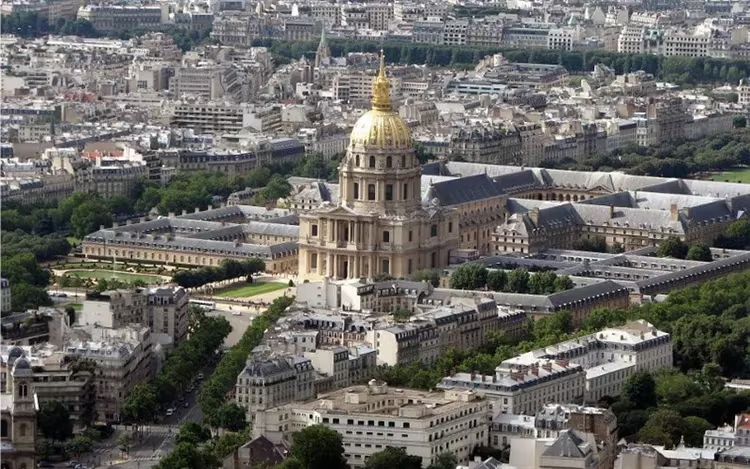
The fully completed grandiose building was striking in its large-scale dimensions (400x450m), only the length of the main facade overlooking the Seine was 196 m. The 107-meter gilded dome of the church, which became an integral part of the ensemble, looked majestic. It (the church) was built for almost 30 years and is an original design of essentially a double cathedral: in the nave there is a soldier's church, and behind a glass partition is a royal one, whose golden dome is visible from afar. The cathedral, built in the classical style, was given the name of Saint Louis in honor of the king who took care of his war-crippled subjects. The entrance to it is decorated with military flags and banners of different countries, obtained as trophies in battles.
A number of slender columns give the cathedral lightness and grace; the dome with its decor, openwork gratings of fences, a quadrangular turret of a domed lantern and a conical spire resembles the precious royal cap of Monomakh. The double structure of the dome was created by the architect Mansart, placing large windows in the lower outer part through which the internal painting is illuminated. The entire domed part in 1989 was covered with new gilding, which took 12 kg. gold.
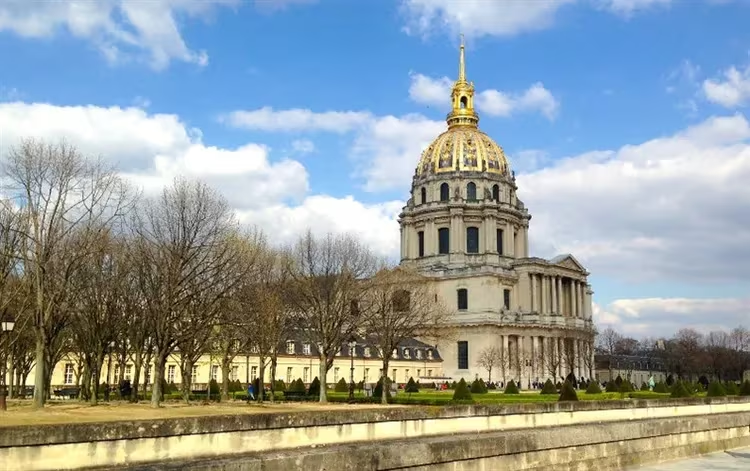
In front of the complex of buildings there is a huge (500x250m) square, officially called the Esplanade of the Invalids, running from the Seine embankment and Pont Alexandre III to the central facade. Landscape architect Robert de Côte developed a project of magnificent lawns and curly alleys that turned the once empty space into a beautiful man-made landscape. All residential and service buildings are also built in a strictly classical style, perfectly fitting into the majestic ensemble of the surrounding area.
House of the Disabled Today
Starting from 1777, the architectural complex gradually loses its status as a place of charity for the disabled and pensioners, and acquires the features of a museum object. First, the Museum of military exhibits was organized, which were delivered from the Louvre; later the Museum of Artillery was opened here. It was merged in 1905 with the Historical Museum of the Army, and now it is a single Museum of the Army, which occupies a fairly solid part of the complex.
2 more museums are open for visiting – the Order of Liberation and Modern History, the expositions of which illustrate military battles, reflect the power of the French Armed Forces. Directly at the entrance, even at the suggestion of Napoleon, who repeatedly visited the House, a number of artillery cannons, domestic and captured, were installed at the very entrance as symbols of the emperor's triumphal victories.
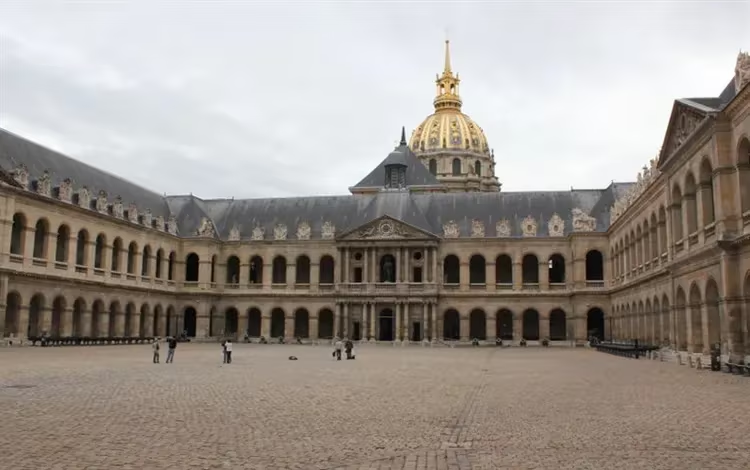
The ashes of honored military figures of the country are located in the Cathedral of St. Louis. Here, in 5 coffins, those brought from Fr. ST. Helena the remains of Bonaparte. They were installed in a sarcophagus on a green granite pedestal. Eight words printed in gold on marble at the pedestal denote the military victories of the great emperor. Nearby is the family tomb of relatives, in which his son, brothers Jerome and Joseph are buried. The ashes of famous marshals and generals are buried here: Turren, Vauban, Foch, Lieutey, Duron and Bertrand.
But along with this, just like many years ago, veterans of past and modern wars live in a military hospital in this territory.
On the days of special festive celebrations of the state, 18 rare cannons installed at the northern entrance thunder salute of cannon volleys.
Use the services of kiwitaxi and at the airport, at the specified time, the driver will be waiting for you, help with luggage and promptly take you to the hotel. Several classes of cars are available – from economy to Minibus with 19 seats. The price is fixed and does not depend on the number of passengers and the address within Paris. Taxi from / to the airport is a convenient and comfortable way to get to the right place.