
















13 Churches in Florence: tickets, hours and what to see
Florence has more than a hundred active churches. Entry to most of them is free, and you only pay for frescoes, domes, and museum halls.
We picked 13 churches worth adding to your city itinerary. For each one you'll find the address, entry cost, opening hours, and an honest catch. We verified prices and schedules on the official websites of the churches and city museums in September 2026.
Ad: this article contains affiliate links, we earn a commission if you book through them, at no extra cost to you.
What to know before visiting Florence's churches
Florence's churches have their own rules, and some of them will surprise you. Many churches close for an afternoon break, and on Sundays they only open from 1:00 PM or 2:00 PM. You may be turned away if you're wearing shorts or have bare shoulders.
💡 In short:
- Entry to most active churches is free; you only pay for frescoes, domes, and museums.
- Paid entry applies to the Duomo complex, Santa Croce, Santa Maria Novella, San Lorenzo, and the Brancacci Chapel.
- The most convenient Duomo ticket is the Brunelleschi Pass: it's valid for three days and includes the dome, bell tower, baptistery, museum, and Santa Reparata.
- Arrive at opening time or after 4:00 PM, when lines are shorter.
- Tickets and opening hours: 09/2026, verified on the official websites of Florence's museums.
1. Church of the nativity of Christ and St. Nicholas the wonderworker
 © Zairon · CC BYPhoto: Zairon, CC BY (https://creativecommons.org/licenses/by/4.0), Wikimedia Commons
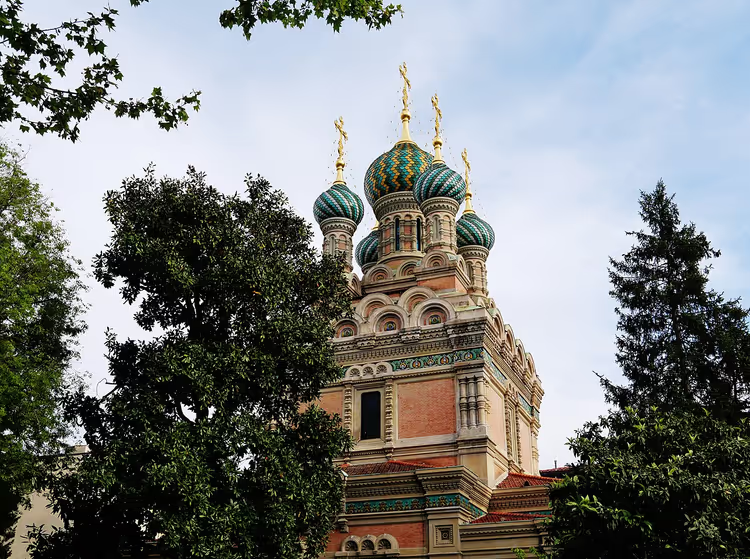
The five-domed church by the Mugnone river stands out noticeably among Florentine churches: it was built for the local Orthodox community in the style of 17th-century churches. The community purchased the plot on Via Leone X in the late 19th century. Construction based on the design by architect Preobrazhensky began in July 1899.
The church has two levels. The lower church was consecrated in honor of St. Nicholas the Wonderworker in 1902. It houses a carved wooden iconostasis and a collection of icons from the Peshekhonov workshop; part of the furnishings came from the collection of Prince Demidov. The upper church was consecrated in honor of the Nativity of Christ in 1903. Its iconostasis is carved from white marble, and the walls are painted in the Russian Art Nouveau style.
Among the church's relics is a bell from a cruiser that took part in the Battle of Tsushima. This is one of the first Orthodox churches in Italy, and its architecture is unusual for Tuscany. Entry is free, but it's an active church, not a museum.
- Address: Via Leone X, 12, near the main bus station.
- Getting there: buses 2, 8, 13, 14, 20, and 28.
- Entry: free, no ticket required.
- The catch: the schedule depends on services; tourists are not admitted during liturgy hours.
2. Santa Maria Novella
 © Commonists · CC BY-SAPhoto: Commonists, CC BY-SA (https://creativecommons.org/licenses/by-sa/4.0), Wikimedia Commons
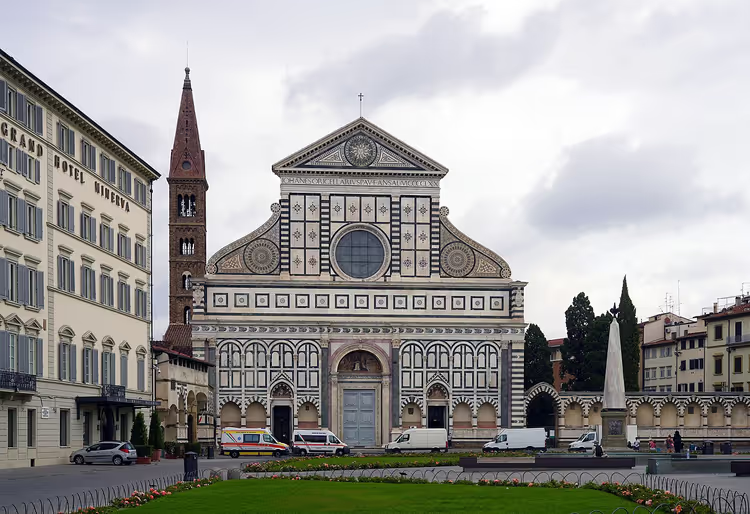
The facade of white and green marble resembles an ornate box, and you'll definitely want to look inside. The church was built by the wealthy Dominican order on the site of the old oratory of Santa Maria delle Vigne. Construction was completed in 1420. The new facade was commissioned by the Rucellai family, and their coat of arms with a small ship still adorns the portal.
The main thing inside is the frescoes. In the Tornabuoni Chapel, Giovanni Ghirlandaio painted scenes from the life of the Virgin Mary, and he is buried there as well. Masaccio left the "Trinity" in the left nave, with a perspective that looked like a breakthrough for the 15th century. The crucifix in the Gondi Chapel was created by Filippo Brunelleschi.
The church is open almost all day, so it's convenient to put at the start of your itinerary. The ticket is a single one: it covers both the basilica and the cloister.
- Address: Piazza Santa Maria Novella, entrance from Piazza della Stazione, 5.
- Ticket: €7.50, reduced €5 (as of 09/2026, official website).
- Who it's for: those who want to see frescoes by Masaccio and Ghirlandaio without the Uffizi line.
- The catch: on Sundays and holidays entry starts later, and hours change due to services.
You can get Santa Maria Novella tickets in advance: Santa Maria Novella ticket.
3. Cathedral of Santa Maria del fiore
 © Xosema · CC BY-SAPhoto: Xosema, CC BY-SA (https://creativecommons.org/licenses/by-sa/4.0), Wikimedia Commons
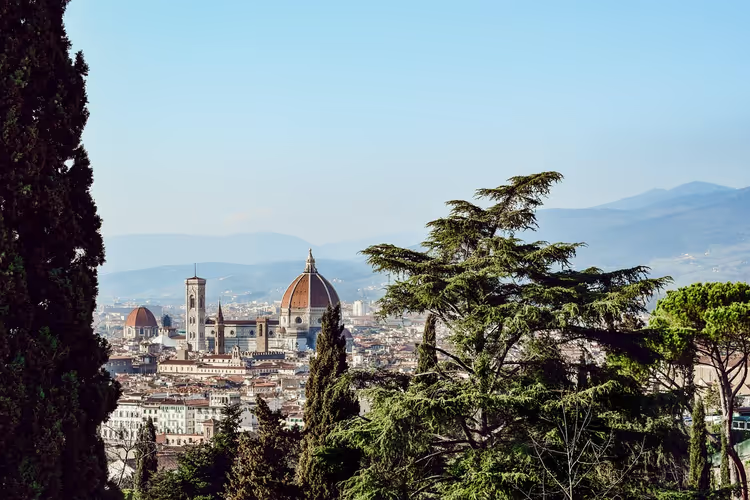
Florence's cathedral took more than a century to build, so that it could showcase the greatness of the growing city. The Duomo was erected on the site of the old cathedral of Santa Reparata, which had stood for nine centuries. Brunelleschi's dome still points the way to the city's main square from any rooftop.
The dome is an engineering breakthrough. Filippo Brunelleschi raised it without internal scaffolding, and the structure has held for almost six centuries. The height including the lantern is about 107 meters, and 463 steps lead to the top. At the top you'll see all of Florence: tiled roofs, the Arno river, and the hills of Tuscany.
Inside, the cathedral is almost empty, but it's the largest in the city: 153 meters long and 90 meters wide. Entry to the church itself is free, but you pay for the dome, bell tower, baptistery, and museum. Buy the dome ticket in advance, because in summer the slots sell out weeks ahead.
- Address: Piazza del Duomo.
- Ticket: Brunelleschi Pass with the dome, bell tower, baptistery, museum, and Santa Reparata, around 35 € (as of 09/2026, 2026 prices).
- How to get there: any bus goes through the center, the nearest stop is at Piazza del Duomo.
- The catch: 463 steps and lines for the climb, dome time slots sell out fast.
It's more convenient to book the dome climb with a guide and skip-the-line entry: Duomo tickets with dome climb.
4. Ognissanti
 © Ricardalovesmonuments · CC BY-SAPhoto: Ricardalovesmonuments, CC BY-SA (https://creativecommons.org/licenses/by-sa/4.0), Wikimedia Commons
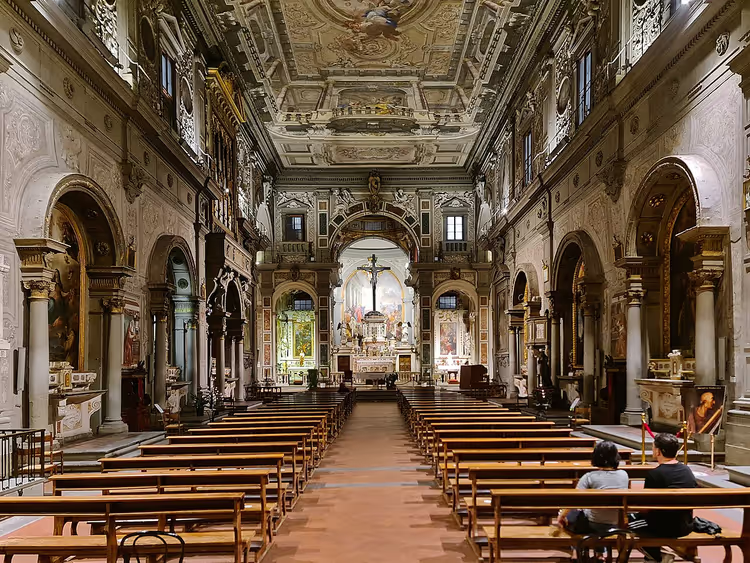
Ognissanti, or the Church of All Saints, stands on the way from the train station to the river. The Humiliati built it in 1251 as part of a monastery complex, and wealthy Florentine families quickly filled the interior with works of art. Today it's a modest Baroque basilica with a very strong collection of paintings.
You'll see "The Last Supper" by Domenico Ghirlandaio, the teacher of Michelangelo, in the monastery refectory. In the church itself hang "Saint Jerome" by Ghirlandaio and "Saint Augustine" by Sandro Botticelli. The artist himself is buried here, next to the tomb of Simonetta Vespucci. Her face was his model for "Venus" and "Primavera."
Admission is free, there are usually few people, and you can walk from the Arno embankment in a couple of minutes. It's a good stop if you're heading to Ponte Vecchio from the train station.
- Address: Borgo Ognissanti, 42.
- Admission: free.
- How to get there: 600 meters from Santa Maria Novella station, about 8 minutes on foot.
- The catch: the church closes for a break, the door is often locked during the day.
5. Basilica of Santa Croce
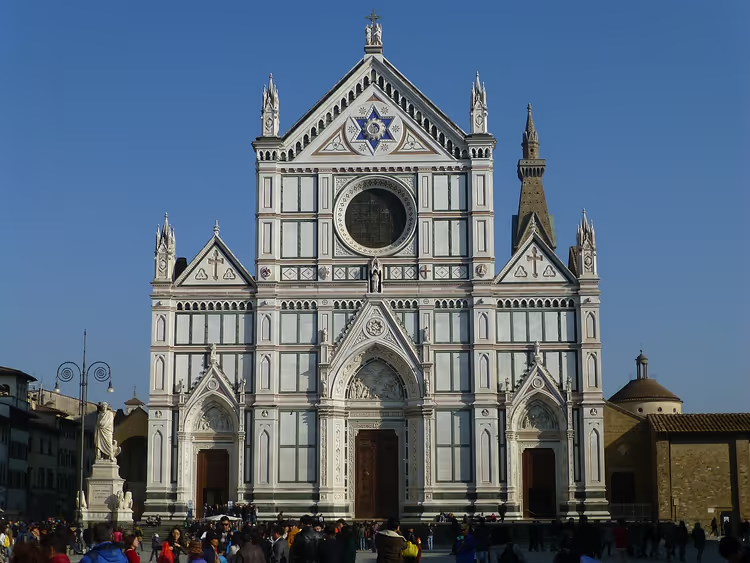 © Grueslayer · CC BY-SAPhoto: Grueslayer, CC BY-SA (https://creativecommons.org/licenses/by-sa/4.0), Wikimedia Commons
Santa Croce is Florence's pantheon under Gothic vaults. The church was consecrated by Pope Eugene IV in 1442, and the facade was faced with multicolored marble only in the 19th century. Michelangelo, Galileo, Machiavelli, and Rossini are buried here. Enrico Fermi is not buried here; the basilica only has a memorial to him.
Tombs line the main nave, each under an arch on columns. The nave is 115 meters long, and the church has 16 chapels with frescoes by Giotto and his pupils. Dante Alighieri is here too, but it's a cenotaph: the poet's remains stayed in Ravenna.
The paid entry is easy to explain: you're paying for the museum and the upkeep of the tombs. The ticket is more expensive than at other churches on this list, but this is where most travelers go.
- Address: Piazza Santa Croce, 16.
- Ticket: 8 € (as of 09/2026, official website), on Sundays and holidays entry from 2:00 PM.
- Who it's for: those who want to see the tombs of Michelangelo and Galileo and Giotto's frescoes.
- The catch: in high season there's a line at the ticket office, entry is paid.
Skip-the-line ticket to Santa Croce.
6. Basilica of San Lorenzo
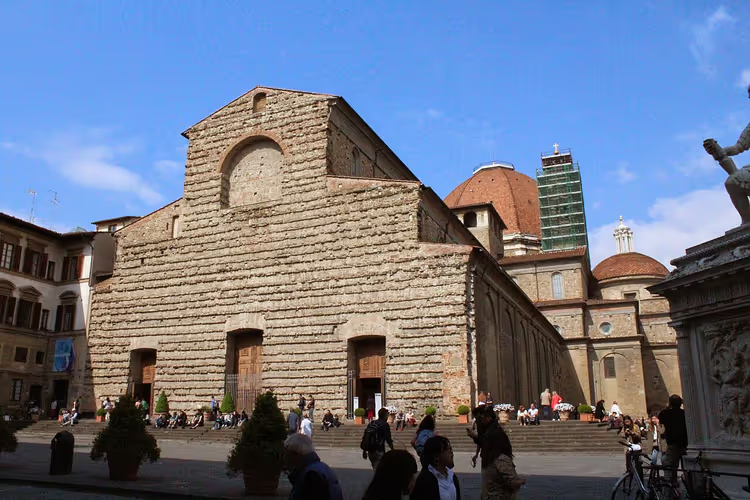 © Nelson Pérez · CC BY-SAPhoto: Nelson Pérez, CC BY-SA (https://creativecommons.org/licenses/by-sa/3.0), Wikimedia Commons
San Lorenzo is the Medici family church and one of the oldest churches in the city. A church of Saints Lawrence and Zenobius stood on this site as early as the 4th century, and until the 7th century it served as Florence's cathedral. In the 16th century, the Medici rebuilt the building as their own burial place.
Two great masters worked inside. Filippo Brunelleschi created the Old Sacristy with its perfect proportions, and Michelangelo built the New Sacristy and the Medici tombs with the figures of Night, Day, Dawn and Dusk. The church facade was never faced, because the project ran out of money.
The Laurentian Library holds Medici manuscripts, but it has a separate entrance. The Medici Chapels have their own line, and they are closed on Tuesdays, so don't schedule San Lorenzo for that day.
- Address: Piazza di San Lorenzo, 9.
- Ticket: Medici Chapels around 9 € (as of 09/2026, official tickets). From March 15, 2026 they are part of a new museum system: a single 72-hour ticket costs 38 € (as of 09/2026, official Musei del Bargello website).
- Hours: the chapels are open on Mondays and Wednesday through Sunday, closed Tuesday.
- The catch: the facade is unfaced, and tickets for the basilica and the chapels are sold separately.
It's convenient to get a San Lorenzo basilica ticket in advance: San Lorenzo basilica ticket.
7. Santa Trinita
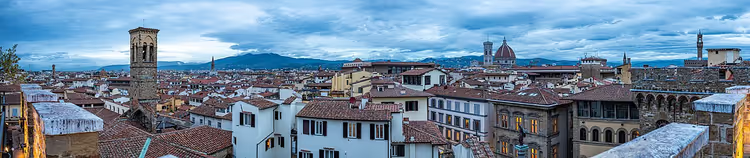 © Nan Palmero from San Antonio, TX, USA · CC BYPhoto: Nan Palmero from San Antonio, TX, USA, CC BY (https://creativecommons.org/licenses/by/2.0), Wikimedia Commons
Santa Trinita was built in 1280 and is considered one of the oldest churches in Florence. Behind its plain facade you'll find a free museum of medieval painting. Domenico Ghirlandaio frescoed the Sassetti Chapel, and his Adoration of the Shepherds still adorns the altar.
In the 16th century the facade received a relief of the Holy Trinity and a new door with figures of holy monks. The church combines Gothic, Renaissance and Baroque, because it was rebuilt many times. Nearby stands the Santa Trinita Bridge, one of the most beautiful in the city.
Admission is free, and you can go inside without a ticket or a line. Come during the day, when the chapels are open.
- Address: Piazza Santa Trinita, by the Santa Trinita Bridge.
- Admission: free.
- The catch: the door is often closed at lunchtime.
8. Santa Maria del Carmine
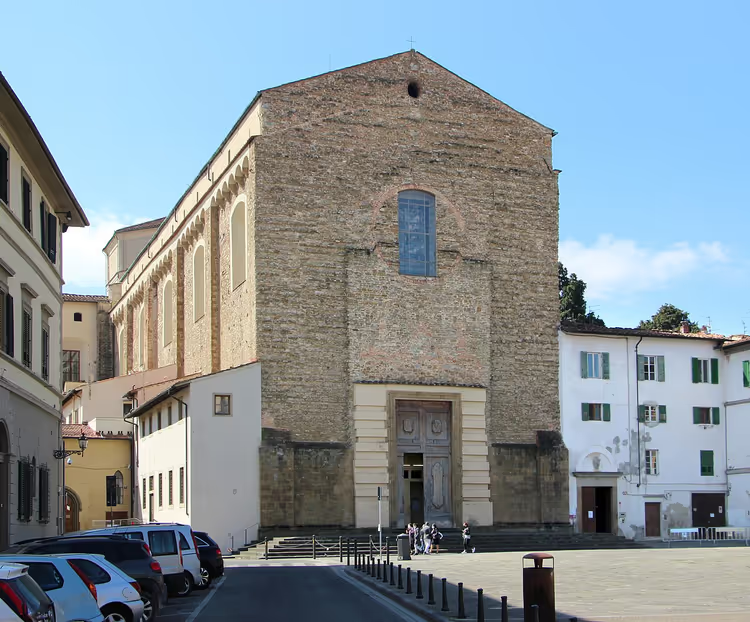 © Francesco Bini · CC BY-SAPhoto: Francesco Bini, CC BY-SA (https://creativecommons.org/licenses/by-sa/4.0), Wikimedia Commons
The small Carmelite church was built in 1268, but it is known for one chapel. The Brancacci Chapel opened to visitors only in 1990, and that is why all tourists come here. The frescoes were painted by Masaccio and Masolino, and they are one of the first examples of Renaissance painting.
Scenes from the life of the Apostle Peter show how Masaccio worked with perspective and light. The Tribute Money and Peter Healing the Sick with His Shadow are still studied by artists. The church itself is free, while the Brancacci Chapel requires a separate ticket.
The chapel is closed on Tuesdays, so don't schedule it for that day. There are fewer people in the morning, and you can calmly examine every fresco.
- Address: Piazza del Carmine.
- Hours: Wednesday through Monday 10:00-17:00, Sunday 13:00-17:00, closed Tuesday (as of 09/2026, Santa Maria del Carmine).
- Admission: church free, chapel by ticket.
- The catch: closed Tuesday, and on other days the chapel may be closed for restoration.
A guided tour of the Brancacci Chapel is worth booking in advance: Brancacci Chapel tour.
9. Santo Spirito
 © Lucarelli · CC BY-SAPhoto: Lucarelli, CC BY-SA (https://creativecommons.org/licenses/by-sa/3.0), Wikimedia Commons
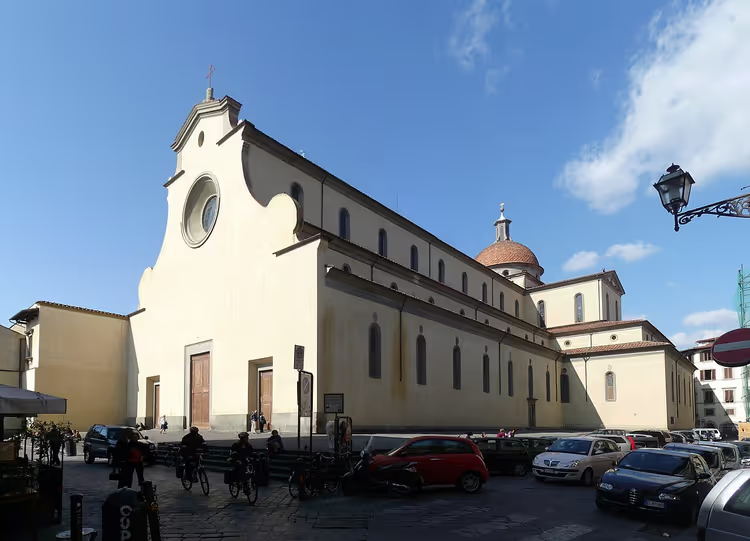
Santo Spirito is Filippo Brunelleschi's last major work, completed after his death. The church was intended as the center of a huge urban project, but not everything was built according to the architect's plans. A 13th-century monastery previously stood on the site, and it burned down in 1471.
Inside you'll find Michelangelo's Crucifix in the sacristy, Lippo's Madonna and Child, and the Expulsion of the Money Changers from the Temple. The Fondazione Romano museum operates in the former monastery refectory. The proportions of the nave are considered a model of the early Renaissance.
The church stands on Piazza Santo Spirito, where locals also come. Admission is free, and the museum asks for a small sum.
- Address: Piazza Santo Spirito, 30.
- Admission: church free, Fondazione Romano museum by a symbolic ticket.
- Getting there: 700 meters from Ponte Vecchio, about 9 minutes on foot.
- The catch: in the morning the square is taken over by a market, and street noise can be heard inside.
10. San Miniato al Monte
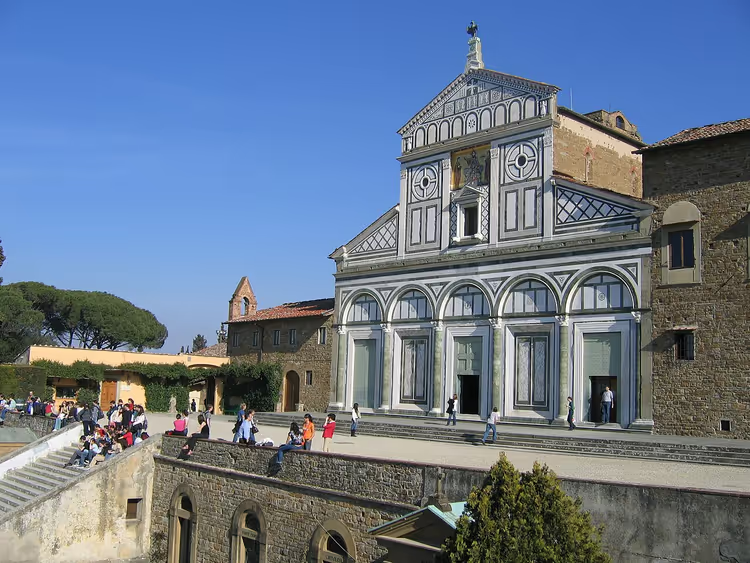
The basilica stands on a high hill, and you'll have to walk up or take a bus. According to legend, Minias, the first martyr of Florence, met his death here. A monastery was built nearby, later handed over to the Benedictines, and fortifications rose above its walls.
The 12th-century facade is clad in colored marble tiles, and at its center shines the mosaic "Christ between the Madonna and Saint Minias." Inside, the floor is laid with marble mosaics featuring zodiac signs and animal figures. The monks still sell herbal infusions, liqueurs, and honey.
Admission is free, but the climb up the hill is long. Come for the evening service to hear Gregorian chant. Nearby, at the Delle Porte Sante cemetery, lies Carlo Collodi, the author of Pinocchio.
- Address: Via delle Porte Sante, 34.
- Admission: free, donations welcome.
- Hours: Monday through Saturday from 9:30 (as of 09/2026, abbey's official website).
- The catch: the hill is high, and it's over half an hour on foot from the center.
You can book a tour to San Miniato and other hills in advance: tour to San Miniato al Monte.
11. Santa Felicita
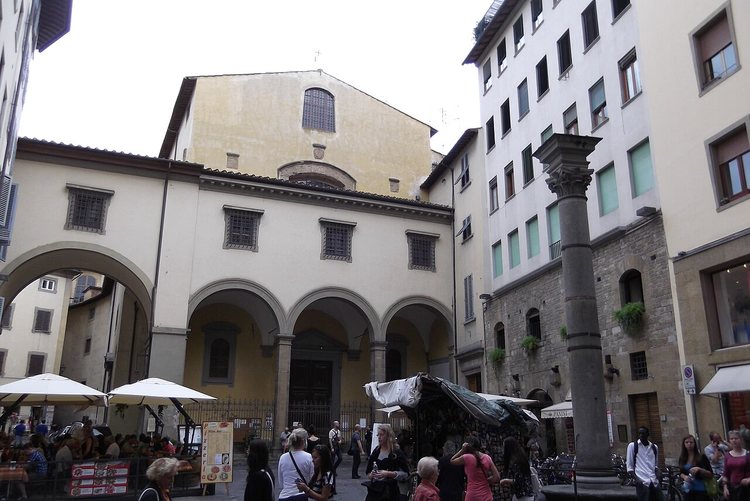
Santa Felicita is considered one of the oldest churches in Florence, although almost nothing remains of the 4th-century structure. The new Gothic church was consecrated in 1354, and after the plague it was rebuilt several times. Today it's a modest church near the Ponte Vecchio.
 © karel291 · CC BYPhoto: karel291, CC BY (https://creativecommons.org/licenses/by/3.0), Wikimedia Commons
The main reason to step inside is the Capponi Chapel with frescoes by Jacopo Pontormo. The 1528 "Deposition from the Cross" is considered one of the most complex works of Mannerism. People stop here on the way from the Uffizi Gallery to Palazzo Pitti just to see it.
Admission is free, no ticket needed. Stop by during the day, when the chapels are open.
- Address: Piazza Santa Felicita.
- Admission: free.
- The catch: often closed during the day; you can only get inside during service hours.
12. Baptistery of San Giovanni
 © Zairon · CC BYPhoto: Zairon, CC BY (https://creativecommons.org/licenses/by/4.0), Wikimedia Commons
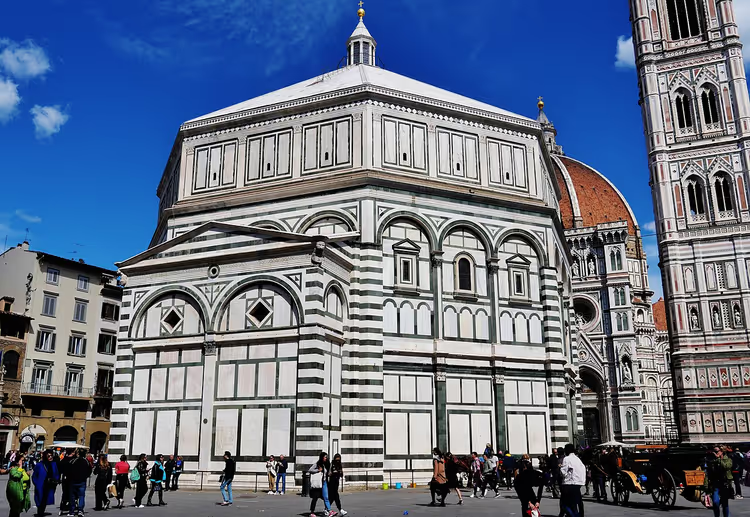
The octagonal baptistery stands right in front of the Duomo and is one of the city's main attractions. According to legend, a temple to Mars stood on this site, and in the 9th century the building was rebuilt as a Romanesque basilica. It received baptistery status in 1128, and for another hundred years baptisms and council meetings were held here.
The most valuable elements are the three pairs of doors. The south doors are decorated with 28 panels depicting scenes from the life of John the Baptist by Andrea Pisano. The east doors, with ten scenes from the Old Testament, were created by Lorenzo Ghiberti and are called Porta del Paradiso. On the north doors you'll see gilded reliefs from the New Testament.
Inside, the dome is painted with scenes of the Last Judgment, and the baptismal font has served for nine centuries. The Medici were baptized here and, according to tradition, Dante as well. The baptistery is included in the combined Duomo ticket, so you don't need to buy a separate one.
- Address: Piazza del Duomo.
- Ticket: included in the Brunelleschi Pass; a separate ticket is cheaper.
- Who it's for: those who want to see Ghiberti's east doors up close.
- The catch: in summer there are crowds at the doors; the best photos come in the morning.
It's easier to book the entire Duomo complex in one go: Duomo complex: dome, museum, and baptistery.
13. Church and monastery of San Marco
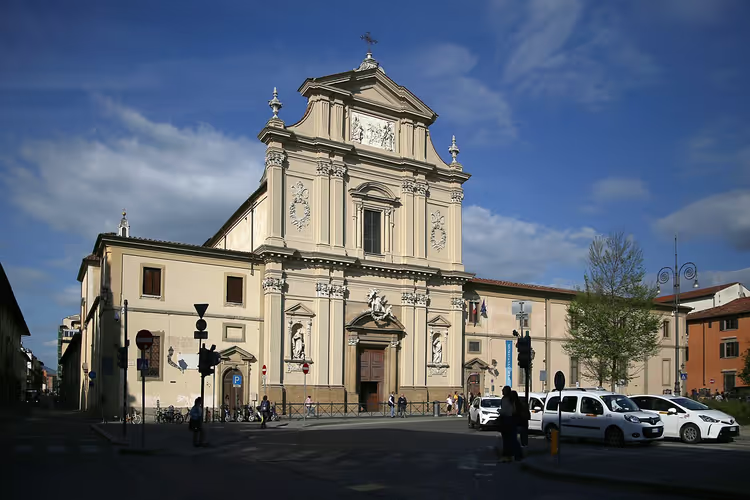 © Sailko · CC BY-SAPhoto: Sailko, CC BY-SA (https://creativecommons.org/licenses/by-sa/4.0), Wikimedia Commons
The San Marco complex consists of a church and a Dominican monastery that now houses a museum. The church was consecrated in 1443, and in 1498 Savonarola was its prior. You will see his cell and portrait, as well as the first monastic building in Florence with Renaissance proportions.
The monastery walls were painted by Fra Angelico, also known as Beato Angelico. Frescoes decorate the cells, corridors and common rooms, and the entrance to each cell is open. The monastery has been closed since 1866, and its halls now house the Fra Angelico Museum.
The library holds a collection of Medici manuscripts, but it is rarely shown to visitors. Tickets can be bought in advance or on site. The ticket office closes in the afternoon.
- Address: Piazza San Marco, 1-3.
- Hours: weekdays from morning to afternoon, the museum is closed on Sundays.
- Who it's for: those who appreciate early Renaissance painting and want to escape the crowds.
- The catch: the rooms are small, and you can't get in on Sundays.
You can get a ticket to the San Marco Museum in advance: San Marco Museum ticket.
Tours and tickets in Florence
Guided tours, skip-the-line tickets and activities — most offers can be cancelled free of charge.
See offers on TiqetsThe widget loads once you give your consent.
Churches and temples of Florence on the map
To understand how the churches relate to each other, open the map. Most of the churches on the list are in the center, and you can walk to all of them in two days. We placed the Basilica of San Miniato al Monte and the Church of the Nativity of Christ outside the historic core.
Churches of Florence
Places on the map
- 1Church of the Nativity and St Nicholas the Wonderworker Orthodox church from the early 20th century by the Mugnone river
- 2Santa Maria Novella White and green marble facade, frescoes by Ghirlandaio and Masaccio
- 3Santa Maria del Fiore Cathedral Cathedral with Brunelleschi's dome
- 4Ognissanti Ghirlandaio's Last Supper and Botticelli's tomb
- 5Basilica of Santa Croce The Pantheon of Florence, tombs of Michelangelo and Galileo
- 6Basilica of San Lorenzo The Medici family church, chapels with tombs by Michelangelo
- 7Santa Trinita One of the oldest churches, the Sassetti Chapel with frescoes by Ghirlandaio
- 8Santa Maria del Carmine Brancacci Chapel with frescoes by Masaccio and Masolino
- 9Santo Spirito Brunelleschi's last work, Michelangelo's Crucifix
- 10San Miniato al Monte Basilica on a hill with a 12th-century mosaic facade
- 11Santa Felicita Capponi Chapel with Pontormo's Deposition
- 12Baptistery of San Giovanni Octagonal baptistery with Ghiberti's doors
- 13San Marco Church and monastery with frescoes by Fra Angelico
⁉️🤔 Frequently asked questions
Which churches in Florence have free admission?
You can enter Ognissanti, Santo Spirito, Santa Trinita, Santa Felicita and San Miniato al Monte freely. In these churches you pay only for individual chapels and museums, such as the Brancacci Chapel. A ticket is required for the Duomo complex, Santa Croce, Santa Maria Novella, San Lorenzo and the San Marco Museum. Bring small change for donations.
Do I need to buy a Duomo ticket in advance?
Yes, if you want to climb the dome. Access to the top is by time slots, and in high season they sell out weeks ahead. The combined Brunelleschi Pass is valid for three days and includes the dome, the campanile, the baptistery, the museum and Santa Reparata. You can enter the church itself for free, but the line moves slowly. Buy online and come for the first slot.
How long does one church take?
A small church like Santa Trinita or Santa Felicita takes 20-30 minutes. Allow an hour for Santa Croce and Santa Maria Novella, and another 30 minutes each for the Brancacci Chapel and the San Marco Museum. The Duomo complex with the dome climb and the museum takes half a day, so make it a separate item on your itinerary.
When is the best time to come to avoid lines?
At opening time or after 4:00 PM. At the Duomo and Santa Croce the longest line forms by midday, especially from April to October. On weekday mornings there are noticeably fewer people, and on Sundays many churches open only in the afternoon. Check the hours the day before, as the schedule changes due to services.
Why is there a paid entrance at Santa Croce?
The basilica operates as a museum and pantheon, and the Gothic complex requires constant restoration. The ticket covers entry, the tombs of Michelangelo and Galileo, 16 chapels with frescoes and the inner courtyard. On Sundays and church holidays entry starts later, and on certain days admission may be free. Check prices on the official website before your trip.
Video: Florence. Star of the Renaissance
A short video will show Florence from above and help you understand what the historic center looks like from the hills. Watch it before your walk to make it easier to find your way around.
In short: what to book
If you only have two days, get the Brunelleschi Pass, Santa Croce and Santa Maria Novella, while Santo Spirito has free admission. If you are traveling for art, add the Brancacci Chapel and the San Marco Museum, where you will find frescoes by Masaccio and Fra Angelico. With children, choose Ognissanti and San Miniato al Monte: admission is free, and the climb up the hill becomes an adventure of its own.
Book tickets to the city's museums and churches in advance, as dome and chapel slots go first. Tickets and tours on Tiqets and Florence guides on GetYourGuide will take care of entry questions before your trip.

A small editorial team writing guides for independent travel. We travel ourselves, but we haven’t been everywhere, so we check prices, opening hours and how to get there against official sources.