
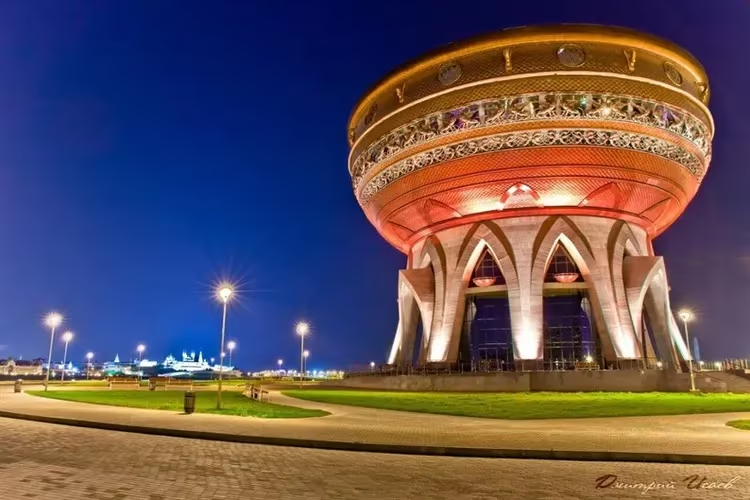
Kazan is a city of many faces and contrasts. Periods of history, different cultures and traditions intertwined on its streets, forming a unique architectural ensemble, acquaintance with which you can devote an infinite amount of time. But still, the tourist visit is usually limited, so in order not to get lost in this variety, below is a list of the most popular and interesting sights of Kazan that you need to see first.
Tower Syuyumbike
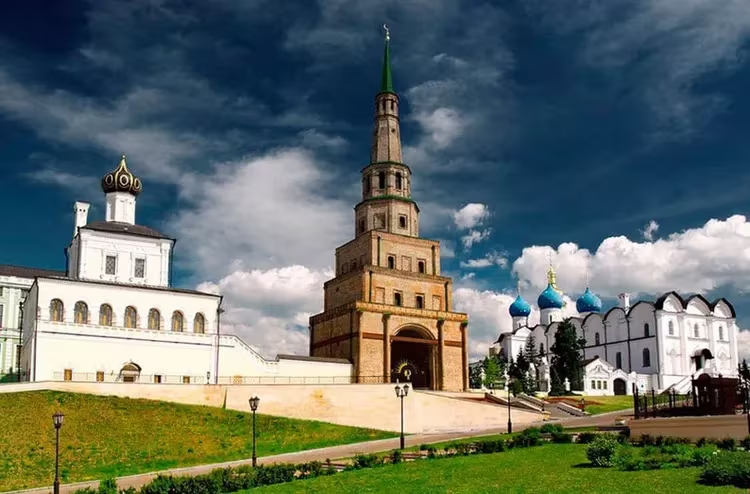
Syuyumbike Tower is not just a visiting card, but also an architectural symbol of Kazan. The “falling” structure, surrounded by the walls of the Kremlin, is visible from afar. Which, in general, is not surprising.
After all, it was from her that in ancient times, when Kazan was one of the border cities of the Russian Empire, the sentinels watched the enemies and warned the inhabitants and the army about possible dangers.
It is difficult to say when the Tower was built. In historical sources, reliable data about this has not been preserved, and researchers give a variety of numbers – the 16th, 17th, 18th centuries, and some even believe that they built the proud and majestic Syuyumbike back in the days of the Kazan Khanate, before these lands were annexed by Ivan Terrible to the Russian Empire. In any case, the architectural solution of the building is ambiguous and interesting.
The tower got its name in honor of the last queen of the Khan, Syuyumbike. There are many legends about her personality, to the point that Ivan the Terrible laid eyes on the beauty, and she, not wanting to be subdued, threw herself from the top of the tallest building in her kingdom, the Syuyumbike Tower. How it was in reality today is difficult to say.
Only one thing can be said with certainty: Syuyumbike, proudly towering in the center of the Kremlin, is a symbol of completely different eras in the history of the city and reminds of the distant khan times. You can look at the Tower up close only by going to the territory of the Kremlin, completely free of charge.
It is impossible to get inside at all – the “falling” structure is strictly guarded by the state and in order not to harm it, guests are not allowed there.
Kazan Kremlin
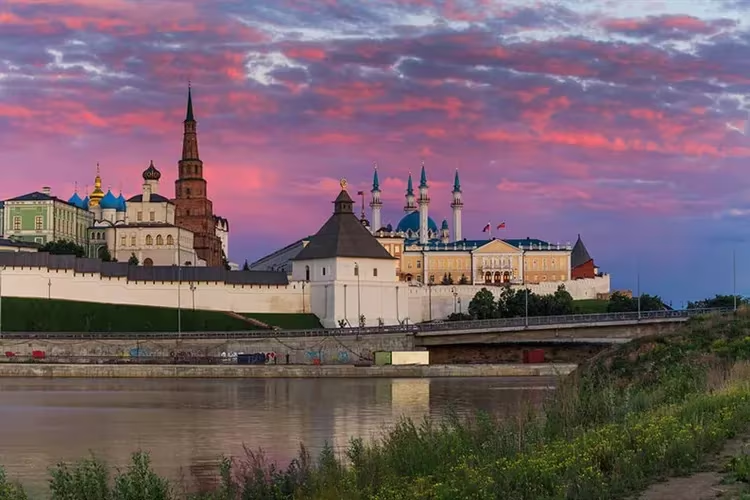
This is an amazing city where both Russian and Tatar cultures coexist. This weave best represents the Kremlin – the main attraction and the heart of the Republic.
The Cathedral of the Annunciation and one of the main Muslim mosques of our country, Kul-Sharif, adjoin on its territory. This is a unique place where you can simultaneously hear the sound of bells and the voice of a mule calling for prayer.
Minarets and domes are visible against the background of the sky. However, these two completely different religious complexes are not the only attractions of the Kazan Kremlin. Guests should definitely take a look at the watchtowers, the most famous of which bears the name of the Khan's queen Syuyumbike, and the Orthodox buildings from the time of Ivan the Terrible, and the Governor's Palace, built much later, in the 18th century.
In addition, here you can not only feel the spirit of the city, but also learn about its past by looking into the museum of the history of Tatarstan or into the halls of the exposition dedicated to Islam. More modern exhibitions are also located here – dedicated to the Great Patriotic War and the local Hermitage, which is the official branch of St. Petersburg.
It is easy to get there, it is located in the city center, near the Kremlevskaya metro station. There are also ground transport stops nearby – buses and trolleybuses.
Entrance to the territory is free, but you will have to pay for visiting museums and exhibitions. In addition, each of them works according to an individual schedule, which is better to clarify before visiting the official website.
Monument to the architects of the Kazan Kremlin
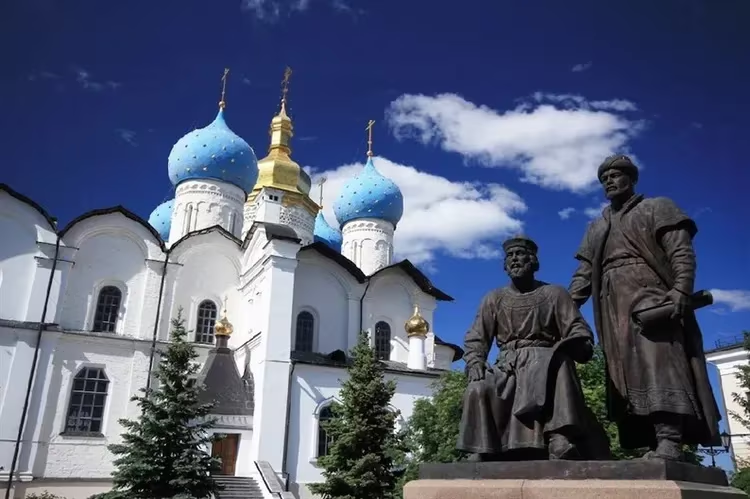
For many centuries, the Kremlin was built, destroyed, burned in fires and rebuilt again. In memory of the architects of those times who participated in the design and creation of buildings, a bronze monument was erected. The project of the monument to the architects was established in 2001 by the first president of Tatarstan M. Sh. Shaimiev and implemented by sculptors A. V. Golovachev, V. A. Demchenko and architect R. M. Zabirov.
The sculptural complex, 3.0 meters high, was installed in 2003 on the site in front of the Annunciation Cathedral. The audience is presented with two monolithic figures, summarizing the appearance of Russian and Tatar architects of past centuries.
In their hands they have drawings with plans for future structures of the Spasskaya Tower and the Khan's Palace. The monument symbolizes the centuries-old interpenetration of cultures and religions of the Russian and Tatar peoples.
Taynitskaya tower
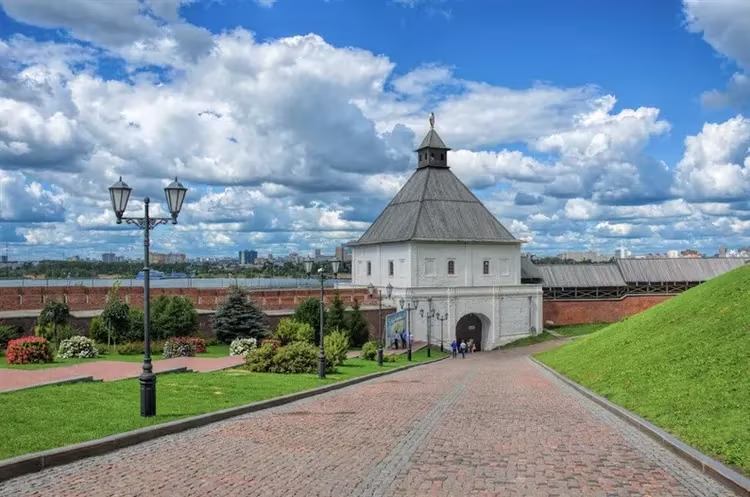
The Taynitskaya travel tower is located in the northwest of the Kremlin and is a two-story square building with an arched opening. The building was erected in the 16th century according to the project of architects Ivan Shiryai and Postnik Yakovlev.
At the time of the conquest of the city by Ivan the Terrible, the previous Nur-Ali tower (Muraleev tower) towered on this place, through the gates of which in 1552 the tsar entered the Kremlin to celebrate the victory over the Tatars.
The name comes from the hidden spring of the same name, the waters of which watered the besieged inhabitants. It was possible to get to it from the defensive tower through a secret underground passage. After the capture of the fortress, the spring was blown up by Russian soldiers, and after a while it was depleted and was completely destroyed in the 50s of the XX century. From pure spring water with an extraordinary taste, the locals have only legends and memories of old-timers.
At the very top of the wooden roof there is a plaque with the emblem and logo of the UNESCO World Heritage Site. There is a cafe on the second tier of the building for visitors.
Resurrection tower
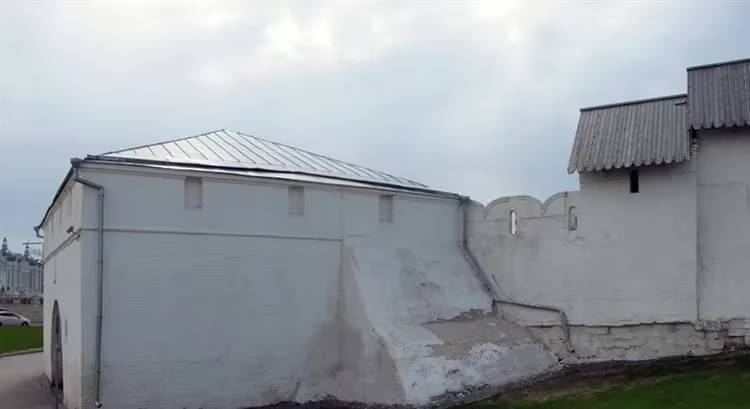
The northeastern Resurrection (Yelabugin) tower of the Kremlin was built in the 15th century, but during the siege by the troops of Ivan the Terrible it was badly damaged and was restored in the 16th century by Pskov masons and architects Ivan Shiryai and Postnik Yakovlev. In the process of reconstructing the tower above the ground floor, a gate church of the Resurrection of Christ was built, which existed until the middle of the 19th century.
In subsequent years, the Voskresenskaya Tower was used as a place for keeping prisoners, so for some time it was called the Ostrozhnaya Tower.
Today, the white stone walls of the Resurrection Tower are presented in the form of a low one-story cubic building with a metal roof and a through opening. The interior decoration of the premises retained the features of the 16th century.
Kul Sharif Mosque
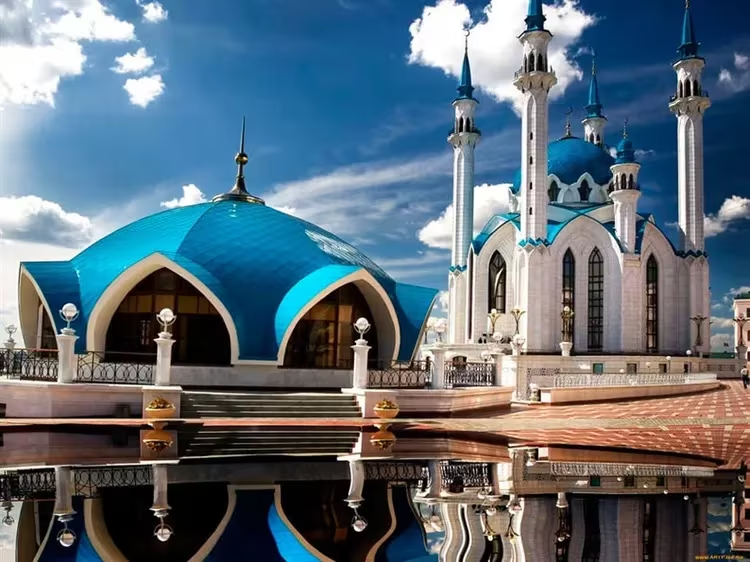
The Kul-Sharif Mosque is a symbol of all Russian Islam. This mosque can rightly be called the largest in Europe and one of the most beautiful in the world. Its construction was carried out for almost 10 years, from 1996 to 2005. This is explained not only by the complexity of the project, but also by the fact that the funds were literally collected bit by bit – Kul-Sharif was built exclusively on donations from individuals and organizations.
However, it is a mistake to believe that Kul-Sharif is a young, new mosque. Of course, in terms of age it is. However, if you look into the past and flip through the pages of history, it becomes clear that it is a copy of the one that symbolized the power and greatness of the Khanate, captured and conquered by Ivan the Terrible.
The Kul-Sharif Mosque is active, services are regularly held within its walls. That is why a special place is reserved for tourists – they can look at the decoration from the balconies, without interfering with praying Muslim believers. Near the mosque there is an information center where you can learn about its past and present, the history of Islam in Tatarstan.
Local guides are happy to acquaint guests with the world of the brightest mosque in our country, being proud that it coexists with Orthodox churches on an equal footing. Kul-Sharif is located on the territory of the Kremlin.
You can enjoy the architecture of the building for free, just like getting inside. But those wishing to visit the mosque, accompanied by a guide, will have to pay for his services.
National Museum of the Republic of Tatarstan
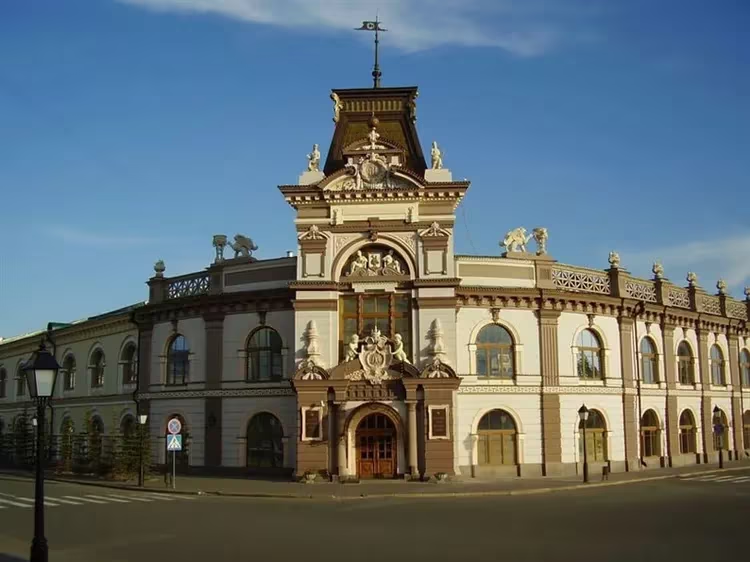
It is simply impossible to pass by a conspicuous building on Kremlevskaya Street without paying attention. Once it was built as Gostiny Dvor, today the premises house the expositions of the National Museum of the Republic of Tatarstan.
Its history began at the end of the 19th century. True, the museum was then called differently – technical and industrial. Yes, and there were much fewer exhibits in his collection, most of them were demonstration samples presented at the exhibition of achievements in 1890.
Gradually, the state collection was replenished with private ones. One of the largest, which to this day is considered the “core” of the museum, belonged to A.F. Likhachev, a local historian and archaeologist. He, who decided to make personal values public property, is considered to be one of the founders of the National Museum.
Guests who come to the museum can get acquainted with the results of archaeological excavations carried out on the territory of the Republic, original art and literature. This is the best place to feel the true Tatar spirit. The National Museum is not only a building on the Kremlin, but also numerous branches. Each of them is interesting in its own way and deserves attention.
In addition, it is here that scientific work is carried out and the museum business of the Republic is actively developing. Finding the museum is easy – it is located on Kremlevskaya Street, not far from the metro station of the same name. You can visit it on any day except Monday, from 10-00 to 18-00 (on Friday – until 17-00).
Bauman street
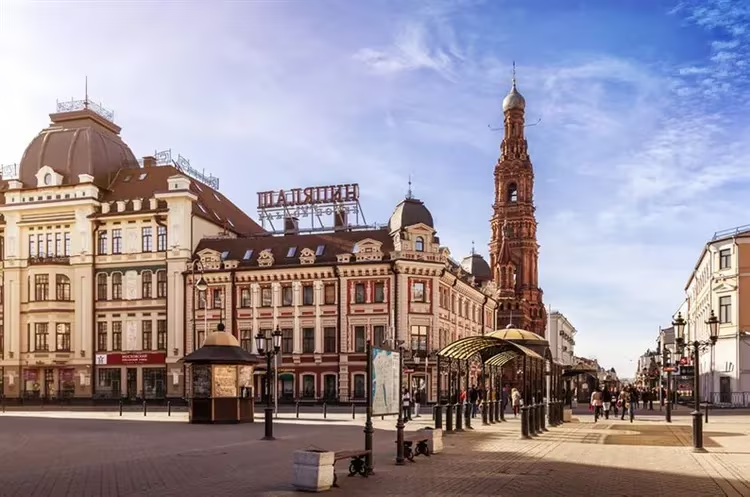
Bauman Street is the Kazan Arbat, a favorite place for walking among local residents and guests of the Tatar capital. Without it, it is simply impossible to imagine a city, just like Moscow without the Arbat or Paris without the Champs Elysees. The street received its current name not so long ago, in 1930.
She was named after the famous revolutionary Nikolai Bauman. One of the most famous universities in Moscow also bears his name. Before the advent of Soviet power, Arbat was called much more simply and less poetically – Prolomnaya Street. It was believed that Ivan the Terrible “entered” the Kremlin through it, literally breaking through one of the walls.
Bauman Street attracts not only lovers of urban landscapes, but also connoisseurs of architecture and history. Almost every building here is a masterpiece worthy of attention. For example, you should definitely look at the Drama Theatre, the National Bank, the Press House and many other buildings. In addition to architecture, Bauman Street is famous for its unusual monuments. The Cat of Kazan “lives” here – one of the symbols of the city.
After all, it was thanks to these animals that the fame of the city during the time of Catherine II thundered throughout the country – the empress, who came here on a visit, received a very unusual gift – three mousecatchers, who were supposed to save the royal court from the attacks of rodents.
Getting to Bauman Street is very easy, it is located next to the Kremlevskaya metro station. During the day it is interesting for lovers of sights, at night there are numerous bars and restaurants open for those who decide to relax after a day full of excursions.
Asimov mosque
The city is famous not only for fountains, modern bridges and the Kremlin. The capital of the Republic of Tatarstan is the location of a large number of mosques, which are of interest not only to Muslim believers, but also to tourists who want to touch a culture that is not traditional for Russia.
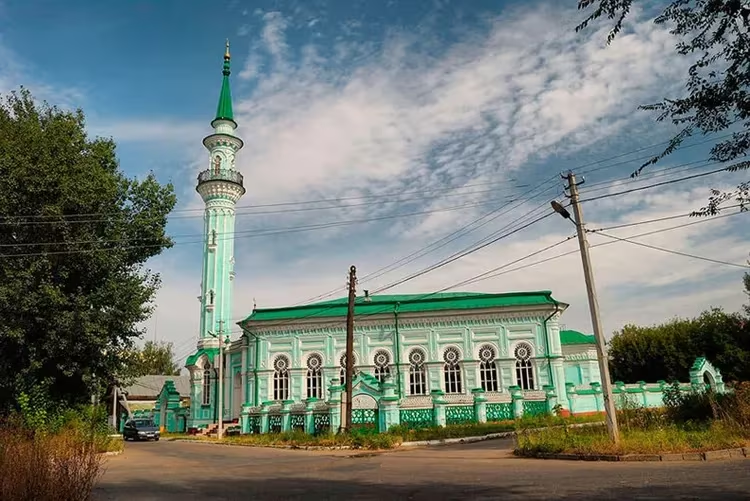
One of the most popular is Asimovskaya. The mosque got its name in honor of a wealthy local merchant, who initiated and sponsored the construction of a Muslim shrine in the 19th century.
However, the services here were destined to take place not so long – in Soviet times, religion, no matter what, was condemned and all places of worship were completely closed. Administrative offices were located within the walls of the Azimva mosque, and in the 1980s it was completely abandoned.
In the early 90s, a reconstruction was carried out and the mosque again began to receive Muslims who wanted to pray. It remains active to this day. However, tourists are interested not so much in the services as in the architectural design of the building – in the national Tatar style.
However, despite this, she was always different from her “sisters”. Wall decorations give the mosque some romance, and a 51-meter high-tiered minaret will make it stand out from the rest. The mosque is located on Fatkullina Street at 15.
You can visit it completely free of charge, any day and any time. True, there are no excursions – in the case of an independent inspection, it is better to prepare in advance for the visit by studying the literature and guidebooks.
Blagoveshchensky cathedral
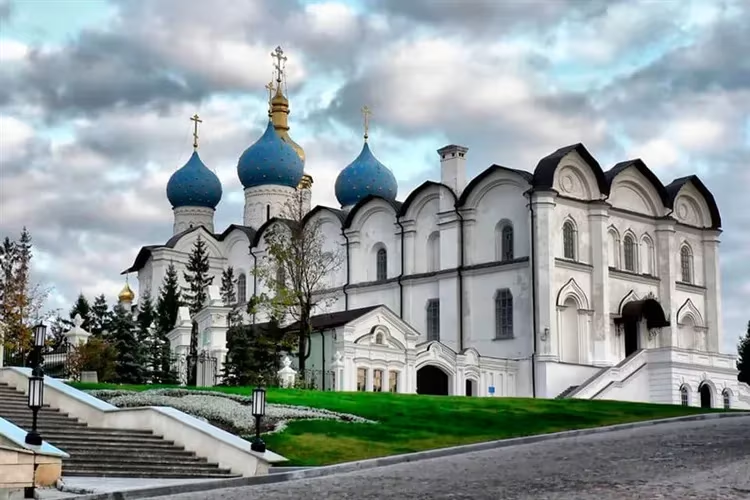
The Annunciation Cathedral is one of the oldest Orthodox buildings in the city, erected by Ivan the Terrible as a symbol of the new power and greatness of the Russian Empire. It was built in record time, but in this case it did not affect the quality of the structure.
The cathedral for a long time remained the center of the Orthodox and cultural life of the city, so it is not surprising that it was repeatedly completed, rebuilt and modernized in accordance with the fashion trends of the 16th, 17th, 18th and even 19th centuries.
The Soviet years for the temple went as smoothly as possible. Naturally, it did not function as a religious center; an archive was placed in the premises, in which the required temperature regime was maintained. This is what saved the wall paintings from the time of Ivan the Terrible, which today are one of the main attractions of the cathedral.
In addition, the cell of Archbishop Guria is popular among guests and pilgrims. Many believe that his soul still lives here in seclusion and helps everyone who handles trouble. The miraculous icon of the Savior not made by hands, painted in the distant 16th century, is also kept here.
The Annunciation Cathedral is interesting not only for its architectural delights and interior decoration, but also for its unique location – next to one of the main mosques of our country, Kul-Sharif.
The two religions coexist peacefully and prove in the best possible way that the difference in faith is not a reason for war. Getting to the Annunciation Cathedral is not difficult – it is located on the territory of the Kremlin, not far from the Kremlin metro station and ground transport stops – buses and trolleybuses. It is impossible to get inside, but solemn services are held on holidays and weekends.
Blue Lake
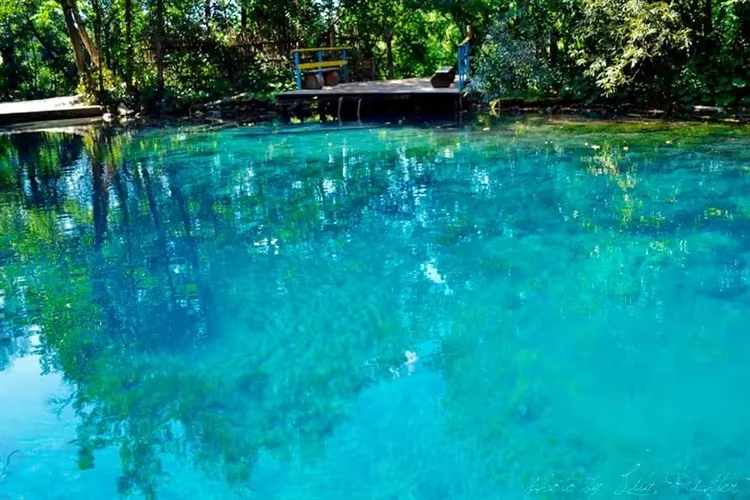
It is customary to call the Volga lakes of karst origin blue. There are three of them in the vicinity – Small, Large and Protochnoye. All of them are rich in mineral salts and are used not only as an excellent recreational base, loved by tourists and locals, but also as a place where you can improve your health. Small and Protochnoe lakes are not too deep, and because of the transparent mirror surface they seem completely shallow.
But the Bolshoi was chosen by divers. True, the underwater world here is not very rich – algae and a few fish are unlikely to surprise seasoned professionals. But there is a tradition at the bottom of the Blue Lakes – to put up a New Year tree at a depth and meet the chiming clock. True, without the traditional glass of champagne.
By the way, when they talk about Blue Lake, of all three they mean Small. Beaches, recreation areas, showers and changing cabins are equipped on its banks. Among beach lovers, this is one of the most popular places in the entire Republic.
Despite the fact that the water temperature does not rise above 4 degrees above zero. The most convenient way to get to the Blue Lakes is by your own car or taxi, along the M7 highway.
Those who have to use public transport start their journey from the Tukaya Square metro station. It is from here that bus number 35 departs, on which you need to pass several stops and get off at Golubyatnikova.
Transfer to bus 40, which will take you to the village of Shcherbakovo, the last test for those who want to relax on the Blue Lakes. If you plan to spend several days here, you should prepare for the fact that prices on the coast are not low. For everything from housing to beer in local shops.
Farmers' Palace
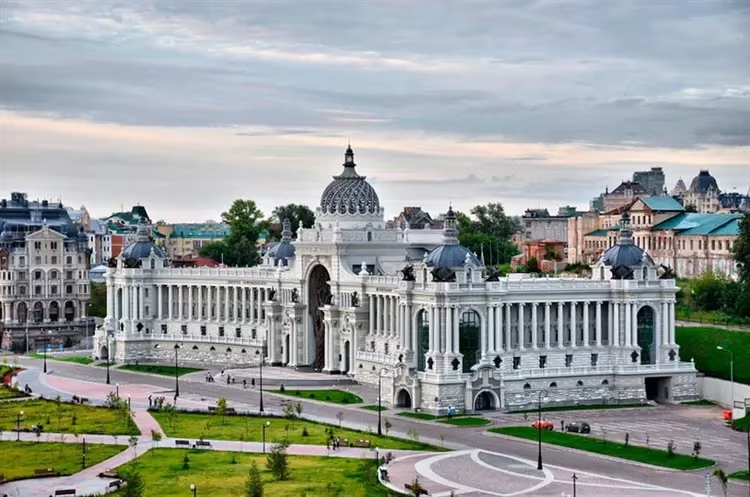
Not far from the Kremlin is the Palace of Farmers. One of the most controversial, but still beautiful sights of the capital of Tatarstan. Despite the name, reminiscent of the bottom of the past days, the complex was built not so long ago, in 2010. A lot of controversy took place around it, some even collected petitions that it disfigures the atmosphere and appearance of the historical center.
But, nevertheless, the palace was erected and became popular among tourists. So hurt the locals.
From an architectural point of view, the Palace of Farmers is a mixture of various architectural styles. It has something from the Renaissance, Baroque, Classicism and even Art Nouveau. It seems that the architect of the project, L. Gornyak, managed to put together completely different things and create a unique, bright and memorable creation.
Inside the palace is the Ministry of Agriculture. This, by the way, explains such an unusual name, and not the similarity with medieval defensive fortresses and romantic castles.
I must say that the officials, inventing the name, showed themselves very ambitious, almost royally. Getting to the palace is not difficult – it is visible from the Kremlin wall and is located not far from it, on Fedoseevskaya Street. You need to look at it at least twice – in the afternoon and in the evening, when the building is beautifully and unusually illuminated.
Circus
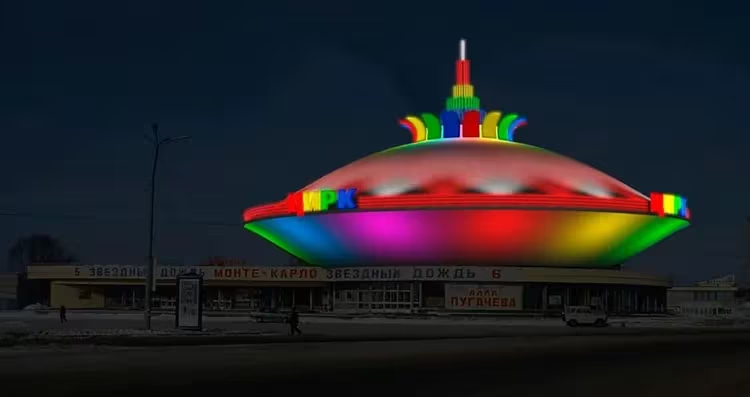
The circus at one time was known throughout the entire union. Too much of everything innovative was connected with it, moreover, both in terms of architecture and in terms of representations. To this day, the building itself and what happens on the stage deserve attention.
The history of the circus began quite a long time ago, in 1890. True, since then the troupe (of course, its composition has changed several times during this time) has been forced to move three times – the arenas turned out to be short-lived until the current one was built in 967.
The fame of her thundered far beyond the borders of the Soviet Union. Firstly, the structure itself is still considered innovative to this day – it holds without concrete supports. Secondly, the appearance, reminiscent of a flying space saucer, for the 60s was definitely something unusual and out of the typical range of Soviet buildings. Over the years of the existence of the circus, its arena has seen the most famous masters of this seemingly fun, but very difficult business.
Pencil, and the Zapashny brothers, and many others, whose names are forever inscribed in circus history, shone here. In addition, a school is open here for those who are just beginning to learn art. Its graduates shine in various troupes, including the legendary Du Soleil.
fountain cascade
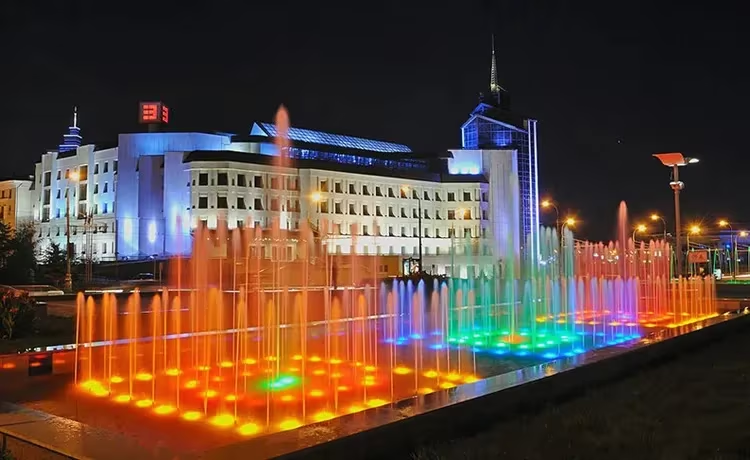
Fountains are traditionally an adornment of any holiday. On hot days, they attract not only tourists walking around the city in search of beautiful urban views, but also local residents hiding from the scorching sun and midday heat. The cascade of fountains on the Bulak River was built for a reason, but in honor of the 100th anniversary of the capital of Tatarstan.
It is not surprising that they amaze not only with their beauty, but also with their scope. By the way, the main fountain of the complex is located not on the river, but on Lake Kaban. It is here that laser light shows take place every evening.
Throughout the cascade, which consists of 22 fountains, benches are installed along the embankment. In summer, you can sit in an open cafe and admire the streams of water. There are also rental points where you can rent a catamaran or a boat and enjoy the fountains not from afar, but in close proximity.
True, this entertainment is very popular among local residents, so there are often no free courts. In general, the embankment of the Bulak River and Lake Kaban is a great place to relax and take a break from the urban bustle and numerous city excursions.
Presidential palace
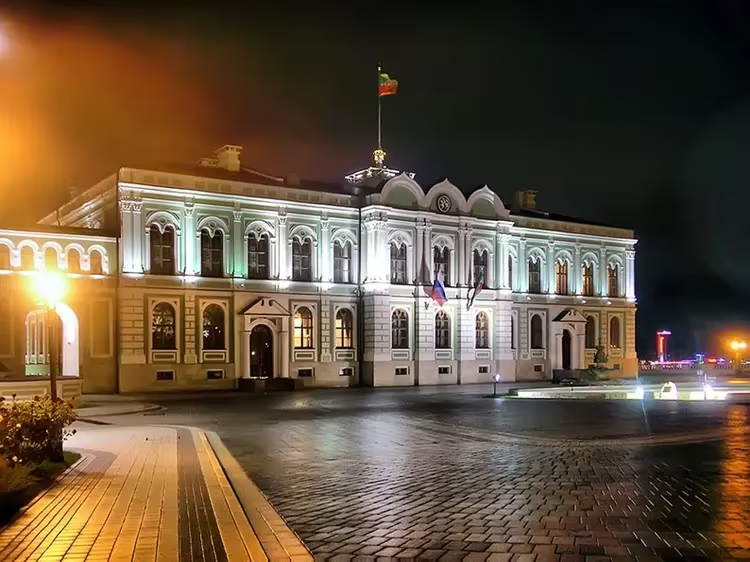
The Presidential Palace is an elongated two-storey building of light green color in the Baroque style, built by the architect K. A. Ton in the middle of the 19th century. Inside the building there was a representative office of the Kazan governor and a number of rooms for imperial persons.
During the Great October Revolution, the Council of Workers and Deputies was stationed in the palace, and during the Soviet period, the Presidium and the Council of Ministers of the Tatar Republic met there.
Now the coat of arms of the republic with a winged white leopard is installed above the main entrance of the palace, and the building itself serves as a residence for the President of the Republic of Tatarstan.
It is interesting that on the site of the presidential residence, in the period until 1552, there was the palace of the Kazan Khan, as evidenced by numerous archaeological finds. The entrance for tourists to the Presidential Palace is closed, but in the evening you can admire the beautifully illuminated facade of the building.
Ushkova's house
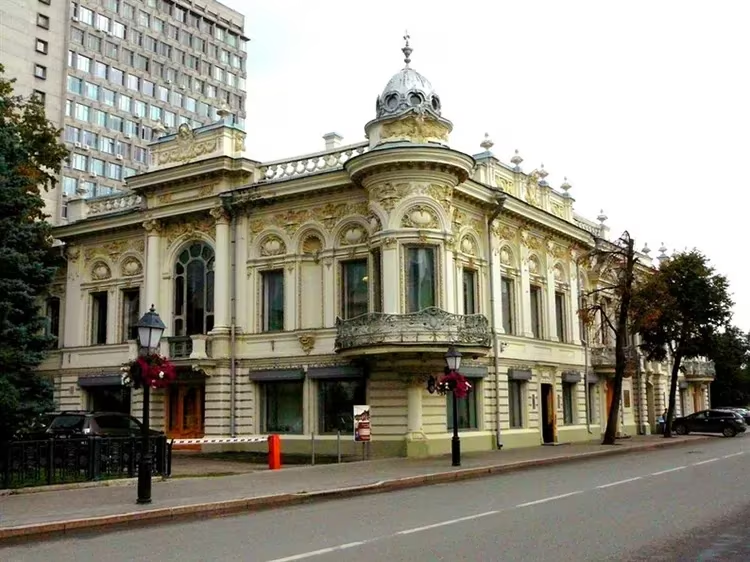
Ushkova's house is a unique attraction, which is a historical object of the federal level. At the very beginning of the 20th century, three houses on Voskresenskaya Street were reconstructed and combined into one exceptional building, intended as a wedding gift for Zinaida Vysotskaya (Ushakova).
This work was carried out with great enthusiasm by the architect-builder Carl Muefke. The white facade of the two-story building was built in the Baroque style and decorated with stucco elements of mythical dragons and birds.
The building impresses with its magnificent interior and unconventional mix of styles. Each of the rooms is presented with a unique design: there are elements of medieval Chinese style and unique wood carvings, an ancient fireplace and French stained-glass windows on the windows.
The hall on the top floor is equipped with a huge aquarium and a winter garden-grotto, created in the form of a stalactite cave. Until the October Revolution, the house was rented out for living and trading. From 1919 to the present day, the National Republican Library of Tatarstan with a reading room has been located in the building.
Millennium Bridge
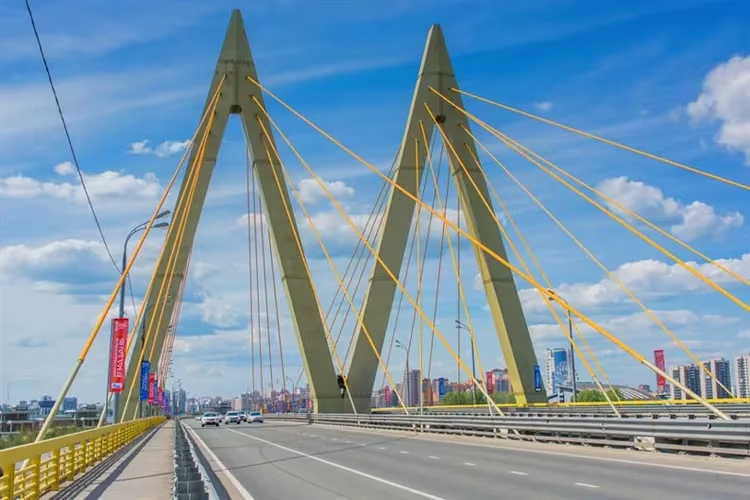
The Millennium Bridge was built in 2005 in honor of the millennium of Kazan and connects Vishnevsky Street and Amirkhan Avenue. The bridge is located on the Kazanka River and is the highest of the city's overpasses. The overpass has a length of 1.5 km and is made in the form of a suspension cable-stayed bridge, the metal cables of which are connected to the beams of the carriageway.
You can recognize the Millennium Bridge by the design of the pylon, made in the form of a large letter “M”, which is 45 m in height. The bridge has three lanes in both directions and a pedestrian zone. The construction cost amounted to 3.4 billion rubles.
The construction is part of the Small Ring of the city's highways. The bridge is illuminated by lampposts and additional illumination of the pylon, which makes it a bright object of the city at night.
Monument to the carriage of Catherine II
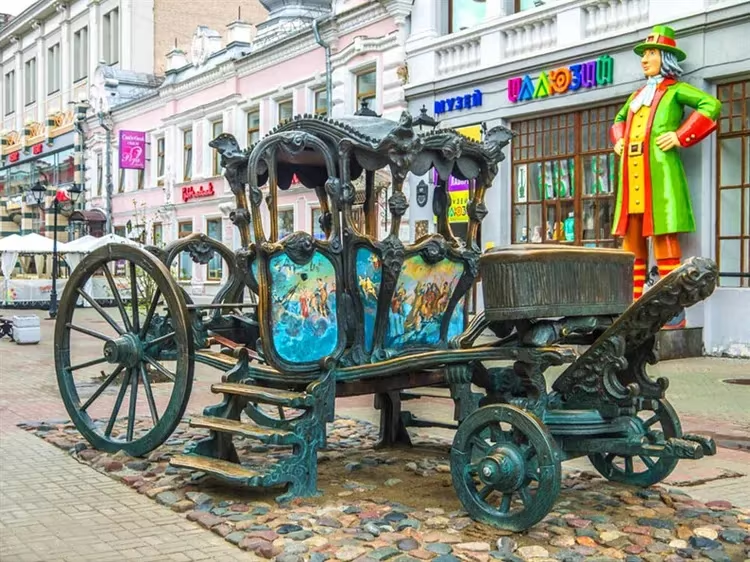
The bronze monument to the carriage of Catherine II is installed on Bauman Street (the original is in the National Museum of Tatarstan) and is directly related to the visit of the queen to Kazan. Traveling along the Volga and visiting coastal cities and sights, Catherine II arrived in Kazan in May 1767, where she stayed for five days.
The Empress attended the services of the Bogoroditsky Monastery, prayed at the icon of the Kazan Mother of God, took part in the procession in honor of the celebration of the Holy Trinity, and attended festivities on the Arsk Field (now Gorky Park).
A warm welcome was arranged for Catherine II, she was met by the first persons of the city, torches burned on the houses, the Russian state emblem was installed on the new triumphal gates.
Every day, during her stay, the Empress received requests and complaints from the townspeople, and as a result issued a Decree on equal rights of the Tatar and Russian merchants, gave a verbal command to the city authorities not to interfere with the construction of mosques and ordered to approve the stone urban planning plan.
Catherine's gilded carriage was kept for a long time in the courtyard of the Kazan Archbishop and only in 1889 was donated to the city.
Monument to Musa Jalil
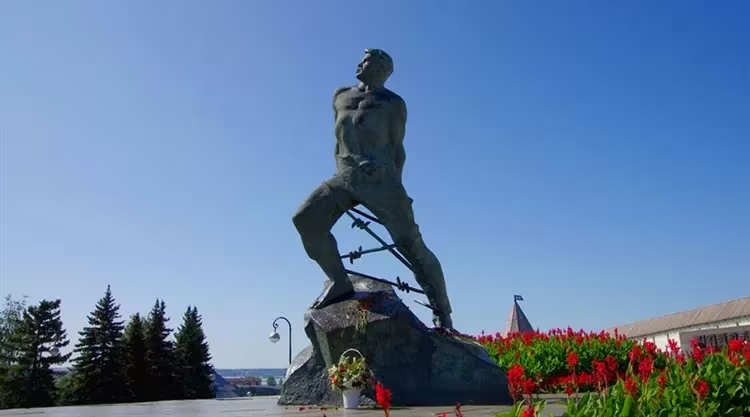
Musa Jalil is a poet of Tatarstan, Hero of the Soviet Union, laureate of the Lenin Prize. The monumental historical complex of national importance was erected in memory of the underground hero and poet, who died in 1944 in a fascist prisoner of war camp. An underground group organized by Soviet prisoners of war led by Gainan Kurmashev was uncovered, and all 11 members, including Musa Jalil, were executed.
A bronze sculpture of the poet, 7.9 m high, with tied hands and proudly raised head, entangled in barbed wire, is installed on a trapezoidal pedestal and is located on May 1 Square.
Every year on February 15, on the birthday of Musa Jalil and on August 25, on the day of the death of underground workers, solemn processions come to the monument and to the granite wall with bas-reliefs to lay wreaths and flowers.
zoobotanical garden

The zoobotanical garden was founded in 1806 and became the first zoological garden in the Russian state. The garden is located in the center, on the bank of the Sredny Kaban lake. Today in the zoobotanical garden there are more than 150 species of animals in the amount of 4.5 thousand representatives, and 1.0 thousand plant species in the amount of 6.0 thousand specimens.
Among the predators of the garden, you can see African lions, polar bears, tigers, leopards and snow leopards. Exotic snakes, crocodiles and monkeys always attract the attention of visitors, both adults and children.
Part of the territory is reserved for a children's petting zoo. Scientists from the Kazan Zoobotanical Garden and employees of the Central Forest Reserve are conducting unique experiments to return captive-born brown bears and swans to their natural habitat.
Research work on the study, conservation and breeding of rare bird species is being successfully carried out. For the reconstruction of the zoobotanical garden, a global plan was developed to expand the boundaries and equip new spacious enclosures and green areas for its inhabitants.
Gallery of Glory Zaitsev
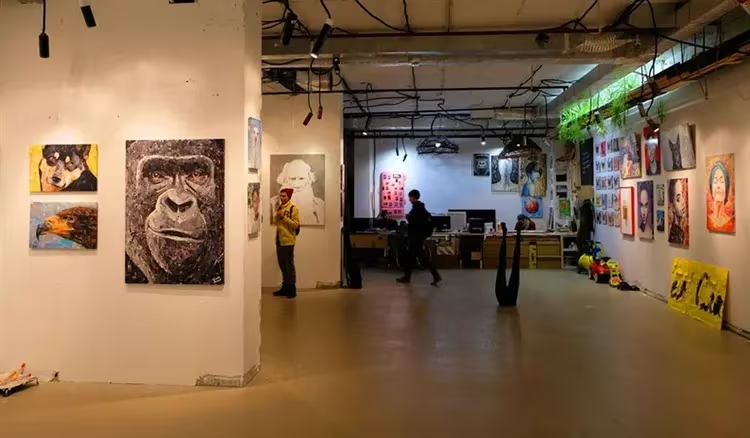
The private gallery of modern art, where the young artist Slava Zaitsev creates his paintings from improvised materials, is located on the territory of the GUM shopping center. The material for the works is not artistic paints, but various improvised bases, such as nails, fabric, sand, cosmetic clay, threads, autumn leaves, newspaper and magazine pages. The artist's original exhibitions are very popular with citizens and tourists.
Slava Zaitsev's favorite technique is collages from magazine clippings. The production of one such work takes from several days to one or two months.
The portraits made by the artist in this technique are impressive. The master of non-standard painting himself is constantly in his gallery, which is also a workshop for him, and presents his works to visitors.
Museum of Socialist Life
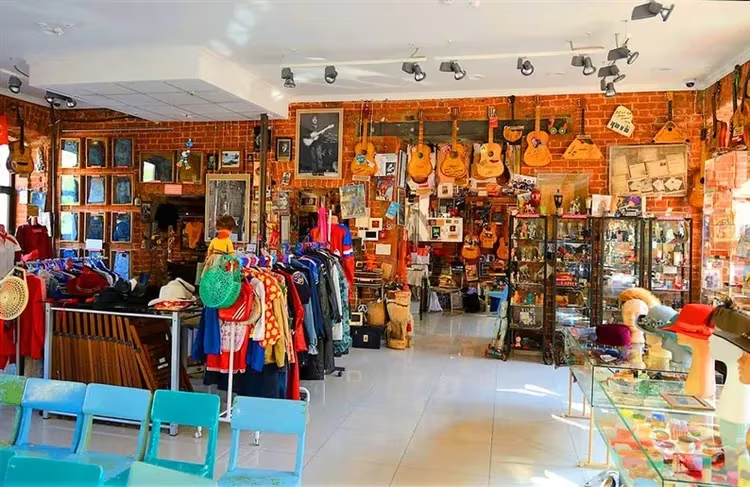
The Museum of Socialist Life is located in a former communal apartment of a house built in 1849 and covers an area of 200 meters. The founder and director of the museum, Rustem Valiakhmetov, has been collecting items from socialist times since the 1990s.
The older generation is interested in the museum with memories of a past life, when an ordinary thing was a scarce commodity, and its possession brought joy, but now it only causes a smile. Young people also enjoy visiting the exhibition, examining the objects with surprise, trying on vintage wigs and hats.
A black-and-white TV, a radiogram, a typewriter, aluminum teapots, children's board games, matryoshka dolls, tumblers and many other things long gone from everyday life – all these are objects of the exhibition. On the wall is a whole gallery of jeans donated to the museum by popular musicians. There is a separate hall dedicated to rock and roll, which has many original guitars of famous performers.
The exposition does not fit in the apartment the entire collection of things from the socialist period, so the organizers hold thematic exhibitions dedicated to holidays and memorable dates, replacing some exhibits with others.
Jubilee Arch (Red Gate)
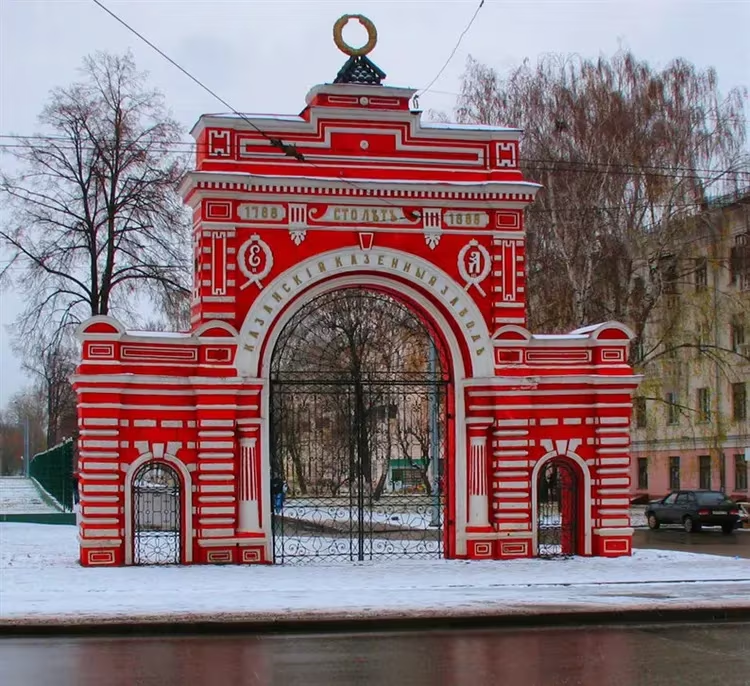
The jubilee arch was installed in 1888 by the architect I.P. Kotelov, in honor of the centenary of the founding of the Kazan Gunpowder Factory by Catherine II. The monument has historical and cultural value and belongs to the objects of republican significance. The Jubilee Arch (Red Gate) is part of the ensemble of the park. R. E. Petrov and is considered one of the symbols of the Kirov region.
On the facade of the arch, the dates of the founding and anniversary of the Gunpowder Factory are laid out in brickwork. The building looks like a triumphal gate and is painted in red and white tones. Symbolic passages are decorated with cast-iron patterned gates and gates. From the Jubilee Arch there is a long alley leading to the Gunpowder Factory.
Millennium Square
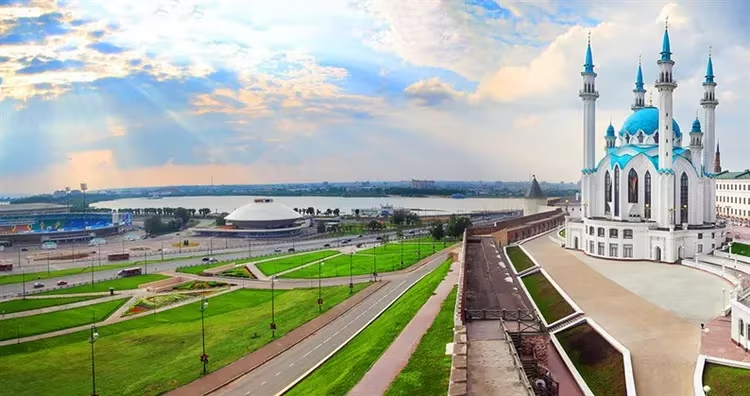
Millennium Square is located in close proximity to the Kremlin and is considered the territory of the battle between the Kazan Khanate and the Russian army in 1552. For a long time, shopping arcades were established on the square, fairs and folk festivals were held.
In 1999, it was decided to restore the historical space of the Kremlin siege to its status. The square was cleared of old buildings and turned into one of the main squares, which is a landmark of the city.
In 2005 and 20013, large areas of the territory were reconstructed on an area of 90 sq.m.
Now Millennium Square includes pedestrian paths and roadways adjacent to it, well-groomed squares, green lawns, an underpass and the Kremlevskaya metro station.
Panoramic pictures depicting the Millennium Square and the complex of buildings of the Kazan Kremlin, the Kul-Sharif mosque and the state circus adorn guidebooks, postcards and memorable souvenirs.
Mausoleum of Kazan Khans
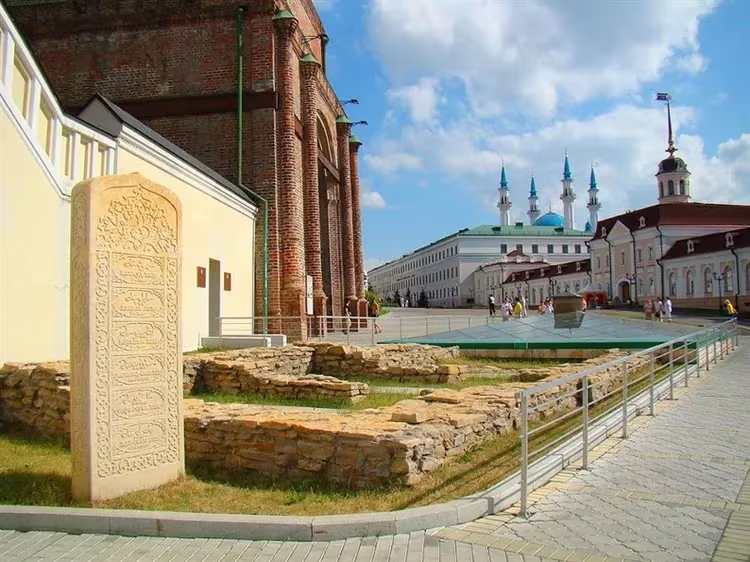
The ancient mausoleum was discovered in 1977 on the territory of the Kremlin during the repair of water pipes and drains. In the course of subsequent archaeological and scientific research, several buried generations from the kind of Kazan khans were found. It has been reliably established that the remains of Khan Mahmud, who died in 1467, and Khan Mohammad-Amin, who died in 1518, rested in the crypts.
During the reign of Ivan the Terrible, the above-ground part of the Khan's mausoleums was destroyed, but the burials themselves remained untouched. The coffins opened by scientists were covered with leather and decorated with silver ornaments. Interestingly, on the basis of the Tatar chronicles, it was established that the construction of the mausoleum was carried out by decree of Khan Mahmud, whose burial was the first in the crypt.
Now a glass pyramid has been installed over the last place of the shelter of the great Kazan khans, and access to the tomb is possible for all travelers visiting the Kremlin.
Victory Memorial Park
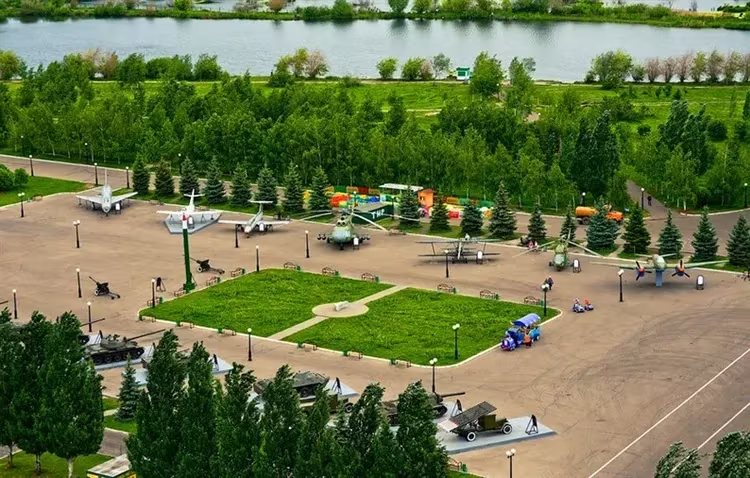
The memorial park ensemble covers an area of 50 hectares and was established in 1970. Victory Park is located on the territory of a previously swampy area, after the development of which, green spaces and a memorial appeared in the park. The complete completion of landscaping and the construction of memorial structures took place in 1995.
Now Victory Park is a complex consisting of a memorial to the heroes of the Great Patriotic War, a Victory stele, a sculpture of a Warrior and a Mother Woman and an Eternal Flame monument, next to which young residents keep a solemn watch every day. Along the perimeter of the park there are exhibition samples of military equipment of modern models and times of war.
The memorial park is one of the favorite places for recreation of citizens and guests of the city. People come here to walk with children, ride bicycles along the equipped alleys and lay flowers at the Eternal Flame.
On the northeast side of the park there is a reservoir where swimming is prohibited, but you can go fishing and feed wild ducks on the shore.
Museum of Konstantin Vasiliev
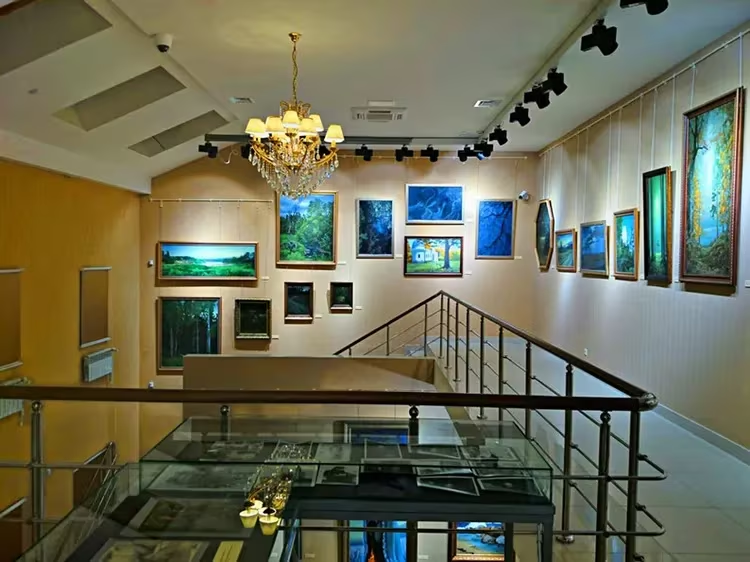
In the very center there is a museum-gallery of the world-famous artist Konstantin Alekseevich Vasilyev, who died untimely. When the future artist was 7 years old, his family moved from Maykop to the suburbs, where Konstantin's father worked as a chief engineer at one of the enterprises.
In 1961, Vasiliev graduated with honors from the Kazan Art School, and as a graduation project presented to the examination committee the scenery for the opera The Snow Maiden, sketches for which are still used in the theaters of the country.
The main areas of the artist's work were the German-Scandinavian epic, Vasnetsov's fairy tales, figures of Russian heroes and poignant images of the Second World War. In the fall of 1976, at the age of 34, Konstantin Vasilyev died tragically under the wheels of an electric train in the city of Zelenodolsk.
The most famous works of the artist are the Reaper 1966, the Elder 1968, the Northern Eagle 1969, At a strange window 1973, Portrait of Marshal G.K. Zhukov 1974, Waiting 1976.
Zero kilometer of Kazan
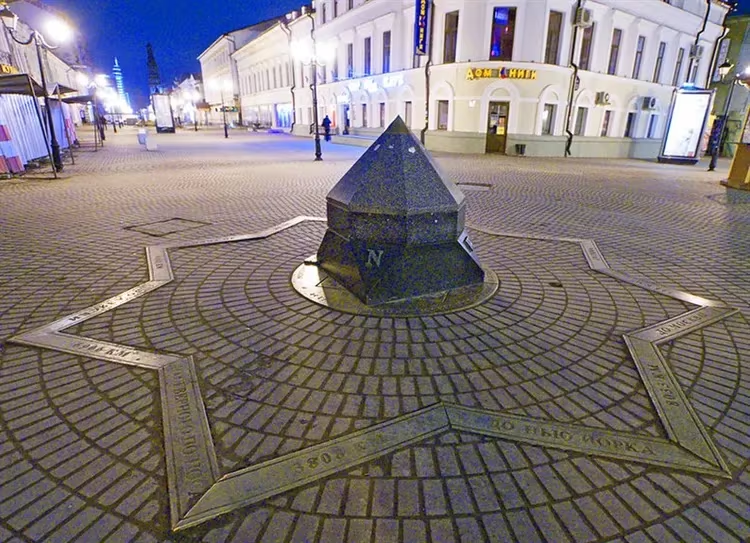
The Kilometer Zero memorial sign was installed at the request of the Transport Committee and the City Department of Architecture in 1999 as a reference point for the road distance. Zero kilometer is located in the center of the intersection of Bauman and Kavi Najmi streets.
The coordinates of the object are carved on a granite circle and are 55 degrees 47'18” north latitude and 49 degrees 07'10” east longitude, a cube is placed on top, then a prism, and at the very top of the composition is a pyramid.
Under the sign is an eight-pointed star, the sides of which look in the direction of some capitals and parts of the world, indicating the distances to Moscow, Rome, New York, Tokyo and Beijing, as well as to the holy place of pilgrimage for all Muslims – Mecca.
The calculation of distances and directions on the Zero Kilometer sign was criticized by students of Kazan Federal University. When recalculating with the help of modern instruments, it turned out that the numbers on the sign and the direction indications were set incorrectly.
Palace (Vvedenskaya) Church
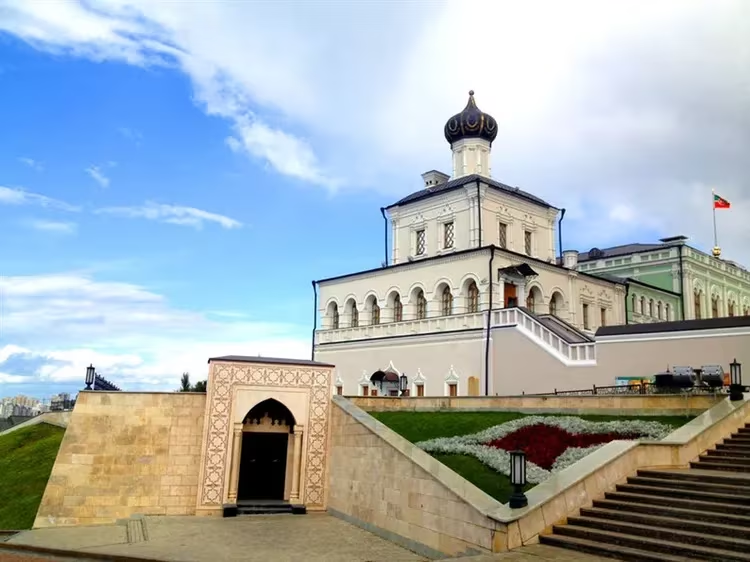
The period of foundation of the Palace Church is considered to be the middle of the 17th century. In 1815, during a fire, the church burned down and was not restored for a long time. After Nicholas I visited Kazan, the tsar issued a decree on the revival of the Orthodox shrine. In 1852, the temple was rebuilt and became the house church of the Descent of the Holy Spirit for the family of the Kazan governor.
During the October Revolution, the church was plundered, and the icon paintings on the walls were destroyed. In Soviet times, there was a dining room in the temple. At the beginning of the 21st century, a major overhaul was carried out in the building of the Palace Church, and the object was given the status of a UNESCO historical heritage.
After that, on the top of the dome, instead of the Orthodox cross, a World Heritage sign was erected, which caused outrage among the residents.
The emblem was removed, and the church remained standing without a cross. Currently, the Museum of the History of Tatarstan is located in the premises of the Palace (Vvedenskaya) Church.
Cannon Yard Museum
On the territory of the Kazan Kremlin there is a museum of the Cannon Yard, which was founded on the site of artillery yards for the manufacture and repair of military guns for the needs of the tsarist army. The cannons cast in the artillery yard played a big role in the victory of the Russian army over Napoleon in the war of 1812.
After a fire at the artillery yard in 1815, the production of gun cannons decreased, and in 1850 the cannon yard stopped its work. Before the beginning of the October Revolution, the courtyard building was used as a barracks for military personnel.
During the archaeological and restoration work of 1998, on the site of the artillery yard, a pit for melting metal of the 17th century was discovered, which, together with the Museum of Weapons, entered the Cannon Yard complex as an exhibit.
Cathedral of the Epiphany
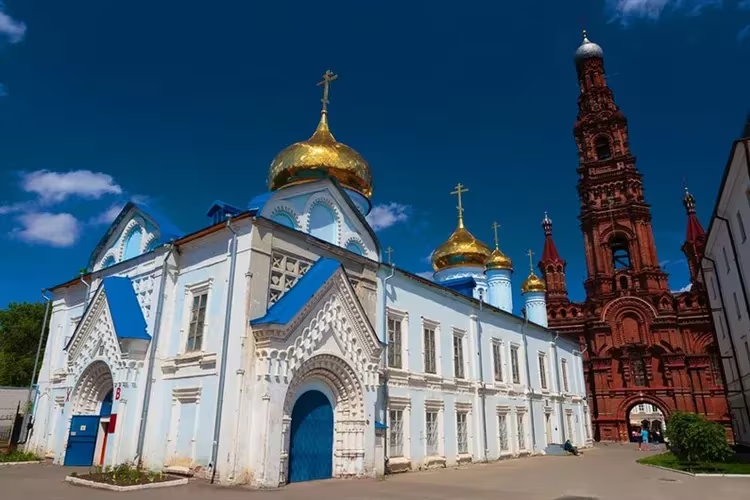
Epiphany Cathedral is considered one of the main attractions. The historical complex includes a temple where services are held daily and a bell tower. The bell tower houses the State Museum of Fine Arts and a chamber hall dedicated to F. I. Chaliapin.
The stone Church of the Epiphany was erected in 1756. In 1897, a bell tower was built near the church, which took more than 2 million pieces of red brick.
The bell tower is still one of the tallest buildings and is more than 70 meters high. In the pre-revolutionary period, the Cathedral of the Epiphany had rich interior decoration and gilded domes. At present, the painting of the walls of the temple and the icons are made by modern masters.
The cathedral and the bell tower have been given the status of historical sites of federal significance. It is interesting that in 1873 in the Cathedral of the Epiphany they baptized at the birth of the great singer of the 20th century, Fyodor Ivanovich Chaliapin, who sang in the same church in his youth. In 1998, a bronze monument was erected to the great opera singer next to the Epiphany Cathedral.
Chuck-chuck museum
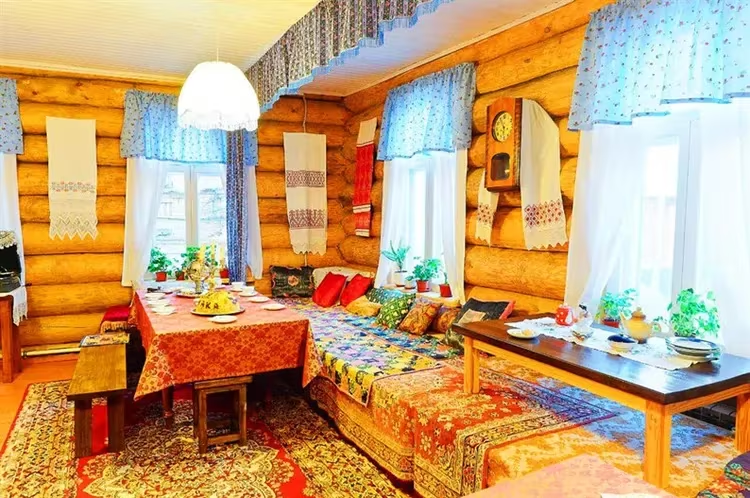
The chak-chak museum is located in the house of the merchant Bigaev Vafa, built in the 19th century in the area of the old Tatar settlement. The museum was founded by D. Polosin and R. Suleymanova in 2014 and opened with their own money. The object is a monument of culture and life of the Tatar people, which covers the period of the history of the Middle Volga region, from the 10th century to the present day.
The exposition presents jewelry, clothes, dishes, household items and tools that have survived to this day. In 2014-2015, the Chak-Chak Museum became the winner and owner of the first prize in the republican tourism competitions.
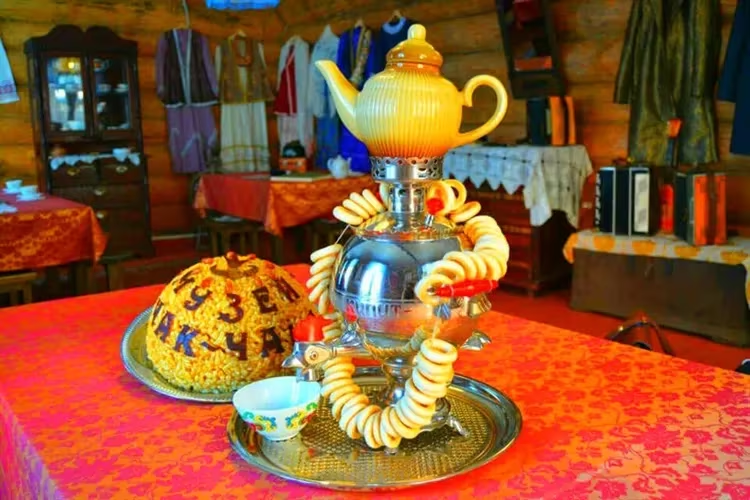
In addition to historical exhibits, the museum organizes the sale of national Tatar dishes chak-chak, baursak and marshmallow, made by hand and according to old recipes. Here, visitors can drink tea from a samovar and get acquainted with some of the tricks of preparing Tatar wedding treats at master classes. When entering the Chak-Chak Museum, it is customary to take off your shoes.
Museum of Illusions
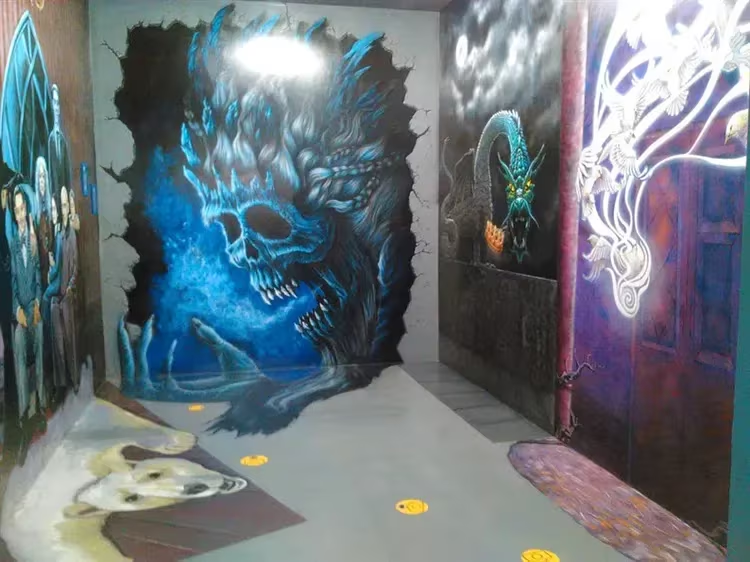
In 2015, the Museum of Optical Illusions and the House of Giants were opened on Bauman Street. Such exhibitions, where you can feel like a direct participant in the project, are open in Moscow and St. Petersburg and are very popular.
The photo project is a labyrinth with 3D interactive installations designed to photograph visitors from unusual angles. Distortions and metamorphoses are visible to the naked eye without the participation of special equipment.
Each of those who wish will be able to become a participant in the paintings, masterfully created by famous artists and props. For the convenience of photography and fun communication, the museum staff recommend visiting the installation in the company of friends. The Museum of Optical Illusions is equally interesting for both adults and children aged 5 and over.
Gorky Park
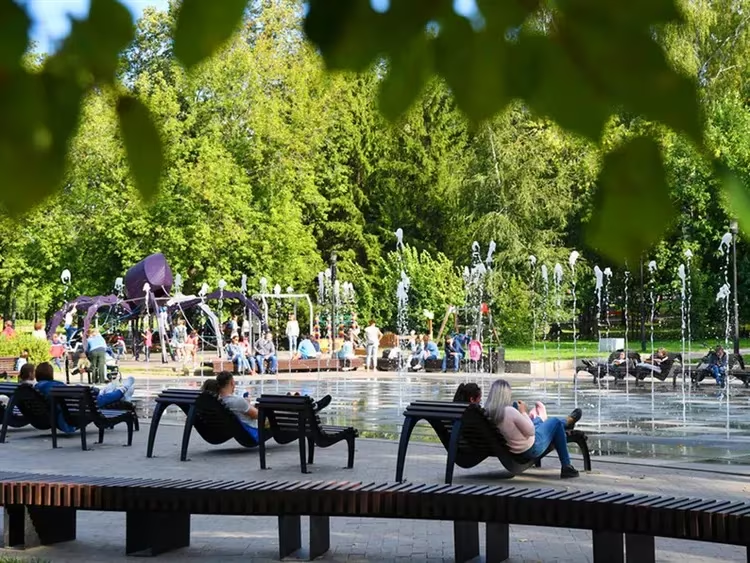
Gorky Park is located in the Vakhitovsky district. The territory of the square is surrounded by hilly terrain and forest, which is conducive to outdoor recreation.
In front of the entrance to the park there is a monument in memory of those who died for the Soviet regime, a memorial monument to the Unknown Soldier and the Eternal Flame. Advertising stands display images of Gorky Park in the 60-90s of the last century.
After the reconstruction carried out in 2014, new lights were installed in the park, a wide main alley of paving slabs and stone walkways were laid, a children's and football grounds were equipped, and outdoor sports equipment was equipped.
The novelty of the park was a light and music fountain, spouting from the ground with many jets, around which children always play in the summer. A large number of squirrels live among the trees, and for visitors who want to have a picnic, there is a huge area with cut grass.
Temple of all religions
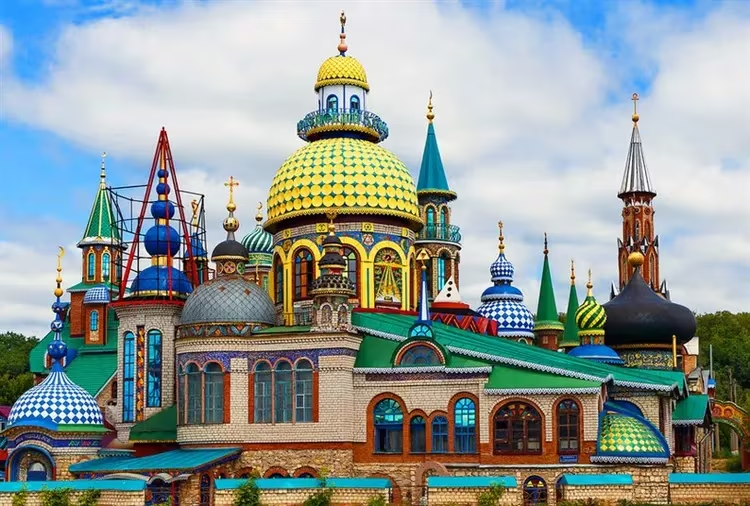
The unique temple of all religions is located in the Kazan village of Staroye Arakchino and is an incredibly beautiful complex of buildings designed as a bright fairy-tale city.
The Temple of All Religions was conceived and implemented in 1992 by the talented architect and artist Ilnar Khanov as a monument to the spiritual reunification of all religions of the world, love, goodness and the glorification of the one God for all believers. It was planned to recreate the symbols of 16 religions in the complex of buildings.
The construction was funded by donations from ordinary citizens, like-minded people and sponsors. After the death of the sculptor, the construction work was continued by his brother and sister.
The temple has musical equipment for organizing charity concerts, but religious services are not held. Due to the fact that the structure does not have an official status, further plans for the implementation of the project are unknown.
Kazan Bogoroditsky Monastery
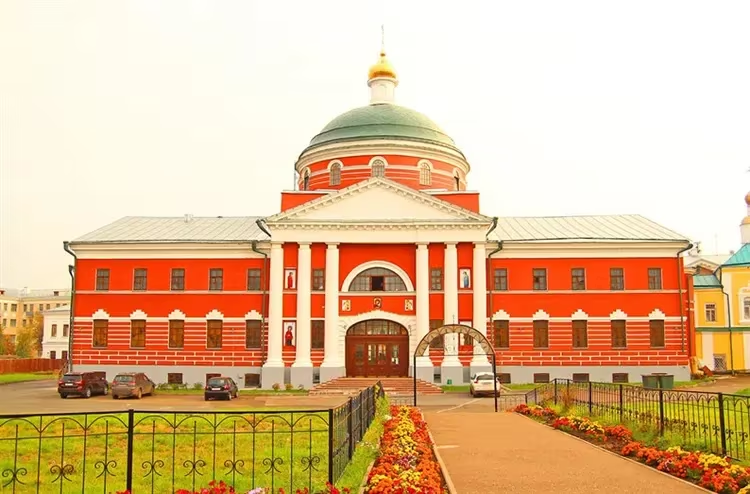
It was built on the site of the discovery in 1579 of the miraculous icon of the Kazan Mother of God. Before the revolution, it was a nunnery with up to 700 nuns. The monastery complex included a large number of buildings, including the Temple of St. Nicholas of Tula, where the acquired icon-painting image was kept.
In 1904, the miraculous icon was stolen, and during the revolution the monastery was destroyed. After the Soviet period, the Exaltation of the Cross building of the monastery is the best preserved. Now 10 monks live in the Kazan Bogoroditsky Monastery.
In 2005, one of the copies of the holy image of the Kazan Mother of God was transferred by the Pope to the Kazan Bogoroditsky Monastery. Many pilgrims come to the monastery every day to venerate the icon and ask for God's mercy from one of the most revered images in the world.
Zakabannaya mosque
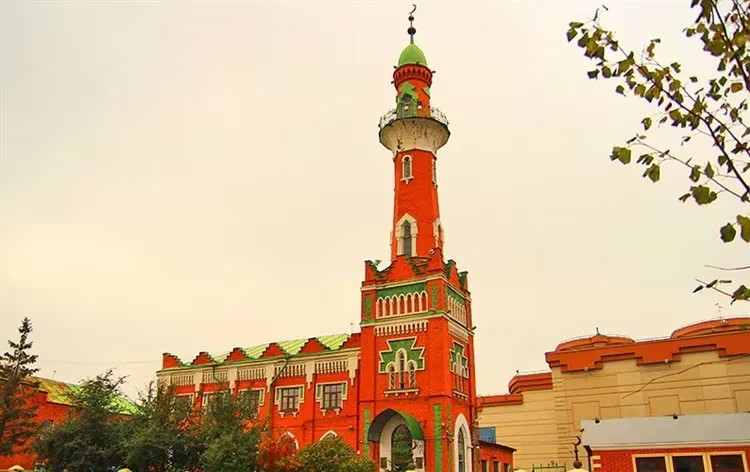
The Zakabannaya (Jubilee) mosque was built in 1926 in honor of the millennium from the date of the adoption of Islam by Khan Almush and the Tatar population belonging to him, who lived in the Middle Volga region.
The architect of the project is engineer A.E. Pechnikov, who realized his plan on the eastern shore of the Kazan lake Kaban. The mosque is represented by a red brick building with a high green dome on the minaret.
It is interesting that permission for the construction of the mosque was obtained from the head of the Soviet state I. V. Stalin, and in 1930 the temple was closed by decision of the Central Committee of Tatarstan. Subsequently, a red flag was erected on the minaret, and in different years the building served as a school, a kindergarten and a building for the public association DOSAAF.
Since 1991, thanks to the legendary Imam Iskhak-Khazrat-Lutfullin, the Zakabannaya Mosque has become a functioning Muslim shrine for the Tatar people.
Alexander Passage
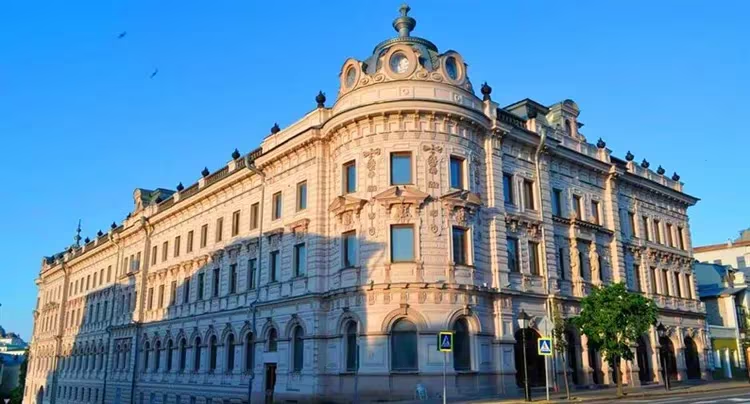
The magnificent white building of Alexander Passage was built in the Russian Baroque style in 1883 by the architect G. B. Rush for the honorary citizen of the city and the merchant of the first guild A. S. Alexandrov. After the death of the owner of the Passage, his sister O. A. Alexandrova-Grains, for little money, transferred the building to the city government.
At that time, there were 28 shops, 7 apartments and 32 rooms for rent in Aleksandrovskaya Passage. The city authorities used the premises to open the Hotel de Passage and for shopping arcades. At the beginning of 1896, the printing house of the well-known publisher of Tatar literature, I.N. Kharitonov, worked in Aleksandrovsky Passage.
Due to the terrible state of the sewerage system, in 1977 a part of the building adjacent to the Black Lake collapsed. Currently, Aleksandrovsky Passage is almost completely restored.
Peter and Paul Cathedral
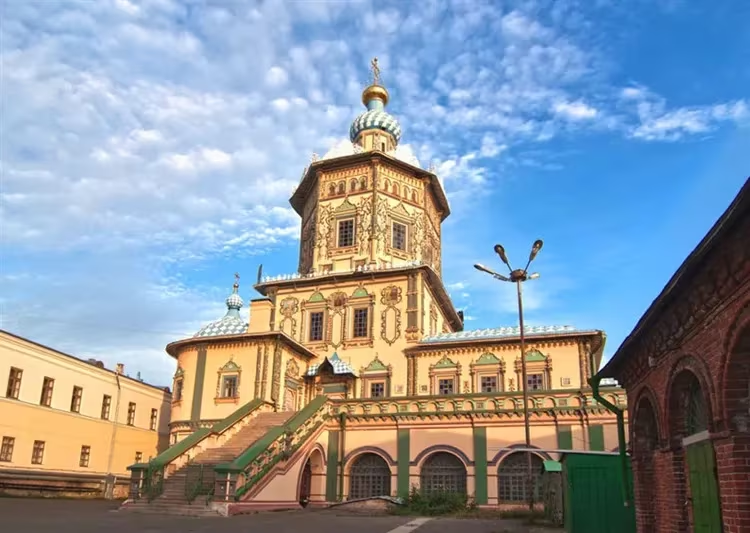
Peter and Paul Cathedral is considered one of the most important Orthodox shrines. In honor of the 50th anniversary of Peter I, on the site of a wooden church of 1565, the owner of the famous cloth factory, merchant Ivan Mikhlyaev, began on May 30, 1722, the construction of a church in the name of Saints Peter and Paul. The work was carried out for 4 years by local craftsmen, and then, by decree of Peter I, Moscow and Italian architects joined them. In 1726, the temple, unprecedented in height and luxury, was consecrated.
The Peter and Paul Cathedral survived several fires, and during the uprising of Yemelyan Pugachev in 1774 it was completely plundered. In 1889, the cathedral underwent a major overhaul, with the strengthening of the walls and foundation.
The exterior decoration of the temple was supplemented with new stucco, restoration of painted icons on the facade of the building and on the 50-meter bell tower. The roof was painted with checkered squares of white and blue.
Until 1939, the cathedral remained active, then the archive of the party, billiards and planetarium were not located in it.
In 1989, the Peter and Paul Cathedral was returned to the Kazan diocese and was again restored. Today, the main decoration of the temple is a 25-meter iconostasis with gilded icons. The temple icon of Saints Peter and Paul has been preserved in the cathedral in its original form.
Planetarium KFU
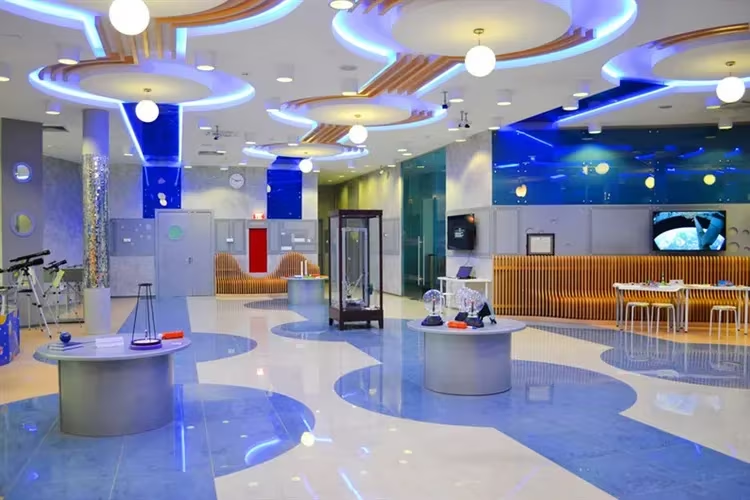
A new planetarium has been opened on the basis of Kazan Federal University, which has become a cultural, educational and research center for the study of space. The KFU Planetarium hosts daily programs that include astronomical shows, creative events, themed holidays and educational excursions for children aged 4 years and older.
The planetarium originated as a university center for space research and is considered one of the largest projects in the study of the universe.
This is the only planetarium in Russia, which is part of an educational institution and forms, together with the observatory of V.P. Engelhardt, a systemic astrological complex. The ultra-modern digital equipment of the planetarium allows visitors to feel inside the vast outer space.
For the scientific study of galactic objects, the planetarium is equipped with a system of super-powerful telescopes that allow real-time monitoring of the fall of meteorites, asteroids and supernova explosions on the domed screen of the stellar hall.