
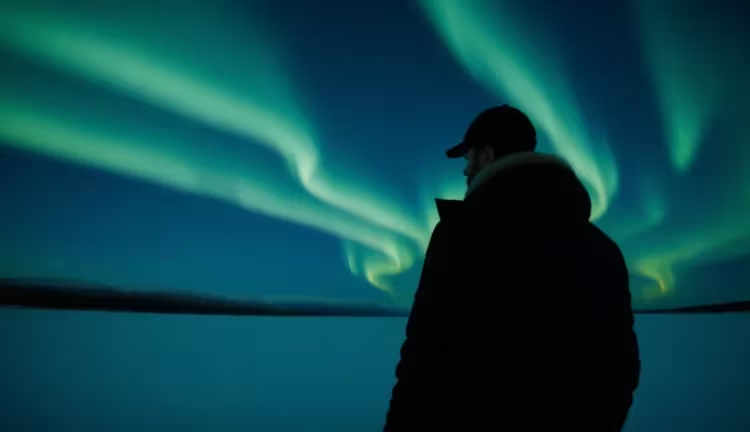
🌠 10 tips for seeing the Northern Lights
One of my main travel desires is to see the Northern Lights with my own eyes. So far I have not been able to do this either in Scandinavia or even in some northern regions. Yes, yes, this happens there too, but rarely. During my so far unproductive hunt (although it is a cool adventure in itself), I have accumulated a lot of life hacks that may help the luckier ones see the aurora.
This enchanting phenomenon has many names: the lights are called northern or polar, and also Aurora Borealis. Although I prefer the ancient names, for example, the reflections of the Valkyries’ swords or the sparks from the swing of a fox’s tail. Photo- worthy hunt!
Why do the northern lights happen?
A glow occurs in the upper layers of the atmosphere due to the interaction of the planet’s magnetosphere with charged particles of the solar wind. To put it simply, the Sun emits millions of charged particles (ions) from its surface. They reach the Earth and excite the atoms and molecules of gases so much that they begin to glow. And we, accordingly, see and admire the greenish strokes with red-yellow tints in the sky.
The color scheme is determined by the gases predominant on Earth: oxygen and nitrogen. If you're wondering, like I was, the glow will look different on other planets with different atmospheric compositions. On Jupiter, for example , it is blue-violet. But let’s dream about other planets and that’s enough, let’s discuss the myths that accompany Aurora on Earth.
Myth 1. The glow is visible only in winter.
No, it's not about the time of year, but about the length of daylight and night. In summer, when it is polar day and light in the north, it is almost impossible to see the northern lights. Absolute darkness is required. Therefore, the “hunting period” is from September to April. It is extremely rare, but still possible to see the lights in August. It is best to choose the period from October to January: the probability and intensity are higher.
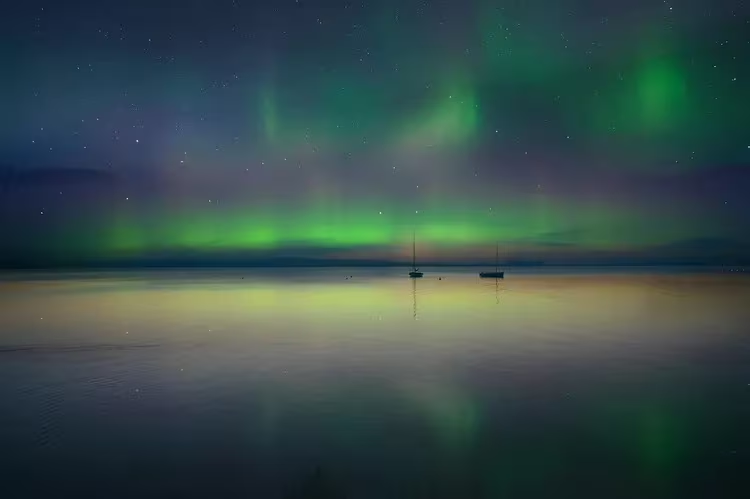
Myth 2. You need frost and sub-zero temperatures.
There is no dependence of the northern lights on the values on the thermometer. At the beginning of September, the multi-colored sky can be seen even at temperatures of +15 degrees. The logic here can only be sought in the ratio of the chances of seeing the lights; in cold weather the sky is usually clearer.
Myth 3. Any clear day will do.
If you are a lucky traveler or live somewhere in northern Norway, then of course you have a chance to see the lights by chance and without preparation. But it is still important to understand that the peak of this wonderful phenomenon has a certain cyclical nature. Therefore, dates are usually monitored on special websites or applications. If solar activity is low on a given day, then even a perfect starry sky will not show the bright spectacle you are hoping for.
Myth 4. The Northern Lights are visible only in the North.
The truth is that in the North the lights are visible more often, that's all. Therefore, it is obvious that it is more logical to try your luck in the Candyan countries, Canada or Alaska than to wait until Aurora appears in the latitudes of Eastern Europe. My friend lives in Estonia, you can’t surprise her with the radiance, but no matter how many times I visited her, I couldn’t catch the bright and such desirable spots in the sky.
How to increase your chances?
- Use special websites and applications that reflect solar activity, show days with a high coefficient and the percentage of your chance of seeing the aurora, respectively. Here are a few: My Aurora Forecast, Northern Eye Aurora Forecast, www.auroranotifier.com and aurora-alerts.com
Solar activity can be easily tracked on SpaceWeatherLive. In almost all services you can find out the current intensity coefficient (Kp), weather data and forecasts for the next hour and for the next days. Travel days are also better correlated with application data. There are quite a lot of such resources, all with the same functionality, plus or minus. The main thing is to always monitor cloudiness and solar activity: let it be above 5-6 points.
- Monitor the weather. The possibility of a cyclone with rain and snow reduces your chances to almost zero.
- Watch out for sun flares. The main condition for the northern lights is the emission of particles into the Sun. After it, you will have 2-5 days to get to the desired latitudes. Of course, the more powerful the ejection, the greater the chance that there will be a glow at all. Remember that the solar wind takes time to reach the Earth's atmosphere and create a magnetic storm in it. Data from satellites, as a rule, are several hours ahead of the aurora itself.
- Choose the right place for observation: away from populated areas, without illumination, preferably in nature with beautiful views around. I dream of seeing the lights somewhere in Lapland, Iceland or beyond the Arctic Circle in Norway.
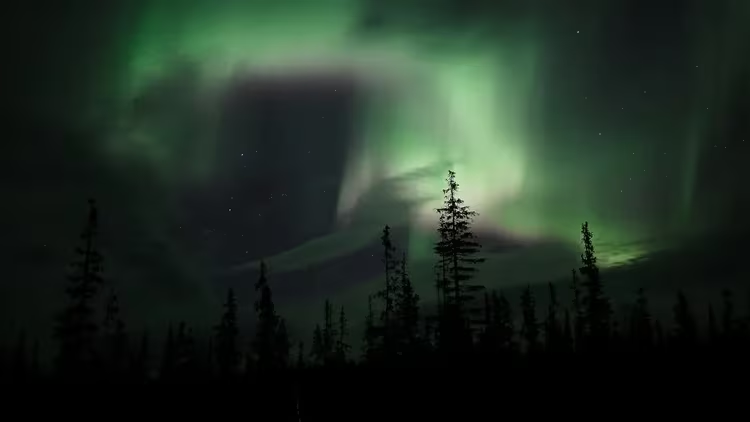
- Spend at least a few nights hunting for the aurora. More attempts mean more chances, which is logical. Radiance is a capricious phenomenon; there may be an ideal forecast, but there is none, or it may appear by chance.
- Therefore, of course, listen to the forecasts, but do not blindly trust them. You can explore a dozen sites and applications, everywhere you will see the clearest clear sky, but in reality it will be overcast.
- Prepare the right equipment: warm clothes, maybe even thermal underwear, good shoes, hot tea in a thermos. Hunting for the northern lights usually lasts several hours. It is believed that the glow is best seen at night between 21:00 and 2:00.
- Ideally, it is better that you have special equipment for photographing the northern lights, since you need a long shutter speed and complete stillness of the camera for a high-quality photo. But you can also shoot something intelligible with a good phone camera. But don't expect a masterpiece.
- Contact the professionals. Local residents of those regions where the lights are a frequent visitor know better about all the nuances and will be able to suggest something, be it routes or the best viewing platforms. And among the locals, it is more profitable to choose a guide for the hunt for the aurora, so that an experienced person will conduct the excursion, and maybe even return some of the money if Aurora never shows up.
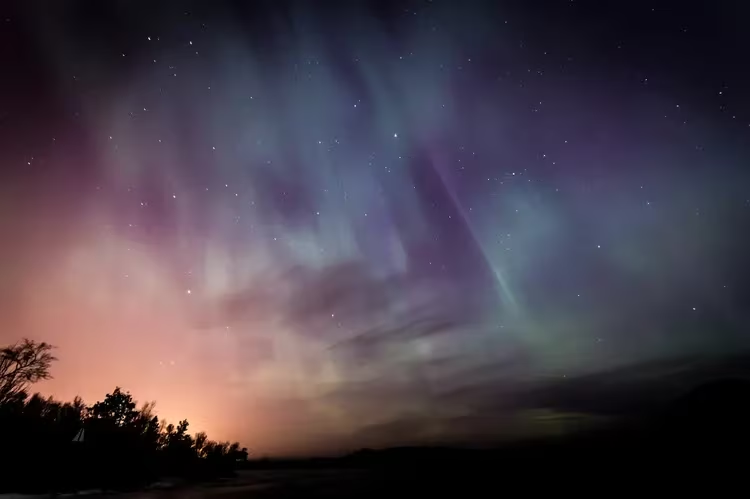
Where to see the northern lights?
Our planet has two magnetic poles, therefore the aurora can occur at any of them, but at certain latitudes, above 66−67°. In the Southern Hemisphere, it is technically more difficult to see the lights, and there they are called the southern lights, by the way.
Residents of the Northern Hemisphere are luckier. You can admire the Aurora in Scandinavia, Iceland, Canada, Russia, Alaska, Greenland, Spitsbergen, etc. The choice of countries and places is larger, but the frequency is lower.
The further north, the higher the chances of success, but during the period of maximum solar activity, residents of Eastern Europe can also see the lights. The aurora is noticeable in Japan, for example, especially in the northern part of Hokkaido, as well as in Scotland.
There are special tours that include hunting for the northern lights. If I don’t see Aurora myself in the coming years, I will definitely turn to them for help.
The Northern Lights are truly a unique phenomenon that is well worth hunting for. So if you, like me, have always dreamed of looking at these magical lights, then don’t put off your trip. Now is the season. May you be lucky on your first try!