
💰 20 financial life hacks for budget travelers
When traveling, the last thing you want to think about is worldly vanity and material things. Even pragmatists turn into impetuous people, and misers into spenders. But retribution will definitely come: upon returning home and counting the expenses for the trip, it turns out that you spent much more than planned. And it seems like they didn’t buy too much, but where did the money go?
The devil is in the little things that add up to big sums. To prevent this and save without interfering with a good rest, we share financial life hacks.
Currency exchange
The financial culture of some countries is such that residents are well versed in their banks: where the exchange rate is more favorable or what documents are needed to exchange currency. You shouldn’t assume that all banks in the world operate on the same principles, but a few tips are still universal.
Carry with you the national currency of the country you are traveling to
The Eurozone, which unites 20 European countries in using a single currency, is very helpful in putting this advice into practice. There are no problems with purchasing Russian rubles. In the head offices of capital's banks you are likely to find Swedish, Norwegian and Czech crowns, Polish zlotys, pounds sterling and Swiss francs.
Why can’t you wait to exchange until you arrive in your destination country? Firstly, upon arrival you can expect immediate spending in local currency on public transport or taxis. It would be nice to think about how to get there, and not waste hours of legal vacation searching for banks.
Secondly, exchange offices with unfavorable rates are usually installed near airports and train stations. Their owners know that their clients will be tourists who agree to do anything.
Avoid currency exchange at airports
If you didn’t want to use the advice above or were physically unable to do so (for example, the currencies of the country of your destination cannot be found in exchange offices), here is another life hack. Never change currency at the airport.
In 95% of my travels, exchanging currency at airports was an extremely unprofitable endeavor. Of the dozens of airports I visited, only Tbilisi airports had “humane” courses. Can you name more? It is quite possible that there are such people, but they are the exception to the rule.
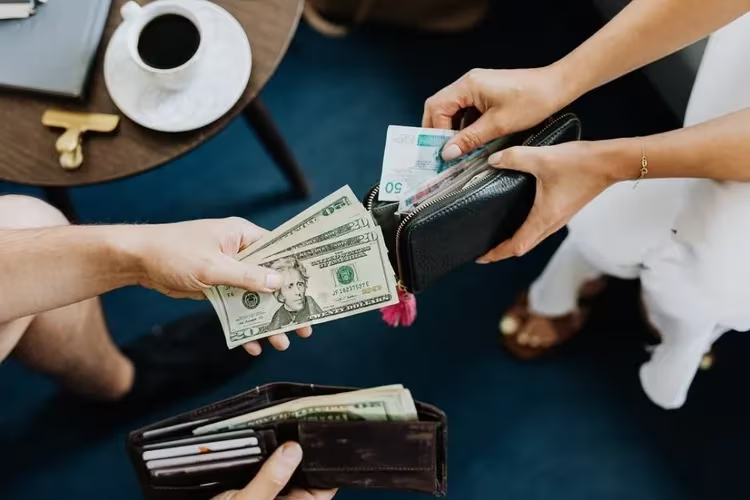
In most countries, banks pay a lot of money for the right to locate at the airport. And they play them out on travelers. You will either have a very large margin (the difference between buying and selling) or a commission. If possible, delay the exchange until you arrive in town.
Check to see if there is a fee for currency exchange
Yes, this is not only possible, but also very common. In some countries, currency exchange is an ordinary, downright socially important operation. In other countries, it is perceived as a whim of the client and they are asked to pay extra for the service. For example, almost all exchange offices in Sweden charge a commission for this operation. This can be encountered quite often in Turkey.
If you get lazy and find that 5-10% is missing from the required amount, you can ask to cancel the operation. But it is not always possible to get an affirmative answer to a request. Therefore, check in advance about the commission, even if the sign says “0% commission”.
Currency exchange is not always a banking operation
In a number of countries, exchange operations are carried out not by banks, but by exchange offices. And they will look at you in bewilderment when you come to a reputable financial institution with such a trifle. This is how the financial sphere of the Czech Republic, Turkey, Sweden, Norway and some other countries is structured. Their banks will either refuse to exchange currencies, or the exchange rate will not be very favorable.
Refrain from reverse currency exchange
We often end up with a surplus of local currency. Some regard them as a good souvenir, others indulge in additional shopping. Well, it’s better not to change too much upon arrival, but to do it gradually, as needed.
Why is it a problem to exchange local currency back to dollars or euros? The point is to control the quality of the currency. When traveling, you can often observe the following picture: an exchange office employee quickly takes a banknote and puts it in a box without checking watermarks and other signs of authenticity. What if someone brings a fake? Therefore, you should not buy dollars and euros in such exchangers. Upon returning home, you may encounter an unpleasant surprise at the bank, where quality control is much stricter.
- Saved and earned: we share lifehacks for buying air tickets
- How to protect yourself from pickpocketing: tips and tricks
- Aircraft crashes: how to avoid and what to do if they happen
Payment cards
Today, without a bank card it’s like being without hands. It will help you purchase tickets in advance, pay for hotels and excursions, and also spend exactly as much as you need. Having a card in hand in a country with a developed payment infrastructure, in most cases you can pay cashless. Therefore, save on currency exchange and avoid a situation where you have extra local money on hand. But even in the case of cards, you can’t do without a few tips.
Find out which cards work abroad
Issued in many countries and fully suitable for international payments, Visa and Mastercard cards are available. Some local payment systems will only be accepted in a very limited number of countries. Chinese Union Pay is more widespread, but you shouldn’t rely on it either.
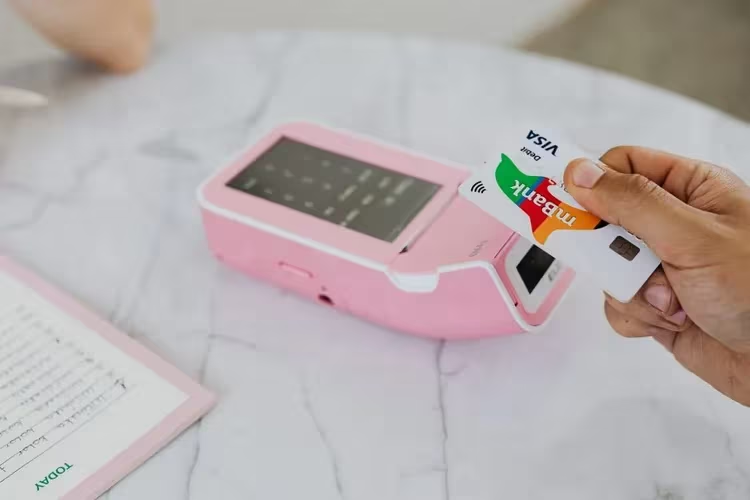
In any case, this information should be kept up to date. And check with the bank before your trip to see if everything is in order with their payments. Otherwise, you risk being left with a piece of plastic on your hands, from which it is impossible to extract money.
Don't rely on the map alone
There's a good balance in everything. In today's turbulent times, with all the convenience of maps, you cannot be 100% confident in their operation. In May 2022, I found myself in Warsaw without a single zloty in my pocket and with my Alfa Bank card suddenly stopping working. The bank warned by SMS that it had problems, but at that time I was already outside my country with a minimal supply of cash.
To avoid such situations, I advise you to divide the funds between cash and card. There are many reasons why a card can fail: it has become demagnetized due to contact with the phone, you have forgotten your PIN code, some country has blocked financial transactions.
Choose card payments in local currency
To begin with, I advise you to get Visa cards in dollars, and Mastercard in euros. Since Visa is an American payment system and payments in it are made in dollars. And Mastercard is European, here transactions take place through the euro.
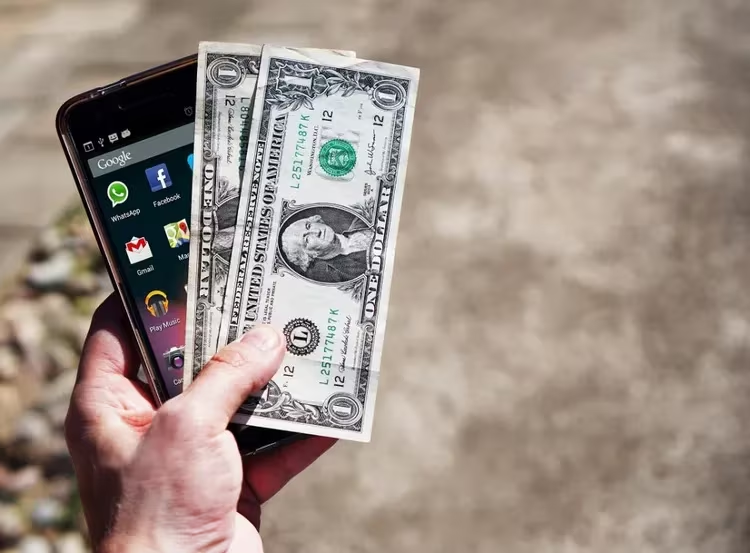
To avoid unpleasant surprises on your bank balance when making payments, choose the local currency to write off from your card. Then the operation will take place at the rate of your bank. And our banks are quite honest in exchange rates. Otherwise, when choosing the payment currency, dollar or euro, you will be forced to trust the bank of another country and its exchange rate. This advice also applies to transactions on the Internet, when it is proposed to use a marketplace course for sale.
Avoid withdrawing cash from your card
Today, in most countries, there are practically no banks left that offer cards with free cash withdrawals from foreign, especially foreign, ATMs. Typically the commission for such an operation is 3% of the amount and some fixed fee for each transaction.
It will be useful to have this information about your card before your trip. But almost always withdrawing cash from a card entails significant costs.