
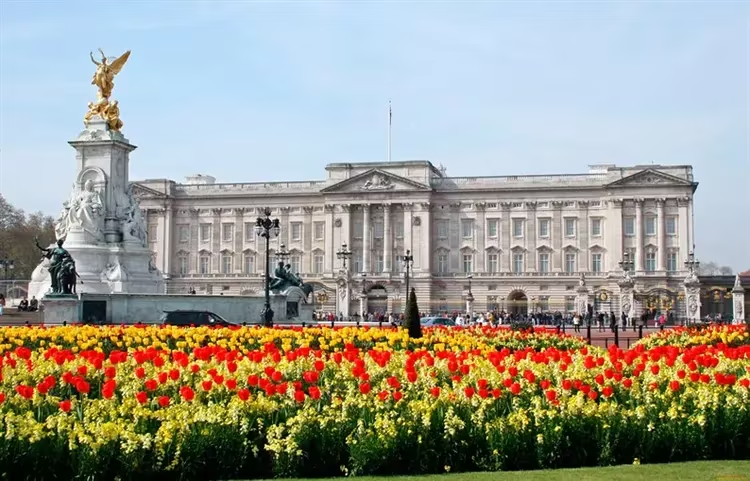
Buckingham Palace in London – history, photo, description, opening hours, ticket prices 2021, map
In the modern world, there are not so many functioning royal palaces left. Buckingham Palace in London is one of them and probably the most famous.
Story
In 1761, George III purchased Buckingham House (the former property of the Duke of Buckingham) for his beloved wife Charlotte, in order to use it as a cozy family nest near St. James's Palace, where most of the court sessions were held. So Buckingham House (Buckingham House) gained fame as the “Queen's House”, and it was within its walls that fourteen of the fifteen children of George III were born.
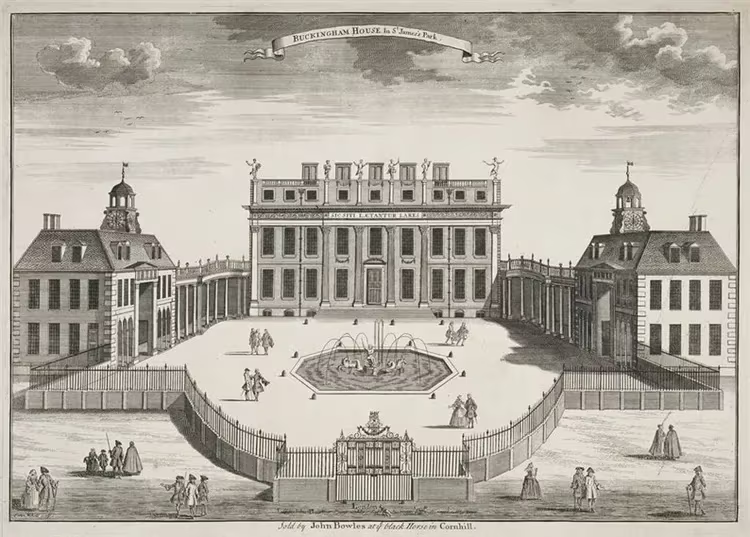
George IV, after his coronation in 1820, ordered a reconstruction in the palace, redrawing it into a “pied-à-terre” (“refuge”, “family refuge”). As the renovation work progressed, towards the end of 1826, the king changed his mind. Hiring architect John Nash, he decided to rebuild the house into a palace. Parliament approved a budget of one hundred and fifty thousand pounds sterling, but the king demanded three times as much. Nash kept the main building, doubling its size and adding rooms in the garden area on the west side.
As for the style, the exterior clearly showed the influence of French neoclassicism, approved by King George IV. The rooms reconstructed by Nash have hardly changed over time. The north and south wings of Buckingham House were demolished and rebuilt on a larger scale with a triumphal arch, or Marble Arch, as the centerpiece of the enlarged courtyard. It was built in honor of the significant victories at Trafalgar and Waterloo.
By 1829 construction costs had risen to almost half a million pounds. Nash's extravagance cost him his job, and after the death of George IV in 1830, his younger brother, William IV, took the place of the architect Edward Blore in order to finish what he had begun. In 1838, Queen Victoria ascended the throne, in 1840 she married Prince Albert, and their family life clearly “revealed” the significant shortcomings of Buckingham Palace. A noticeable drawback for the newlyweds was the virtual absence of children‘s and guest rooms.
The only way out of this situation was to move the marble arch to Hyde Park and build a new wing. Blore added an attic to the main block of the palace and decorated it on the outside with marble friezes originally intended to decorate Nash's marble arch. The work was completed in 1847. Unfortunately, over time, the stone used by Blore in the construction of the east wing began to deteriorate, mainly due to the infamous London soot, and needed to be replaced.
In 1913, it was decided to change the facade. Sir Aston Webb, who had designed quite a few local buildings, set to work on the design. He chose Portland limestone, which had been cared for for a year before work began. And after another 13 weeks, they spent on dismantling the old masonry. The current look of Buckingham Palace was finally formed by 1911 as part of the Victoria Memorial program.
Changing of the Guard
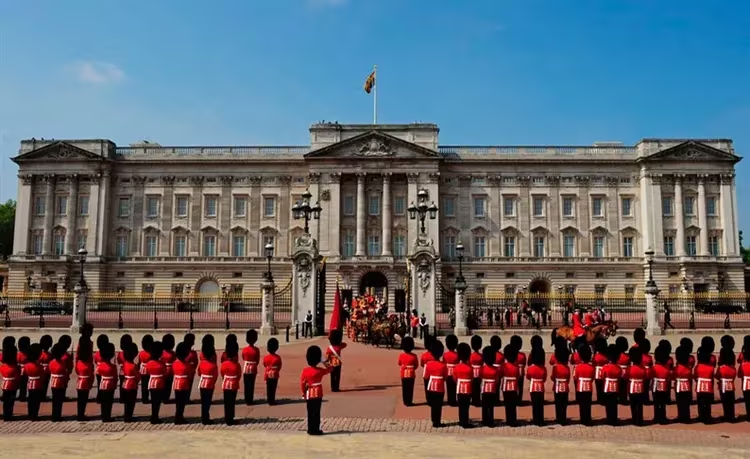
The impeccably dressed guardsmen, drum roll and solemn orchestral music make the changing of the guard at Buckingham Palace one of the most magnificent and popular performances in London, and in the whole of Great Britain as a whole. This is the ceremony when the old guard hands over responsibility for guarding Buckingham and St. James's palaces to the new guard. The guardsmen who were lucky enough to participate in the ceremony are not only skilled soldiers, but also those who, in addition to their ordinary duties, specially prepare for this solemn event.
The ceremony itself is free, and you can watch it from two angles: either arrive at Buckingham Palace at about 10:15, or go for the trick and spend time at St. James's Palace, where you can see the beginning and end of the ceremony. Surprisingly, sometimes the orchestra performs not only solemn classics, but also relatively modern melodies, say, the hits of the Beatles. The guardsmen themselves are almost impossible to miss – their red uniforms and tall black bearskin hats are visible from afar.
An interesting fact is that the caps of ordinary guardsmen are made from the fur of female grizzlies, and the high ranks are made from males, which is why the latter are more shiny and voluminous. Since the changing of the guard ceremony is optional, it can be celebrated due to bad weather conditions – you should take this into account when planning your trip. If everything is in order with the weather, the shift is held daily in the summer months, and every other day in the winter months.
Coca-Cola London Eye ticket £24.30
Tower of London and Royal Treasures
ticket £26.80 Tower Bridge ticket £9.80
Westminster Abbey entrance ticket and audio guide £20
Madame Tussauds ticket – £29
St. Paul's Cathedral: Fast Track Ticket – £16
Shard Skyscraper – Entrance Ticket & Champagne – £24.95
Rooms available for viewing
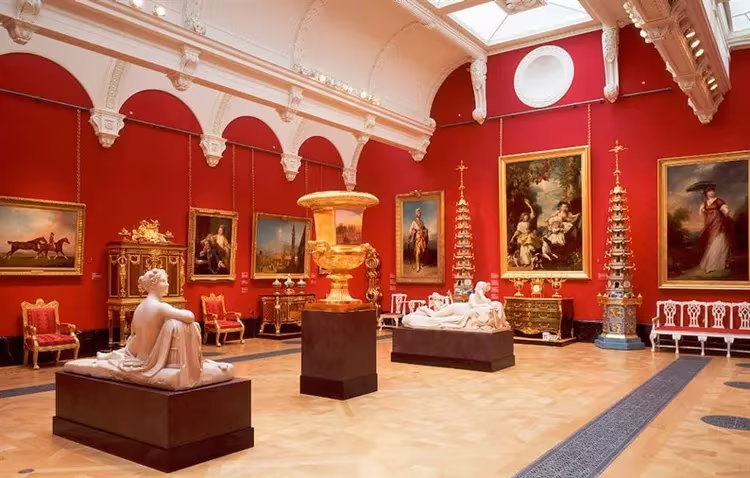
Since Buckingham Palace is the official residence of the British rulers, the number of rooms available for inspection by tourists is limited. You can visit the following ones:
Throne room
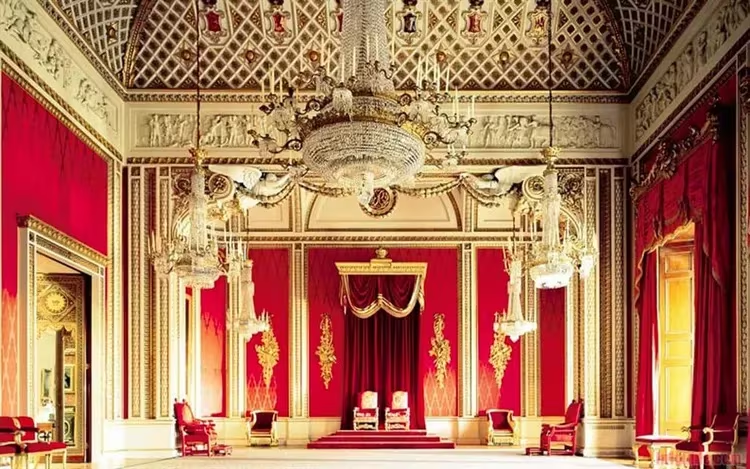
The architect John Nash was once involved in the decoration of theatrical scenes, and the influence of this period is clearly visible in the design of the Throne Room – a spectacular arch and a canopy over the royal chairs look truly impressive. The color scheme of the design is majestic – rich red and gold tones predominate.
The central place in the hall is occupied by the royal chairs of the monarchs, which were used for the coronation of the Queen and the Duke of Edinburgh in 1953. There are also thrones from the coronation of George VI and Queen Elizabeth in 1937, and one made for Queen Victoria in 1837.
green living room
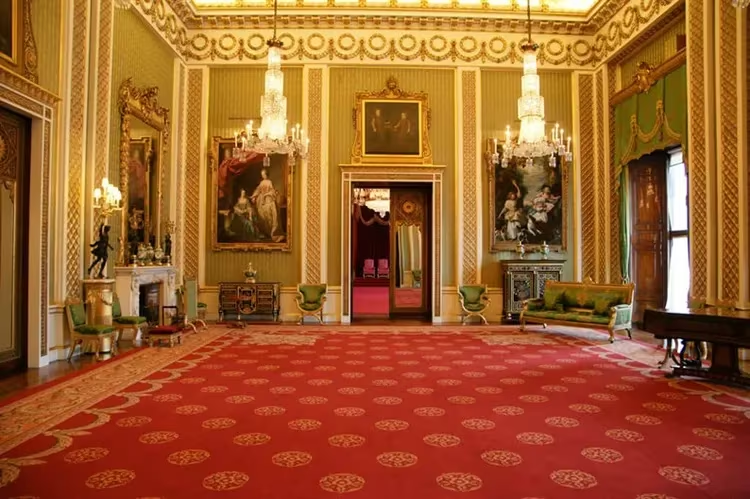
The largest room on the ground floor, originally intended for the Duchess of Buckingham as a salon, but then, in early 1760, was reconstructed specifically for Queen Charlotte. And then it was changed again for George IV. According to Nash's design, the ceiling was replaced with a new, richly decorated one, and the fireplace on the north side was destroyed, making another doorway leading straight to the Throne Room.
blue living room
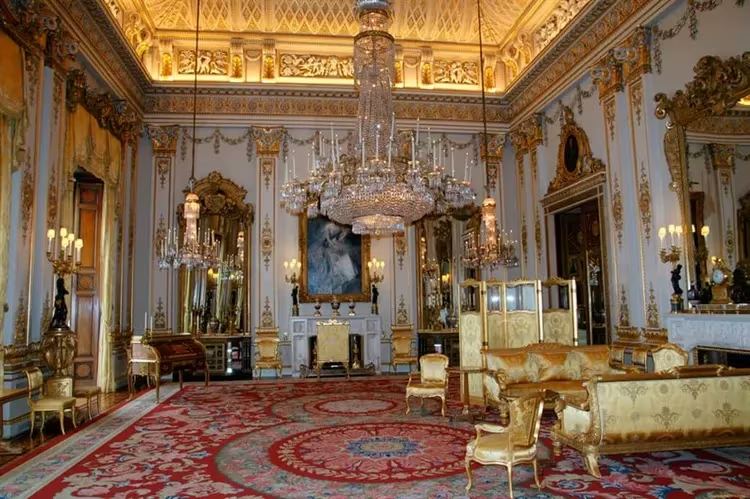
Before the Ballroom appeared at Buckingham Palace in the 1850s, large-scale celebrations took place in the blue drawing room. In particular, in May 1838, the first state ball was held here, dedicated to the celebration of the coronation of Queen Victoria. Blue hues predominate in decorative elements and furniture (in particular, in the upholstery of chairs). Also here is the famous “Table of Outstanding Generals”, the marble top of which is decorated with images of ancient heroes.
white living room
A majestic room decorated in white and gold tones. Many ancient exhibits are kept here. Take, for example, a table made by Jean-Henri Riesener himself, or a beautiful gilded piano by Sebastian Erard, which he made especially for Queen Victoria. A notable detail of this living room is a secret door through which the queen herself likes to enter in order to surprise unwary tourists.
Interesting Facts
- Buckingham Palace has 775 rooms. Of these, 19 are government, 52 are royal and guest rooms, 188 are staff bedrooms, 92 are offices and 78 are bathrooms.
- The building is 24 meters high, 108 meters long (front view), and 120 meters deep.
- At one time, Buckingham Palace was visited by such prominent personalities as Wolfgang Amadeus Mozart (at the age of 7), Johann Strauss, Charles Dickens, J.F. Kennedy, Neil Armstrong, Mahatma Gandhi, Nelson Mandela and many others.
- Every year more than 50,000 people visit the palace as guests for state banquets, lunches, dinners and garden receptions.
- In 2002, on the occasion of the Queen's jubilee, a magnificent concert was organized at Buckingham Palace, where Brian May performed the immortal “God Save the Queen” on the roof of the palace.
Opening hours and ticket prices
From July 21 to August 31, Buckingham Palace is open from 9:30 to 19:00 (last ticket sold at 17:15), and in September from 9:30 to 18:00 (last ticket until 16:15).
Price:
Where is it located and how to get there
Address: Westminster, London SW1A 1AA
By tube: Victoria, Green Park, St. James Park.
By bus: No. 11, 211, C1 and C10, stop “Buckingham Palace Road”.