
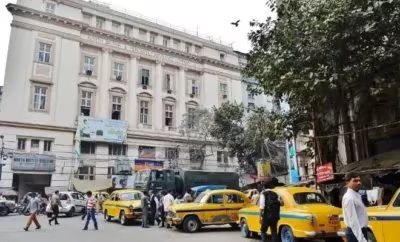
Central Kolkata attractions. India
This part of the city includes Maidan Park, Fort William and the Chowringhee area.
Fort William is the most impressive example of European fortification art in the East. It was built over 13 years (in 1758) according to the project of Captain John Broheier. The work cost £ 2 million. The fort looks like an octagon in plan. There are 6 gates along the perimeter. The construction was completed by Archibald Campbell, after J. Broheyer was accused of forgery and imprisoned.
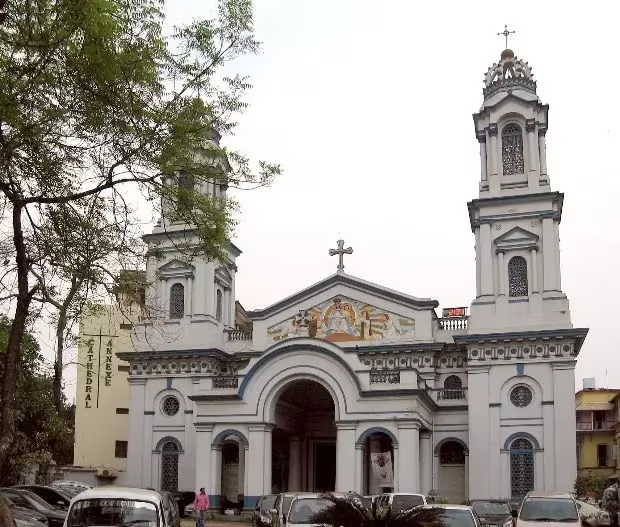
Cathedral of the Virgin Mary
The construction of the fort greatly changed the appearance of Calcutta and provoked a wave of reconstruction of the already existing buildings. A significant open area was cleared around the fort to allow direct fire from the fort. It got the name Maidan (literally “square”).
Nowadays, Fort William is the headquarters of the Indian National Army's Eastern Command, so it can be visited by invitation only.
On the embankment near the fort is the Prinsep's Ghat Ionic pavilion, built in honor of the English orientalist and antiquarian James Prinsep. This scientist became famous for the fact that in 1837 he deciphered the Brahmi script, which was used to write the edicts of Emperor Ashoka Maurya (III century BC).
К югу от Гхата расположен памятник матросам-индийцам из Бенгалии и Ассама, а к северу, напротив Водных ворот (Water Gate) форта Гвалиорский монумент (Gwalior Monument), созданный по проекту полковника Гудвина и установленный в 1847 г. в память о военной кампании лорда Элленборо (генерал-губернатор Индии в 1842-1844 гг.). В 1843 г. Элленборо вмешался в спор из-за наследования престола маратхского клана Сциндия в Гвалиоре (штат Мадхья-Прадеш). По одной из легенд, купол монумента отлит из оружия побежденных врагов.
North of Fort William are Eden Gardens, once owned by the daughters of Lord Auckland (Governor General of India 1836-1842) Emily and Fanny Eden. Part of the territory is occupied by the Calcutta Criket Ground Ranji Stadium. There is a small lake in the Eden Gardens. Near it rises the Burmese Pagoda, brought here by Lord Dalhousie in 1854 from Prome as a trophy after the Second Burmese War of 1852. The pagoda was turned into a war memorial.
Eden Gardens Road curves towards the north towards the Raj Bhavan complex. To the east there is a monument dedicated to the victory of General David Ochterloni in the Nepal War of 1814-1816. Today it is called the Shahid Minar Column. The monument, unveiled in 1828, is a Doric column (46.3 m high) mounted on an Egyptian-style pedestal with a metal Turkish dome. There are two narrow observation platforms at the top, but you cannot climb them.
To the northeast of the Column of Martyrs, J. Nehru Road leads to Lenin Sarani, at the intersection of which stands Tipu Sultan's Mosque (1842), built by Muhammad, son of the famous ruler of Mysore.
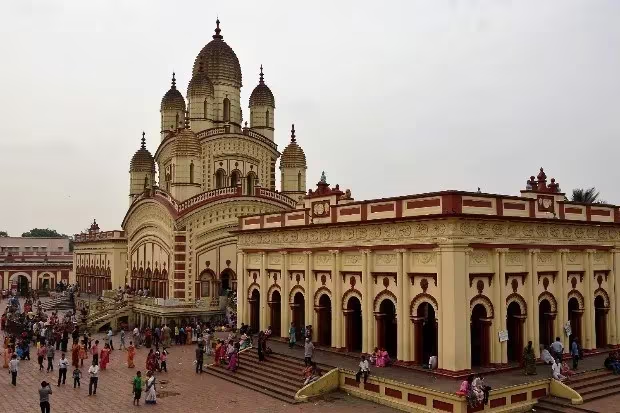
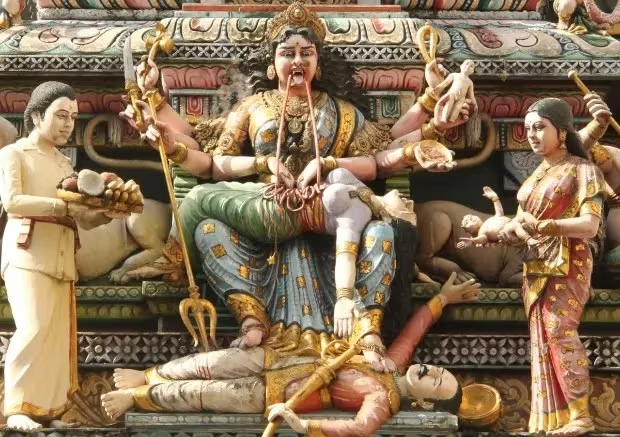
Temple of the goddess Kali
J. Nehru Road separates the Maidan Park from the Chowringi area. Opposite the Monohar Das Tank pond dug in 1793 at the intersection of J. Nehru Road and Sudden Street is the Indian Museum. It is the largest and oldest museum in India. Founded in 1814. The building was designed by Walter Granville in 1875. The museum contains an excellent collection of geological and zoological artifacts, as well as a rich collection of antiquities, including finds from the settlements of the Ancient Indus civilization (about III millennium BC).).
At the corner of Park Street we see the building of the Asiatic Society. The society was founded on February 15, 1784 by William Jones to study the rich culture of Indian civilization. It was under the Asiatic Society in 1814 that the collection of the collection began, which later formed the basis of the Indian Museum. Today, the building houses a small museum of Indian antiquities, as well as a library (over 15 thousand rare books).
Park Street leads southeast to the old European cemetery (Cemetery), a visit to which, as well as acquaintance with the surviving mansions and palaces of the Chowringa district, provide an opportunity to imagine the life of Europeans in Calcutta during the existence of the British East India Company. The cemetery, opened in August 1767, resembles a huge city of the dead. Pyramids, pavilions and obelisks, sometimes of colossal size, are crowded together and are fine examples of neoclassical gravestones from monuments erected outside Europe.