
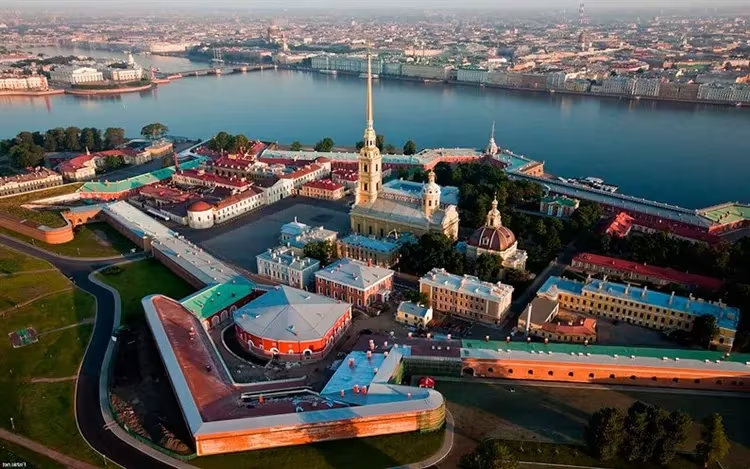
Peter and Paul Fortress in St. Petersburg – history, photo, description, ticket prices 2021, map
The Peter and Paul Fortress in St. Petersburg is an outstanding architectural and historical ensemble of the 18th-19th centuries. Its construction marked the beginning of the foundation of the new Northern capital, designed to become a political, military and economic center, change the fate of Russia, tear it away from the “hated Moscow antiquity” and bring it closer to Europe.
Construction history
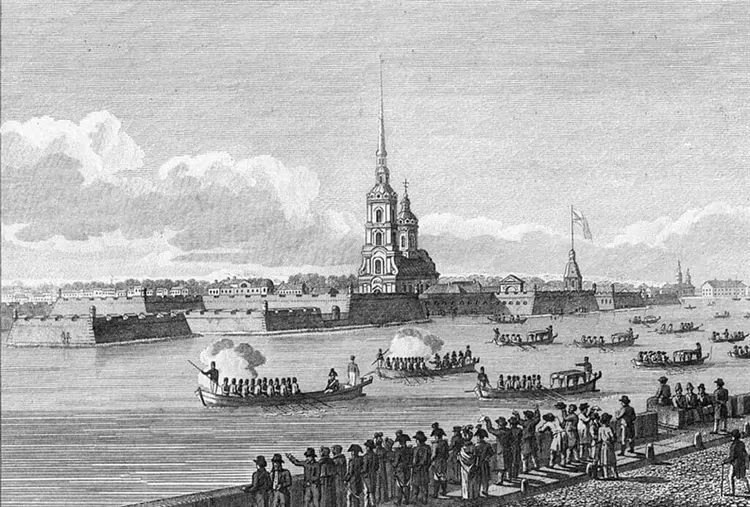
The exact date of the beginning of the construction of the fortress is reliably known – May 16, 1703. It was intended for the defense of the original Russian Neva and Baltic territories conquered from the Swedes. Tsar Peter I personally chose the place for the construction and carefully considered all options, giving priority to the military-strategic location. The choice fell on Hare Island, as it was called by the Finns who once lived here. Being at the mouth of the Neva, it is surrounded on three sides by water, all branches of the river were visible from it.
Together with the talented military engineer J. Lambert, the king drew up a plan. The architect D. Trezzini supervised the construction. Many people were driven to work: peasants, convicts, artisans, soldiers. Working conditions were inhumanly difficult. People lived in damp dugouts, ate poorly, got sick and died by the thousands. Despite this, the fortress was built in record time: in October it was ready. Its appearance resembled an elongated hexagon, which followed the contours of the island and occupied it entirely.
The structure consisted of six bastions, located at the corners, interconnected by walls. Initially, it was made of wood and earth, but already in 1704 the walls began to be replaced with brick ones. The defensive fortifications were equipped with 150 cross-fire guns. The tsar himself and five of his associates were responsible for the construction, which was reflected in the names of the bastions: Sovereign, Menshikov, Naryshkin, Trubetskoy, Golovkin, Zotov.
The bastions were connected by very wide walls – curtains (width 20 m, height 12 m). They consisted of two walls, between which there was an empty space, partly covered with stones, sand, earth, and partly used as warehouses for storing ammunition and weapons.
18th century
1708 – in order to secure the fortress from the mainland, a kronverk was erected (an earthen structure surrounded by a moat).
1712 – instead of a wooden church, built in 1704, the construction of a temple in stone began.
1718 – a commandant's house with a carriage house (stable) was built.
1723 – the first sailing and rowing vessel (boat) was brought.
1733 – to cover the bastions and curtains, the Ioanovsky and Alekseevsky ravelins were built, which look like powerful triangular-shaped fences with casemates.
1766 – by decree of Catherine II, a special pavilion was erected for the boat, called the “Botny House” and faced with granite 700 m of a brick wall on the south side.
Soviet period
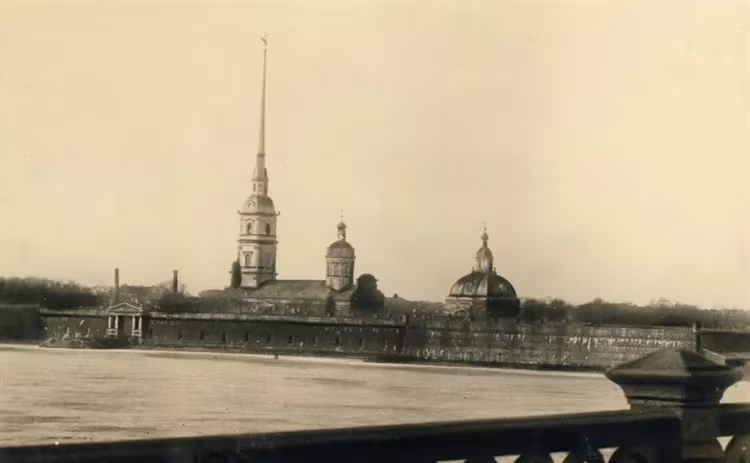
The Soviet authorities recognized the historical and artistic value of the Peter and Paul Fortress and did everything possible to preserve its integrity. In 1919, a special commission was created, which issued a safe-conduct for the object. With a catastrophic shortage of firewood, the cathedral was heated so that it would not collapse from dampness. Since 1920, the first excursions began, the conduct of which since 1922 has been put on a regular basis.
In 1923, the Trubetskoy Bastion was transferred to the jurisdiction of the Museum of the Revolution. The prison located in it was associated with the names of many famous revolutionaries and proletarian writers. Two years later, they carried out a huge amount of work to improve the island: they put up fences and lattices, paved paths, planted flower beds, planted trees and bushes, and repaired buildings.
It took a lot of work to preserve the museum town during the years of the siege. The gilded spire of the cathedral was closed so that it would not attract the attention of aviation, the roof and windows damaged during shelling were regularly repaired. In the 30s of the XX century, the Gas Dynamics Laboratory worked in the fortress.
Fortress today
Nowadays, the Peter and Paul Fortress is the main attraction of the city, its historical core. Especially attract the attention of tourists: the Cathedral with the necropolis, the Museum of the prison, the Museum of Cosmonautics. The historical exposition “River of Time” is interesting, covering the 300-year history and life of the inhabitants of this area. Porcelain and antique furniture lovers can get acquainted with the unique products of glass and porcelain factories in Russia and Europe of the 18th-20th centuries and antique furniture made of rare woods.
The exhibition “Instruments of Torture” presents samples of the means of punishment, in the pavilion “Oriental Mosaic” visitors will be greeted by wax characters of kings, famous figures, famous convicts. As in former times, the Mint functions, where medals and commemorative coins are printed. The buildings of the island host temporary exhibitions, fashion shows, conferences, and competitions.
Ioannovsky Ravelin and Petrovsky Gates
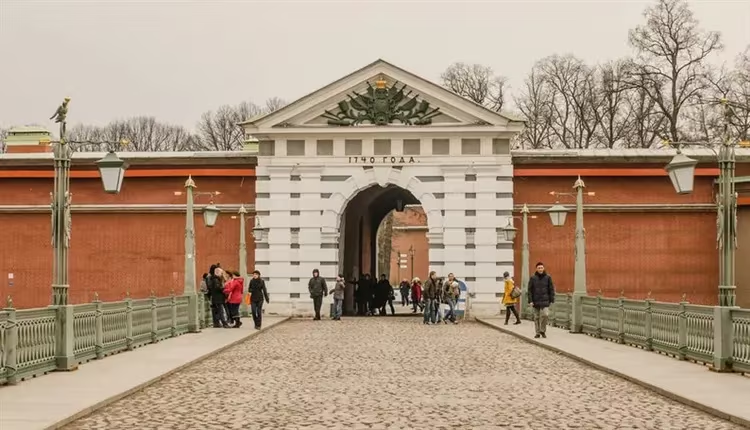
Ioannovsky ravelin is named in memory of the elder brother of Peter I – Ivan V. Its purpose is to cover the eastern curtains and bastions from the sea. Initially, it was a wooden and earthen building, which in 1731 began to be replaced with a brick one. The work was carried out until 1740 under the guidance of engineer H. Minich. Between it and the fortress wall ran a moat with water.
Petrovsky gates of an arched form (project by D. Trezzini) were the main entrance. At first they were wooden, in 1718 they were replaced by stone ones. Their size is 16 16 m. Several bas-reliefs serve as decoration: the topmost one is the God of Hosts, below it is “The overthrow of Simon the Magus by the Apostle Peter” measuring 4.9 3.3 m (work by K. Osner). This allegory means the victory of Russia over Sweden. On the sides are statues of the ancient Roman goddess of war Bellona and the wisdom of Minerva. Above the arch in 1720 a crown and a massive coat of arms of a double-headed eagle were installed.
Courtyard and ramparts
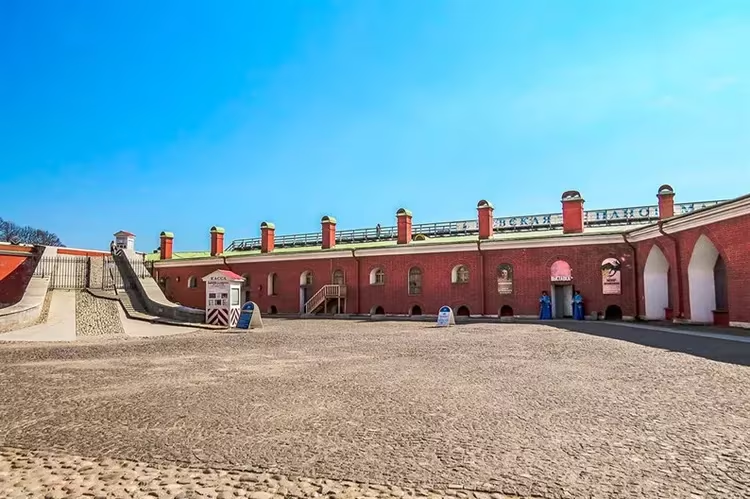
The total area of the yard is 182 thousand m². On its territory are located:
The Sovereign and Menshikov bastion, located next to the Petrovsky Gates, were intended to defend the eastern side of the island. In Trubetskoy – there were casemates, a prison. Golovkin – was a defensive structure with a powder warehouse. Zotov – was used as the Secret Office, later as a forge and archive. In Naryshkin there were casemates, the Mint, a flagpole.
Naryshkin bastion
The building with two-tiered casemates was built according to the project of H. Minich and D. Trezzini in 1728 instead of the wooden-earth one, which had served since 1703. It is named after the name of Prince K.A. Naryshkin, who supervised the work, the closest friend and cousin of Peter I. Nevsky Gates and the Commandant's Quay adjoin the bastion. It was used to accommodate soldiers, store uniforms, weapons, ammunition. In the 60s of the 18th century, it housed the Mint with warehouses for storing money, which lasted until 1881.
In 1731, a flagpole with a flag was installed on the fortress wall, which was raised daily in the morning and lowered in the evening. Today, the St. Andrew's flag is constantly on the tower. Every day, a cannon salvo is heard from the bastion, heralding a new day. The Naryshkin Bastion is a magnificent observation deck overlooking the Neva and its surroundings.
Peter and Paul Cathedral
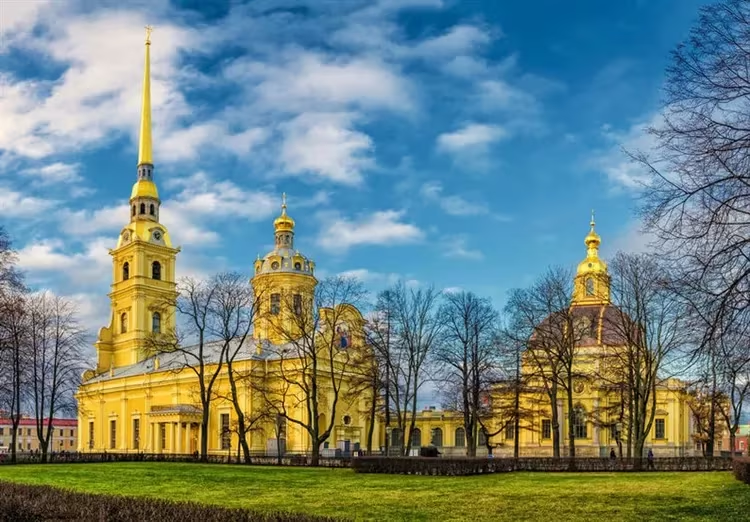
The dominant feature of the island is the Cathedral of Peter and Paul, standing in the center of the fortress. It was designed by D. Trezzini. After construction, which lasted 20 years, on June 29, 1733, the consecration and opening took place. The building of the temple is different from the usual Russian Orthodox churches. It is rectangular in shape (61*27.5 m), with a bell tower on one side and a small hipped dome over the altar on the other.
At the request of Peter I, a bell tower was first erected, from which the area was clearly visible. It is a tiered building of decreasing volumes, which is crowned with a gilded spire with an angel. Initially, the height was 106 m, but in 1856, as a result of reconstruction, it increased to 122.5 meters. The originality of the composition was given by the chimes located on the upper tier.
Interior
The inner space of the cathedral is divided by columns into three naves. Marble, jasper, gold, crystal, rhodonite, stucco were used in its decoration. The vaults are painted with frescoes, under them there are 18 panels on Christian themes by G. Gzel, A. Matveev, I. Velsky.
The arched iconostasis is unique, on which 40 craftsmen worked for 5 years under the guidance of I. Zarudny. It is carved from wood, covered with gilding, decorated with sculptures and 43 icons. The entrance to the Royal Doors is preceded by two archangels installed on the sides: Gabriel and Michael. Nearby is a pulpit with statues of Peter and Paul. The royal place is upholstered in burgundy velvet, decorated with a coat of arms and a crown.
Burials
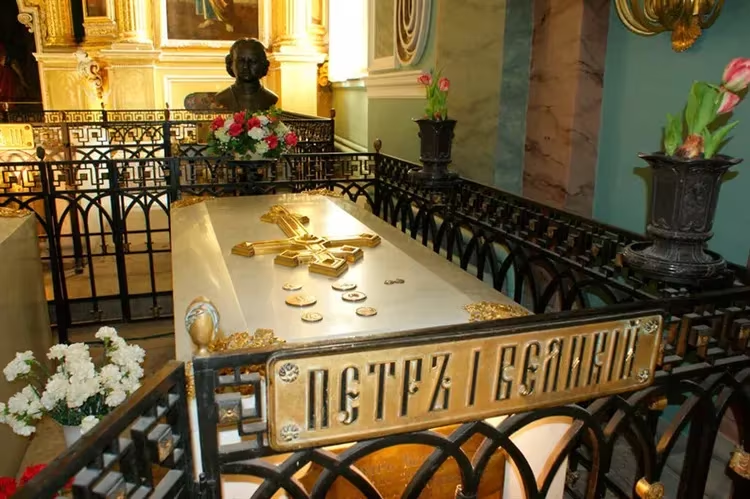
The burial of royalty in temples has existed in the Christian tradition since ancient times and symbolized the divinity of their power. The Peter and Paul Cathedral served as a necropolis of the Romanov dynasty. There are 48 graves of emperors, empresses, grand dukes and family members here. All the kings of the Romanov dynasty found peace in this temple (with the exception of Peter II and John VI). Tombstones, except for two, have the same appearance: rectangular in shape, made of white Carrara (Italian) marble, on top is a large cross covered with pure gold.
On the tombs of kings and queens, Russian coats of arms are placed in the corners. Commemorative plaques with the inscription of the title, dates of birth / death and other information are attached to the end. The gravestones of Alexander II and his wife are made of green jasper and pink rhodonite.
Grand Duke's Tomb
By the end of the 19th century, the space for burials inside the temple was filled, so they decided to attach a grand ducal tomb to it. Construction of the baroque building began in 1897 and ended in 1908.
Light marble, black labradorite, granite, and bronze were used in the interior design. Until 1915, 13 remains were placed in the tomb, of which 8 were transferred from the cathedral. Then the tradition was interrupted for many years and continued again in 1992 with the burial of Prince Vladimir Kirillovich, and subsequently four more members of the royal dynasty.
Cathedral Square
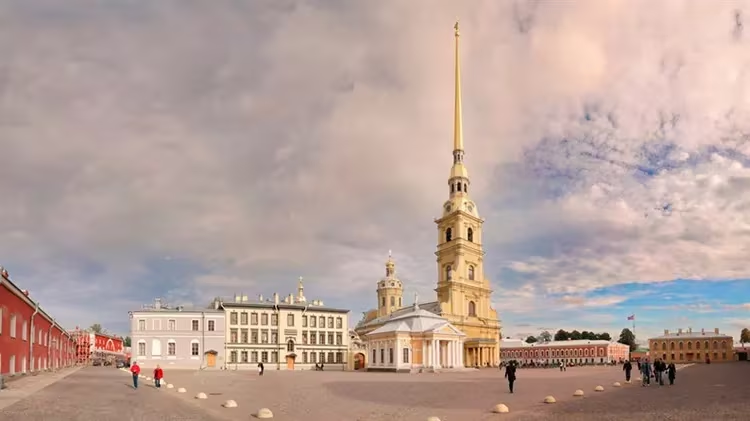
The area looks like a trapezoid with long sides of 128 and 107 meters, and a width of 67 meters. It is located in front of the Peter and Paul Cathedral. The Boat Pavilion stands almost in the middle, with the Mint and the Commandant's House overlooking it. Before the revolution, the area was used for military training of the soldiers of the garrison. Nowadays, concerts, festivals, performances of opera singers are arranged on it.
Trubetskoy Bastion Prison
In the 18th century, in the Trubetskoy Bastion, along with casemates, warehouses, living rooms, there were prison cells. In 1872, it was rebuilt into a prison building – a two-story building with 69 solitary confinement cells. Especially dangerous political criminals were kept here. The conditions were extremely harsh. They were monitored around the clock, communication, reading, smoking were completely excluded.
The food was so meager that the prisoners suffered from scurvy. Light and fresh air did not penetrate into the damp chambers. For any offense, the prisoners were beaten with spetsruten and punished with a punishment cell. This prison contained such well-known politicians as: P. Kropotkin, V. Figner, A. Ulyanov, N. Bauman, B. Savinkov, L. Trotsky, M. Gorky. After the revolution, those who were considered an enemy of the new government got there: ministers and members of the Provisional Government, Cadets, Socialist-Revolutionaries, Junkers. In cells designed for one person, 5-6 were placed.
Alekseevsky ravelin
The name was given in honor of Tsar Alexei the Quietest – the father of Peter I. A one-story triangular ravelin was erected in 1733 in the west of the island. It was defensive in nature and served to protect the Trubetskoy and Zotov bastions.
Under Paul I in 1791, within its walls there was a “secret prison” for 20 cells for especially dangerous political prisoners. They were kept in unbearable conditions, dooming them to a slow death. Decembrists, Petrashevists, organizers of the uprising in Poland passed through the prison. Among the well-known names are: N. Chernyshevsky, F. Dostoevsky, P. Pestel, K. Ryleev, M. Bakunin. The prison existed until 1884.
Kronwerk
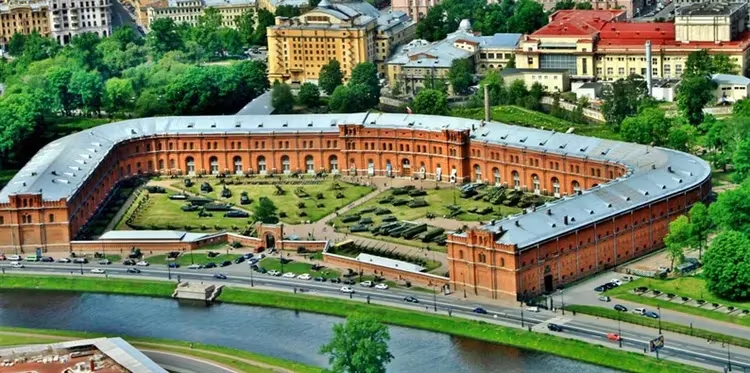
Kronverk was built in 1708 and was a wooden and earthen structure in the form of ramparts to protect approaches to the northern part of the island from land. The German name in translation means “crown”, which indicates the shape of the Kornvek in the form of a multi-toothed crown. On the perimeter it is surrounded by a moat with water. The building is separated from the fortress by the Kronverk Strait. Konverk is infamous for the execution of the Decembrists in July 1826.
Over the years, it fell into disrepair, and in 1850 it was decided to build a stone building. At the end of the construction, which took 10 years, it housed the Artelery Arsenal. Now there is the Artillery Museum, where cannons and other military equipment, banners, standards, more than 850 thousand exhibits are exhibited.
Opening hours and ticket prices
Entrance to the territory is free daily from 9:30 to 21:00. Museums and the cathedral are open every day except Wednesday from 10:00 to 19:00. Tickets to the cathedral cost 450 rubles. (preferential – 200), to museums 200 rubles. (preferential – 120)
Where is it located and how to get there
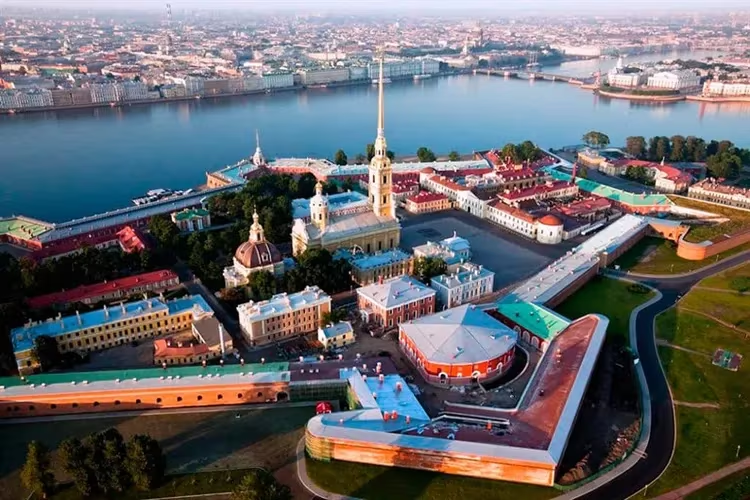
The fortress is located on Zayachy Island in the center of St. Petersburg near the Gorkovskaya metro station, it takes 7 minutes to walk through the Alexander Garden and the bridge.