
🏰 Sinaia and Rasnov: hidden gems of Romania
The vast majority of travelers traveling to Romania have two main “tourist Meccas” on their route – the capital of Transylvania – Brasov and the gloomy castle of Dracula – Bran. They are located within an hour's reach of each other. And what to do when both locations have been inspected, studied and are already quite boring, and there is still time left? Don’t rush to get up and go far in search of new experiences. After all, there are two wonderful towns near Brasov. One is a regular in tourist guides, Sinaia with Peles Castle. The second is the undeservedly ignored Ryshnov. Why are they so special? Read our mini-guide.
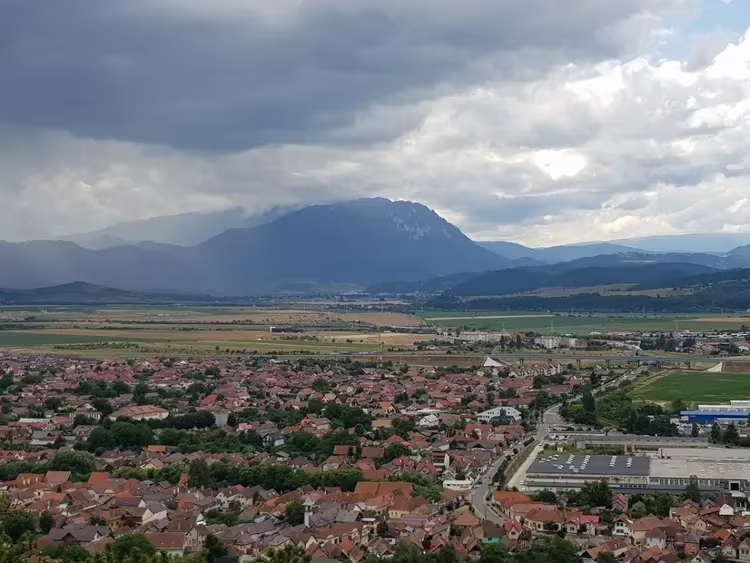
Rasnov
This town is located exactly halfway between Brasov and Bran. So you can include it in your trip to Dracula's castle. Buses to Bran departing from Autogara 2 (Bus Station 2) in Brasov make a stop on request in Rasnov. It will be a little more difficult with a return ticket: public transport returns from Bran loaded with satisfied tourists. And he doesn’t always stop in Rasnov. Not because of the anger of the drivers, but because of a banal lack of space. But don't worry. Rasnov and Brasov connect not only suburban, but also municipal cities, which are used by locals. They run about once an hour and cost a couple of euros per ticket.
Rasnov Fortress
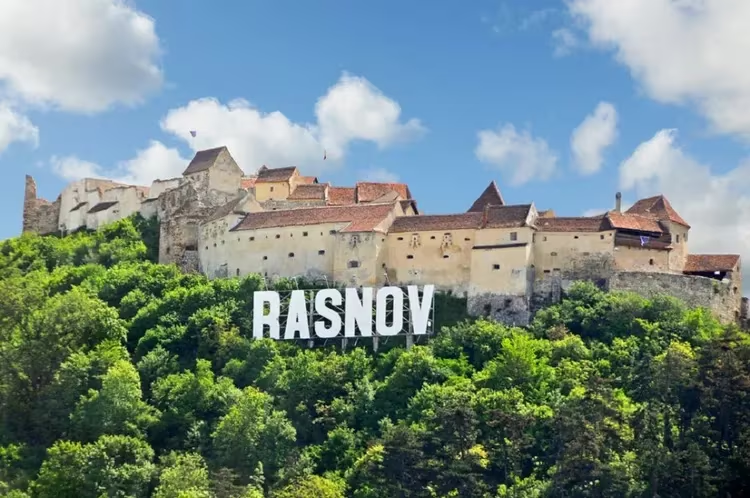
Of course, the main attraction of the city is the Rasnov Fortress, which is in the process of reconstruction. But visiting it is open and free for tourists. The fortress rises above the city at an altitude of 200 meters. You can use the cable car to go up, but I would recommend walking this route. 800 steps is not such a big challenge for an active traveler. Along the way, you can enjoy views of the city from different angles and feel what the soldiers besieging the fortress had to endure.
The Rasnov fortress, like Brasov, has a barely noticeable, but still undeniable connection with our history. The fortress was built by the knights of the Teutonic Order starting in 1215. After they quarreled with neighboring Hungary, the Teutons began to move to the Baltic tribes and the Grand Duchy of Lithuania to the coast of the Baltic Sea and disturb our ancestors. The Ryshnov fortress they built also disturbed neighboring states, who tried to capture it several times. Which, however, was only possible once in its 800-year history – in 1612.
There is one local legend associated with the Rasnov Fortress. The surrender of the fortress in 1612 showed the need for it to have its own well to provide the garrison with clean water. According to legend, this mission was entrusted to two captured Turks, promising to grant freedom. The captives spent 17 years breaking through the rocks to get to the source. But then they still died at the hands of townspeople who did not keep their word. Romanian historians do not believe in the legend. The well actually took 17 years to create, from 1623 to 1640. But this was done by Saxon craftsmen, who dug into the stone as much as 98 meters.
Tourists who climb to the very top of the hill will be rewarded. Firstly, beautiful views of the Rasnov valley, framed by high mountains. Secondly, travelers can visit the feudal art museum inside the fortress, where weapons, tools, antique furniture, armor and even a torture mask and a yoke used to transport prisoners are displayed.
Evangelical Church of Rasnov
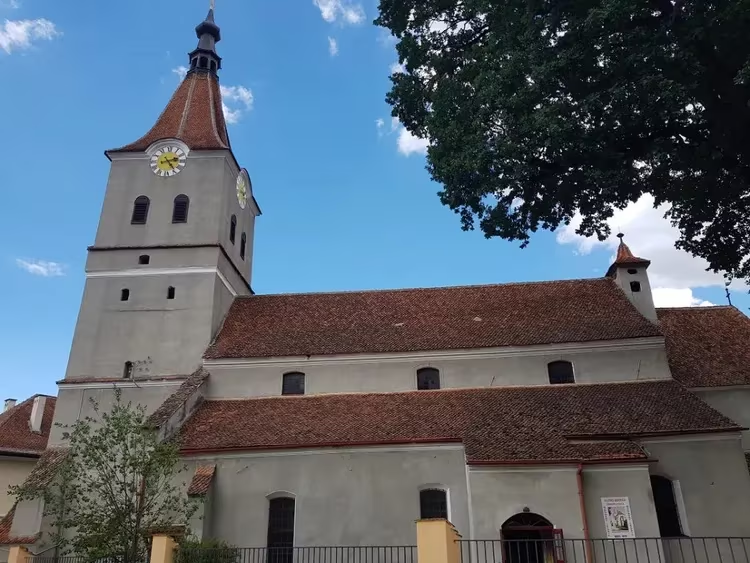
At the foot of the fortress hill, refresh yourself in one of the cafes in the quiet square. There, look for the tallest building in the town – the Evangelical Church of Rasnov. It was built at the beginning of the 14th century. For lovers of architecture, the church is of particular interest because of the symbiosis of two styles: squat Romanesque and sublime Gothic. The building is literally stuck between two cultural eras, which is clearly demonstrated by its appearance. Another symbiosis inherent in this region is the religious affiliation of the temple. Created by Catholics, in the 16th century it moved into the hands of the Lutheran community. The new owners hastened to transform the house of God in accordance with their understanding: they removed many statues of saints from the interior and covered up the frescoes.
- Romanian Frankenstein: guide to Bucharest
- Heart of Transylvania: guide to Brasov
- Chasing vampires: going to Romanian Bran
Sinaia and Peles
Between Brasov and Bucharest lies another prominent landmark of Romania, Sinaia. It is famous for its monastery and castle. Getting there is very convenient by trains, running from the capital of Transylvania to the capital of Wallachia every hour. An hour and a half journey to Sinaia is hardly enough for you to enjoy the stunning views of the Romanian Carpathians. But after getting off at the Sinaia station, you can peer at the silent stone guardians of the tranquility of this corner as much as your heart desires.
Sinai Monastery
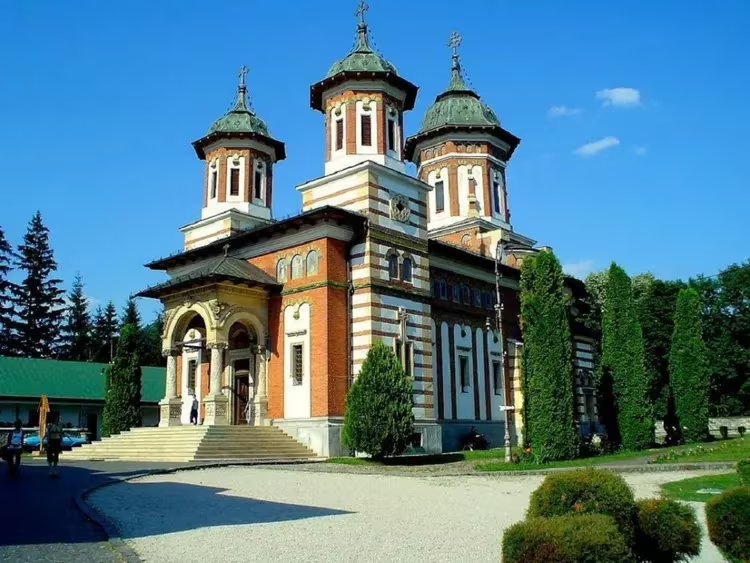
Sinaia was known primarily for its Orthodox monastery until the 19th century. The city owes its existence to him. After all, he grew up around him. If you thought that the name “Sinai” had some connection with the Sinai Peninsula in Egypt, then you didn’t think so. The current Romanian shrine was created at the end of the 17th century by the nobleman Mihai Cantacuzino. He decided to do this after his pilgrimage to the monastery of St. Catherine on Mount Sinai in Egypt.
The Sinai Monastery is a whole complex of buildings: cells, churches, tombs, and a bell tower. The monastery was first built to house twelve monks, following the example of Jesus Christ, who chose twelve apostles. But over time, the number of monks increased, which required additional buildings. As a result, the complex acquired its modern appearance.
Peles Castle
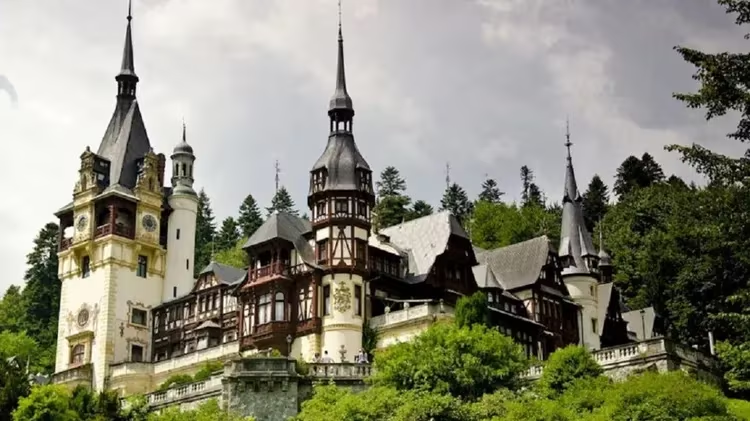
Having inspired yourself in the church complex, proceed to the next monument, Peles Castle, famous throughout Romania. Peles was founded by the first king of independent Romania, Carol I, as a summer residence. The castle often served as a haven for royalty. Architect Johann Schulz used a mixture of styles during construction. And I must say, he did it very successfully. There is no artificiality in the interweaving of neo-Renaissance, Baroque, Rococo and Mauritanian, everything looks very organic.
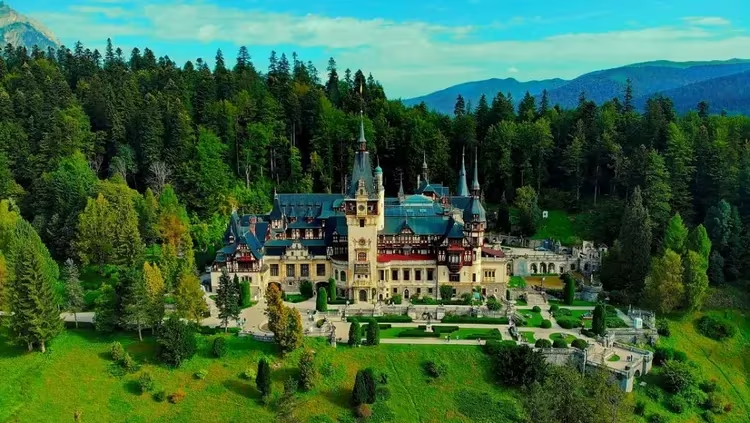
Every meter of this castle is imbued with the royal spirit. An exquisite collection of Meissen porcelain, hand-painted stained glass from Switzerland, rich oriental carpets, ivory, gold and silver make up the decoration of the castle. The Florentine hall is decorated with ebony wood, while the Turkish hall is covered with silk. The theater room is furnished in the spirit of the Sun King. There, at the beginning of the last century, the inhabitants of the castle watched a movie. What’s interesting: the most modern technologies of that time were used in the construction of the castle. Built in 1883, the castle was equipped with a central heating system and was fully electrified.
35 of the 168 rooms of Peles Castle open to tourists are available on an organized tour for 10 euros. You can get to Peles from the Sinaia railway station on foot in 30 minutes. However, keep in mind that the road will be uphill. Don't forget to check the castle's opening hours on the website so you don't end up on a day off.
Pelisor Castle
By the way, when visiting the castle you will get two bonuses – the Pelisor castle and the hunting house-villa Foysor. They are located within walking distance from their larger brother. Pelisor or “little Peles” was built by order of Carol I for the family of the heir to the throne, the future King Ferdinand I. The future King of Romania Carol II, the future Queen Maria of Yugoslavia and the future Queen Elizabeth of Greece spent their childhood years in this castle. And in Foixor, unfortunately closed to the public, the last Romanian king Mihai I, son of Carol II, was born.
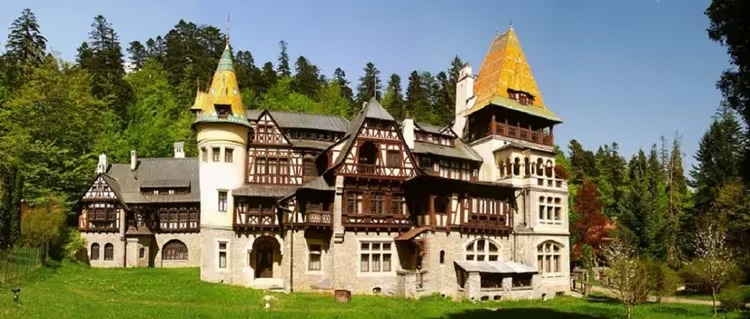
The Romanian government showed its best qualities. In 2006, it tried to return the castle complex nationalized by the communists to its former owners. Being alive at that time, Mihai I graciously accepted the gift. But then I decided that such real estate on the balance sheet would not be suitable. And he handed over the newly acquired property back, receiving 30 million euros in return. Thanks to this exchange, today we can visit Pelis and Pelisor, feeling our involvement in the royal family and its complex and amazing history.