🏰 Brasov: the hidden gem of Transylvania
Transylvania has long been one of the most attractive and, importantly, accessible tourist routes for tourists. Vampire mysticism, Gothic architecture, gloomy mountains that guard from the outside world – a wonderful preview that adorned booklets for travelers. Availability has disappeared in recent years. But the alluring charm has not gone away. What creates it in the case of Brasov? Let's figure it out.
How to get there?
To begin with, about the earthly: how to get to this vampire corner of Europe? This was a difficult puzzle for travelers centuries ago due to the mountainous nature of the region. Today the issue is resolved simply. It is highly likely that you will be heading to Brasov either from Bucharest, the capital of Romania, or from neighboring Hungary.
Train
If the first option is relevant for you, I advise you to use the trains of the Romanian railway – CFR Calatori. You can purchase tickets online on the website. For users in certain regions, access to the site may be limited, so using a VPN is recommended. Trains depart frequently, almost every hour. The journey from the capital of Romania to Brasov will take about 2 hours, and this time will fly by thanks to the beautiful views from the window. The ticket price is approximately 10-11 euros for a ticket in second class.
It is quite possible that your trip to the capital of Transylvania will be carried out from neighboring Hungary, as it was for me. Several trains operated by the Hungarian side also run between Budapest and Bucharest. Including the night train. If you decide to use this option, you should think about purchasing tickets in advance; trains between the two countries are in demand. You can buy a ticket on the website of the Hungarian carrier MAV (be patient in advance due to the inconvenient interface). Cost: 50-55 euros (as of 2022).
However, I hasten to dispel the imaginary convenience of the night train. “Lie down and sleep” will not work. There are no reserved seats here, the seats are seated, albeit comfortable. A bright light is on in the carriage all night. After crossing the border, noisy Romanians continuously load at the stations. In addition, for a reason that is still incomprehensible to me, conductors on the train change every two hours, who walk around and check the ticket over and over again. The only bonus of such a trip will be the unsurpassed views of the Carpathians.
Bus
Therefore, when traveling from Hungary, despite all my dislike for this carrier, I still advise you to use the Flixbus bus. There are night and day flights; if you're lucky, buy a ticket for 30 euros.
Airport
Since 2016, Brasov has its own airport, but you can fly there from a very limited number of cities. Wizzair will only fly from Dortmund and London, and other airlines will be prohibitively expensive.
Brasov – general information
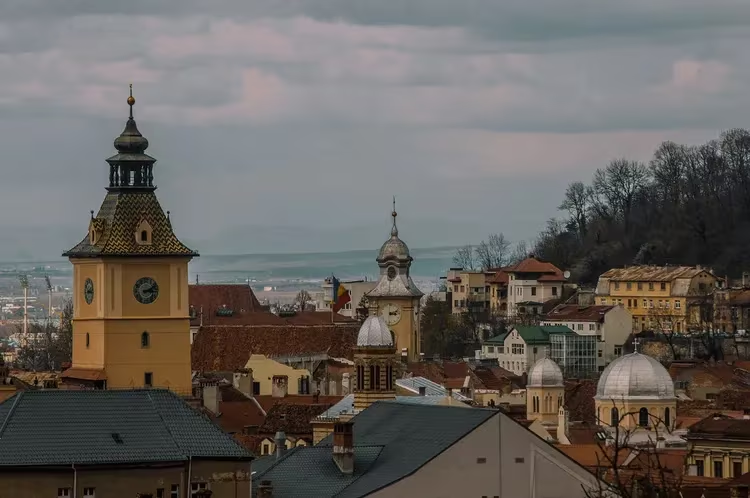
Brasov is the city where, according to popular Romanian opinion, “Transylvania begins.” Transylvania is one of the three historical regions of Romania, along with Wallachia and Moldavia (not to be confused with Moldova). However, the Hungarians will be offended by me. After all, many of them are sure that Transylvania is the original Hungarian land. Oh, this “originality”. The division of Transylvania provoked many conflicts between the two countries. And he shed a lot of blood, not by vampires, but by people.
Of course there is something to share. Transylvania is vast. It extends from Alba Iulia in the west of Romania to Brasov in the east. Who would refuse such a tasty morsel, adored by tourists? Historically, the Principality of Transylvania was ruled from Alba Iulia, sometimes from Sibiu. But today the capital of the region is Brasov.
The date of its foundation is considered to be 1211. Then the Kronstadt Fortress was founded. Just not the one that guards the approaches to St. Petersburg from the Baltic, but its own, Romanian one. Flashbacks to Eastern Europe will continue when you learn that the fortress was founded… by the knights of the Teutonic Order, also well known to tourists.
What to see in Brasov
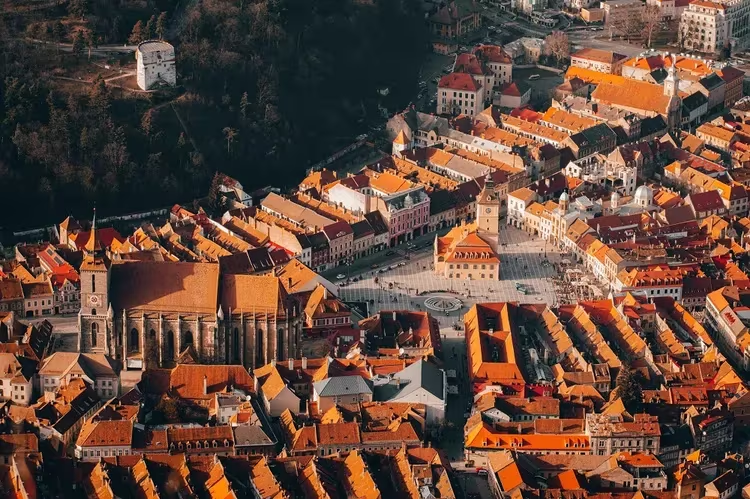
Brasov is one of the Romanian Big Ten. Both in terms of population (about 280 thousand people) and significance in the past and present of Romania. Some people call the city “Romanian Salzburg”. I still prefer not to compare two completely unique cities, but to discern their own authenticity in each of them.
Brasov has this authenticity in abundance. Some will find in its views a connection with Candy Navia, some will really catch the Alpine features, some will recognize in the restrained pathos of the historical quarters a similarity with the pre-revolutionary architecture of Imperial Russia. And of course, the scabs of communist architecture will not allow us to forget what period Romania recently went through.
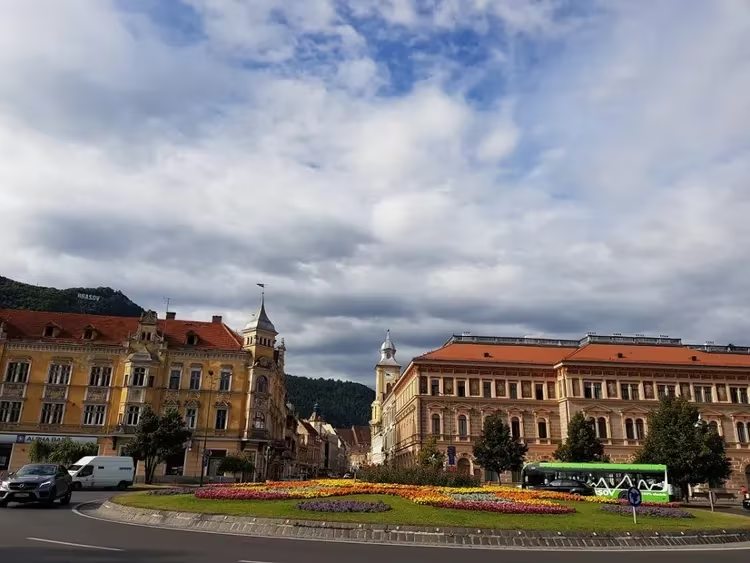
This eclecticism and diversity of Brasov is its own style. Unlike Bucharest, Brasov does not look like Frankenstein, awkwardly cobbled together from different parts. These combinations look organic and natural. But we will single out the pearls from the total.
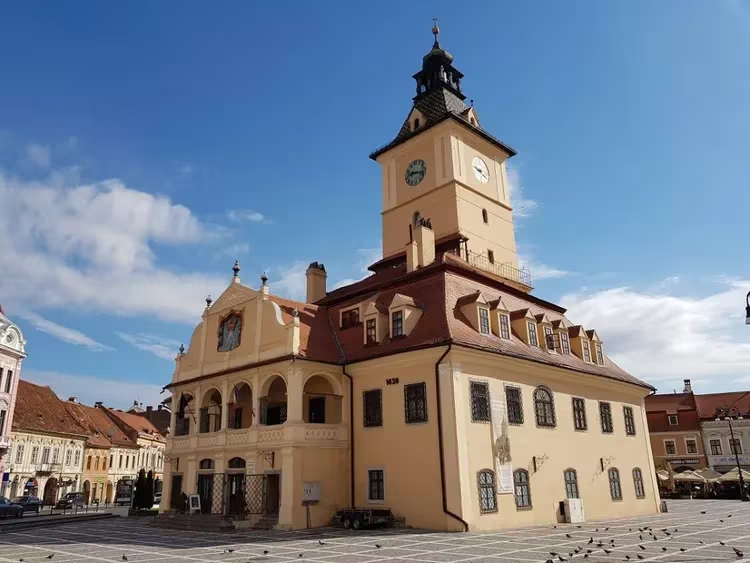
Market Square and Town Hall
The main tourist attraction in Brasov is the market square and the Town Hall. This example of baroque architecture was erected in the 15th century, and a century later, a 48-meter-high Clock (High) Tower was added to it. In the Middle Ages, the tower performed security functions, for which it was called the Watchtower. Such a grandiose building by the standards of its time was built not for the sake of idle admiration, but with specific functions – the City Council (magistrate) that governed the city was located in the Town Hall. Well, today there is a city historical museum there.
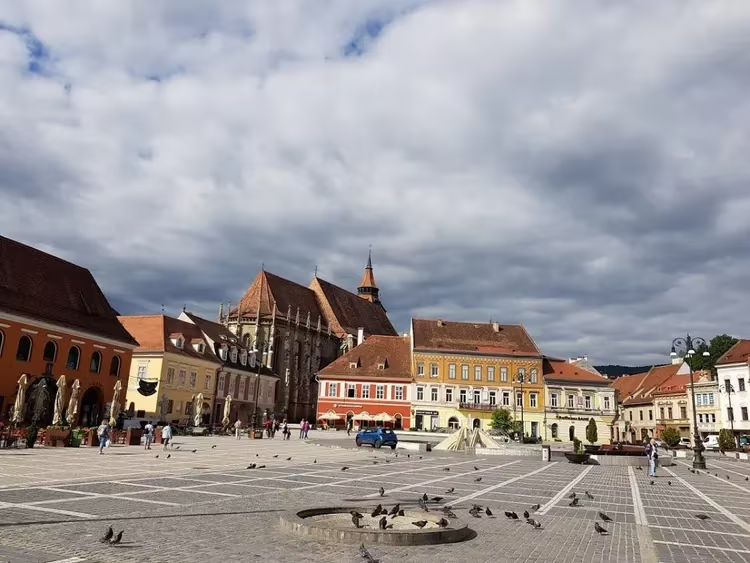
Creating a very cozy and picturesque space, the Town Hall is framed by a series of peer buildings. There are shops, hotels, and cafes here. Together they make up the Market Square or City Council Square.
Mount Tympa
This is one of the symbols of Brasov, which you will definitely notice when you are on the Market Square. The landmark is the inscription “Brasov” in large letters on a densely forested slope. You can climb the mountain either on foot or by cable car (cost about 5 euros in 2022).
If you decide to play climbers, calculate your strength. Still, the mountain reaches a kilometer in height. Be especially careful in winter; tourists on the forums are complaining about slippery surfaces, poor infrastructure for climbing and the imminent danger of rolling down. The mountain offers a beautiful view of Brasov, but if you are limited on time, I do not recommend spending an extra hour or two for it.
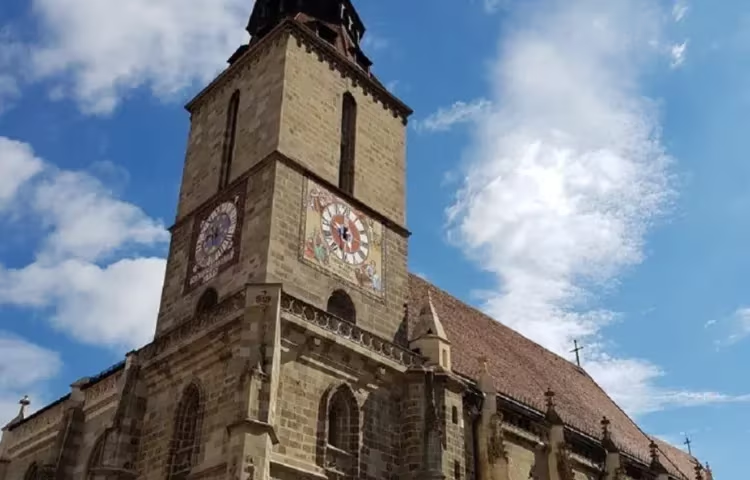
St. Mary's Church (“Black Church”)
One of the most significant, vibrant and memorable monuments of the city. It personifies the symbiosis of different eras and styles. The church was founded in 1383 on the foundations of the one that existed before. During the years of the Reformation, the building moved from Catholics to Lutheran Protestants. And its “double nature” is completed by an unofficial story, which is known many times better than the official one.
The church received the name “Black” because of the fire of 1689, which largely destroyed the temple. It was rebuilt, of course, but major changes were made. And the original style acquired many baroque decorations so dear to the residents of Brasov.
There is another reason for the gloomy name of the church. According to legend, during construction a German boy pestered the workers, repeating that one of the walls was leaning. The builder threw the child from the tower and then walled up his corpse in the wall of the church to hide his crime.
From legends to facts. The Church of St. Mary is the largest Gothic building in Romania. It rises above the city to a height of 65 meters. On top of it there is a 6-ton bell – again the largest in Romania. The temple also has an organ with 4 thousand pipes, created in 1839. Sometimes it can be heard as part of “organ evenings”. Tickets for these evenings, as well as for viewing the interior of the temple, are paid. A visit to the “Black Church” will cost about 3 euros (price for 2022).
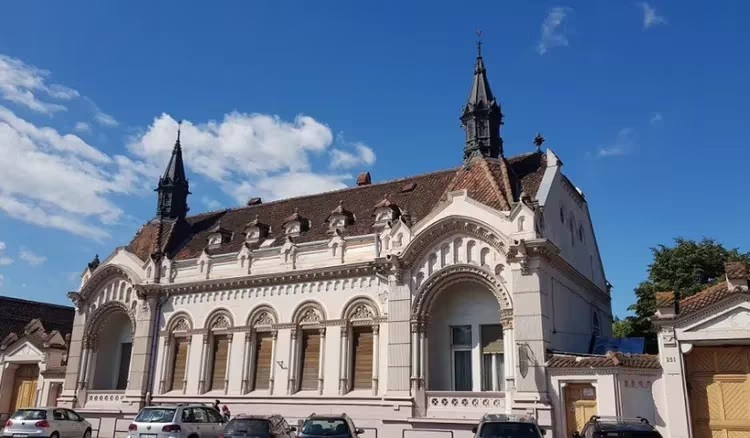
Church of St. Bartholomew (Bartholomew)
Heading to one of the attractions nearby from Brasov, Bran Castle, you will find yourself very close to a little-known, but very valuable architectural structure – the Church of St. Bartholomew. It is removed from the historical center and the main tourist attractions. But it’s worth a visit – it’s the oldest building in the city!
Its construction dates back to 1223-1260. And again Gothic, however, without the later layers of Baroque. And again, by the will of the Reformation, a Catholic church passed into the Lutheran camp. According to historical chronicles, the church was once surrounded by full-fledged fortress walls. Now the walls remain only symbolic, fake.
There is a cemetery on the territory of the church, which gives the visit a special atmosphere. But getting inside the church is a big problem. There are no services at St Bartholomew's Church. Tourists are allowed in, but only for the latter's luck. Often the temple is closed and can only be viewed externally.
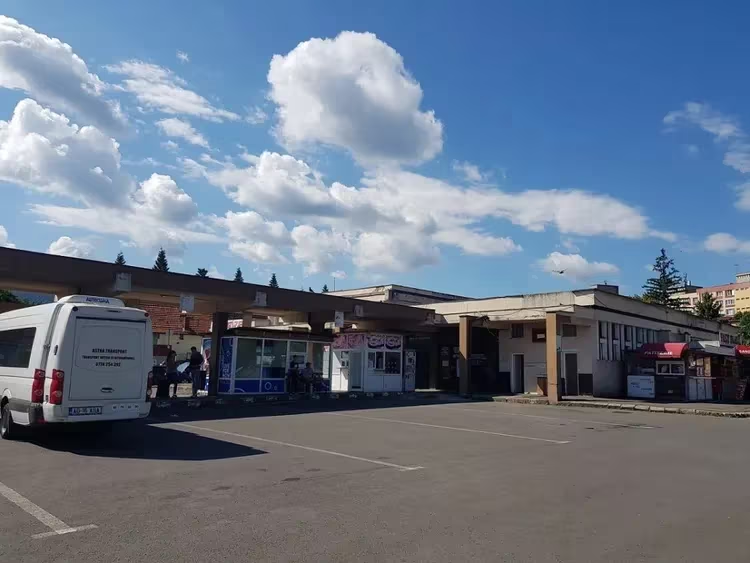
This is a very good express option to pass the time if you are heading to Bran Castle. Buses depart from bus station 2 (Autogara 2 in Romanian). The church is located 500 meters from this “unique logistics facility,” which in itself is worthy of becoming the hero of our review.
- Chasing vampires: going to Romanian Bran
- Lebanon – an oriental fairy tale against the backdrop of the fires of rebellion
- What to see on the road from Lisbon to Porto?
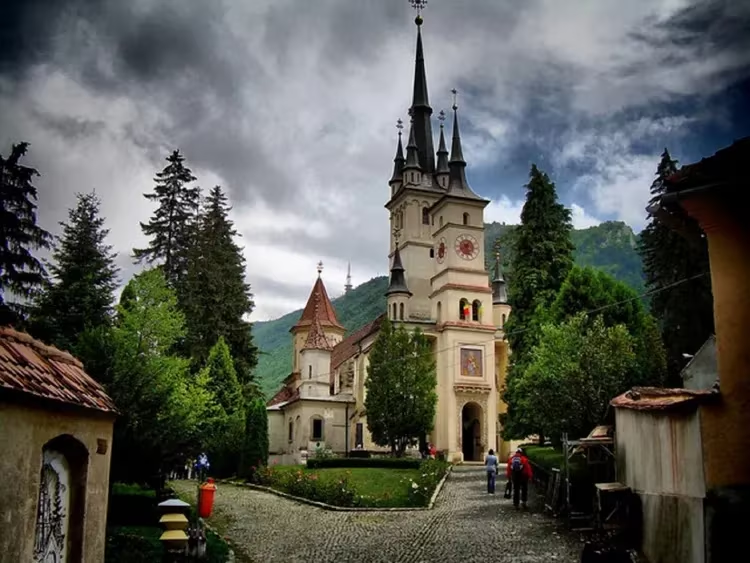
Church of St. Nicholas
This church completes the overview of the city's religious buildings. And brings “religious tolerance” to your sightseeing trip. After all, she belongs to the Orthodox faith. Oddly enough, in the midst of many Lutheran churches we are only now remembering Orthodoxy. But 86% of the population of Romania consider themselves Orthodox; the country has its own autocephalous Orthodox Church.
As for the temple itself, it is also one of the oldest buildings in the city. The first church of St. Nicholas was built in 1292 using short-lived wood. Therefore, after 2 centuries, full of turmoil and cataclysms, it had to be rebuilt in stone. Interestingly, they did this with the support of the Gospodar (ruler) of Wallachia Vlad IV, the son of Vlad Dracula.
From an architectural point of view, the building has undergone the usual metamorphoses. First Gothic, which is very unusual for Orthodox churches. And then the church was rebuilt in the favorite Baroque style, which is only slightly more familiar to the Orthodox.
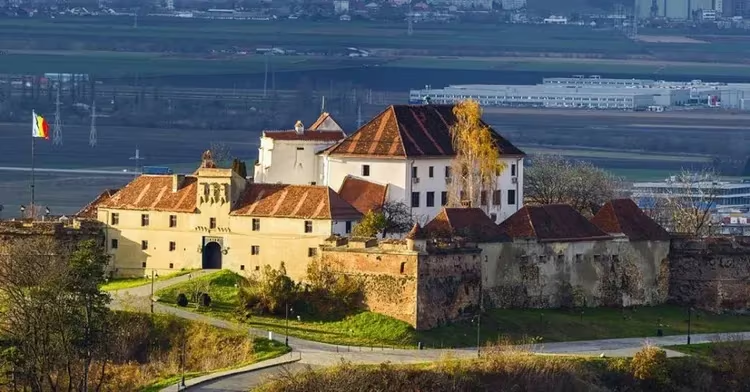
Chetetsuya Fortress
The land of Brasov is not only famous for its churches. The city has preserved a great many fortifications from different eras. One of these structures, the Chetetsuya fortress, is located some distance from the historical center of the city. If the climb to Tympu is not enough for you, then feel free to go to another hill that shelters these defensive buildings.
The Chetetsuya fortress was built in the 16th century. Oddly enough, her goal was not to shelter the city from the enemy. And to prevent the aggressors from using artillery in the city from a hill very convenient for shelling. Each of the four corners of the fortress is reinforced with a powerful bastion. In the center of the complex, a horseshoe-shaped tower built back in 1524 has been preserved. A single drawbridge leads into the fortress itself.
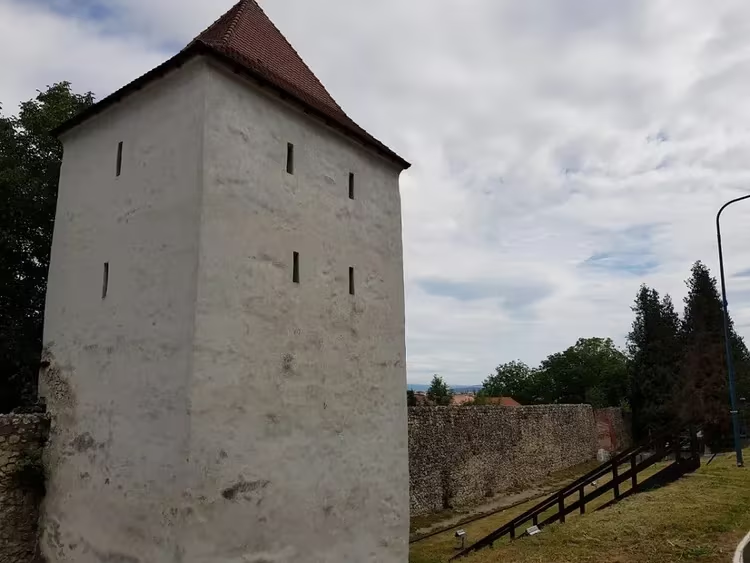
Brasov fortifications
If you don’t want to explore another hill and move away from the city center, but really want to touch militarism, you will have at your disposal the fortifications of Brasov proper. At first glance, you might think that their arrangement is chaotic and meaningless. But no. Having carefully looked at the map of defensive structures, it is easy to detect the outlines of old Brasov, which was protected by the walls. Everything outside these walls is comparatively new construction.
By the way, historians write that the Saxons (a Germanic tribe), who formed the basis of the population of early Brasov, in the 13th-17th centuries forbade the Romanians to settle inside the fortress walls. They could only enter the city at certain times, and had to pay a fee for the right to sell their goods inside the fortress. This is such discrimination.
The construction of the fortifications bordering Brasov began in the 15th century. In historical records you can find mention of 27 towers and 8 bastions with traditional and not very names: artillery, gunpowder, archers' tower, weavers' bastion. The most famous and grandiose are the White and Black Towers. Fact checking has established that the Black Tower is about as white as the White Tower. But let’s believe the Romanian legend: in 1559, the tower was struck by lightning, it burned and has since received its name.
It’s also worth looking at the fortifications of old Brasov because, being close to the center, they are literally immersed in nature. A pleasant promenade awaits you with views of the old town on one side and wooded hills on the other. It’s no wonder that locals choose this part of the city for sports.
Guidebooks usually separately highlight the Catherine Gate and the Shkei Gate as tourist attractions in the city. However, it is correct to consider them as part of defensive structures. The ancestors did not build gates in the middle of a bare field.
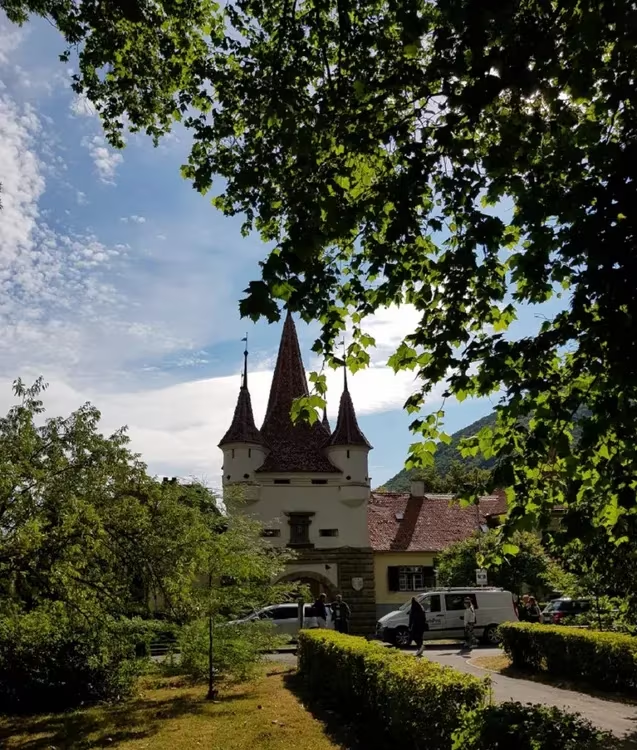
Catherine's Gate and Shkei Gate
Catherine's Gate is the only city gate of Brasov that has survived from the Middle Ages. Erected on the site of the old gate in 1559, it was badly damaged by earthquakes and fires in 1689 and 1738. So only the central tower is part of the original gate.
This gate was also called the Gate of the Vlachs, that is, the Romanians. Remember the discriminatory policies of the local German administration in the 13th-17th centuries? So, the Wallachian Gate was the only entrance to the city that Romanians living in the Shkei region could use. The other four entrances were closed to them.
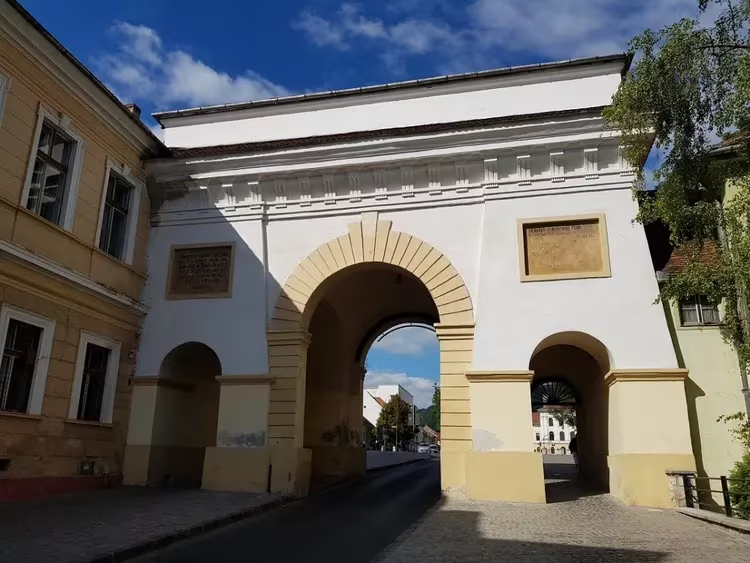
The Shkei Gate is much younger than the Catherine Gate. They were erected in 1827-1828. And they resemble a triumphal arch. The gate separates the old town from the Shkei district, where Romanians lived in abundance.
Strada Sforii Street
Strada Sforii Street, translated as “Rope Street”, is one of the narrowest streets in Europe. Its maximum width is 135 centimeters, the minimum is 111. What is the use of such streets, you ask? The fact is that at the time of its construction in the 16th century it was not a street in the literal sense of the word, but a corridor for firefighters. The architects did not expect, but after 5 centuries the street would acquire another function – a tourist attraction.
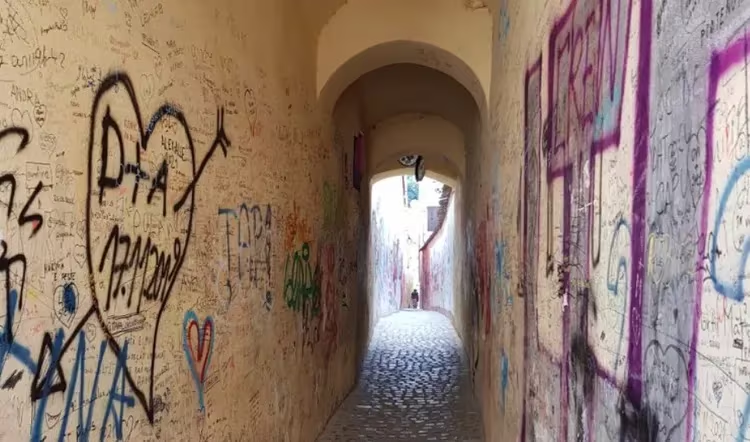
What awaits you is 80 meters of not just a cramped walk, but an enjoyment of street art. All the walls of the street are covered with messages from tourists. And this is done absolutely legally. So feel free to take a marker with you, look for a free corner on the wall and leave evidence of your happy moments in Brasov. There will be a reason to go back and re-read years later. This is a more effective method than putting a coin in a fountain.