
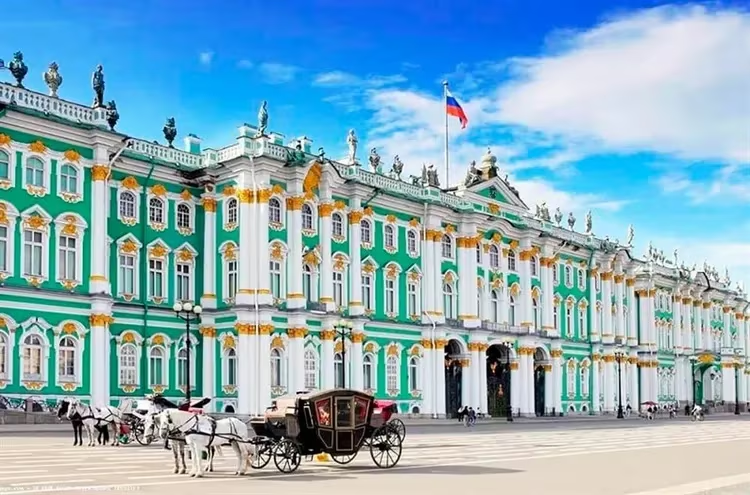
Winter Palace of Peter I in St. Petersburg
The Winter Palace of Peter I in St. Petersburg is only partially preserved. This is a unique architectural example of the beginning of the 18th century, which was once the main dominant of the Neva Embankment, and today has become one of the components of the Hermitage museum complex.
Construction history
The idea of building a cozy home for the royal family was first realized back in 1712, when Wedding Chambers were erected between Millionnaya Street and the partially completed Neva Embankment. However, they did not fully correspond to the taste of the monarch. Gradually, the Embankment expanded to the north, and it became possible to build a personal residence that would be more in line with the character of the king. From this, a rather tragic chain of events began, which leads us to the current Winter Palace of Peter I, which so little resembles the original house of the ruling family.
First stage
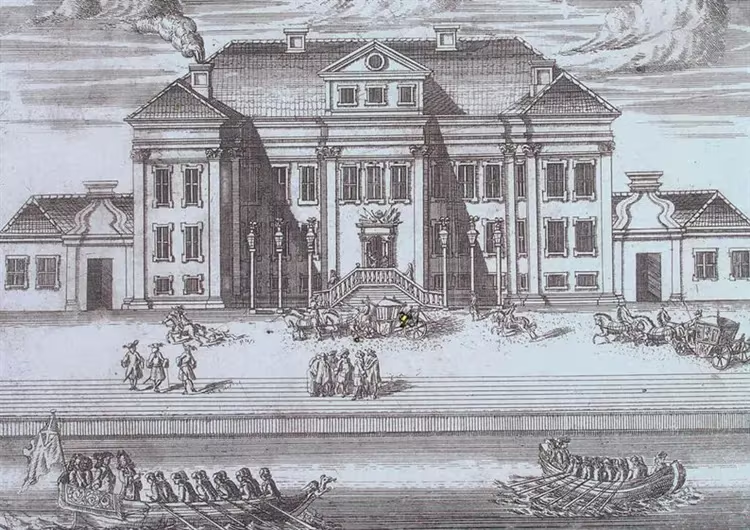
Back in 1715, when Peter the Great was considering the possibility of erecting a building opposite the Winter Canal, which then existed mainly on paper, there were not even foundations on the site of the modern Winter Palace. Mattarnovi undertook to translate into reality the desire of the great sovereign, who prepared the project for the Winter House and even erected the western facade. However, it did not correspond much to the status of Peter I and rather resembled the house of some rather wealthy burgher, rusticated and decorated with pilasters of the most ascetic Doric order. The royal title of the future owner was only reminded of the allegorical sculptures, which comfortably settled in the traditional triangular pediment. The building was crowned with a crown.
However, the original project was never fully implemented. Oddly enough, this was prevented by the return of the sovereign himself from Europe in 1718. He brought with him new ideas and a new vision for his Winter Home. Significant changes were made to the drawings and soon the interior decoration began. According to the sketches of the chief architect himself, the interior was dominated by oak furniture, and the walls were finished with red marble. The stairs and floors were also made of oak, emulating the French style.
As planned by the monarch, the house complex included not only living quarters, but also a boathouse, that is, a room that is usually used for repair work or the construction of, for example, airships. But, at the time of the Great Reformer, the latter did not yet exist, and the real passion of the monarch was the sea, therefore Peter's sailboat was in the boathouse. The house owned a small harbor, and a small inner garden with fountains was laid out for the wife of Peter.
New Winter Embankment Chambers
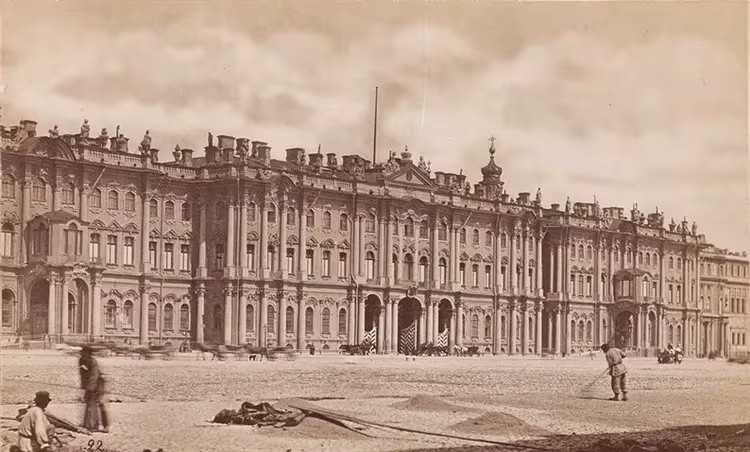
The construction was not completed. It had to be temporarily interrupted, since Georg Mattarnovi, who led this project, suddenly died for everyone. Meanwhile, only the foundations and the western part of the structure were completed from what he had planned. Nikolai Goebel was called to continue the work, who took up the central and eastern parts of the palace. The ceremonial halls, the design of which was extremely pompous, overlooked the Neva. So that the western facade, made in the “burgher” style, did not get out of the general mood, the western facade was made in the same spirit, while the center was purely baroque.
In its design, a strong Roman influence was clearly felt. In some ways it resembled the solemn beauty of the triumphal arch of the Roman kings. At the same time, the German influence did not disappear, which was more clearly imprinted in the shape of the central cartouche with complicated outlines and several allegorical figures that symbolized the power of Peter the Great.
Even during Peter's lifetime, the Winter Palace saw some of the most magnificent feasts in the Mother See: the betrothal of his beloved Anna and the Duke of Holstein, the big autumn feast of 1723, which was held in the recently completed Cavalier Hall, and other events. Some celebrations ended with the brightest fireworks on the ice of the Neva. Here – in the Winter Palace – Peter the Great died. His “Sad” hall became the Great Hall, where his daughter's betrothal took place at one time.
Many culturologists believe that with the construction of the Winter Palace, Peter I played a funeral march through the modest royal dwellings. Now it was the Winter Palace that became the most pompous building of the then-built St. Petersburg. In addition, the architect tried to create it, taking into account the atmosphere in which the rest of the Neva was built up. Thanks to his efforts, the palace managed to organically merge into the general image of the Embankment. Thus, the foundations of ensemble architecture were laid, the center of which is still the Northern capital.
Winter Palace of Catherine I
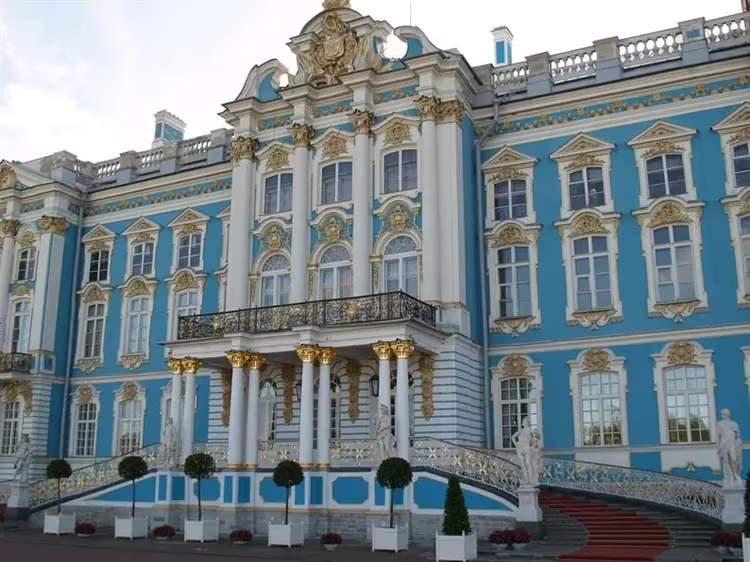
The rise of a new monarch brought with it the rise of a new star in the arena of architectural research. Such a star was Domenico Trezzini, who was instructed to expand the palace in the direction of Great German Street as soon as possible. The work was to be large-scale, since, at the direction of the empress, the harbor was filled up, and all the buildings, which seemed to her scattered, had to be demolished for the subsequent construction of a long two-story building with a rhythmic division of facades, which is typical for the architecture of St. Petersburg of that time.
This unification was to be completed by the creation of a pompous front arch to enter the large courtyard. However, the changes turned out to be too large-scale, and Catherine could not fully enjoy them, dying before the completion of construction.
Location
It may seem to many that the place for the construction of the Winter Palace was chosen almost by accident. What motives had to be guided by in order to decide to build a palace right in the middle of the houses of far from the richest residents of St. Petersburg? The answer is pretty simple. It was from here that the best panorama of the Northern capital opened with the majestic Neva, the spit of Vasilyevsky Island and the Malaya Neva, which subsequently flowed into the sea.
Discovery in the 20th century
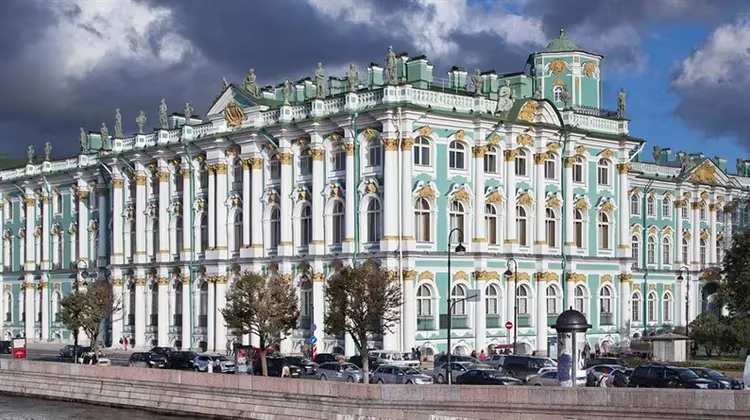
After the death of Catherine I, the Winter Palace of Peter the Great gradually began to fall into disrepair. Anna Ioannovna, although she moved the courtyard from Moscow back to the northern capital, was little concerned about the preservation of this amazing architectural nursery and preferred to stay at Apraksin's house. The Old Winter Palace began to be used occasionally, until at the end of the eighteenth century the very critical moment in its history came – it was decided to demolish the Winter Palace in order to build the even more magnificent Hermitage Theater of Jocamo Quaregi in its place. It would seem that here it would be necessary to put an end to the biography of this once sparkling place with all the lights, but the circumstances were different.
Nicholas I made an attempt to discover the very Great Hall where the first owner of the Winter Palace died, but this enterprise turned out to be a failure. Subsequently, already in the last third of the 20th century, a number of attempts were made to discover fragments of the Winter Palace. This time, luck was on the side of the seekers, and it soon became clear that Quarenghi, due to insufficient time, did not completely destroy the old palace. So, separate rooms of the basement and first floors were buried under the stages. Gradually, more and more new premises were opened: part of the front courtyard, several “Small tents”, which were erected under Peter, and even the monarch's office itself.
The latter has an excellently preserved Dutch-style fireplace and stove. The situation was also almost unaffected. This allowed researchers to obtain numerous artifacts that became part of the Hermitage collections. The last major find was the chambers of Catherine I, erected by Trezzini. Twelve well-preserved rooms were scattered along the Winter Canal.
The work was really painstaking, as researchers and architects did not limit themselves to passive study of correspondence, drawings and sketches. It also seemed to them that opening the premises was not enough. The masters began to remove layers of plaster layer by layer in order to reveal medallions, rust and remnants of paint that lay on the walls during the first work on the design of the Winter Palace.
Premises and interiors
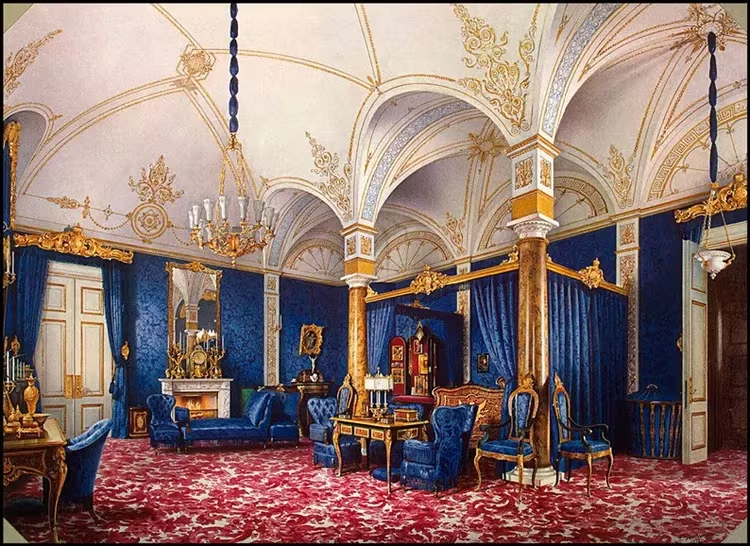
Some interiors and rooms have been restored, others have been carefully recreated on the basis of documents, memoirs and drawings. They just housed a permanent exhibition, which includes some personal belongings of Peter I, a lathe, some tools for carpentry. Guests of the palace can fully feel the richness of the atmosphere that reigned in the Old Winter Palace: Dutch panels, oak shutters and skillful window bindings, type-setting parquets. You can visit the following halls: an office, a dining room, a turnery and a front yard.
The interior of the office is decorated with paintings by Mommers. Some little things, such as an amber box presented to the monarch on one of his travels by the Prussian king, a sun and mechanical clock, an English desk, allow you to get a clearer idea of u200bu200bthe personality of the king. The pearl of the front yard is the carnival sleigh, as well as the monarch's garden carriage. The latter is considered perhaps the rarest example of a pleasure carriage characteristic of the Petrine era.
Opening hours and ticket prices
The Winter Palace of Peter the Great is open to the public from 10:30 to 18:00 on Tuesdays, Thursdays, Saturdays and Sundays. Monday is a day off. On Wednesday and Friday, tourists can enjoy the expositions from 10:30 to 21:00. Regardless of the day, the box office closes an hour before the palace itself. The ninth of May is also a public holiday.
There are two options for purchasing tickets. In the first case, the boulet will cost about 600-700 rubles, but you can use it to get to all parts of the Hermitage. If you plan to focus your attention only on the Winter Palace, you have the opportunity to purchase a ticket for 300 rubles. Students and cadets can enter the palace for free. The same applies to children. There is another opportunity to see the galleries of the Winter Palace without paying a dime. The first Thursday of each month is a day of free access to the complex.
Where is it located and how to get there
The Winter Palace is located at 32, Palace Embankment. It is quite easy to get to the palace, as it is located at the very beginning of Nevsky Prospekt. In the immediate vicinity is the metro station Admiralteyskaya. It is worth bearing in mind that the entrance to the Winter Palace looks rather unremarkable. To find it, you will have to go around the Hermitage on the right side (to the right, if you look at the facade of the Hermitage). Then walk along the infamous St. Petersburg Winter Canal to find yourself on the Embankment. You are unlikely to miss the desired facade – brownish against the background of light blue walls.