
















Underwater sculptures and museums: 5 most famous places in the world
More sculptures hide underwater than in many a museum on land. Over twenty years, artists have lowered hundreds of figures to the seabed, from a lone Christ off the coast of Italy to an entire gathering of people in the Caribbean Sea. Divers spend years trampling living corals, while a concrete figure on empty sand gathers new life around itself and draws people away from the reefs. According to Jason deCaires Taylor's official website, his underwater museums are visited by more than half a million people every year. Below are five of the world's most famous underwater sculptures and parks: where they stand, at what depth they lie, and what you can see on a dive.
How underwater sculpture parks work
💡 In short:
- Sculptures are made from pH-neutral concrete: corals colonize the surface, and the figure becomes an artificial reef.
- Divers move away from living reefs to the sculptures, and damaged corals get years to recover.
- Depth and access to dive sites: 09/2026, verified on the sculptor's official website
 © Lady K Writer · CC BY-SAPhoto: Lady K Writer, CC BY-SA (https://creativecommons.org/licenses/by-sa/4.0), Wikimedia Commons
The movement was started by Briton Jason deCaires Taylor, a sculptor and diving instructor. He was born in 1974 in Dover and has been scuba diving since age 18 (sculptor's Wikipedia page). He opened his first underwater gallery in Grenada and has since lowered more than 1,200 works into the sea (information from the official website).
The idea behind the project is simple. Coral polyps attach to the rough surface of a statue and gradually change its appearance. At the same time, the sculptures pull tourist traffic away from natural corals, which suffer from touches and fins.
Site | Country | Who it's for |
|---|---|---|
Molinere Underwater Sculpture Park | Grenada | beginners with snorkeling gear and families |
MUSA | Mexico | those who want to see an entire museum underwater |
The Silent Evolution | Mexico | fans of large-scale installations |
Museo Atlántico | Spain | certified divers |
Christ of the Abyss | Italy | those heading to Liguria for the classics |
1. Molinere underwater sculpture park, Grenada
The first public underwater park opened in Grenada in May 2006 (Wikipedia). It lies off the island's western shore, on the sandy bottom of Molinere Bay, where the reef was badly damaged by Hurricane Ivan in 2004.
 © Boris Kasimov · CC BYPhoto: Boris Kasimov, CC BY (https://creativecommons.org/licenses/by/2.0), Wikimedia Commons
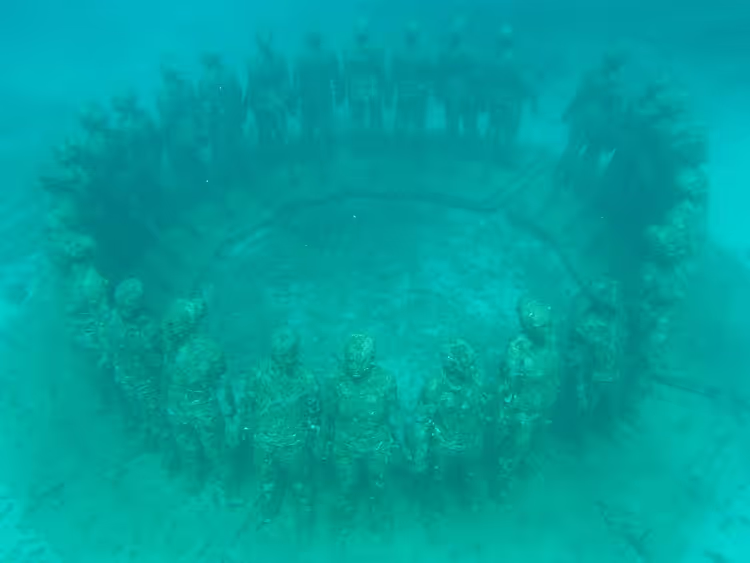
More than 65 concrete sculptures cover over 800 square meters and weigh about 15 tons in dry cement (Wikipedia). The maximum depth reaches 12 meters, so some works are visible even with a mask at the surface. The most recognizable piece is called Vicissitudes: a ring of 26 children holding hands and facing into the current.
The park is only accessible by water. The boat departs from the port of St. George's or from Grand Anse Bay; you can't reach the sculptures on foot. National Geographic included this gallery in its list of 25 wonders of the world (Wikipedia about the sculptor).
- Where: west coast of Grenada, Molinere Bay
- Depth: from 2 to 12 m (as of 09/2026, Wikipedia)
- The catch: you can't get into the park without a boat or kayak
- Who it's for: it's a good fit if you snorkel and want to see sculptures without scuba gear
2. MUSA, Cancun
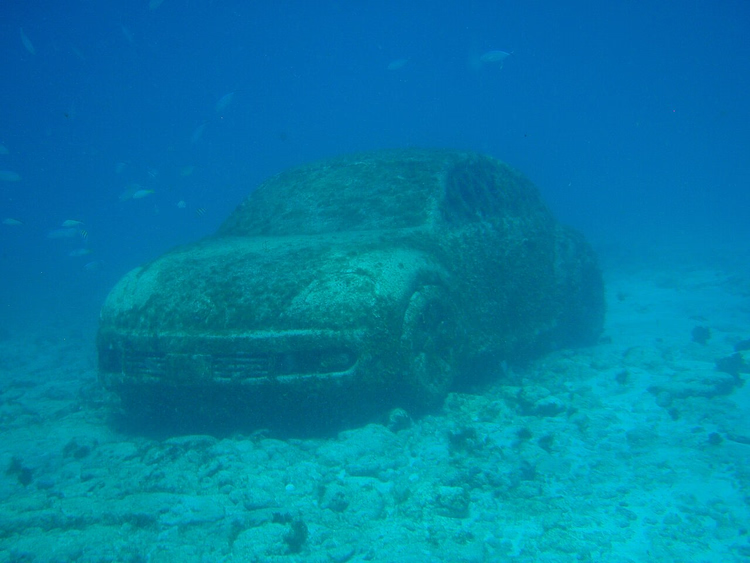
Taylor's second major project began after he moved to Mexico in 2009. The MUSA museum (Museo Subacuático de Arte) officially opened in November 2010 (Wikipedia data). Today more than 485 of his sculptures stand underwater, plus another 30 works on land.
 © Andy Blackledge from Scottsdale, AZ, USA · CC BYPhoto: Andy Blackledge from Scottsdale, AZ, USA, CC BY (https://creativecommons.org/licenses/by/2.0), Wikimedia Commons
The museum covers more than 420 square meters of previously empty seabed between Cancun and the west coast of Isla Mujeres. The project was commissioned in 2008 by the national nature conservation commission CONANP and the Cancun Nautical Association (MUSA project description). Some of the figures were immediately planted with live coral fragments taken from damaged reefs.
- Where: Caribbean Sea off Cancun and Isla Mujeres, Mexico
- Scale: more than 485 sculptures underwater and 30 on land (as of 09/2026, Wikipedia)
3. The silent evolution, Cancun
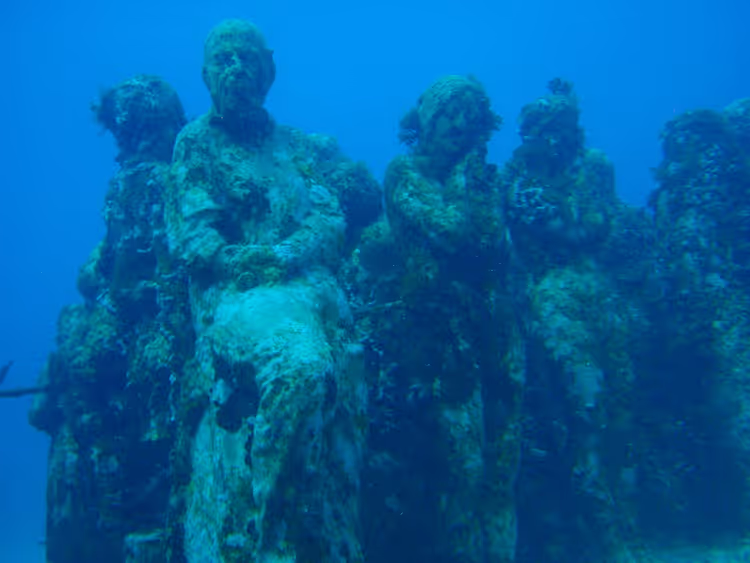
A separate gallery within MUSA is called The Silent Evolution. It was added in 2011 and consists of more than 400 figures (Wikipedia about underwater museums). The models were about 90 real residents of the fishing village of Puerto Morelos.
 © Andy Blackledge from Scottsdale, AZ, USA · CC BYPhoto: Andy Blackledge from Scottsdale, AZ, USA, CC BY (https://creativecommons.org/licenses/by/2.0), Wikimedia Commons
The people stand in a dense crowd, as if protecting the ocean. The models range in age, so the group looks like a real settlement, with both children and elderly people.
- Where: same area, near Cancun and Isla Mujeres
- What to see: life-size concrete figures of Puerto Morelos residents (as of 09/2026, Wikipedia)
4. Museo Atlántico, Lanzarote
After moving to Lanzarote in 2016, Taylor built Europe's first underwater museum. Museo Atlántico opened on January 10, 2017 in a UNESCO biosphere reserve (article about Museo Atlántico). It contains more than 300 sculptures.
The museum lies about 300 meters off the coast of Lanzarote, in the Atlantic Ocean. Its most powerful piece is called Crossing the Rubicon: 35 figures walk toward a 30-meter-long wall, unaware that there is no way back. Another work, The Raft of Lampedusa, depicts a boat with 13 refugees.
Divers can visit the sculptures only with a museum guide (Wikipedia on underwater museums in Europe).
5. Christ of the Abyss, Italy
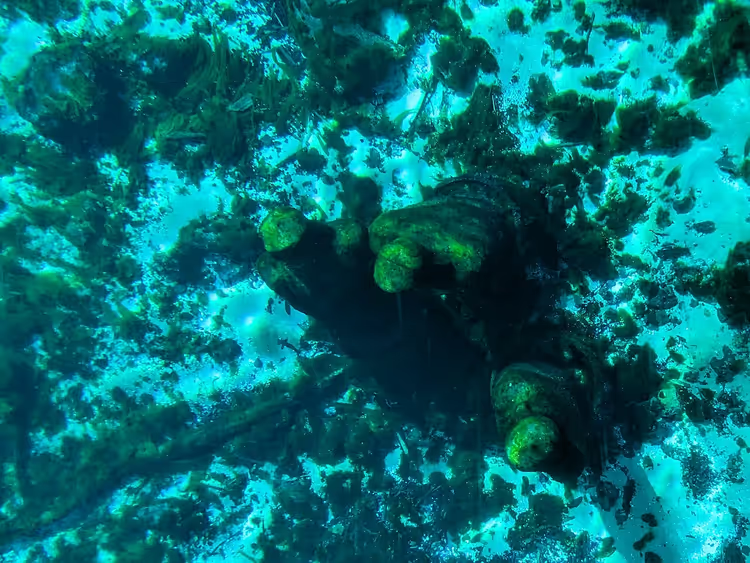
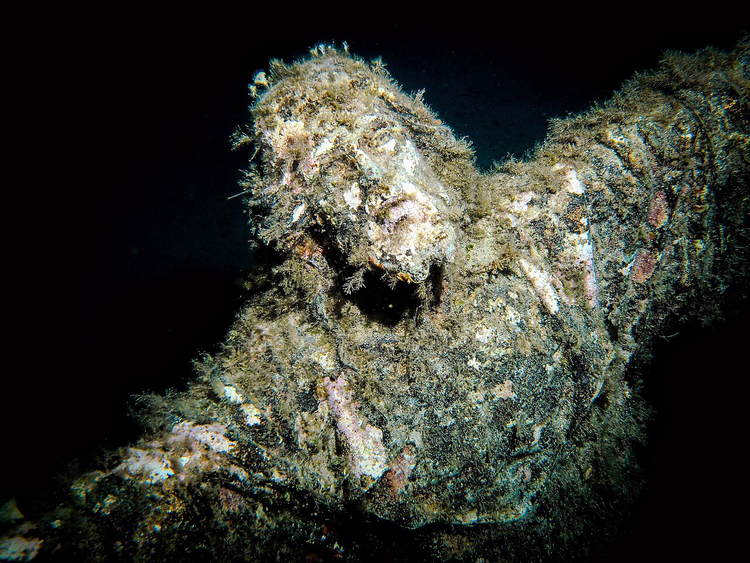
The oldest statue on this list appeared before Taylor. The bronze Christ was created by sculptor Guido Galletti in 1954 (Wikipedia about the statue). The 2.5-meter figure was lowered to the seabed on August 22, 1954.
 © Victor Micallef · CC BY-SAPhoto: Victor Micallef, CC BY-SA (https://creativecommons.org/licenses/by-sa/4.0), Wikimedia Commons
It stands in the Mediterranean Sea off the commune of San Fruttuoso, between Camogli and Portofino, at a depth of about 17 meters (Wikipedia). Christ's hands are raised toward the surface, as if blessing those who swim past. The statue was placed near the spot where Dario Gonzatti, the first Italian to wear scuba gear, died in 1947.
Over the decades, corrosion has eaten away at the figure. It was raised for restoration in 2003 and returned to the water on July 17, 2004 (statue restoration). Copies of Christ of the Abyss also exist in Grenada and off Key Largo in Florida.
⁉️🤔 Frequently asked questions
At what depth do underwater sculptures stand?
Most of Taylor's works sit at 2-12 meters, so they are visible even with just a mask. The Italian Christ of the Abyss stands deeper, around 17 meters, where scuba gear is required. Check the exact depth of each site with the local operator before diving.
Do I need a diver certification to see everything?
No, certification is not required. In Molinere Bay and near Cancun, the upper figures are accessible by snorkeling. Museo Atlántico admits only divers accompanied by a museum guide. Certification is needed only for deep dives at 15-20 meters. Beginners can get by with a mask, fins, and calm weather.
Does salt water damage the sculptures?
The concrete is made pH-neutral with a rough surface. Corals, sponges, and algae take hold on it, so over time the figures become covered with life rather than breaking down. After decades, only the base remains of a sculpture, but in its place a working artificial reef thrives.
Can I see the sculptures without getting in the water?
Some figures stand at shallow depths and are visible through the water. Glass-bottom boats run to Molinere Bay and Cancun. If you don't swim, take one of those tours: it shows the upper works without a mask or scuba gear.
How many underwater sculptures are there in the world?
Taylor alone has installed more than 1,200 works over twenty years, not counting projects by other artists in Egypt and Italy (sculptor's project page). There is no exact figure: some pieces deteriorate, and new ones are added every year. Check the sculptor's website for the current list.
In short: where to go for underwater sculptures
The five projects on this list vary in depth and difficulty. If you're just starting out, go with Molinere in Grenada: it has pieces at 2 meters, accessible by snorkeling.
- If you're a beginner: Molinere, Grenada, 2 to 12 m
- If you're certified: Museo Atlántico, Lanzarote, about 300 m from shore
- If you want a classic: Christ of the Abyss, Italy, about 17 m
- If you like scale: MUSA and The Silent Evolution near Cancun
Visit the sculptures in the dry season and go in the morning: the water is clearer and there are fewer boats. A guide will show you a safe route and keep you from touching live coral.

A small editorial team writing guides for independent travel. We travel ourselves, but we haven’t been everywhere, so we check prices, opening hours and how to get there against official sources.