
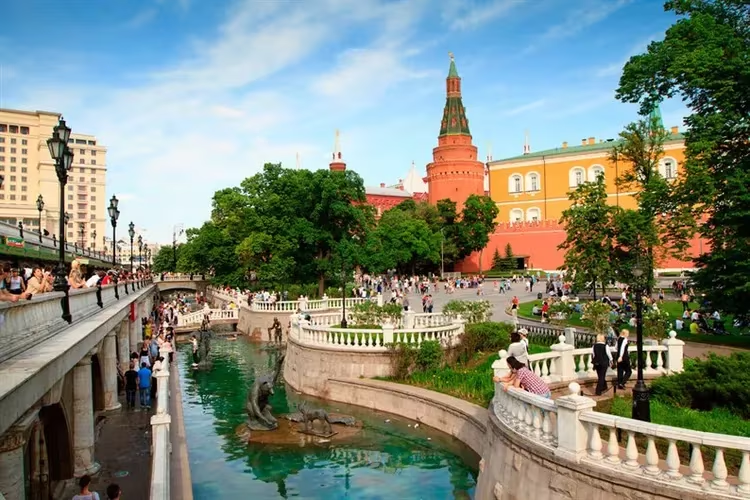
Alexander Garden is a park located near the Moscow Kremlin. The green massif, with an area of about 10 hectares, is both a place for walking and a complex reminiscent of a number of events in Russian history. We can say that history and modernity meet here, slowing down the rapid rhythms of the capital.
Story
Today we are talking about the Alexander Garden, and earlier until 1856 (before the coronation of Alexander II) it was the Kremlin Gardens. They owe their appearance on the city map to Emperor Alexander I “Blessed”, who sought to revive Moscow after the destruction and burning by Napoleon's troops (the date of creation is considered to be 1812). It is noteworthy that even in Soviet times, when the authorities sought to eliminate the memories of the tsars, the garden continued to be Alexander's. The opening of the park took place on August 30, 1821. Up to this point, a lot of work has been done, which was led by the architect Osip Bove.
The territory was divided into three parts: Upper (350 m long), Middle (382 m long) and Lower (the shortest, 132 m long) gardens. They were separated from each other (and are now separated) by the Troitsky and Borovitsky bridges. The relief had to be leveled, since earlier in 1708, Peter I, who fought with Sweden, fortified the Moscow Kremlin with earthen bastions. And the garden is located above the river Neglinnaya (Muscovites call it simply Neglinka), which in 1819, according to the architectural plan, was enclosed in a pipe due to pollution.
Gardens were created and opened in stages. The Upper Garden was the first to be arranged. Its basis was three alleys, which were complemented by trees, shrubs and flowers. The arrangement was carried out by the best gardeners invited to Moscow. The main entrance was arranged from Resurrection Square. According to the description in the “Historical Guide to Moscow”, published in 1831, it was “covered” by a “lattice” cast from cast iron, filled with the symbols of a military victory (the drawings were developed by the architect E. Pascal).
Further, in 1822, the middle part was opened, and a year later, the lower part. Interestingly, medicinal herbs grew in the place of the middle zone in the 16th and 17th centuries. Here was the apothecary garden of His Majesty. Around the same time (until 1707), instead of the lower section, there was a pond in which swans were bred for the royal table. The original incarnation of the project, of course, was not preserved. For more than two years of existence, something has gone forever (for example, the forged gates designed by the architect F.M. Shestakov collapsed), something has been added (the famous linden alley, planted in 1947 (today it is also gone), the grave an unknown soldier with an eternal flame, lit in honor of the 25th anniversary of the victory in the Great Patriotic War).
In 1872, the territory of the park became the site of a technical exhibition, which was a huge success. Its exhibits became the beginning of the creation of the Polytechnic Museum. The event was dedicated to the 200th anniversary of Peter I.
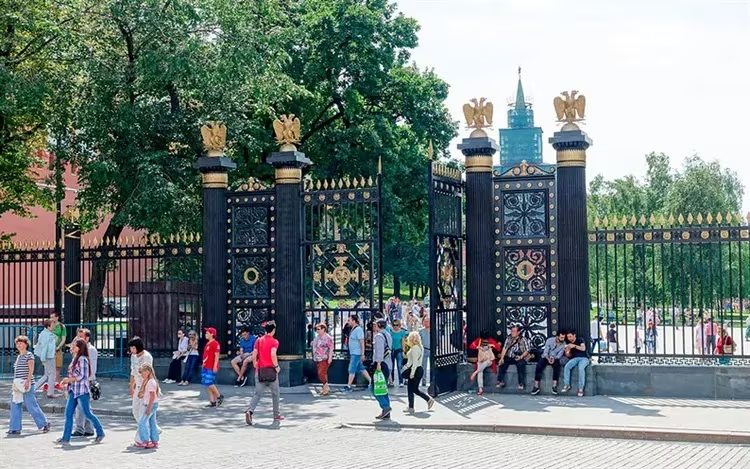
In 2012, the city authorities planned to recreate the pre-revolutionary appearance of the garden on the basis of archival photographs and documents. It was at that time that some of the old trees and shrubs were replaced with new ones, and it was also planned to create a rose garden, install lanterns in the style of the 19th century, and plant a live Christmas tree. The oldest garden in Moscow is mentioned in the literary works of Blok, Ostrovsky, Turgenev, Bulgakov, Akunin, Pimanov.
What to see
There are a lot of sights in the Upper Garden. These are the “Ruins” grotto, the Tomb of the Unknown Soldier, the Romanovsky obelisk, the monuments to Patriarch Hermogenes and Marshal G. Zhukov, the “artificial Neglinka River”. In the Middle Garden, the Trinity Bridge, the monument to Alexander I, the Kutafya Tower are interesting. Tickets to the Moscow Kremlin museums are sold here.
You will not be able to see the sights of the Lower Garden – it is closed.
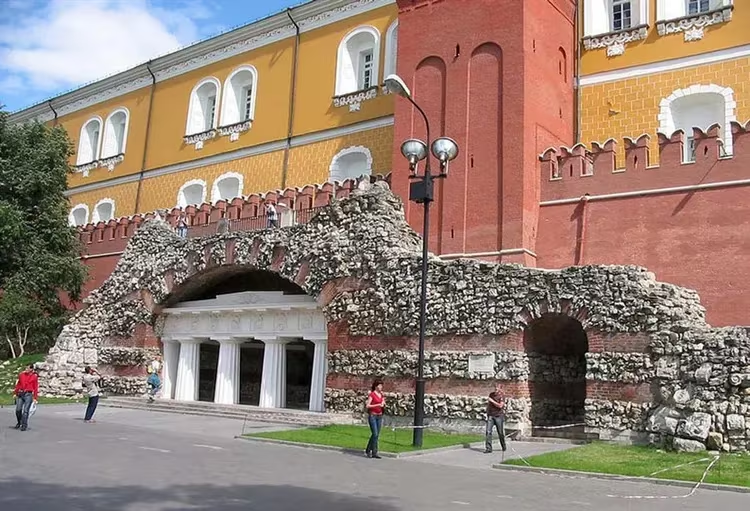
Grotto “Ruins”. This is a symbol reminiscent of the victory of Russian troops in 1812. The decorative cave-grotto is lined with the use of wooden cores left over from the time of Peter the Great and fragments of Moscow buildings destroyed by Napoleon. This is the creation of Osip Bove himself. There were times when an orchestra played in this grotto, also called “Italian”.
Tomb of the Unknown Soldier. Date of creation – December 1966, the 25th anniversary of the defeat of the Nazi troops near Moscow. This is an idea to honor the memory of all those who fell in the war and whose names remain unknown. The monument has a continuation – an alley with blocks along which earth is poured, brought from ten hero cities. An eternal flame burns here and since 1997 Post No. 1 (the main post of the Russian Army) has been located.
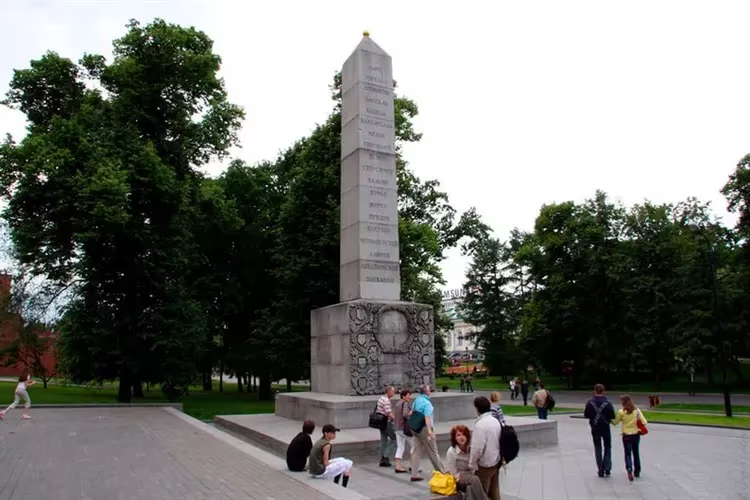
Romanovsky obelisk. A project made of gray granite and dedicated to the 300th anniversary of the Romanov dynasty. Initially, a double-headed eagle was located on its top, below – the coat of arms of the Romanovs, even lower – the names of the Romanovs. After the 1917 revolution, the royal attributes and names were replaced by revolutionary ones. In honor of the 400th anniversary of the Romanov dynasty, the monument was returned to its original form.
Monument to Patriarch Hermogenes (Hermogen). The initiator of the installation is the Russian Orthodox Church. Installed and consecrated by His Holiness Patriarch Kirill in 2013.
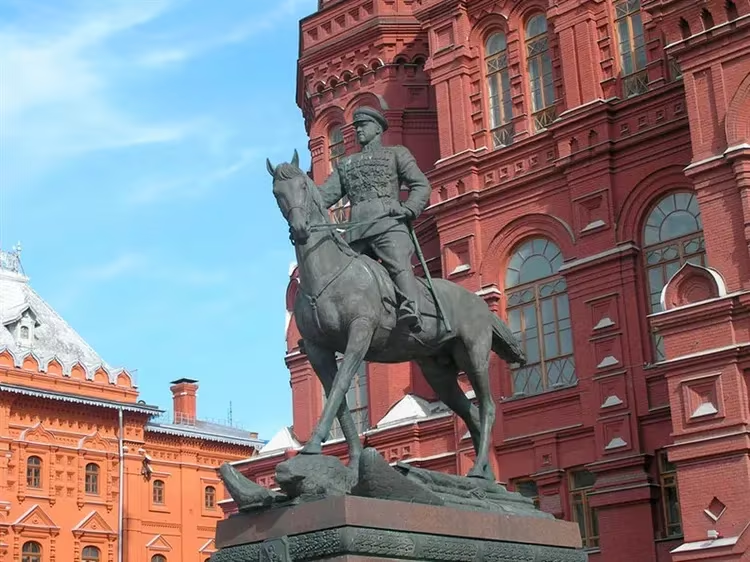
Monument to Marshal Zhukov. The work of the sculptor V. Klykov, set to celebrate the 50th anniversary of the victory in the Great Patriotic War. Located at the main entrance to the Alexander Garden.
“Artificial River Neglinka”. In reality, this is a water complex of two fountains, united by an artificial channel and decorated with sculptures of heroes of Russian fairy tales. The project, launched in 1996 by Moscow architect Zurab Tsereteli, became, as it were, a continuation of the original architectural plans (from the very beginning it was not planned to completely “hide” Neglinka under the ground, it was supposed to create ponds on its basis).
Kutafya tower. The building, erected in 1516 in order to protect the approaches to the Kremlin. Mountings for the lifting mechanisms of the bridge over the Neglinka are still visible on the gates. The “jagged crown” was added at the end of the 17th century.
You can also see the Trinity Bridge, which was reconstructed in 1901, and the Monument to Alexander I. The bronze figure was installed in 2014.
How to get there
It is difficult to get lost and not find the park. The fastest and most convenient way to get there is by metro. The garden is located near the stations Aleksandrovsky sad, Borovitskaya, library im. Lenin. If you go by bus (No. 144, K, M1, 2, 3 or 6, H1 or 2), then get off at the Lenin Library stop. Another landmark is next to the main entrance of the Historical Museum.