
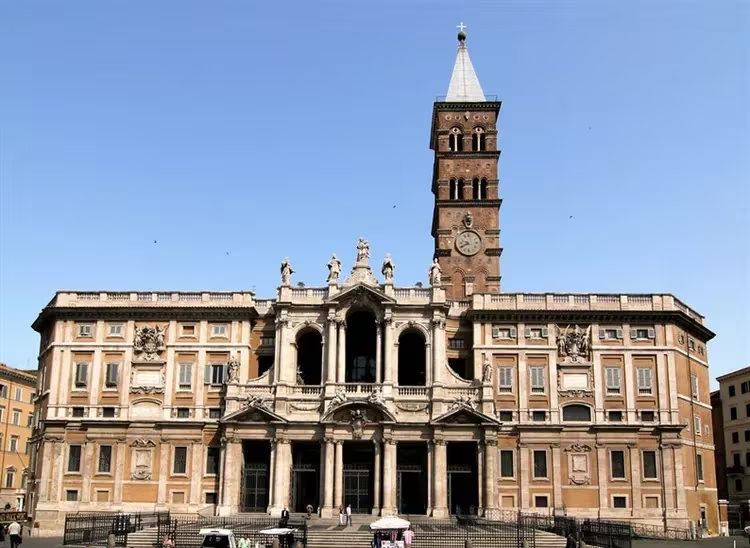
Basilica of Santa Maria Maggiore in Rome – history, photo, description, how to get there, map
Tourists are always happy to come to Rome – there are many sunny days a year, warm sea, beautiful nature and numerous, well-preserved architectural monuments.
Story
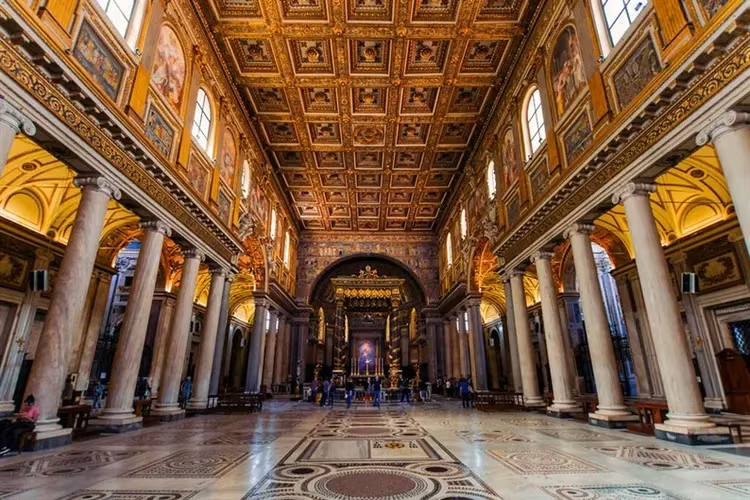
The Basilica of Santa Maria Maggiore – Maggiore in translation means “majestic”, it is really the largest of all the churches of the capital. This is a papal basilica. They differ from ordinary churches in that only once in a quarter of a century they open the “Holy Doors” and hold The gate, which depicts Jesus and the Virgin Mary, will next open in 2025.
It is believed that only a truly believing parishioner, having passed through them, will be cleansed of all sins. There are several legends about the appearance of the basilica. The initiator of its construction was Bishop Liberius. When they began to decide where the temple should be built, the bishop had a dream – the Blessed Virgin leads him to a hill on which snow lies.
In Italy, snow is not a very frequent event even in winter, but in that distant year 352, at the beginning of August, the Esquiline Hill was really covered with a snow-white cap. It was a sign, and the construction of the church began. Since that time, in memory of this day, parishioners are showered with scarlet rose petals at the entrance. Roses have recently been replaced by dahlias, but that doesn't make the tradition any less beautiful. At first it was called “Church of Our Lady in the Snow”, then by the name of the Bishop of Liberius, who initiated the construction. After some time, fragments of the manger of Christ were brought to the temple, and from that time on it became known as “Manta Maria Presepe”, that is, “Madona with a manger”.
The church received its final name in 431, after the famous Cathedral of Ephesus – “Santa Maria Maggiore”. Pope Sixtus II reconstructed the temple in 440. After him, all the pontiffs considered it their duty to bring at least minor changes. In 1377, on behalf of Gregory XIY, a bell tower 75 meters high was built. Every evening at 21 o'clock the bell rings. In the first half of the 18th century, in order to preserve the early frescoes, the façade with a portico and a loggia were completed.
Interior
The most expensive, sacred objects of the basilica for believers, which you should pay attention to: several fragments of a manger, the cradle of the infant Christ, the icon “Salvation of the Roman people” and the relics of Levi Matthew. The Basilica is the burial place of the architect Giovanni Bernini, Popes Pius Y, Clement YIII, Clement Y, Paul Y, Sixtus Y and Pauline Bonaparte.
We can say about the interior – magnificent, grandiose, solemn! The interior of the basilica, in contrast to its outer part, has changed little since the day of construction. During the construction of the building, different styles were used that did not go into dissonance with each other. In the back of the room there is an arch with an original mosaic depicting scenes from the life of Christ and the apostles Peter and Paul, preserved from the 10th century.
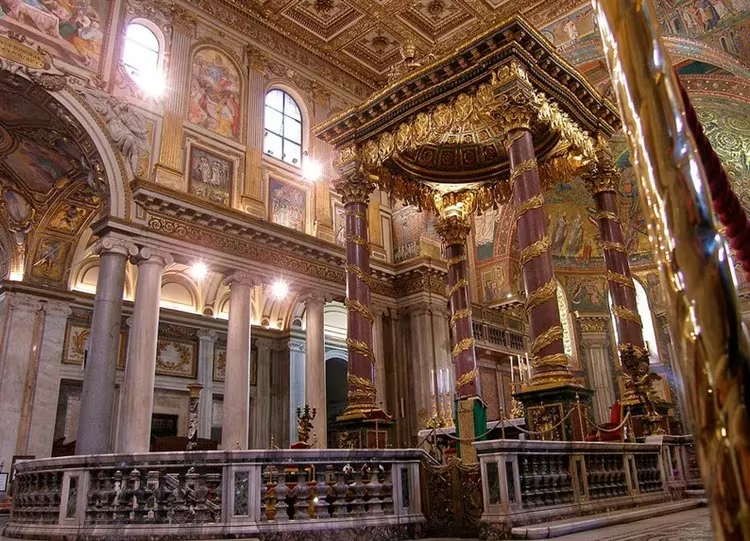
The frescoes retained the brightness and purity of colors. Next, you can see the Papal Altar – it is here that the Pope holds a service on Assumption Day on August 15th. Under the altar is the Bethlehem crypt, it contains a casket with fragments of the manger of Jesus. During the year, the pilgrim can look at the relic from a distance, and access is opened on Christmas Eve and Christmas Day.
So that visitors can see the relic and bow to it, one wall is made of crystal. The mosaics in the nave were made during the reign of Pope Sixtus III and are believed to have been made by local craftsmen. In the central nave, the paintings depict scenes from the Old Testament. The arch of the nave is supported by 36 columns, four columns hold a huge canopy, where there is a sarcophagus with the relics of Matthew – the sacred relic of Catholics.
The wall of the loggia is decorated with a mosaic of the 13th century, which depicts the dream of Pope Liberius – the appearance of the Virgin Mary. The loggia is called the “Lodge of Blessing”, from this place the Pope blesses the faithful on holidays. The ceiling is decorated with rectangular recesses trimmed with gold, which are called caissons, giving the impression of golden honeycombs.
Ancient mosaics were not preserved everywhere, some suffered, they were replaced in the XIII century. The floor of the basilica is magnificent, lined with complex geometric patterns. For it, multi-colored marble of valuable varieties was used. The technique is called “cosmateco”. It is named after the creators of the technique – Kosmati. Some art historians believe that it was the representatives of this family who folded the floor pattern.
Chapels
Sistine Chapel. The temple has several chapels. Sistine is located to the right of the entrance. It was built by Domenico Fontana on behalf of Pope Sixtus Y in 1543-1607. In terms of the room is a Latin cross. The dome of the structure is amazing, consisting of 8 sectors with picturesque images of saints. A tabernacle rises on the thrones of the Holy Gifts; it is held by bronze gilded angels (Ricci's work, late 17th century).
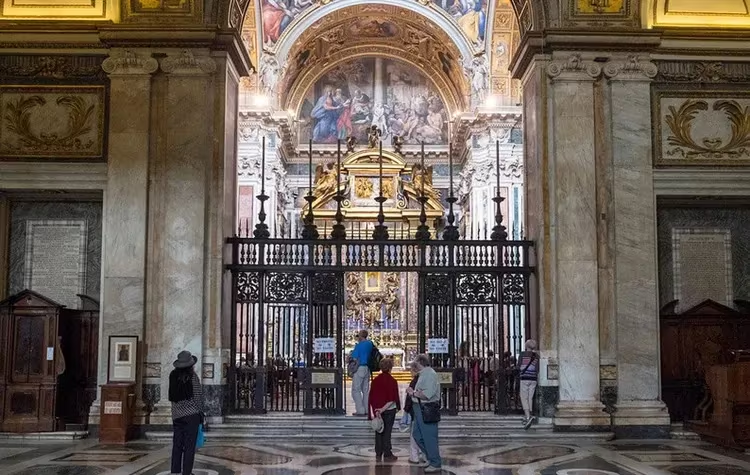
Paolina Chapel (Borghese) and Sforze Chapel. The Paolina Chapel is, as it were, a mirror image of the Sistine Chapel, located in the opposite direction. Borghese – noble, exalted thanks to Cardinal Camillo Borghese. In 1605, he was elected Pope under the name Paul Y. At his direction, the Paolina Chapel, or the Borghese Chapel, was built. The chapel was designed by Flaminio Ponzio, he was given significant funds from a wealthy family, so the room is striking in its splendor and wealth. The decor is made of marble, bronze, richly decorated with gilding. The main relic is the Byzantine icon of the Mother of God “Salus Populi Romano” (“Salvation of the Roman People”).
The artist of the priceless icon is not exactly known; historians attribute it to Luke the Evangelist. Studies have shown that it is at least 2000 years old. In the chapel are the burial places of Clement YIII and Paul Y, whose tombstone was sculpted in 1611 by Flaminio Poncio. Another masterpiece of the basilica is the chapel, which some think was designed by Michelangelo shortly before his death in 1564. In decoration, it is much more modest than the Sistine or Borghese chapels.
Square
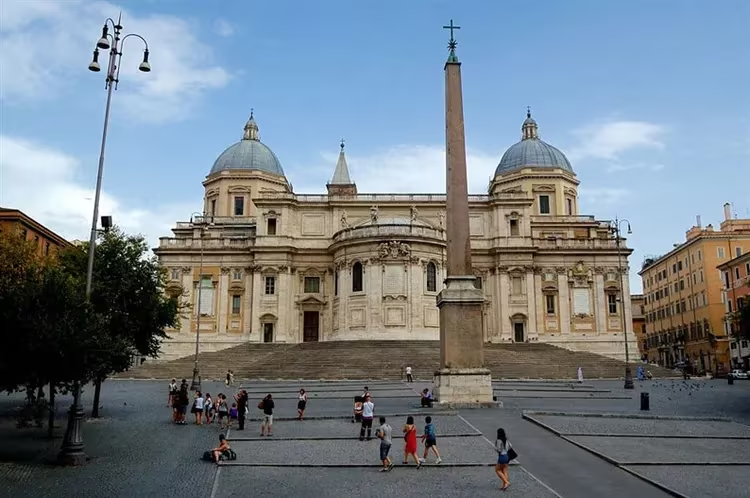
On Piazza Santa Maria Maggiori, on both sides of the church, there are palaces of the XYII and XYIII centuries. Opposite the basilica is a statue of the Virgin Mary with a baby. It is cast from bronze and mounted on a column 15 meters high. Erected in gratitude to the Blessed Virgin for saving the inhabitants of the city from the plague, it was moved from the Roman Forum. The rear facade of the temple overlooks Exvilino Square. Here is an obelisk that served as a lighthouse for pilgrims. Its height together with the cross is 25.53 m.
Where is it located and how to get there
The basilica is located in Piazza Santa Maria Maggiore, Rome, Italy.
You can get there:
All kinds of museums, galleries with masterpieces of fine art, architectural monuments, historical museums, the majestic Vatican – all this leaves an unforgettable impression. Having visited this magnificent country once, you want to come back here again and again.