
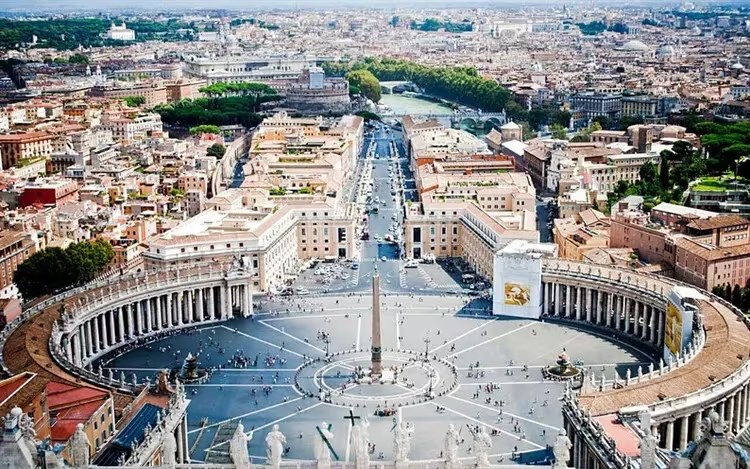
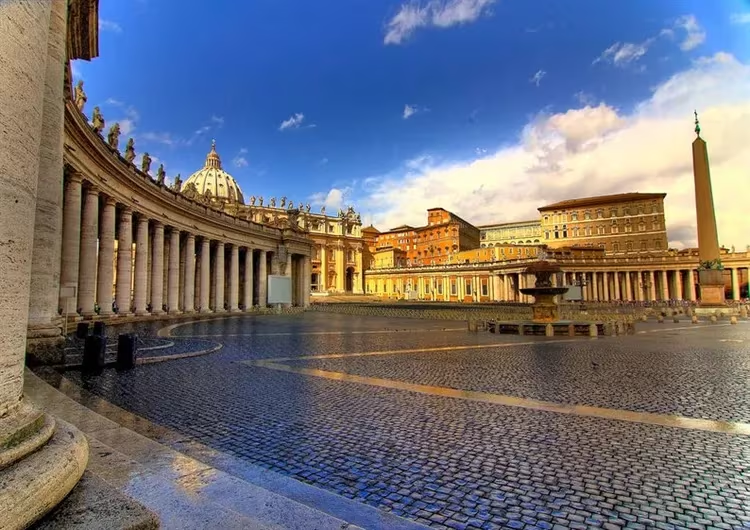
Rome, or the “Eternal City” is one of the greatest cultural and historical centers of the globe. This is a real treasure trove for those who want to touch and see with their own eyes the ancient structures that have miraculously survived to our time. But besides the stone remains of a bygone era, Rome is filled with other memorable places: cathedrals, churches, museums and charming streets. Particular attention of tourists is invariably attracted by St. Peter's Square, which is remarkable not only for its original architectural design, but also for the fact that it is located inside the Vatican, the smallest state in the world.
Story
At the beginning of our era, St. Peter's Square bore little resemblance to a model of modernity. The space between the Janiculum and Vatican hills was occupied by the circus and the gardens of Nero. In the first century, an obelisk brought by Caligula was installed here, the height of which exceeds twenty meters. The Romans consider it a symbol of rebirth.
In the IV century, after the construction of the first building of St. Peter's Cathedral, the space in front of it was cleared. However, for many centuries on rainy days it looked like an unsightly swamp. The problem was in the height difference as much as ten meters. Of course, this was no good, given the close proximity of the Vatican. By decree of Pope Julius II, it was decided to build a new cathedral, and with the coming to power of Pius IV, the square itself was expanded.
The obelisk from the gardens was ordered to be placed in the center – an ambitious undertaking, given the weight of the structure, exceeding 300 tons. The transfer became a real performance, where the assembled onlookers were forbidden even to whisper. Luckily, there were no casualties or damage. As soon as Pope Alexander VII ascended the throne in April 1655, he commissioned the architect and sculptor Lorenzo Bernini to bring the square in front of the basilica into a divine form. The task before the creator was not easy.
He needed not only to take into account the peculiarity of the architectural ensemble, which includes a majestic cathedral, an elaborate fountain and a huge obelisk, but also to fulfill the main wish of the pope – from anywhere in the square, citizens are required to see the pope when he goes out onto the balcony of the cathedral in order to bless the sinful inhabitants. Construction took a long eleven years, and was entirely controlled by Alexander.
Architect
Giovanni Lorenzo Bernini is an outstanding Italian architect and sculptor. While still young and inexperienced, he earned the patronage of Cardinal Borghese. Thanks to the support of a noble nobleman, Bernini was able to fully realize his talent. His sculptures bribed thoughtfulness and elaboration of characters. He created not just faceless sculptures, but emotional and “live” works. When Cardinal Barberini ascended the papal throne, Lorenzo managed to please him too. But now he was instructed not only to sculpt sculptures for mansions, but also to participate in the transformation of the city.
With the coming to power of Alexander VII, it was decided to turn Rome into a world cultural capital. In the Eternal City, a global architectural restructuring began, in which Bernini was directly involved. He carried out both small projects, such as the church of Sant'Andrea al Quirnale, and large ones. Of course, the most ambitious is the reconstruction of St. Peter's Square. The two massive semi-circular colonnades are often compared to arms enveloping the crowd – the arms of the Pope, whose greatness, as well as the greatness of the Vatican, is indisputable.
Despite the honor and favor of the secular and religious authorities, this medal also had a downside. At the urgent request of Pope Alexander VII, the famous architect was forced to go to France in order to take on the order of Louis XIV. In a foreign land, he was greeted cordially, but soon the enthusiasm and praise came to naught. Most of Bernini's projects were rejected, and he closed himself, not finding friends and associates among the French. Later, the architect returned to his homeland, where he spent his last years. The most significant work of that period is considered to be the tomb of its main patron, Pope Alexander VII.
sights
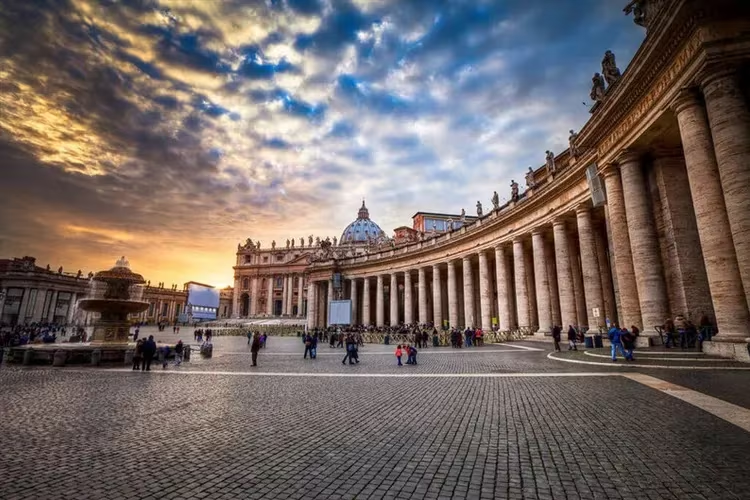
Peter's Square is surrounded on two sides by semicircular colonnades, which, according to Bernini, personify the outstretched arms of the church, covering the whole world. They were built in 1660 and consist of four rows of columns. In total, there are 284 Doric and 88 pilasters. At the top of the colonnades are 140 statues created by Bernini and his students. They depict popes, martyrs, evangelists and other religious figures.
The geometry of the area is also amazing! To the left and right of the central obelisk are round marble slabs. If you stand on one of them and look at the nearest colonnade, it will seem that there is only one row of columns instead of four. Of the places that are mandatory for viewing on St. Peter's Square by every inquisitive traveler, the following are distinguished:
- Obelisk and fountains
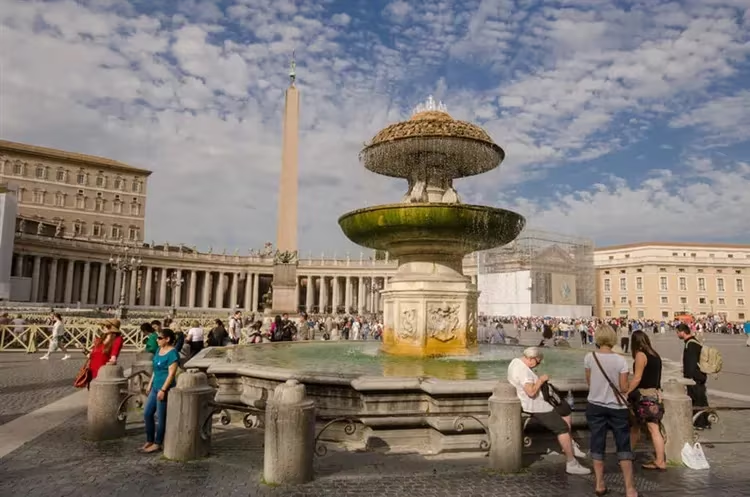
In the center of the square is an Egyptian obelisk with a net height of 25.5 meters, and including the pedestal – 41. It was originally erected in the ancient city of Egypt called Heliopolis for the prefect Cornelius Gallus. In the thirty-seventh year of our era, the emperor Caligula transported the obelisk to Rome on a ship specially designed for this transportation. It was installed in the garden of Nero, but then they decided to move it to the center of the square. The difficult task was entrusted to Domenico Fontana, while Michelangelo himself considered the task impossible. It took about nine hundred men and a hundred or more horses. The transfer took about five months.
The fountain, designed by Carlo Maderna himself, was installed to the right of the central obelisk in 1613. It is a vast pool with a stone block in the middle. Two bowls are installed on it: rounded, with low sides – the lower one and the inverted upper one. Prior to Madern, similar designs of fountains were not erected in Rome. To make the area symmetrical, Bernini ordered to install an exact copy of the fountain on the left. It was built by Carlo Fontana in 1677.
- St. Peter's Basilica
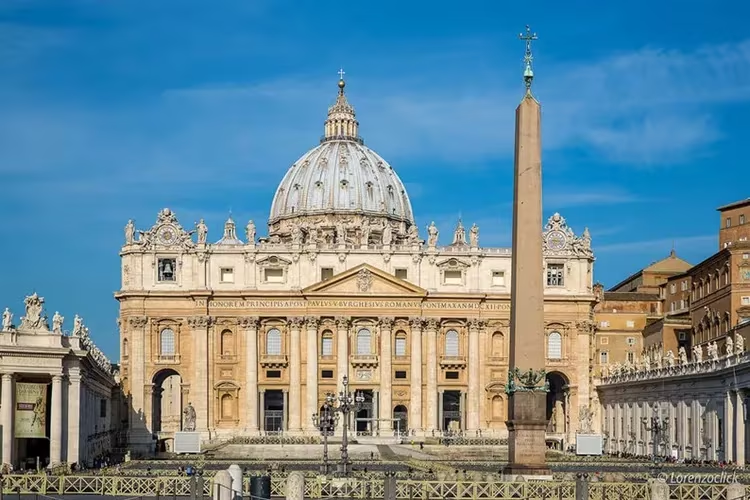
The largest Christian church in the world. The first version of the cathedral was built in the fourth century AD. Many architects had a hand in the building, which has reached our time. For example, D. Bramante, A. di Sangallo, Michelangelo, J. Della Porta, Carla Maderna. The height of the temple is about one hundred and twenty meters, and many Orthodox chapels and churches could easily fit inside. The interior decoration consists of sculptures, mosaics, altars and bas-reliefs. Here is the tomb of St. Peter. Without exaggeration, this cathedral is the main attraction of the Vatican, and one of the five main ones in Rome.
There are always enough tourists in the square, but on special days, like the election of a new pope, more than four hundred thousand people are present here, and entry is strictly limited.
Where is it located and how to get there
Address: Vatican City State, Piazza San Pietro, 00120
To get to your destination, it is best to use public transport. The nearest metro station is called Ottaviano, another one is Cipro. The express bus, route number 40, also stops here.