
You can find them in forests, along busy roads, on hills, among mountain peaks. Complex technical structures in the form of fortified bunkers were built to protect against enemies at all times. For this, advanced technologies, equipment and materials were used. The operational requirements for buildings depended on the type of weapon used.
Modern bunkers are built to protect the population during a deadly nuclear war. They are created to accommodate the main persons in any country. One of them is Bunker-42. The object is located on Taganka. It was conceived for the same purpose during the Cold War. The dream of an anti-nuclear shelter built in the center of the capital to protect the main figures of the USSR was born after nuclear testing. No country in the world at that time had such fortifications. Variants of the design of structures of this type were worked out at this facility. The construction order was signed by I.V. Stalin. Construction was carried out from 1950 to 1956.
Story
The ancient walls of the Kremlin also once served as a defense against invaders. Historical events have turned the Kremlin into an important seat of government. This fact was taken as a basis for choosing the location of the anti-nuclear bunker. From it it is easy to get to the Kremlin, to manage the army, the state in the event of a nuclear war. The location of the Tagansky Hill was better than others for construction. It was necessary to build a unique structure in the city center without damaging the existing communications and buildings.
All work must be carried out in conditions of special secrecy from foreign intelligence, ordinary people. Construction work was entrusted to the best specialists of Metrostroy. All of them signed a document on non-disclosure of the construction secret. Until 1986, bombers equipped with nuclear weapons were controlled from the underground fortification. It was a command post for long-range aviation equipment control.
The main building elements of the shelter are a protective dome (head), a deep mine, and a bunker.
Headband
Even the locals had no idea that a unique structure was hidden inside ordinary brick walls, capable of withstanding a powerful nuclear strike. The thickness of the walls of the protective dome reaches 6 m. They are made of cast iron, durable concrete. The dome was installed on a special foundation. Its width does not allow the dome to move as a result of the impact of the blast wave. Inside the head, modern methods of protection against shock waves are implemented. In the course of its distribution, two sliding type doors are installed. Their thickness is 40 cm. These are iron boxes filled with concrete.
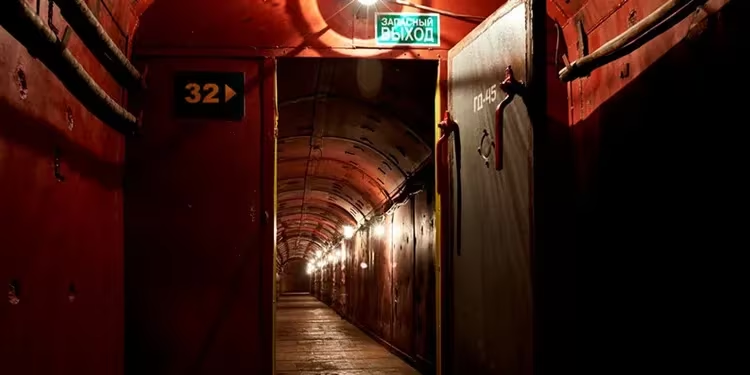
In the first corridor, the blast wave takes the direction parallel to the door without damaging it. The second corridor has a dead end (air). It provides a bifurcation of the wave, brings it up, out. The air outlet served as the facility's emergency exit. The corridors are equipped with thoughtful turns. Together with numerous turns, they are able to weaken the force of the shock wave, protect the doors, the path to the elevator, the stairs leading to the bunker from damage. The corridor labyrinth reliably protected from the passed radiation. There are two technical floors in the basement of the domed room. Here is located equipment for providing ventilation in the bunker.
An interesting fact is the method of testing the reliability of the dome. For this purpose, fortified drifts were built at the Semipalatinsk test site, having types of fastening of reinforced concrete structures at different depths: 10, 20, 30 m. The thicknesses of protective domes were used different. Projects RDS-1, RDS-2, RDS-37 were tested at different explosive charge power. The option was taken as the basis, when not a single animal in the structure was harmed.
Mine
The protective dome is connected to the bunker through a vertical shaft. Its diameter is 6m, depth is about 60m. It has an elevator and stairs. It conditionally passes through 18 floors going underground. The staircase is formed from 310 steps of different heights. The staircase has dimensions of 2 by 4m.
Bunker
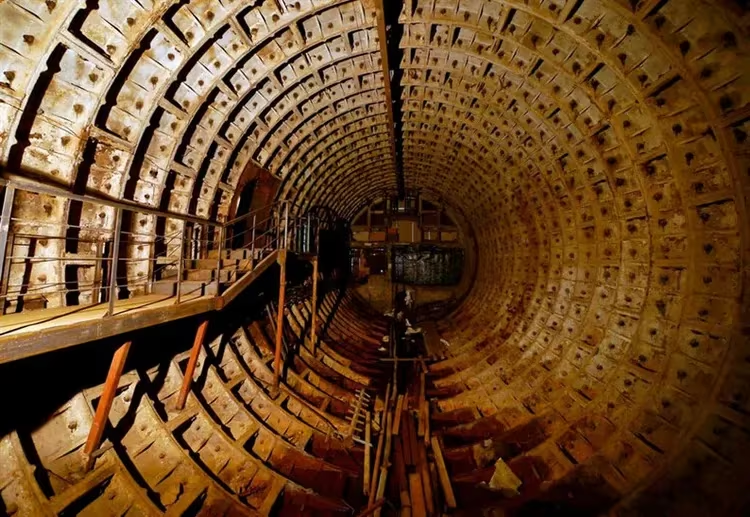
It is made of block tunnels. Their diameter is about 9.5 m. The usable area of the building is 7000 sq. m. m. The tunnels are located at the same level, run in parallel, connected by passages. Through the Taganskaya and Kurskaya stations, the bunker is connected to the city's metro system. The object was supplied through a tunnel between the Taganskaya and Kurskaya stations. On the second pass it was possible to get to the technical hall of the Taganskaya ring station. The bunker housed a laboratory for geodetic research, a radio station, and a telegraph.
There were two wells of the purest artesian water. There were large stocks of food. The staff of working employees was about 2500 people. Employees entered work through four separate entrances. One is currently active, representing a massive gate marked with a red star on a green background. Behind the door, you need to go through two sealed doors with a compressed air locking system. A shower was built in the compartment, a change of clothes was organized. After descending into the mine, everyone passed a checkpoint confirming the right to enter.
The era of perestroika, the collapse of the Soviet Union, a sharp leap in the development of technology made the object unprofitable, not meeting the requirements of modern military power. In 1995, secrecy was removed from him. Serious accidents in the metro, outdated waterproofing, which allowed the object to be repeatedly flooded, did not allow the bunker to be used for the same purposes without serious reconstruction. Object GO-42 was purchased by the private company Novik-Service in 2006 in order to create a Museum that reveals the secrets of the Cold War.
What to see
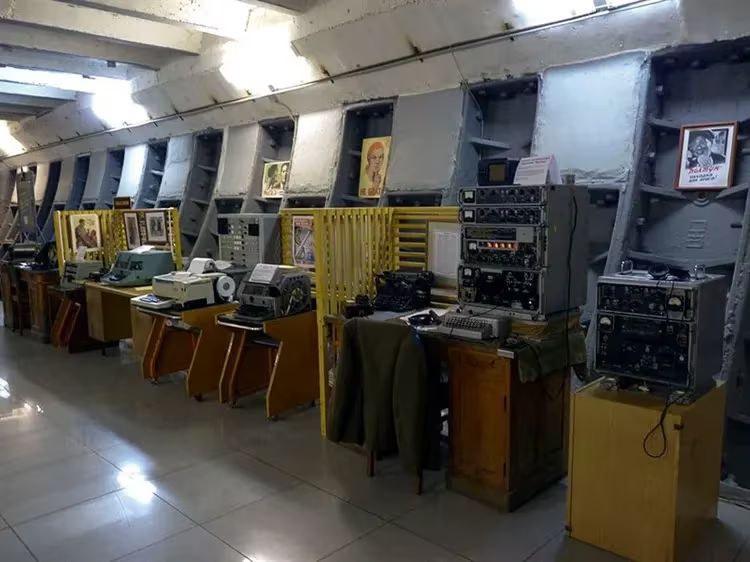
An interesting offer of the museum is the architectural elements of the halls and corridors. One of them contains a copy of the command post. A room with buttons for a nuclear strike. A stand depicting rockets that could fly anywhere on the planet at any moment. Now it is possible to see the virtual destruction from such a nuclear strike. A hall of interesting expositions with Soviet-era radio stations and Geiger counters has been organized. Protective suits against hazardous chemical compounds, gas masks.
Propaganda posters of the Soviet era are viewed with interest. A modern entertainment zone, a dining room has been created. The rooms of engineering systems have been restored for display to visitors. Upon entering the museum, the visitor receives a scarlet pass similar to that of the former Ministry of Defense. It has a name on it, a photograph of an unknown person with a gas mask.
Game programs and excursions
Group and individual excursions are organized on the territory of the museum. Their program includes familiarization with underground tunnels, participation in conferences, sports games, entertainment events, real trips through the dungeon. The most interesting excursions are the following offers:
In the museum, you can take part in various entertaining games, for example, master airsoft. This is one of the best places in Moscow for game team shooting. The Crazy Professor program provides an opportunity for visitors of any age to pass tests for dexterity, ingenuity, accurate target shooting, and strength. In the Zombie Apocalypse adult program, participants must destroy the bunker without letting the zombie virus spread. Or in the Bunker Quest game, destroy the terrorists who have seized the object, defuse the bomb. To do this, you need to correctly go through all the stages, unravel the available clues. Children of any age can participate at the same time, adults in the interesting game “Confrontation”. And in the “Horror of the Dungeon” learn to conquer inexplicable horror, fear.
Services
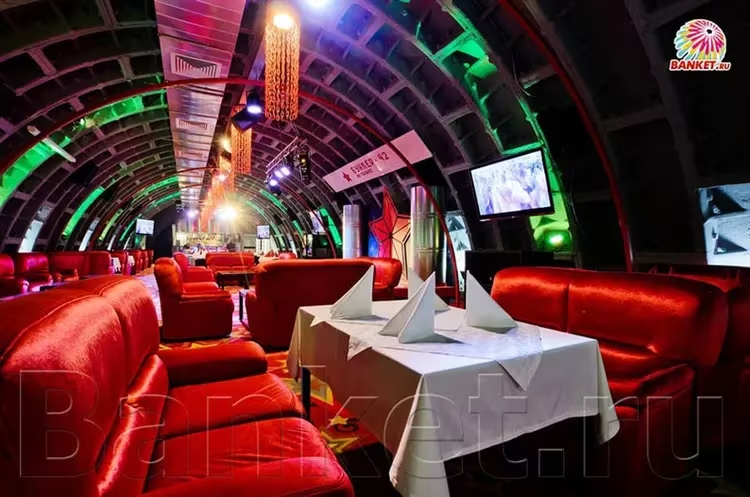
In Bunker-42 on Taganka you can visit a restaurant, order a banquet hall for use during family holidays. Try your hand at a karaoke club, watch an interesting movie in a cinema with a DVD system. In a comfortable, modern conference hall, take part in a scientific seminar, conference, organize a presentation of your business. Weddings, children's parties, exhibitions, corporate parties are held here for a specific fee, previously agreed with the museum administration. The territory of the museum has been repeatedly used as a location for filming various films, for example, “Infection”, an action movie based on the novel “SMERSH-XXI”.
How to get there and opening hours
You can get acquainted with one of the secrets of underground Moscow, which, fortunately, did not take place on our planet, can be found at the address: 5th Kotelnichesky lane, 11. You need to get off at the Taganskaya metro station, go through Nizhnyaya Radishchevskaya to the lane and go to the museum building. It operates around the clock every day.