
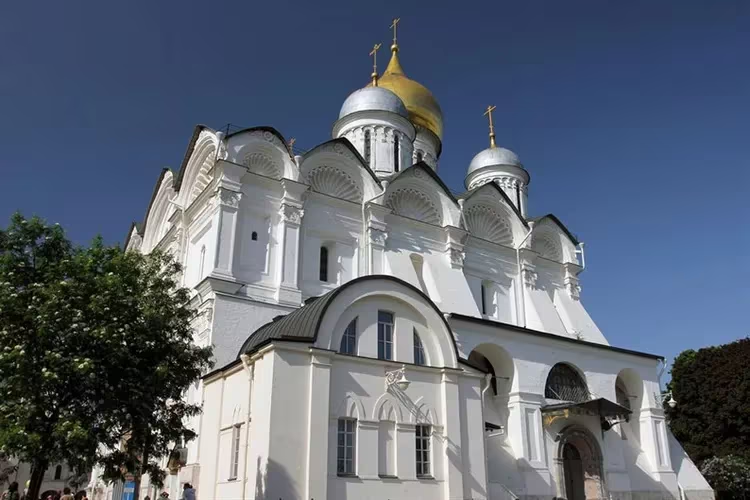
The Moscow Kremlin with its majestic cathedrals is the pride of Russians, but not many people know about its unique sights. For example, about the history of the creation of the Archangel Cathedral, or, as it is also called, St. Archangel Michael. This saint, according to Christian teaching, accompanied the souls of the departed people to the kingdom of the dead.
Construction history
Historians know almost nothing about the first, wooden church, they assume that it was built in the twenties of the XIII century. At this time, Khorobrit reigned in Russia. He did not rule for long, so he was mortally wounded in a battle with the Lithuanians. In the XIY century, on the site of the former church, by order of Prince Ivan Kalita (r. 1325-1340), a stone structure was erected. As follows from historical documents, at that time in Russia there was a terrible crop failure of rye, one of the main food products, the people began to starve. Ivan Kalita vowed to build a cathedral to stop the crop failure and restore peace in the country. About the first temple built of stone, scientists know only the date of completion of construction – 1333, in the same year, in September, Metropolitan Theognost consecrated it.
Later, chapels were erected, named after Saints Andrew and Simeon, and a few years later, chapels of the Ascension of the Lord and the Apostle Akila appeared. But, since they were built of wood, they almost completely burned out during the strongest fire of 1475, when Moskvorechye, Arbat, Zaneglimenye were engulfed in fire. A few years later, the aisles were replaced with stone ones. But where they were located, historians could not determine. During the reign of Ivan III, the building lost its grandeur, dilapidated, and was also damaged by lightning in the 50s of the XY century. Therefore, in 1505, the prince ordered to dismantle the old temple and build a new one. Unfortunately, Ivan III died before the construction was completed. He was buried in the Archangel Cathedral – this is the first burial here of royalty.
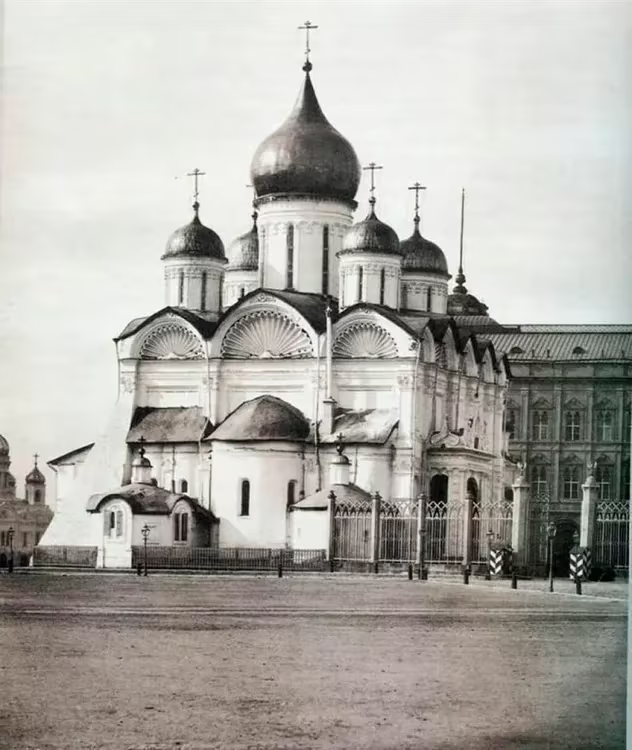
The construction of the building was completed in 1508 and exists to this day. For its construction, one of the most famous architects of that time, Aleviz Novy, was invited from Italy. He used the motifs inherent in the Italian Renaissance in architecture. The building itself is five-domed, with eight aisles. Zakomaras (semicircular ends of the outer part of the wall) are decorated with shells. Pilasters (a vertical ledge in the wall, resembling a column) are decorated with floral ornaments. Contemporaries were struck and amazed by the new cathedral, its appearance was uncharacteristic for the temples of Russia, resembling rather Italian palaces. Metropolitan Simeon consecrated it in September 1508.
The building was badly damaged in 1812, during the Patriotic War – Napoleonic soldiers outraged the holy place, setting up a camp kitchen in it. Then, in 1917, the cathedral was severely damaged during the shelling of the Kremlin, and the next year it was closed to the public. In 1929, the remains of women of the royal dynasties were transferred to the basement of the temple.
Tomb of the kings
At its core, the temple is a royal tomb. The custom to bury in temples came from Byzantium. It was believed that some important persons “did not die after death.” This is how a tradition arose – tombs are erected for representatives of one ruling family, therefore, in the Cathedral of St. The remains of the Rurik and Romanov dynasties rest in Archangel Michael. Ivan Kalita and Dmitry Donskoy are buried here. At the southern wall are the tombs of the great Moscow princes, in the western part – the remains of specific princes, in the northern part you can see the burials of princes who fell under the royal disgrace.
The tomb of Ivan IY the Terrible is located on the altar, in a separate tomb. Attracts the attention of the cancer, which contains the body of the youngest son of Ivan II – Tsarevich Dmitry. It is located in the central nave. As is known from history, the prince was killed in Uglich, although historians still argue about this. Members of the Romanov dynasty, including Mikhail and Alexei, rest in the center of the cathedral. The last of the Romanov family was buried the grandson of Peter the Great, Peter II, this happened in 1730.
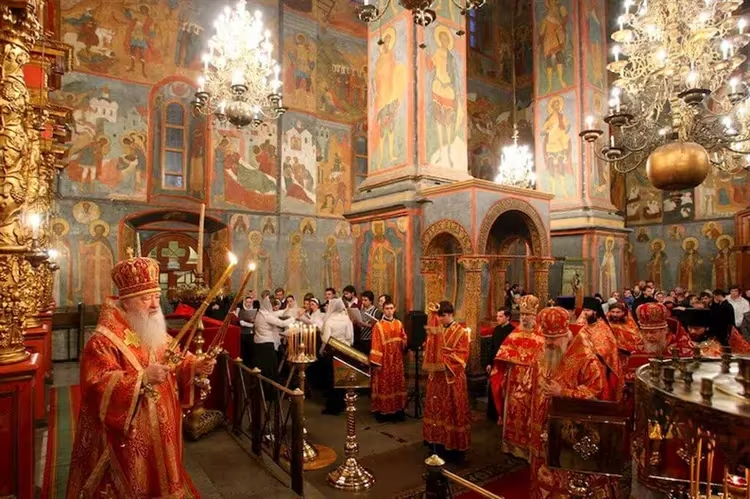
Currently, there are 44 tombstones dating back to the 30s of the XYII century. They are made of brick and lined with white slabs, on which you can read the names and dates of the life of the deceased. In the first quarter of the twentieth century, the tombstones were covered with brass covers.
Unique frescoes and ancient icons
Inside, the temple amazes with frescoes, the walls were painted in the seventeenth century by skillful artists, the names of some of them have been preserved – Yakov Kazanets, Gury Nikitin, Fyodor Zubkov and other masters. On the walls of the cathedral you can see about 60 images of royalty and their wives: Princess Olga, princes Bogolyubsky, Nevsky, Vladimir, Ivan Kalita and Semyon Proud. Some of the people depicted in the portraits are canonized as saints. There are portraits above each princely burial, depicting the deceased in a prayerful pose, the images are accompanied by an inscription that indicates their names and the names of patron saints.
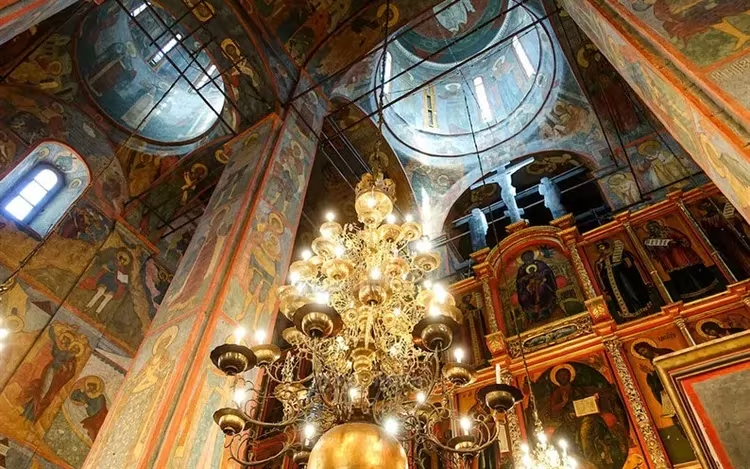
To replenish the original iconostasis, which has not been preserved, Tsar Ivan II did a lot. Historians suggest that icons have remained since that time: “John the Baptist – the Angel of the Desert”, “The Annunciation of Ustyug”, “Nikola Mozhaisky”. The temple icon “Archangel Michael with the deeds of angels” attracts attention – it is considered one of the oldest icons. Now it is hardly possible to prove it, but according to legend, Evdokia, the widow of Dmitry Donskoy, ordered it in honor of the victory in the Battle of Kulikovo. Perhaps the icon was in the previous cathedral, erected by order of Ivan Kalita. It is possible that Theophanes the Greek himself or his students took part in its writing.
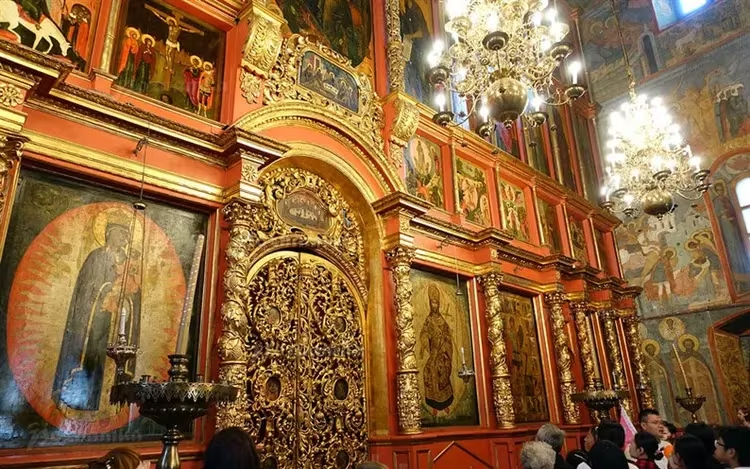
The icons that can be seen within the walls of the temple were mostly painted in the seventies and early eighties of the XYIII century. They were ordered by Tsar Fedor Alekseevich. The carved iconostasis was made by skilled craftsmen called from all over Russia, in total more than 60 people were engaged in this work. It has four tiers, with the Crucifix at the top. On both sides of the Royal Doors you can see unique icons – “The Great Bishop of the Savior”, “Our Lady of the Blessed Sky”.
Where is it located and how to get there
It is most convenient for guests of the capital to take the metro to the Borovitskaya, Aleksandrovsky Sad and Arbatskaya stations. Exit to the Alexander Garden, here you can buy entrance tickets.
Ticket price
To avoid unpleasant misunderstandings, you need to know the rules of conduct on the territory of the Kremlin:
- You can take pictures on the territory of the complex, it is not allowed to take pictures in museums and cathedrals
- You can not visit the territory in a state of intoxication, in inappropriate clothing, carry flammable substances, weapons, all this can be deposited
- Can't eat, drink
- It is not recommended to sing, put up flyers, play musical instruments
Tourists do not need much – you just need to show respect for a place that is significant for a Russian and not commit unworthy acts.
At least once in your life, if you have such an opportunity, you should visit the Moscow Kremlin, and one of the most beautiful buildings and most interesting museums is the Museum of the Cathedral of St. Michael the Archangel. The unique frescoes, icons and tombs collected there will not leave anyone indifferent, the impressions will remain for a long time.