


Cathedrals and churches of Moscow: why we removed these guides
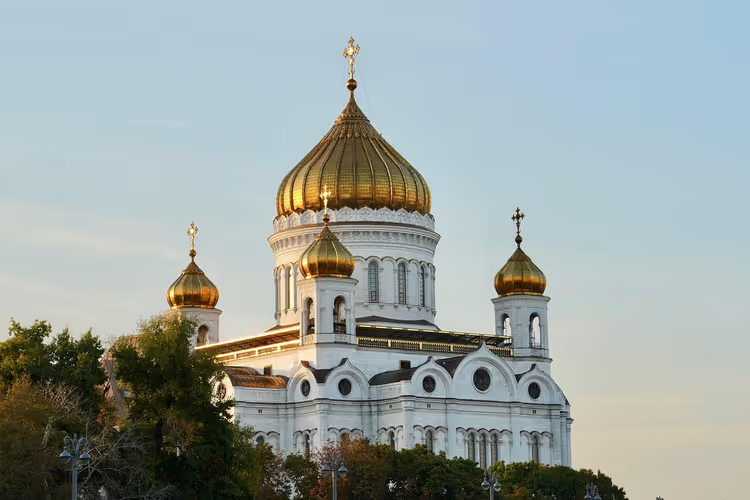
Five guides to the churches of central Moscow are no longer available at this address. These were texts about St. Basil's Cathedral, the Cathedral of Christ the Savior, the Epiphany Cathedral in Yelokhovo, the Ascension Cathedral, and a general roundup titled "churches, cathedrals, and temples of Moscow."
For a reader who was looking for a list of churches and service times, the short answer is this. The architectural value of a building is a real argument, but it answers the question "is it interesting to look at," not "is it worth going." The second question is decided by other circumstances, and since February 24, 2022, when Russia launched its full-scale invasion of Ukraine, those circumstances have changed irreversibly.
💡 At a glance:
- which five guides were deleted and where the old links now point
- what our previous church texts were silent about
- which registries and bans are in force in the country we were inviting readers to visit
- which countries with major cathedral ensembles remain in our live sections
- Last updated: 09/2026
Why we deleted these guides
The five removed texts were all structured the same way: construction history, architectural details, photographs, opening hours, directions. All old addresses in all language versions now have permanent redirects to this text.
We did not rewrite them or put a warning on top. We believe that a warning placed above material that is promotional by genre does not change the material itself: it still remains an invitation to come. The entire section on Russia, occupied Crimea, and Abkhazia was removed, and the church guides were no exception.
We phrase the money argument carefully, because the familiar version is inaccurate. The share of oil and gas revenue in Russia's federal budget fell to roughly 22 percent in 2025 and 2026, down from 42 percent in 2022 (OSW Centre for Eastern Studies, 12/09/2025). So the argument should not be about oil. The share of non-oil-and-gas revenue, which includes taxes from the service sector, has grown to roughly 78 percent, and that is exactly where a visitor's spending lands. A candle in the gift shop has nothing to do with it, but the hotel, transport, and food around a church route do.
What our church texts were silent about
A cathedral guide is structured so that it physically has no room for the country's context. It talks about domes and mosaics and implies that everything else around it is ordinary life. Below is what we should have told the reader and did not.
Since 2015, Russia has had a law on "undesirable organizations" that allows foreign organizations and their materials to be banned (EU Agency for Asylum, legal overview). As of April 2026, more than 343 organizations have been designated "undesirable," and the "foreign agents" registry contains more than 1,173 entities and individuals (Human Rights Watch, World Report 2026, "Russia" chapter).
In April 2026, UN special rapporteurs stated that the strategy of blatant abuse of anti-terrorism and anti-extremism legislation to destroy Russian civil society must stop, and cited the same registry figures, adding 830 organizations and 20,813 individuals on the "terrorists and extremists" list (UN Human Rights Office, 04/2026). This is not an editorial assessment but the wording of independent UN experts, and it applies to the country as a whole, not to a specific building or congregation.
Another point that a sightseeing text, by its very structure, does not mention. Germany's Federal Foreign Office, in its current travel advice, warns that German citizens and people with dual German-Russian citizenship face the risk of arbitrary detention (Auswärtiges Amt). A "five churches in one day" piece is written for a reader who has no reason to think about detention, and it cannot accommodate such a warning.
Where the russian orthodox church stands
On March 27, 2024, at the Cathedral of Christ the Savior in Moscow, the World Russian People's Council, chaired by Patriarch Kirill, adopted the document "The Present and Future of the 'Russian World'," which calls the war against Ukraine a "holy war": "From a spiritual and moral point of view, the special military operation is a holy war, in which Russia and its people defend the single spiritual space of Holy Rus" (Atlantic Council, UkraineAlert; OSW Centre for Eastern Studies, 04/12/2024). The World Council of Churches, the international ecumenical organization to which the Russian Orthodox Church itself belongs, publicly stated that it could not "reconcile" this document with its core principles and criticized the characterization of the war as "holy" (World Council of Churches).
On June 9, 2026, the European Commission proposed for the first time since 2022 to include Patriarch Kirill in the EU sanctions list, this time as part of the 21st package; at that point he was already under personal sanctions from the United Kingdom, Canada, and Czechia, and Estonia and Lithuania had banned him from entering their territory (Euronews, 06/09/2026).
The practice of Orthodox priests blessing ballistic and cruise missiles, strategic bombers, submarines, and tanks has been documented in numerous photographs at least since the 2014 annexation of Crimea; a senior cleric of the Russian Orthodox Church publicly stated that blessing ballistic missiles is permissible "if they serve people" (National Catholic Reporter; United24 Media).
In Ukraine itself, on August 20-21, 2024, the Verkhovna Rada passed a law allowing the banning of religious organizations linked to the Russian Orthodox Church, including the Ukrainian Orthodox Church of the Moscow Patriarchate; the president signed the law on August 24, 2024, on Ukraine's Independence Day (Al Jazeera, 21.08.2024).
All of the facts above concern the centralized leadership of the church: the Moscow Patriarchate, the Synod, and Patriarch Kirill personally as its head. We do not assert or imply anything about the position of specific parishes, individual local priests, or parishioners of the churches mentioned in this text.
Our argument does not become simpler because of this: it is not only about what happens inside a church, but about what happens in the country we were suggesting readers visit, about the public position of the church leadership, and about the legal framework in which a publisher from the European Union operates. All circumstances are confirmed by documents with numbers and dates and are listed in this text.
There is also a strong objection to any tourism boycott, and we prefer to name it ourselves. Refusing to travel hurts ordinary people: private hotels, cafes near the church, the person who leads tours. This argument is examined by researchers of consumer campaigns, and it was not invented by our opponents (Ethical Consumer). For us, it is resolved not by argument but by fact: for a person from the European Union, providing tourism-related services in Russia has been directly prohibited since January 1, 2026, and the German Foreign Ministry warns against travel. The question of "whether to refuse or not" for an EU-based publisher has already been legally decided, and not by us.
What this means for you
Item | Status 09/2026 | Source |
|---|---|---|
Tourism-related services in Russia | Prohibited by Article 5n(2) of Regulation 833/2014 as amended by Regulation 2025/2033 of 23.10.2025 | |
Transition period | For contracts concluded before 24.10.2025, ended on 01.01.2026 | |
Tour guide services | Explicitly named among the covered prohibitions | |
German Foreign Ministry advisory | "Vor Reisen in die Russische Föderation wird gewarnt" | |
Risk of arbitrary detention | The German Foreign Ministry warns about it directly | |
Travel market | Organized tourism to Russia fell by roughly 90 percent as early as 2022 |
Our previous text with a route through five churches, service times, and advice on where to start differs little in form from the work of a tour guide, and tour guide services are explicitly named in the list of covered prohibitions.
Where to go instead
The need readers brought to these texts was for large cathedral ensembles, tent-roof and dome architecture, mosaics and iconostases. The live sections of the site answer that need: the Vatican and Italy, Greece with Athens and Thessaloniki, Hungary, and also Cyprus and Georgia if the Byzantine tradition is what interests you. For wooden and early medieval architecture, we have material in the Norway and Armenia sections.
The overall explanation for the whole section is collected in the section hub. Related text: where we stand on Moscow monasteries and the Vagankovo cemetery.
Where we stand
We believe that a building's architectural value is not an argument for traveling there when the state is waging war against a neighboring country and has shut down freedom of association and independent civic work at home. In our assessment, a guide to churches is the most deceptive genre in this section: it looks the least political, and that is exactly why it sells a feeling of normality so effectively. We decided to remove these materials and explain why at the same address.
We write about a state and its policies, not about people based on their passport. There are people in Russia who came out against the war and received prison sentences for it. Our decision not to publish guides to Russia is about money, sanctions and reader safety, not nationality.
Publication date: September 3, 2026. Last updated: September 3, 2026.
⁉️🤔 Frequently asked questions
Isn't a church outside politics?
A building can be outside politics; a trip cannot. We removed not a description of architecture, but an invitation to come and spend money. For an EU-based publisher, such an invitation has been covered since January 1, 2026 by the ban on providing services related to tourism in Russia.
Are you making any claims about the Russian Orthodox Church?
Yes, but only about the centralized leadership, not about specific parishes, local priests or parishioners. It is documented: the World Russian People's Council statement about a "holy war" (27.03.2024), the European Union's proposal for personal sanctions against Patriarch Kirill (09.06.2026), and the sanctions already in force against him from the United Kingdom, Canada and Czechia. We make no claims about the positions of individual church rectors mentioned in this text or their parishioners.
Can I just go to a service without buying anything?
We do not provide travel advice and do not describe any procedures. We can only state the official position: Germany's Federal Foreign Office warns against travel to the Russian Federation.
Where do the old links to these guides lead?
To this page, in all language versions. The reader gets an explanation, a list of sources and a list of destinations we continue to write about.
In short
Five guides to cathedrals and churches in central Moscow have been removed, and the old addresses redirect here. As of April 2026, Russia has more than 343 "undesirable" organizations and more than 1,173 "foreign agents," and in April 2026 UN experts demanded an end to the abuse of anti-extremism legislation against civil society. Germany's Federal Foreign Office warns against travel. Since January 1, 2026, providing services related to tourism in Russia has been prohibited for persons from the EU. Countries with large cathedral ensembles are listed above.
How you can help
We do not collect money and receive nothing from the links below. These are official websites of organizations working with the consequences of the war:
- UNHCR, the UN Refugee Agency, unhcr.org
- UNICEF, unicef.org
- Ukrainian Red Cross, redcross.org.ua
Sources
- European Union Agency for Asylum, overview of legislation on "undesirable organizations" and "foreign agents." https://www.euaa.europa.eu/russian-federation-country-focus/22-legislation-undesirable-organisations-and-foreign-agents
- Human Rights Watch, World Report 2026, "Russia" chapter. https://www.hrw.org/world-report/2026/country-chapters/russia
- UN Human Rights Office, statement by UN special rapporteurs on the abuse of anti-extremism legislation, 04.2026. https://www.ohchr.org/en/press-releases/2026/04/strategy-blatant-abuse-counter-terrorism-and-extremism-laws-destroy-russian
- Council Regulation (EU) 2025/2033 of 23.10.2025 amending Regulation 833/2014, EUR-Lex. https://eur-lex.europa.eu/legal-content/EN/TXT/?uri=OJ:L_202502033
- Skadden, analysis of the EU's 19th sanctions package, 11.2025. https://www.skadden.com/insights/publications/2025/11/eu-adopts-19th-sanctions-package
- Auswärtiges Amt, Russische Föderation: Reise- und Sicherheitshinweise, as of 02.09.2026. https://www.auswaertiges-amt.de/de/service/laender/russischefoederation-node/russischefoederationsicherheit-201536?isLocal=false&isPreview=false
- Fox News, overview of industry statistics on the decline of organized tourism to Russia, 2022. https://www.foxnews.com/world/organized-tourism-russia-down-90-2022-ukraine-invasion-drags.amp
- Ethical Consumer, on arguments against consumer and tourism boycotts. https://www.ethicalconsumer.org/our-ethical-ratings/oppressive-regimes-and-their-allies
- Centre for Eastern Studies OSW, Russia's 2026 budget, 09.12.2025. https://www.osw.waw.pl/en/publikacje/osw-commentary/2025-12-09/russias-2026-budget-mounting-financial-challenges-and-economic
- Atlantic Council, UkraineAlert, on the decree of the World Russian People's Council "The Present and Future of the 'Russian World.'" https://www.atlanticcouncil.org/blogs/ukrainealert/russian-orthodox-church-declares-holy-war-against-ukraine-and-west/
- Centre for Eastern Studies OSW, on the same document, 12.04.2024. https://www.osw.waw.pl/en/publikacje/osw-commentary/2024-04-12/a-holy-war-russian-orthodox-church-blesses-war-against-west
- World Council of Churches, statement on the impossibility of reconciling the WRPC decree with its principles. https://www.oikoumene.org/news/wcc-cannot-reconcile-world-russian-peoples-council-decree-describing-ukraine-conflict-as-holy-war
- Euronews, on the EU proposal to add Patriarch Kirill to the sanctions list and on his current sanctions status, 09.06.2026. https://www.euronews.com/2026/06/09/eu-targets-russias-patriarch-kirill-in-new-sanctions-proposal
- National Catholic Reporter, on the ROC practice of blessing weapons. https://www.ncronline.org/news/russian-orthodox-church-considers-ban-blessing-weapons-mass-destruction
- United24 Media, on a ROC cleric's statement about blessing ballistic missiles. https://united24media.com/latest-news/blessing-ballistic-missiles-is-fine-if-they-serve-the-people-says-russian-orthodox-priest-8104
- Al Jazeera, on Ukraine's law banning organizations linked to the ROC, 21.08.2024. https://www.aljazeera.com/news/2024/8/21/ukraine-adopts-historic-law-to-ban-moscow-linked-orthodox-church
Link check date: 03.09.2026.

A small editorial team writing guides for independent travel. We travel ourselves, but we haven’t been everywhere, so we check prices, opening hours and how to get there against official sources.