
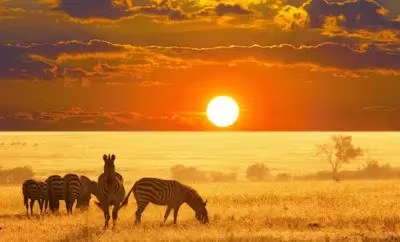
Great Kalahari Desert
If the conversation turns to deserts, then most often they remember the Sahara, completely forgetting about the great Kalahari, spread over the territory of three African countries at once: South Africa, Namibia and Botswana. But its huge area – more than 600 thousand square kilometers every year is growing at the expense of the territory of other countries – Angola, Zimbabwe and Zambia. A trip to those lands cannot be cheap and short, so you should definitely take some time to get to know this desert.
The Kalahari is considered the hottest region in all of South Africa, and the minimum annual rainfall makes this desert one of the driest and deadliest on the planet. At the same time, the “rainy period” falls on the summer, however, one should not assume that at this time stormy rivers flow along the Kalahari and young grass makes its way everywhere between the stones. Geographically, the boundaries of the desert are the Molopo River in the south, the Namibian plateau in the west, and the Transvaal plains in the east. The plateau on which the desert lies is located 1,500 meters above sea level, while it itself is a product of the weathering of rocks formed many millions of years ago.
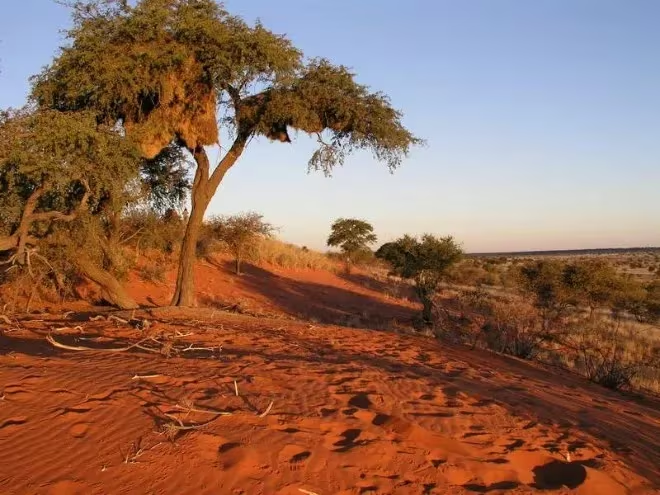
If you come here, you will be able to observe the real desert in all its diversity, and not the dune sands that are usually shown in films and in pictures. The famous Giza Valley (Egypt) boasts just such a “yellow” desert. In addition to just sand, which in the Kalahari has a reddish color due to iron oxides, blocks of dense sandstone are scattered everywhere here, and there are also massifs of limestone. The channels of ancient rivers are full of pebbles and gravel, and only in flat places does fine-grained sand of aeolian (wind) origin act as the upper layer. It composes huge dunes and dunes, located in long chains. It is interesting to observe how sand in one dune can change its color, from deep red to pink.
Walking along the Kalahari, you can come across outliers – high rocks, vertical bollards going up. They are all that remains of the high plateau, which gradually turned into heaps of sand lying everywhere. These rocks resemble those in Arizona or Texas, only they are slightly smaller. But the wind has given them such bizarre shapes that you will involuntarily begin to fantasize looking at them. Many climbers use these rocks for training. You can also try your hand if you are involved in this sport, you only need to obtain permission from the authorities and the administration of the Kalahari Natural Park.
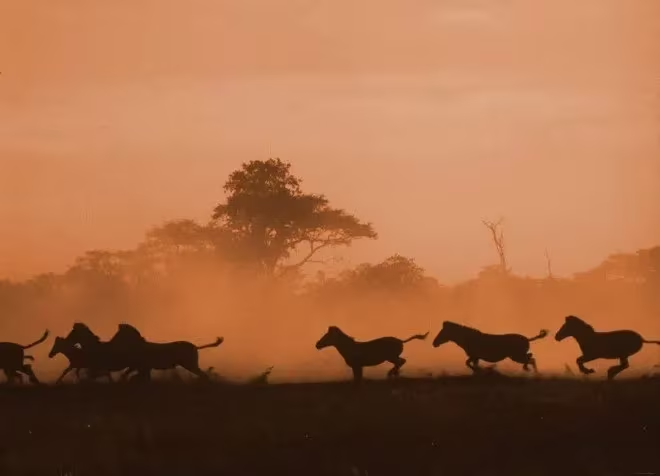
When planning an excursion or even a short trip through this vast desert, be prepared for various difficulties. Firstly, you do not need to try to do everything yourself, be sure to hire a guide and follow his advice not only on the way, but also a little earlier – during the training camp. Of course, if you are planning a walk for a couple of hours, you should not turn it into a serious expedition, but such simple things as a compass and a flask of water should be taken with you anyway. In the Kalahari, you can meet many small animals, because contrary to popular belief, the deserts are not at all deserted, but inhabited, and quite densely. Having carefully looked at the local hills, you will notice how small furry fennecs run, lizards and small snakes crawl. Here and there dry, brown blades of grass break through, which seem completely dead,
The Kalahari Desert is a whole interesting world in which wild animals coexist with African tribes. Come here to witness the life of the desert with your own eyes, to feel its hot breath and the incinerating rays of the sun on yourself.