
Spit of Vasilyevsky Island in St. Petersburg – history, photo, description, how to get there, map
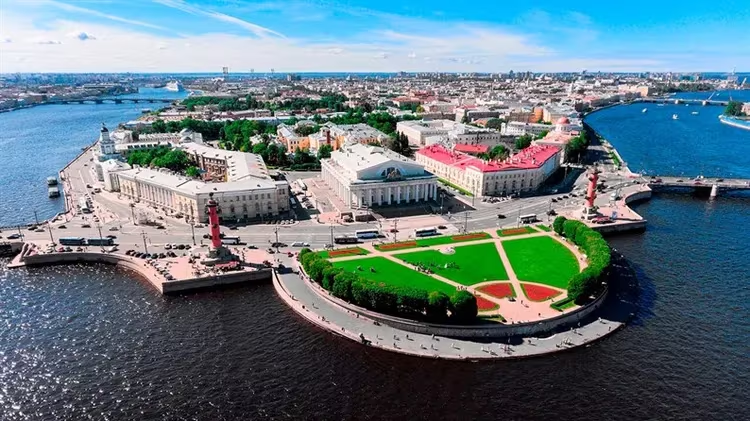
The Spit of Vasilevsky Island in St. Petersburg is one of the most beautiful places in the Northern capital. How was a masterpiece of architecture created, where to walk and where to go?
Story
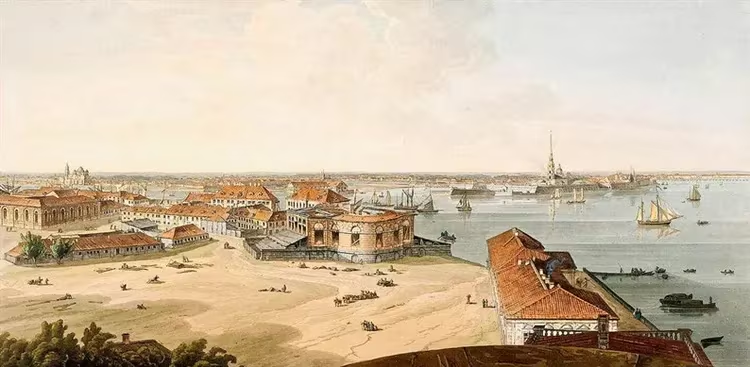
The cape (arrow) of Vasilyevsky Island, the largest in the Neva Delta, divides the river into two channels. It is assumed that it was named so for its shape, similar to an arrowhead.
Start of development
According to the research of scientists, pre-Christian temples were located in this territory in ancient times. The Magi performed pagan rites and magical rituals, all kinds of sorcerers, soothsayers and other mysterious personalities always aspired here. The history of the arrow began at the beginning of the 16th century, long before the development of St. Petersburg. According to the census of that time, there were small fishing settlements in these places. The first name belongs to this time. According to the hypothesis, the island is named after one of the posadniks of Novgorod – Vasily Seleznya, or Ananyin, according to another version – in memory of a simple fisherman, one of the first settlers. Under the Swedes, in the 17th century it was called Prudovy, referring to the ponds in the tributaries of the Smolenka River. After the founding of St. Petersburg, the old name returned.
Implementation of building plans
From 1707 to 1714 the island was owned by Governor-General A. D. Menshikov, the prince's palace was the only stone building. The rest of the territory was almost uninhabited – only small wooden dwellings of serfs, mills and some other buildings. The development of this territory began along with the construction of a new city. According to the plan of Peter the Great, the new capital of the state should become a sea fortress, a military and commercial port.
Initially, the port facilities were located on the Petrograd side, but then they decided to move them to a more convenient place – the spit of Vasilyevsky Island. Trezzini, one of the most talented architects of his time, was entrusted with preparing a development plan for the eastern part. According to the first project, most of the buildings should be residential, but the emperor wanted to create an administrative and cultural center with a large seaport. According to the new plan, government buildings formed the basis.
Architectural ensemble
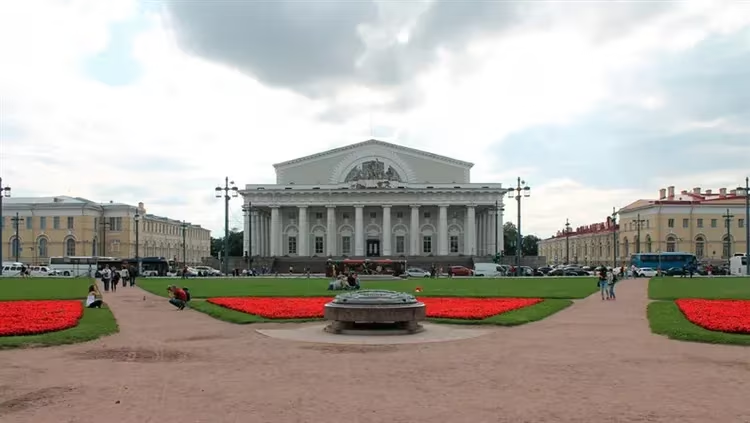
The main element of the ensemble, located along the banks of the Neva, was the complex of the Twelve Colleges. It consisted of 12 identical three-story sections, which were occupied by state governments. Now the University of St. Petersburg, a library and administrative premises are located here. In the shortest possible time for those times, buildings were built that became the basis of the appearance – Gostiny Dvor, the palace of Queen Praskovya (after her death, the Academy of Sciences was located here for some time), the Kunstkamera, the Stock Exchange. From the 30s. the seaport began to receive ships, but already in 1885 it was moved closer to the Gulf of Finland, since the fairway did not correspond to the displacement of new merchant ships.
Change of panorama in 2008
In 2008, the construction of modern multi-storey buildings began in the area of the House of Culture. Kirov. Thus, according to experts and ordinary residents of the metropolis, significant damage was done to the appearance of the iconic place for St. Petersburg residents. The city community stood up for the protection of the historical panorama, a scandal broke out, the construction site was called a “crime.” But when the government turned to the developer to reduce the number of storeys of high-rise buildings, he refused. a similar project called “Marine Facade”, which can lead to even more serious violations in the harmonious ensemble.
Exchange on Strelka
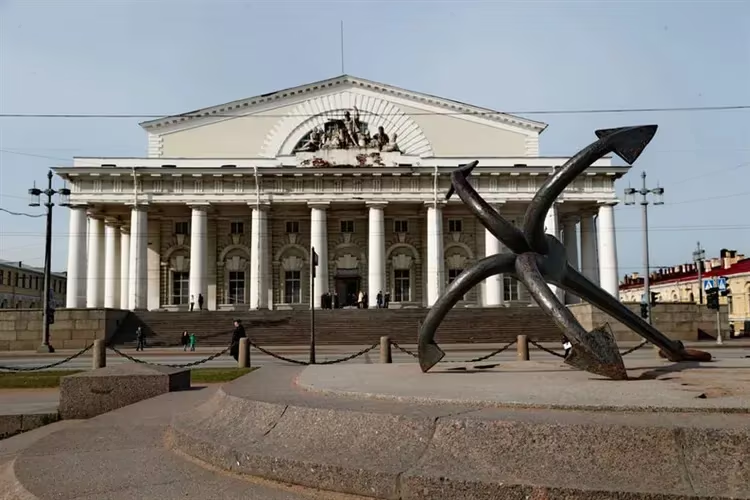
From 1703, merchants gathered here, the meeting was called the stock exchange, later the place where trade transactions were made was also called that. The first Russian Exchange was built on Vasilievsky Island from wood in the 1730s. Over time, the turnover of the port increased and the area was not enough for full-fledged work. In 1781, at the direction of Catherine the Great, they decided to build a new stone structure, the construction of which began in 1784. The construction was delayed, there was not enough money in the treasury, in 1788 the construction was suspended due to hostilities with the Swedes and Turks.
The new building was erected according to another project, which was developed by J. F. Thomon. The old building was dismantled, in the summer of 1805, after the laying ceremony, the construction of a structure in the style of an ancient palace began. The work was completed by 1810, but construction flaws were revealed, they were eliminated for another two years. The official opening, which was delayed due to the war with Napoleon, took place in July 1816. On this occasion, a grand celebration was arranged. Dimensions – 69 m x 44.5 m. The plinth is made of granite, around which forty-four majestic columns rise.
On the western and eastern facades there are 40-meter-wide stairs. Ramps from the side facades are designed for the entry of carriages. The building is decorated with sculptures glorifying the power of Russia. The main hall is approximately 900 sq. m., its height is 25 meters. The floor and walls are lined with marble slabs. In this building, Russian and foreign merchants made major transactions, and a special committee was formed to manage the work. The structure was rebuilt in 1913-1915: instead of furnaces, a calorific heating system was installed, and a reinforced concrete vault was built for trading. Reconstructed staircases and basement.
After the revolution, a club of sailors was opened here, various meetings of cultural workers were held, then the North-Western Chamber of Commerce and a museum were located. In 1930, the building was transferred to the Academy of Sciences, in 1939 – to the Naval Museum, currently it is owned by the Hermitage.
Stages of formation
To make the outlines of the coastline symmetrical, they created an artificial arrow contour, for this they hammered piles and poured soil, pushing the coast more than 120 m into the river. A semicircular area was formed with a smooth descent to the river and a granite fence. To complete the ensemble, they built the Customs House and two symmetrical warehouses (closed warehouses) – northern and southern in 1826-1832. In 1924, a severe flood damaged the broken square, the existing one was restored by the architect Ilyin in 1926. At the same time, monuments to Rossi and Quarenghi were erected, the fence of the square was replaced with granite pedestals. By 1936, the area was asphalted.
Rostral columns
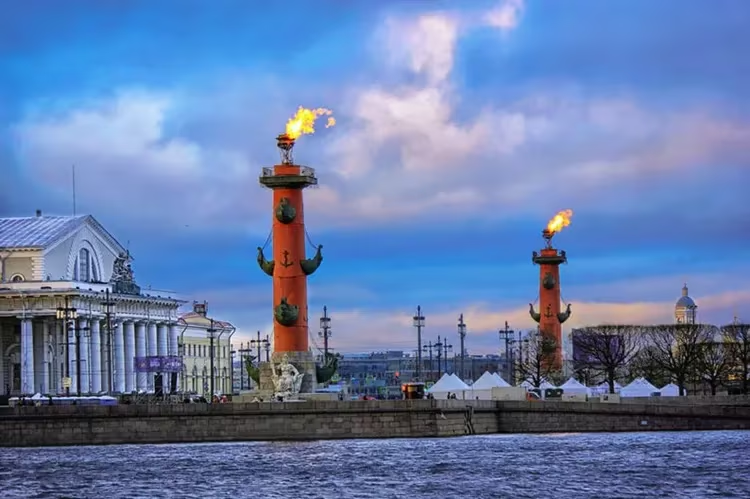
Two grandiose columns, installed not far from the Stock Exchange in 1810, played the role of lanterns that were lit at night and in fog. Why are the columns called Rostral? On the bow of the ancient ships, rosters were installed (translated from Latin means a beak). They played the role of a ram during the battle with enemy ships. In ancient times, they were also used as decorative elements for various purposes – they decorated stands, front columns. In St. Petersburg, they symbolize the might of Russia as a military and commercial power. Decorated with four pairs of rostra in memory of the war with Sweden for access to the Baltic Sea, which Peter the Great waged for 20 years. They are decorated with figures of mermaids, fish, heads of crocodiles, mermen and images of seahorses.
At the bottom of the columns there are statues symbolizing sea deities. The assertion that the figures are allegories of the largest Russian rivers (Neva, Volkhov, Volga and Dnieper) appeared recently and, according to documents, does not correspond to reality. The columns were designed by the architect Tomon, using various building materials. The rosters on the barrel are made of metal. The author wanted to cast the sculptures in the lower part of the structure from bronze, but no one took up the difficult work. They were carved from stone mined in quarries located near Gatchina.
Lanterns were used until 1885 at night and when fog descended on the city. Inside each building there is a steep spiral staircase, at the top there is a tripod in the form of ancient altars, on which a lamp bowl is installed. First they burned pitch, resin torches, then hemp oil, but the red-hot particles fell on passers-by, burning them. In 1896 electricity was provided. In 1957, gas burners were installed; currently, the fire is lit on holidays.
Museums
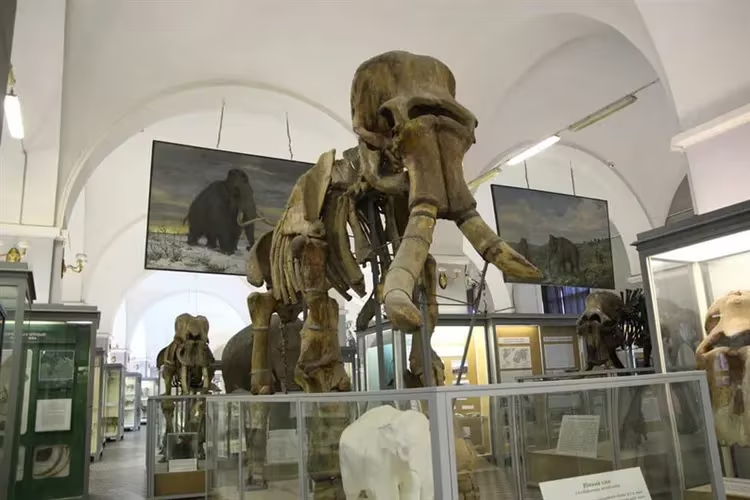
On the spit of the island there are several unique museums that will be of interest to adults and children. Kunstkamera – the exhibits tell about the beliefs, life and culture of the peoples of the world. But he is better known for anatomical rarities and anomalies. The collection began to be compiled by Peter I, here are materials of the 17th – 19th centuries, brought from expeditions in Siberia and Kamchatka. The collection of N.N. Miklouho-Maclay, collected on the islands of Oceania and in New Guinea, and many more amazing things. Pushkin House (Literary Museum) – located on the Makarov embankment, representing more than 300 thousand documents and works of art. You can get acquainted with the exhibits dedicated to the work of brilliant Russian writers and poets, including the Silver Age.
The Zoological Museum is located in the premises of the former Southern Warehouse. It contains a huge collection of animal specimens from all over the world – the first specially equipped exhibition space in Russia. There are more than ten thousand exhibits here – stuffed animals of living representatives of the fauna, skeletons and remains of extinct animals, rare and endangered species that are under the threat of extinction. Among them is a strikingly preserved stuffed mammoth Dima, which was removed from the permafrost.
The former Northern Warehouse houses an equally interesting Museum of Soil Science, which opened in 1904. The collection includes soils of all natural zones of the Earth, it is more than 2500 exhibits. The basis of the exposition is the samples collected by the outstanding naturalist, soil scientist V.V. Dokuchaev. The purpose of the museum is to display the diversity and role of soils in ecosystems, the patterns of their distribution.
arrow today
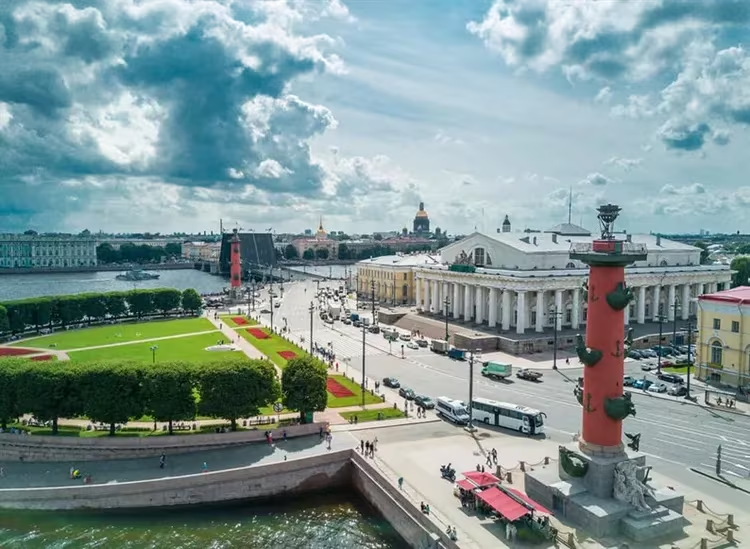
The embankment, smoothly descending to the river, is one of the favorite places of St. Petersburg residents and guests of the city. Newlyweds often come here on their wedding day. The granite wall along the embankment is decorated with the heads of lions with rings in their mouths. There is a tradition – you have to touch the ring for good luck. Folk festivals are held on the square, city and national holidays, concerts are held. In 2003, new sights appeared – an 18th-century anchor raised from the Skipper Canal of the Neva River. As well as a memorial sign donated by the customs service of St. Petersburg in honor of the 300th anniversary of the city. It is a round bronze plate with a diameter of about 2.5 m, mounted on a granite pedestal. The grand opening of the sign, which depicts the structures of the Island Spit, took place on November 14, 2003.
Where is it located and how to get there?
Strelka is located in the city of St. Petersburg, the eastern part of Vasilyevsky Island. It is more convenient to get there by metro: go to the Admiralteyskaya station, then along Palace Square, through the Palace Bridge, go to Birzhevaya Square. Distance about 1 km, 15 minutes on foot. From Art. Vasileostrovskaya metro station can be reached in 25 minutes. Coming out of the metro, walk to the Makarov embankment, then to the right to Birzhevaya Square. From Art. Metro station “Gorkovskaya” should go through the Alexander Garden, then along the Kronverskaya embankment and across the Birzhevoy Bridge. The walk will take less than half an hour.
During navigation, a sightseeing boat runs to the cape, including from Kronstadt or Peterhof, but you must first familiarize yourself with the schedule. The picturesque place is rich in history, beautiful nature, cultural monuments. Guests of this beautiful city will get the best impressions from walking, which will remain in memory for many years.