
Alexander Column in St. Petersburg – history, photo, description, how to get there, map
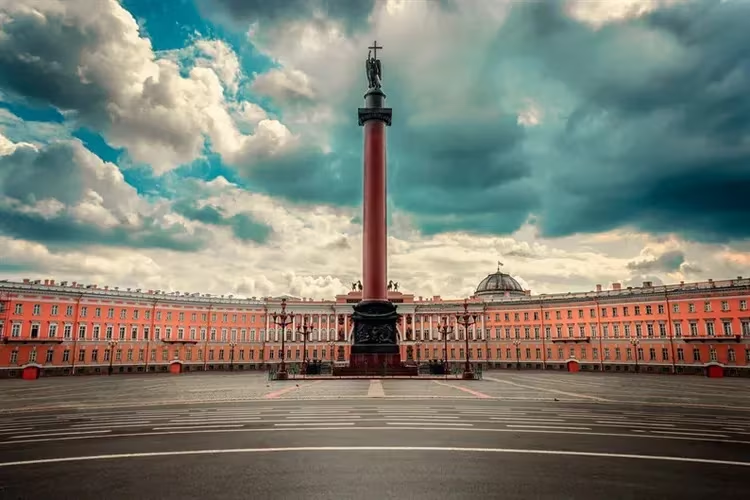
One of the highest (among the famous columns of the planet), the city landmark is built of beautiful, rare granite, rises on the Palace (main) square in its central part. The Alexander Column in St. Petersburg deservedly attracts special attention of tourists and local residents.
Story
The architectural landmark is a monument dedicated to the glory, courage of the Russian people under the leadership of Emperor Alexander I in the significant overthrow of Napoleon. The majestic creation harmoniously complements a single architectural ensemble. It continues the historical version of the triumphal structures that were born in ancient times and adorn the squares of many countries (Trojan's columns in Rome, Nelson's in London).
The main difference, the advantage of the Russian column is the beauty of a monolithic stone used in the form of a single piece of beautiful granite. It is almost 10 meters taller than its original source: the Trojan Monument in Rome (the Vendome Column of Paris). The initial stage of the construction of the column included a serious competition of projects, a detailed discussion of each element. All of them have their own interesting history of creation.
Two variants of the Montferrand project
The attraction is a masterpiece of labor, engineering, artistic creativity of Auguste Montferrand. The main requirements imposed on the architecture at the beginning of the project were: the monument should serve as a landmark and exceed in height (all existing at that time) similar structures. The first version of the monument looked like an obelisk. On the front side of the surface (height 25, 6) it was supposed to place paintings, bas-reliefs from the moments of the war. The complex pedestal was planned to be decorated with a sculpture of a rider who defeated a snake. In front of the rider is a double-headed eagle. Behind the figure is the goddess of Victory. It was also supposed to place the line “To the Blessed, Grateful Russia.” The project was rejected by Nicholas I. Now it is kept in the library storage. The Emperor approved the second version of the project in 1829.
Final project
After rejecting the first version of the monument, the emperor indicated the specific form of the monument, reminiscent of ancient columns. The images of three columns were chosen as the basis for the final project of the monument: Trajan and Anthony (Rome), Pompeii (Alexandria), and the Vendôme column of Paris. The architect did not plan to use complex elements of column decoration (bas-reliefs wrapping around the entire height of the column). It was a variant of a simple pillar, fixed on a special pedestal (a copy from the Troyan column), decorated with a top. The planned height should be about 48 m, which is higher than single, monolithic buildings. In 1829, the proposal (without the final development of sculptural design) was accepted by the emperor. The main idea was to create a majestic monument from a single stone piece. Montferrand was approved by the builder.
Stone mining
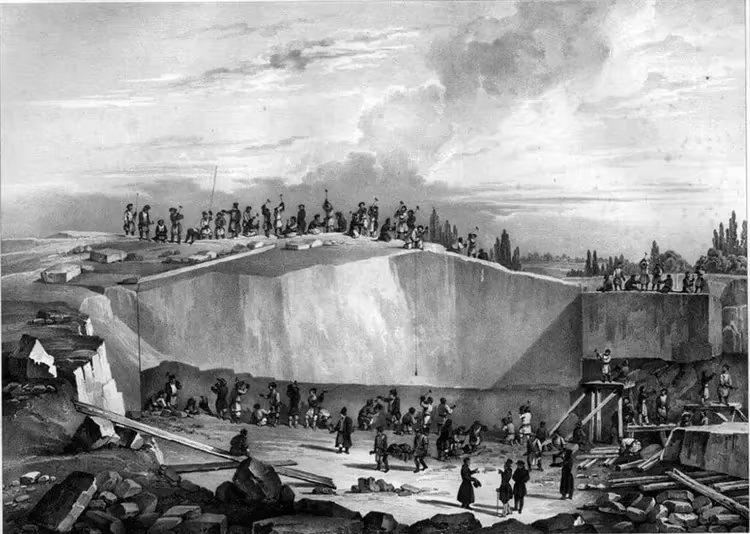
Granite mined in the Pyuterlak quarry (now this territory belongs to Finland) was used as a building material. Previously, elements of St. Isaac's Cathedral were carved on this site (the weight of its columns was about 114 tons). The rock work was supervised by a young master (20 years old self-taught) Vasily Yakovlev. Their rocks of red granite cut down a huge prism, cleared of soil, moss, laying on a bed of spruce paws. To overturn the prism (from the rock to the litter), complex levers and other devices were used. The fulfillment of the required dimensions, the processing of the column was carried out here, at the cutting site.
For the delivery of heavy cargo, a special ship “Saint Nicholas” was built according to the project of engineer Glasin. The ship with a cargo of 600 tons was towed by two steamships. From the same rock, the foundation stones of the monument were cut down and also delivered to the city (the weight of individual stones was 400 tons). They were brought to the city first. During the transportation of the column, an accident occurred. The berth could not withstand such a weight. The column fell into the water. About 600 strong soldiers were able to lift it and complete the delivery.
Building a pedestal
Before installation, 1250 pine piles were driven into the ground. Their length is 6 m. In the center was placed a box with special commemorative money (coins) issued as a sign of victory over Napoleon. A massive monolithic pedestal with rollers moving on an inclined surface was installed on the original platform. They drove to the desired site, dumped on a prepared pile of sand. The impact shook the neighborhood, frightening passers-by with a powerful blow. After fixing the special props, the sand was removed, and rollers were installed in its place.
Having destroyed the props, the block was moved to the rollers. With their help, it was installed on the foundation. With the help of steel ropes, the stone was lifted to a meter height. They removed the rollers, poured out a kind of (slippery) solution. It consisted of vodka, cement, soap. Thanks to the soap additive, it was possible to accurately install the monolith due to repeated movements. The upper steps of the pedestal were smaller. The processed granite parts were fastened with steel brackets, installed on the prepared cement composition. In 1832, an important element of the monument was ready for further work.
Installation
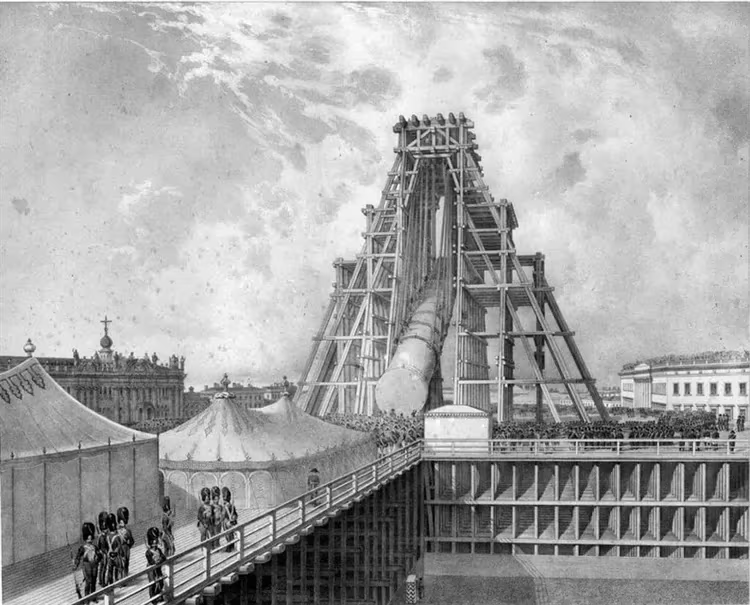
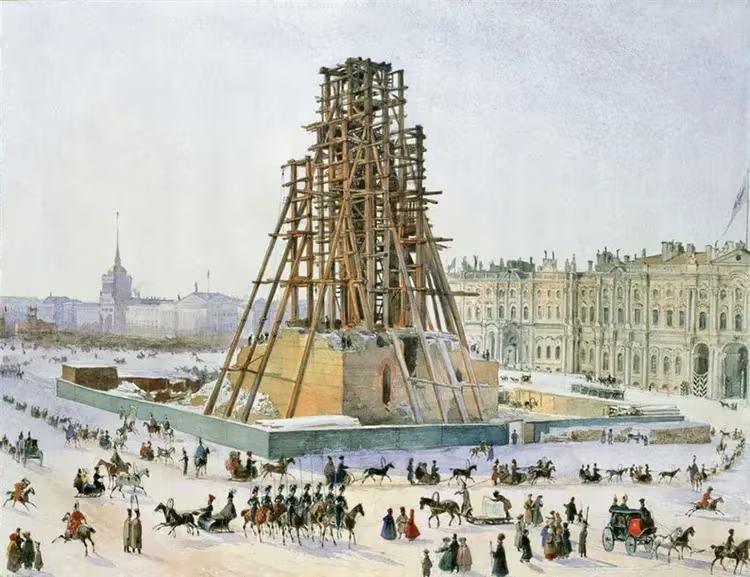
To lift a heavy pillar onto a pedestal, special devices were used, by analogy with the systems used in the construction of St. Isaac's Cathedral. Huge forests, thousands of soldiers' hands, several hundred workers were involved in the ascent. The lifting mechanism consisted of scaffolding (47 m high), 60 powerful capstans installed throughout the area, a block system at the top and bottom of the monument. To mark the base of the pillar, a temporary brick array 10 m high was built. Next to the scaffolding, there was a special platform, to which a monolith was brought along the skating rinks, an inclined surface.
Numerous ropes were wound along the entire length, leading to block systems, capstans. At the appointed time, the column rose, moved quietly, broke away from the soil, rose to the calculated height, determined by the calculated position in the pedestal. On command, the movement of the column ended. She got to the required place in just 1 hour 45 minutes. The rise was watched by the emperor, a huge number of ordinary people. “Hurray” sounded over the city. At first, the columns, held under the influence of their own weight, were careful, they walked carefully. To relieve tension in society, the architect began to regularly walk next to his creation.
Opening of the monument
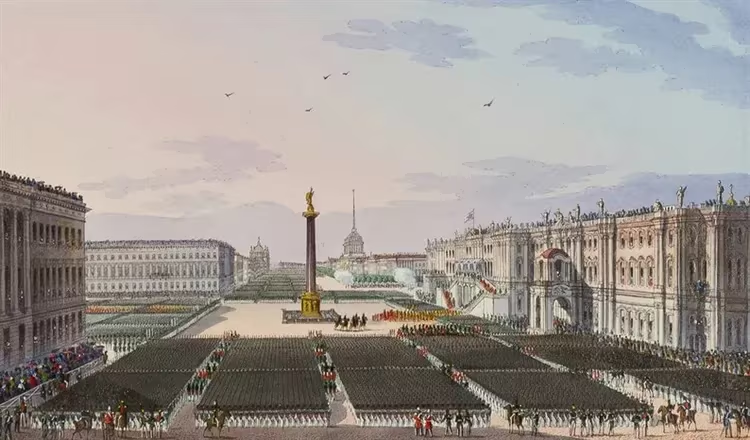
Two more years after the installation of the column passed until the day of the grand opening. It was necessary to decorate the structure with bas-relief slabs, to make the final polishing of the rod. Finish building the amazing top of the column. For convenient movement of troops across the territory of the square, along with the construction of the monument, the Pevchesky (Yellow) bridge was erected (Montferrand's version) across the Moika River. After that, the grand opening ceremony of the monument was scheduled (for August 30, 1834). A hundred thousandth army passed along the new bridge to the site of the opening of the monument. Members of the imperial family, diplomats, generals of the Russian army were present at the grand opening of the monument, which became a harmonious decoration of the main square.
Description
If you look from some windows of the Winter Palace, then your eyes will stop admiringly at the sight of the majestic pair of the arch of the General Staff, the Alexander Column. The pink giant, created by Montferrand in the likeness of existing antique columns, has an important difference: a fundamentally different approach to the principles of thinning the rod, which affects the integral perception of the architectural structure.
Unlike ancient versions, the formation of the column line did not begin from the third part of the height (the classical version of the calculation), but from the base. The thinning curve was calculated according to more complex mathematical laws using a larger number of approximations (divisions). The diameter of the base of the monument had dimensions similar to the column of Troyan. An important element of the structure is the capital of the Doric order, built of bronze at the top of the rod.
It is mounted on an abacus (rectangular) made of brick with bronze lining. The main support of the array is hidden in the upper part (in the form of a half-ball). It is made of many layers: granite, high-quality brickwork, two layers of granite. Thanks to the ideas of the architect, a tall, reliable column does not look like a massive block, but like a slender arrow victoriously goes high into the sky.
Specifications
The total height of the column is 47.5 m. At the same time, the main parts of the monument have the following parameters:
Pedestal
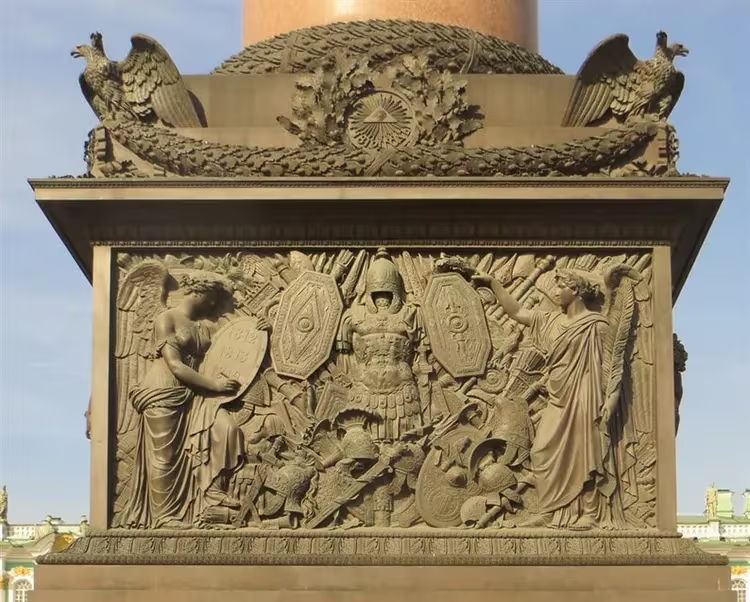
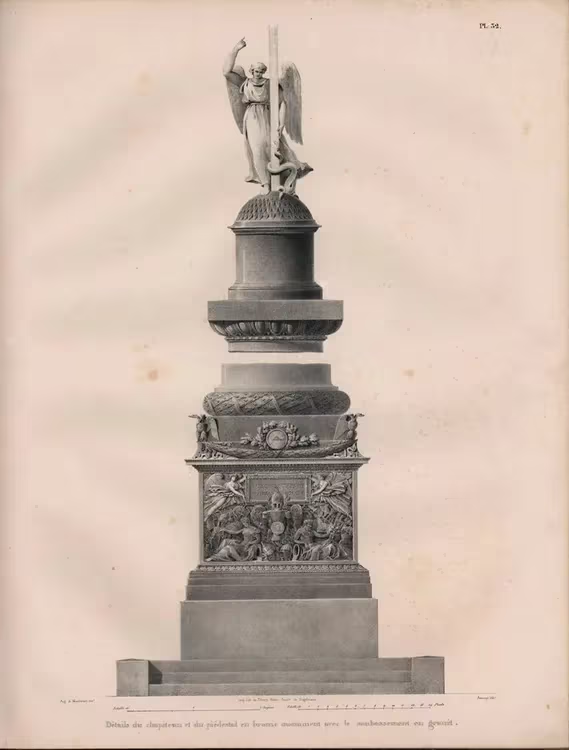
Sketches for the decoration elements of the pedestal, bronze decorations were made by Montferrand. The thematic direction corresponded to the purpose of the column in glorifying the victory of the Russian army, types of weapons. Among them there are ancient Russian chain mail, helmets, shields, armor. They were made in full analogy with the originals, which are among the exhibits of the Armory.
The style of execution of the bas-reliefs most closely matches the methods of the Renaissance. The elements were previously made from natural-sized cardboard. On the north side of the pedestal there are figures of winged women holding a plate with the inscription “Grateful Russia to Alexander I”, exact copies of military armor. On both sides of the elements with weapons are the figures of a young girl, Aquarius. From the urn standing next to the girl, water flows out, depicting the symbol of the Neman rivers, the Vistula, where the battles took place.
Dates of important victories are recorded on separate bas-reliefs, allegories such as “Victory and Peace” are presented, and others. The upper part of the pedestal is decorated with figures of two-headed eagles with an oak garland, clutched by its paws. All elements of the pedestal symbolize courage, the victory of Russian soldiers in the war of 1812.
Column, sculpture of an angel
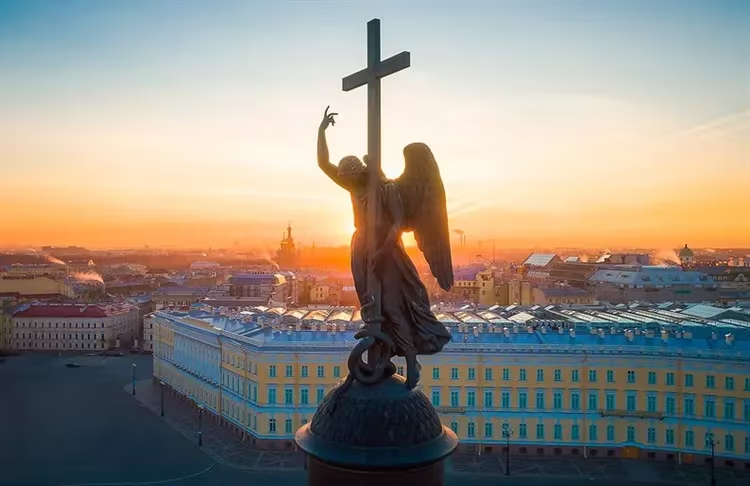
The vertical line of the monument, the harmony of the majestic building is completed by the figure of an angel with a cross. The figure resembles Alexander I, standing with his right arm extended upwards, holding a cross in his left hand and trampling on a snake. The gaze of the winged angel is directed to the earth. He, as if, rules over the order, tranquility of the inhabitants of an amazing city. The sculpture is considered a symbol of peace, peace that came to Europe after the victory over Napoleon's army. The figure was fastened with a special rod (an angel leaned on it). During the restoration in 2003, it was removed. Now the angel (like a column) is supported by its own weight.
Fence surrounding the monument
A panoramic view of the monument from all sides is completed by an interesting fence erected at the suggestion of Montferrand. All elements of the fence were assembled in 1837. In the initial version of the building, a sentry bun was located in the corner of the fence. A disabled person dressed in formal clothes was on duty here. The height of the building is 1.5 m. It houses the figures of 136 two-headed birds, 12 cannons, rows of spears, flagpoles with double-headed eagles. Symbolic locks hung on the gates of the castle fence.
The project provided for the possibility of lighting the monument with lanterns, gas devices located in candelabra. The secret of the fence is considered to be an optical illusion hidden in the figures of eagles. They have not two heads, and two wings, but three. At any viewing angle, only two are visible, in accordance with the double-headed eagle symbol. The third element is visible only upon close examination of the monument.
legends
The famous landmark of the city is covered with interesting facts and legends from her life. The locals have long feared the majestic structure, which is supported by its own weight. They also believed that:
- Omens, mystical stories are associated with the column. It seemed to Foreign Minister Lamsdorf that a bright letter “N” appeared on the column, speaking of the appearance of a new king. The solution turned out to be simple: the letter (etched with the name of the manufacturer) appeared when the lamps were turned on on the side of St. Isaac's Cathedral.
- An interesting legend is connected with the presence of a place with rich oil deposits under the column. If the column is moved, then an unprecedented fountain of natural wealth will gush out of the ground.
- During the wedding rituals, the groom carries the bride in his arms as many times as there are children in the family.
Where is it located and how to get there
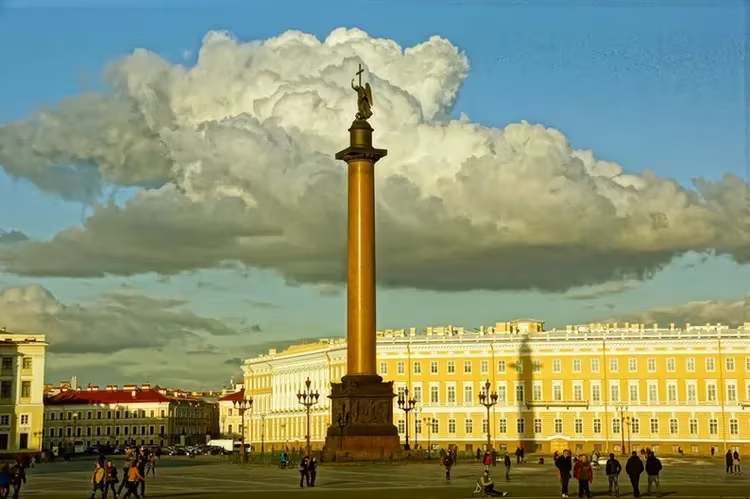
The attraction is located in the central part of the Palace Square. Using the services of the metro, you need to go to the Nevsky Prospekt stop. Focusing on the spire of the Admiralty, go to the beginning of Nevsky Prospekt. A beautiful view of the main square of the city strikes the eye from the junction of Nevsky and Admiralteysky prospects. Next to the majestic column, holidays, festivities, concerts, the traditional celebration “Scarlet Sails” are held.
A lot of people walk here. Finding attractions is not difficult. At the monument, carriage rides are organized, used in the time of Peter. They make trips to the historical center of the city. Tourist buses are parked near the embankment. You can take part in numerous excursions.