
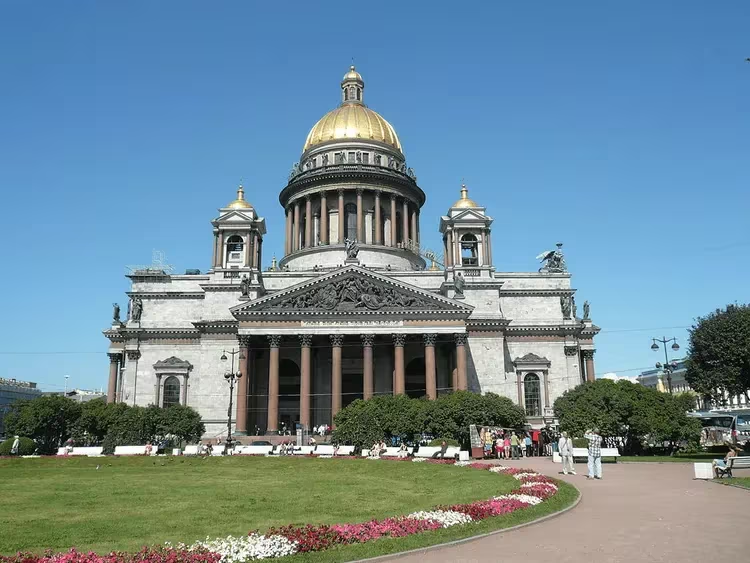
St. Isaac’s Cathedral in St. Petersburg – history, photo, description, schedule of services, map
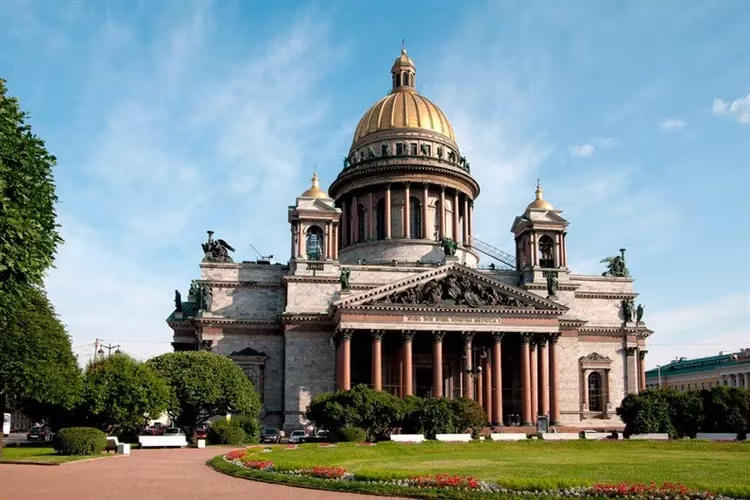
St. Isaac's Cathedral in St. Petersburg is almost the same age as the city. The initiator of its construction was Tsar Peter I. Initially, the temple served as a home church, where the monarch's family prayed. Subsequently, the basilica acquired national significance and became one of the significant architectural structures of the northern capital. Today, the Church of St. Isaac is one of the largest religious buildings in the world, is an object of the cultural heritage of Russia, and serves as the main cathedral of the city. The building houses a museum exposition, guided tours for tourists. Orthodox believers can attend the Divine Liturgy in the Basilica.
Construction history
Cathedral of St. Isaac of Dalmatia is a standard of classical style in architecture. Its correct forms and strict decoration correspond to the spirit of St. Petersburg.
First Church
By order of Peter I, next to the Admiralty, a plot was allocated for a small church. It was intended for shipyard workers. It was decided to convert the drawing shed into a temple. The work was supervised by the Dutch architect Hermann van Boles.
The one-story building was crowned with a spire and a small dome was erected over the altar space. Divine services in the church began in 1710. The tsar was often present at the services. It was he who came up with the idea to give the temple a name in honor of the saint on whose feast day he was born. In 1712, the wedding of Peter I with his second wife, Ekaterina Alekseevna, was held in the church. Isaac became not only the patron of the royal family, but of the entire new city.
As the city grew, the church could no longer meet the needs of the parishioners. The building was small and cramped, not accommodating everyone. Therefore, they decided to build a new building on the banks of the Neva. The wooden frame was dismantled.
Second church
The foundation stone of the new temple was solemnly laid by Peter I in August 1717. Several architects took part in the construction work:
The plan and decoration of the building corresponded to the trends of the “Petrine baroque”. In section, the base resembled an elongated Latin cross. Inside the church was divided into 3 naves and had side narthexes. The total length of the building was 60.5 m, and the maximum extension was 32.4 m. Virtually no interior decor was provided. The windows were glazed and the roof was covered with iron.
The appearance of Isaac partly resembled the Peter and Paul Cathedral. The identity of the two buildings was strengthened by the presence of an elegant belfry topped with a spire. It was equipped with chimes brought from Europe. St. Isaac's bell tower rose to a height of 27.4 m. The length of the spire was -13 m. The top ended with a weather vane – a figure of an angel with a cross in his hands. The iconostasis for the church was painted by Moscow icon painters from the workshop of I. Zarudny.
In the 30s. 18 The church was twice badly damaged by lightning strikes. Restoration work has been carried out. However, it soon became clear that the place where the hull stands was heavily heated. The foundation began to erode. A survey conducted by the architect S. Chevakinsky in 1760 stated the need to dismantle and transfer the building to another site.
Third Cathedral
The Senate ordered the appointment of Savva Chevakinsky as the chief designer of the new building. But his plan was not implemented. Empress Catherine II took an active part in the development of the sketch. She suggested the idea to rebuild the belfry above the basilica. The foundation stone was laid in 1868. A special commemorative medal was even minted in honor of this momentous event. By order of Catherine II, polished stone and granite were brought from Finland for the construction of the cathedral.
The Italian architect A. Rinaldi proposed his own plan for the arrangement of St. Isaac's Church. It provided for the erection of a bell tower and 5 domes in the upper part of the structure. The architect recommended using marble for wall cladding. The death of the empress did not allow the idea to be realized. V. Brenne was appointed as Rinaldi's successor. Lack of funding forced him to make significant changes to the original design of the building. It became smaller and had only one dome. The height of the bell tower was also reduced. Marble prepared for decoration was given to the Mikhailovsky Castle.
The temple of Isaac turned out to be small-sized and not beautiful enough. Literally immediately after the consecration in May 1802, the question arose about its alteration.
Cathedral today
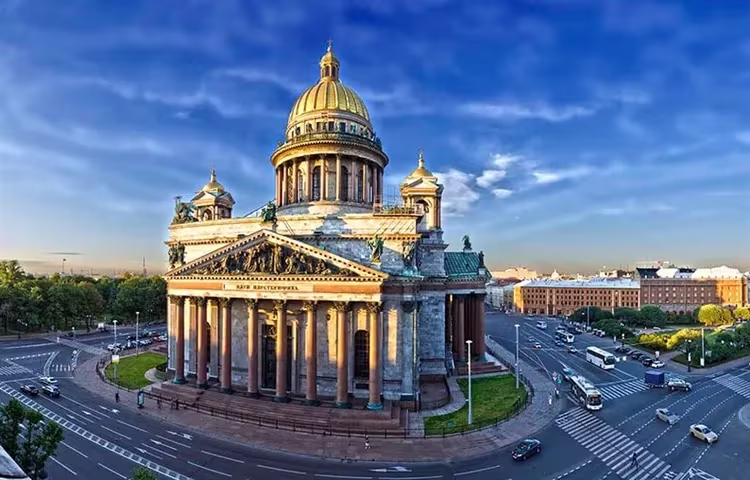
Emperor Alexander I acted as the new customer for the construction. By his decree, the little-known architect O. Montferrand was appointed as the contractor for the work. The architect did not have the necessary experience and knowledge, so the process of creating a new basilica dragged on for 40 years. Montferrand amended the project, conceived under Catherine. He increased the area of the hull and the size of the domes. The final touches to the development of the sketch were added by Emperor Nicholas I. He ordered to erect turrets at the corners of the building, equip porticos, and also ordered to bring marble for decoration.
St. Isaac's Cathedral acquired the characteristic features of nobility and grandeur. Its consecration took place in May 1858.
Name history
The holy monk Isaac lived in the 4th century. in the Byzantine Empire. He headed the Dalmatian monastery. Known for his struggle for the purity of the Christian faith. He had a prophetic gift. The date of his commemoration coincided with the birthday of Tsar Peter the Great, so the grandiose building in the northern capital was called St. Isaac's.
Foucault's pendulum in St. Isaac's Cathedral
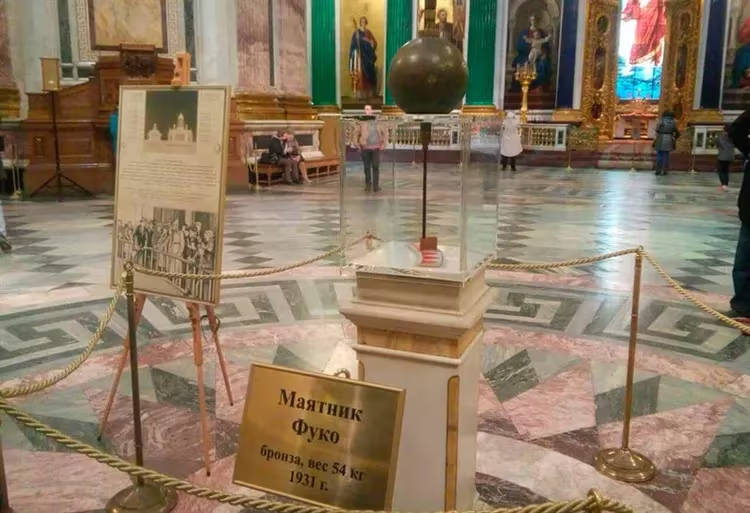
In the early 30s of the 20th century. Isaac was turned into an anti-religious museum. It became the first institution of its kind in the USSR. One of the main objects of the museum exposition was Foucault's pendulum. With its help, a visual demonstration of the rotation of the Earth was carried out. The device was invented by a French physicist J. Foucault. The device consists of a ball with a rod suspended in a free state. During the movement, the pendulum gradually deviates to the side, making a complete revolution around the circle in 24 hours.
The public presentation of the experiment with the Foucault pendulum took place in the temple on the night of April 11-12, 1931 in the presence of 7 thousand spectators. The mechanism in St. Isaac's Cathedral had the world's longest suspension – 93 m. It is made of bronze and weighs 54 kg. In 1986, the Foucault pendulum was dismantled. It was moved to the storerooms of the museum. Instead of hanging on a hook, they attached the figure of a dove.
Colonnade
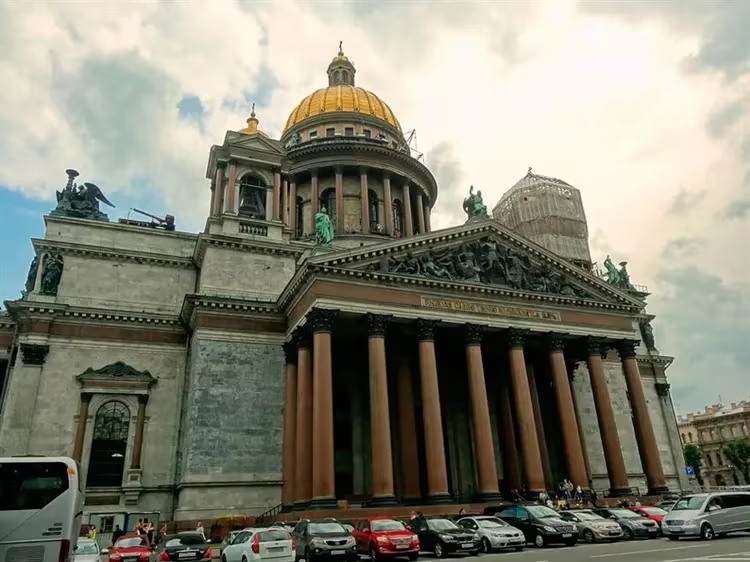
Columns are an important element in the architecture of a building. They encircle the body below, forming porticos of 8-16 pillars each. The second belt of monolithic columns stretched along the dome.
Upper colonnade
During the construction of the temple, for the first time in Russia, the technology of lifting large-sized weights to a considerable height (up to 40m) was tested. The pillars were carved from granite monoliths near the city of Pyuterlak (Finland). Their dimensions are:
The columns meet the characteristics of the Corinthian order:
The upper colonnade is used as an observation deck. You can get to it using two spiral staircases, 200 steps each:
lower colonnade
Bulky columns in the lower tier of the building were erected before the start of the main construction. The pedestal and pillar are made of granite. A coin is embedded in the foundation of each column – a ruble made of silver, minted in 1837. Under the central pillar there is a medal with the image of Emperor Nicholas I, made of platinum.
outdoor decoration
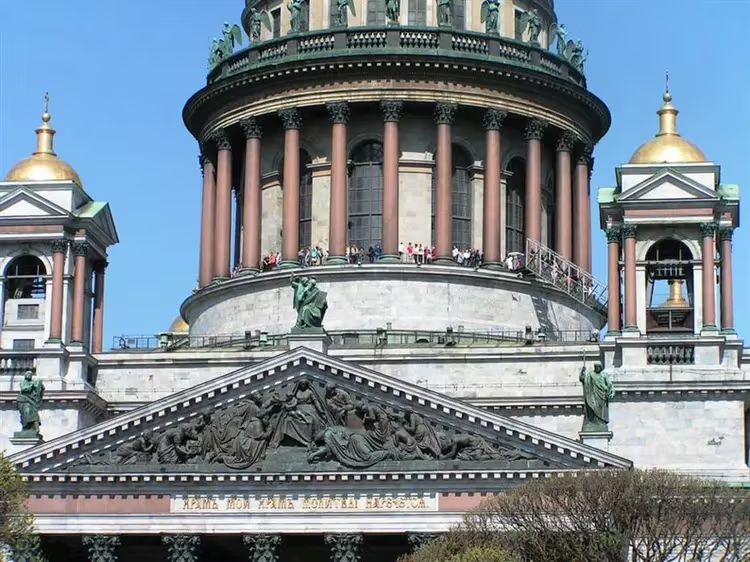
The building is rightly called the “Museum of Colored Stone”. 43 types of rocks and minerals are involved in its decoration. Among them:
The foundation and plinth consists of granite slabs, which were cut in quarries in Finland. The steps of the stairs and platforms for the columns are laid out of the same slabs. There are porticos around the perimeter of the building. They have 48 massive pillars.
The upper part of each portico is decorated with a high relief image:
The plots are taken from the biblical history and biography of St. Isaac of Dalmatia. The author of the sketches is K.P. Vitali.
The colonnaded space is divided into 3 parts. The side vaults have a rectangular ceiling shape, and the central vault is round. They are decorated with copper rosettes, sculptural images of angels and flowers. Statues of 12 apostles are installed in the area of the porticoes. On the floor is a pattern of alternating checkerboard slabs of gray and red granite, as well as white marble.
The inscriptions are carved along the pediments:
Statues of 12 apostles are installed in the area of the porticos.
Interiors
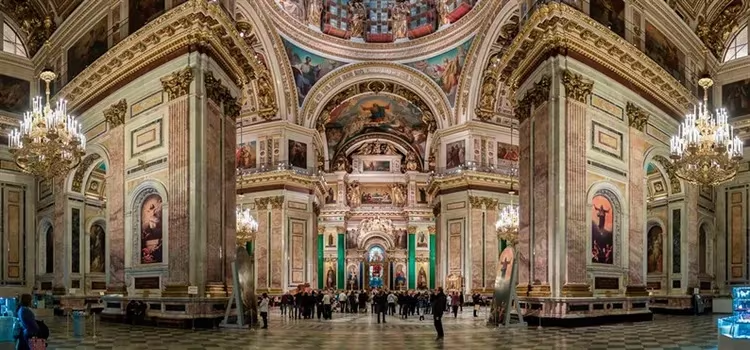
The interior decoration of the basilica is striking in its splendor. The walls are decorated with:
The following people took part in the interior design work:
Mosaic canvases are made up of pieces of ornamental stone of different shades.
The cathedral has 3 altars at once. They are dedicated to the memory of:
The space behind the main iconostasis is occupied by a multi-colored stained-glass window “The Resurrection of Christ”. At the royal gates there is a sculptural composition “Christ in Glory”.
Bell tower and dome
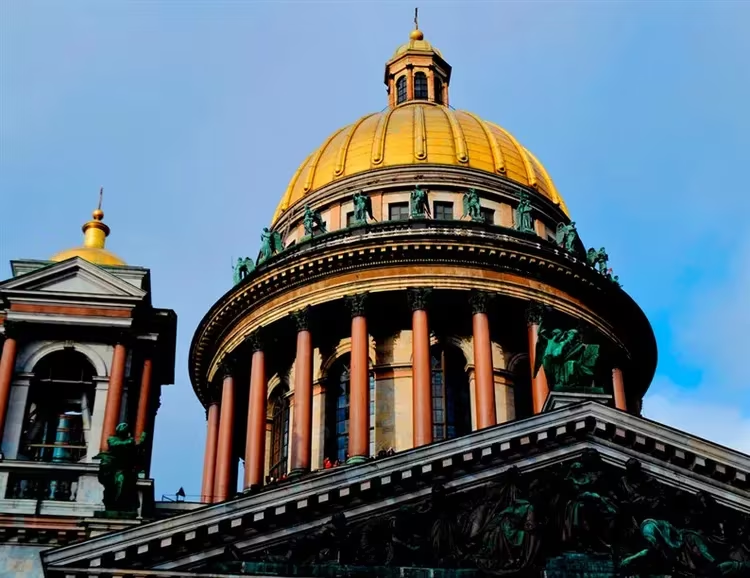
As planned by the architect, 5 domes were erected over the cathedral. The central, most voluminous dome, is conditionally divided into 3 parts:
Due to its size, Isaac has long established itself in the ranking of the largest domed structures in the world. The diameter of the outer part is 25 m, and the inner part is 22.15 m. The vault of the cathedral rises at a distance of 101.5 m from the ground. There are 24 windows around the circumference of the dome. A balustrade runs around the middle part. There are 24 sculptures of angels on the pedestals, symbolizing human virtues. The top of the vault is crowned with a “lantern”. In the design of this architectural element were used:
There is a cross on the top of the lantern. The ceremony of its establishment took place in a solemn atmosphere in 1839. To perform a prayer service, clergymen climbed a special platform and consecrated the cross. For the gilding of all 5 domes of the temple, 100 kg of gold was used.
4 corner belfries were built at the temple. Inside them are suspended bells made of an alloy of silver, copper and tin. The largest alarm has a mass of 30 tons. Since 1848, it has been located in the northwestern tower.
shrines
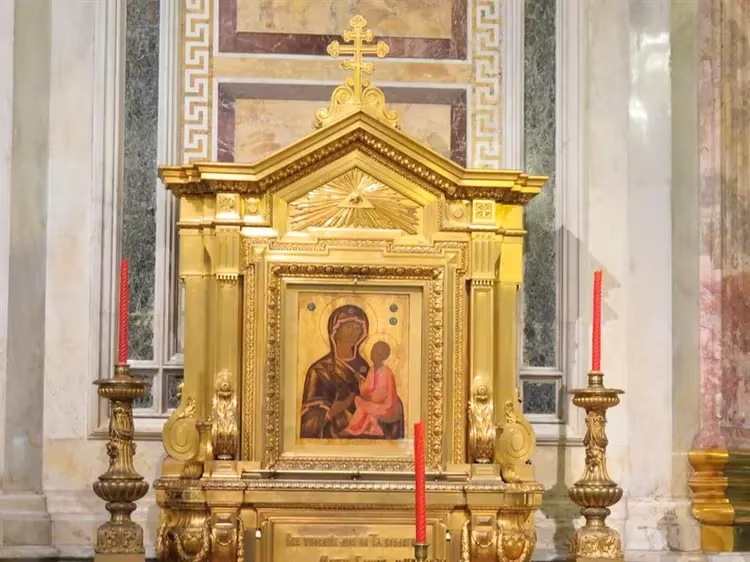
In pre-revolutionary times, the church of St. Isaac of Dalmatia served as a repository for revered Orthodox shrines. These included:
In addition to religious attributes, military relics were kept in the church:
The face of Our Lady of Tikhvin, according to legend, was created by St. Luke. It represents the Virgin Mary as the Guide. On the hands of the mother, the baby Jesus is depicted holding a scroll in his hand. The miraculous icon served as one of the main amulets of the Russian lands. Every year it was carried around during the procession through all the territories of the Russian state. In Tikhvin way, the first monarch from the Romanov dynasty, Mikhail Fedorovich, was blessed to reign. The icon was highly valued by Ivan the Terrible.
At his command, she was moved from the city of Tikhvin to Moscow. Ivan the Terrible considered the Mother of God his intercessor and ordered copies of the icon to be made, which were transferred to different churches. The original image was taken out of the USSR during the war years. From 1950 to 1995 she was in the USA and was solemnly returned to the Russian Orthodox Church.
Interesting Facts
The cathedral takes an honorable 2nd place in the list of the highest Orthodox churches, yielding leadership to the Moscow Cathedral of Christ the Savior.
The overall dimensions of the basilica are amazing:
Several times a year, patronal feasts are celebrated in the cathedral in honor of:
In the post-revolutionary period, the following were confiscated from the church:
The money from the sale of seized valuables went to a fund to help people from the starving Volga region. During the Great Patriotic War, the dome of Isaac was covered with green paint for camouflage. On the western bas-relief, in the role of a courtier, the architect O. Montferrand is depicted. In his hands is a model of the temple. The architect died a month after the completion of construction. He asked to be buried in the temple. However, at the request of the widow, the body was taken to Paris.
Worship Schedule
For the parishioners of St. Isaac of Dalmatia twice a day divine services are carried out:
You must arrive for confession by 8:30 a.m. The cathedral is closed on Wednesday.
Opening hours and ticket prices
The museum exposition in the temple is open daily from 10.30 to 18. Wednesday is a day off. During the warm period of the year (27.04 – 30.09) evening excursion programs for tourists are held from 18.00 to 22.30. From the beginning of May to the end of October, the colonnade is open to the public daily. In the cold season (1.11 – 30.04), every 3rd Wednesday of the month, a day off is built. The time of evening excursions is similar to the general schedule (from 18:00 to 22:30).
The price of tickets varies depending on the category of citizens:
If you have an international student ID card International student Identity Card, the entrance fee is 150 rubles. Evening subscription is more expensive and has a fixed cost of 400 rubles. The same price is set for familiarization with the colonnade of St. Isaac's Cathedral.
Where is it located and how to get there
The location of the temple is St. Isaac's Square, building 4. The location in the central part of the city provides several options for access by public transport: