
Church of the Savior on Spilled Blood in St. Petersburg – history, photo, description, how to get there, map
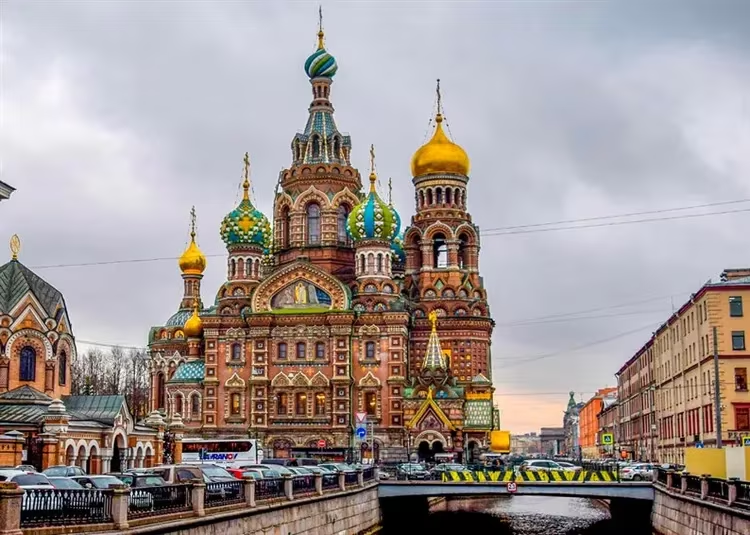
The Orthodox Cathedral of the Savior on Blood in St. Petersburg is a monument to the Russian autocrat Alexander II. Built in the Old Russian style, the building gives the impression of fabulousness and exclusivity.
Construction history
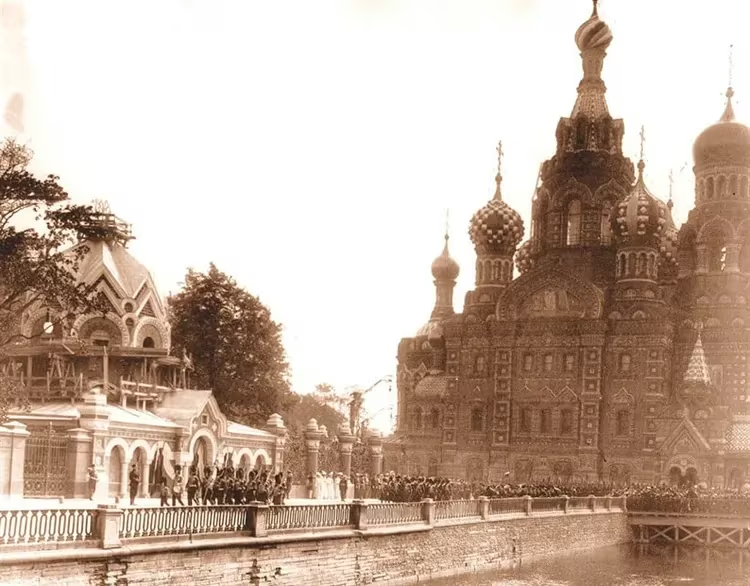
On March 1, 1881, Emperor Alexander II was mortally wounded. The very next day after the assassination, a commission was created, which began to perpetuate the memory of the liberator tsar. Before the construction of the church, a small chapel was erected in a very short time – on April 17 of the same year it was consecrated. Petersburg merchants of the first guild Gromov and Militin allocated funds for its construction. The chapel was erected on the site of the terrorist attack, it was there until the construction of the main church began in the spring of 1883.
Then the building was transferred to one of the squares of St. Petersburg, where it stood for almost 10 years, then it was dismantled. A competition for architectural design projects was announced in 1881. By the end of this year, more than 25 proposals were submitted, famous architects such as Benois, Bogomolov and others took part in it. They were given a large plot of land on both sides of the canal, including in the Mikhailovsky Garden. 8 projects were selected, the work of the architect A. O. Tomishko, called “To the Father of the Fatherland”, was recognized as the best.
But the king did not finally approve this option, and a second competition was held, as a result, in 1887, the work of Alfred Parland was approved. After that, the construction of the temple began, which lasted more than 20 years. They consecrated the Savior on Blood in 1907. The building was transferred to the St. Isaac's Cathedral Museum as an independent branch in the early 1970s, since 1977 the church has been undergoing a major restoration for 14 years, and only in 1997, almost a century after the official consecration, it is opened to visitors.
Where did the name come from?
The news that the Emperor of Russia had died from a mortal wound shocked all the inhabitants of the country. As is known, 7 attempts were made on Alexander II during his reign: they shot five times, a train crash was planned, an explosion in the palace, during which 10 soldiers from the royal guard died and almost 80 were wounded. In none of these incidents did the emperor suffer significantly, but on the tragic day of March 1, 1881, luck turned away – a bomb thrown by the terrorist I. Grinevsky, a member of the People's Will, inflicted a mortal wound on the king.
It was a planned and well prepared act. A preliminary observation of all the movements of Alexander II was established. During the passage of the royal cortege along the Catherine Canal, the revolutionary Rysakov threw the first bomb. People were injured from the explosion of the first bomb, including the security guard Maleichev, who was accompanying the carriage, and the peddler N. Zakharov, who were mortally wounded. The explosion damaged one of the walls of the carriage and knocked out the windows, but the king was not injured and did not immediately leave this place.
He ordered to take care of the wounded, looked at the captured terrorist and was about to continue his journey. At this time, another explosion occurred – Grinevitsky, a Narodnaya Volya member, threw a bomb at the feet of Alexander II. The emperor, still alive, was taken to the palace on a sleigh. From mortal wounds, Alexander II died by the evening of the same day. A unique architectural monument was erected on the site where the assassination attempt on Emperor Alexander II took place. It is popularly known as “The Savior on Blood”.
The name speaks for itself: Savior – Savior, and on the blood – because it was erected on the site where the blood of the Russian emperor was shed. This cathedral is a monument to the Tsar-Liberator, built with public funds. Interestingly, right under the bell tower with a golden dome, a small section of the street and the metal fence of the embankment were left, where the blood of the Russian Tsar was shed.
Architecture and interior decoration
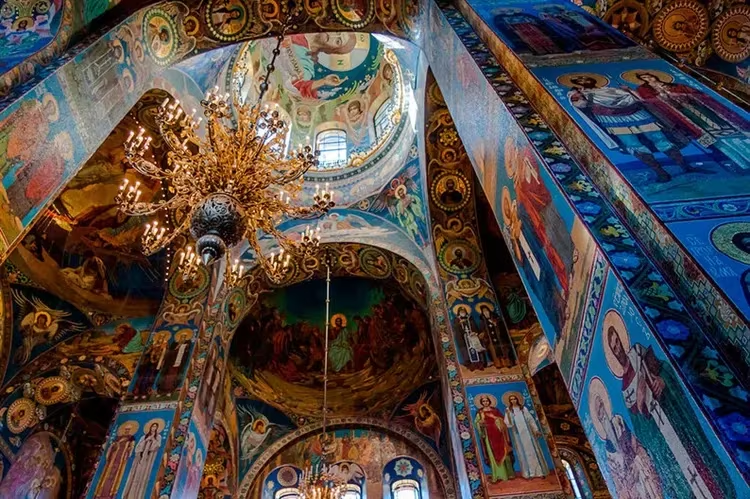
The project, a bit reminiscent of St. Basil's Cathedral, is made in the “Russian style”. The magnificent interior of the church, whose area is more than 7065 square meters. m., decorated with mosaics almost completely. Valuable types of stone were used in the decoration. In terms of the richness of the finishes and the variety of rocks, shades and textures of marble from Italy and gems brought from the Urals, it is difficult to find a structure equal in beauty.
In the decorative decoration of the interior, the unique combination of mosaic art and the fine work of stone cutters is interesting. This is a museum of stone, in the construction of which talented foreign and Russian masters took part.
Domes
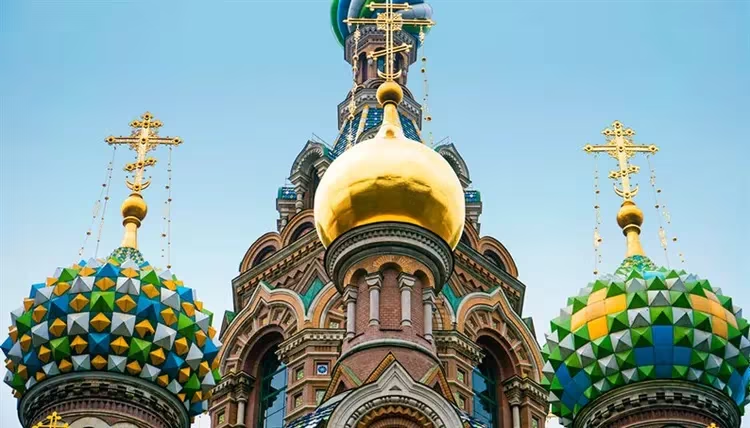
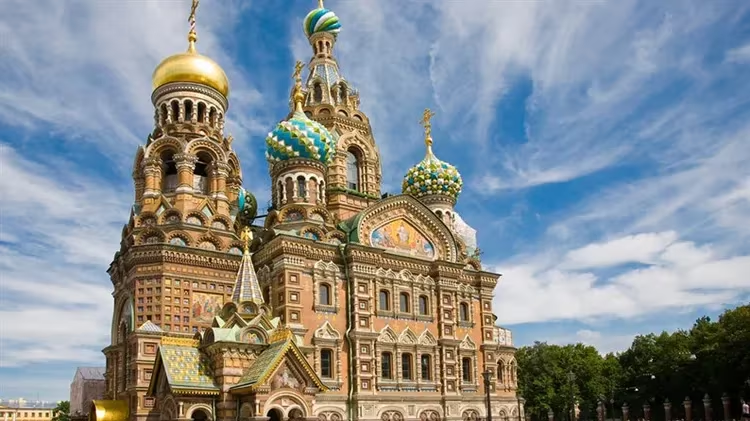
The church is crowned with a central hipped dome and four side bulbous domes crowned with Orthodox crosses. In the center rises a tent of eight sides. At the base are eight oblong windows decorated with carved kokoshniks. Five cupolas are covered with jewelry enamel, each pattern of the cupola is individual and inimitable – that's why the building seems elegant and fabulous. To cover the domes, a new technology was used – enamel was applied to copper plates. Prior to this, enamels were used only in jewelry. The coverage area exceeds 1 thousand square meters. m.
On the east side, the building is decorated with three graceful gilded cupolas, mounted on semicircular apses (protrusions of the building of various shapes). In the western part there is a bell tower, which is crowned by the largest cupola. In the architecture of the entire building, the bell tower plays an important role – it is the site of the assassination of the Russian emperor. According to the architectural design, the structure somewhat goes beyond the boundaries of the embankment and inside the building turned out to be part of the cobbled pavement and the fence, next to which the bloodshed occurred. Because of this architectural solution, the church does not have a traditional entrance.
The central tent rises 81 meters above the ground – this symbolizes the year of the death of the autocrat, the bell dome – 63 meters high – the age, the year he died. The cathedral organically fit into the landscape of the city, although its elegant and light facade looks somewhat alien to the architectural style of the Northern capital.
Appearance
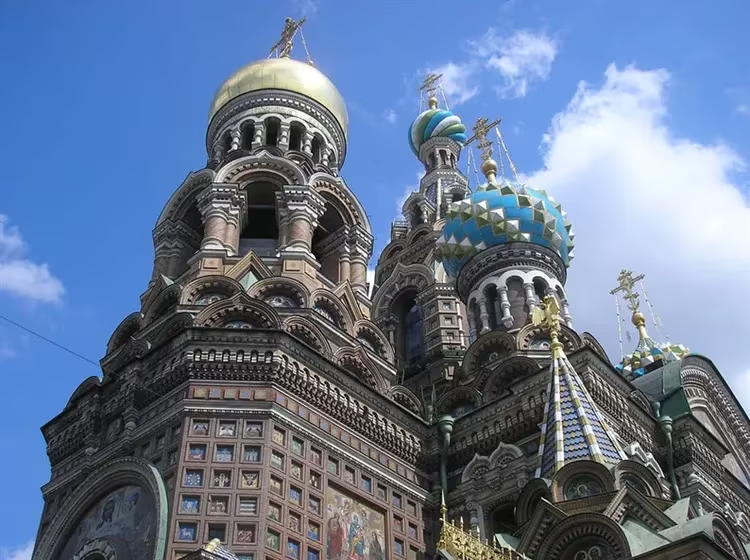
The unique appearance of the building is created thanks to the finishing materials. Dark gray granite was used in the lower part of the plinth, the upper part of the columns and arches were made of light granite brought from Lake Ladoga. Drums under the dome, window frames are made of Estonian marble. The cladding used German brick. The length of the entire building from east to west is about 56.7 meters, in the central part the width is just over 30 meters.
The facades are decorated with ornaments used in the architecture of Yaroslavl and Moscow church buildings. In addition, the outer walls are decorated with porcelain and ceramic tiles. They can be seen in the wall, on the roof, in arches and on columns. The decoration elements perform not only a decorative function – it contains cult symbols that are often found both in Orthodoxy and in the religions of other peoples. One of them is an image of a bud, indicating the origin of the Universe, where the world is the core of the bud.
The Orthodox cross topped with a crown and double-headed eagles indicate that the monument was erected in honor of the Russian autocracy.
Interior decoration
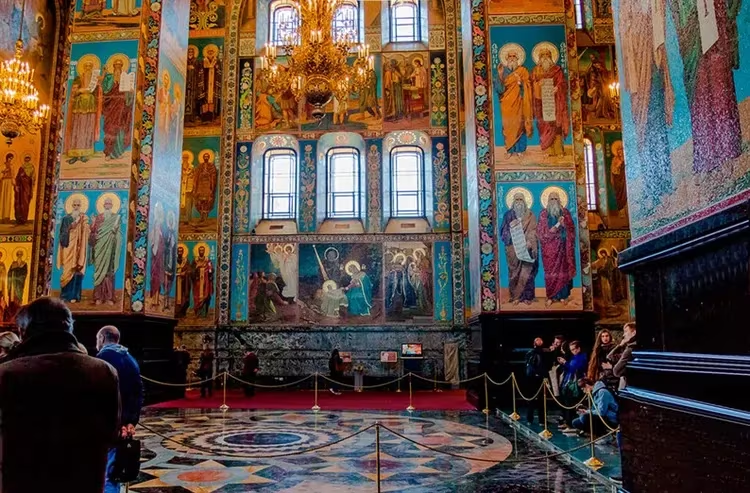
The interior is almost completely covered with a mosaic pattern. According to the original plan, the interior was planned only to be painted with paints, including the mosaic only partially in the composition of the facades and icons. Only in 1895, a rather extraordinary decision was made – to completely decorate the interior with mosaic decor – before that, this method was used only as a fragmentary decoration of the outside of the building.
Mosaic fragments were created in the private studio of A. A. Frolov. Pictures from colorful mosaics fill the entire interior of the temple. The ensemble was created by mosaic masters, sketches were prepared by talented Russian painters.
The interior of the church is unique in the variety and splendor of stone decor, abundance of rocks and many shades of material that was used in construction and decoration. Italian marble, amazingly patterned Ural jasper, gems delivered from the Altai Territory, as well as a variety of rocks – porphyry were used in the interior design.
Icons of the Resurrection of the Lord
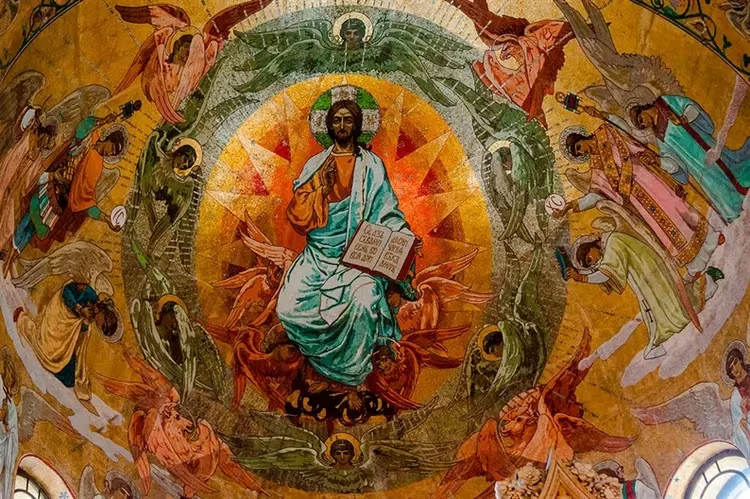
In the construction, decorative decoration, unique for Orthodox churches, was used – mosaic icons. The life of Jesus Christ, from Christmas to the Ascension, all his deeds, created during earthly life – everything is reflected in mosaic pictures. Above the golden altar are two images: “The Savior in Strength” and “Christ in Glory.” In the center of the altar apse you can see the icon of the Eucharist. An interesting depiction of Jesus Christ in a golden light, giving holy gifts to the apostles Peter and Paul, who bowed before him.
Mosaic icons “The Descent of the Holy Spirit” and “Ascension of Christ” are laid out above the iconostasis. In the mosaic “The Transfiguration of the Lord”, Christ appears before his followers in the golden divine radiance, other disciples are located around. On the central vault is the icon “Christ the Almighty”, made in the Byzantine tradition. “Saved Good Silence”, “John the Baptist”, “Our Lady”, are also made according to the canons of Byzantine writing.
The iconostasis is made in the classical traditions of easel art. The faces of the “Savior” and “Holy Mother of God” are notable for their laconic composition, careful execution of images in the difficult art of mosaic. To the right of the icon-painting “Savior” is the “Descent into Hell”. The image “Prince Alexander Nevsky” is located in the northern icon case, “The Resurrection of Christ” – in the southern one. It is difficult to list all the extraordinary beauty of the work – it is better to see them for yourself.
Where is it located and how to get there
Address: emb. Griboedova, 2.
- Metro.
The nearest metro station is Nevsky Prospekt, you need to walk about 500 m from it. From the Griboyedov Canal, about 150 m further.
- By bus number 27, 22, 7, 3
- By trolleybus No. 22, 11, 10, 7, 5, 1
Visiting times and opening hours
Open daily, Wednesday is a day off.
Opening hours: from 10:30 to 18:00.
Ticket office hours: until 17:00.
The duration of the tour is from 18:00 to 22:00.
Entrance ticket price:
The Cathedral of the Resurrection of Christ is one of the 10 most significant and famous architectural monuments of the Northern capital. Hundreds of thousands of tourists visit the temple every year to admire the decoration of the interior and the graceful facade of the building.