
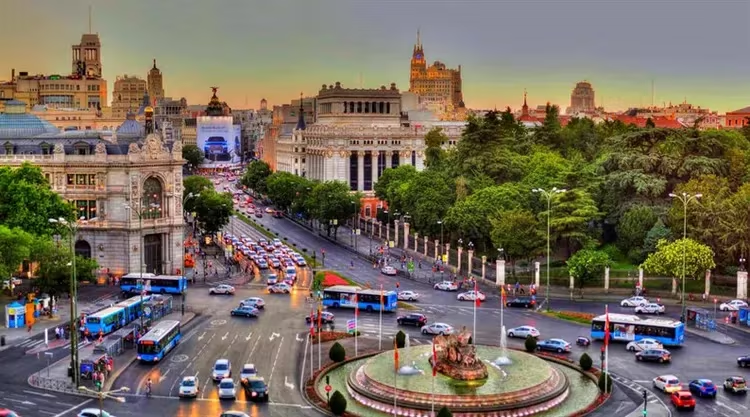
Cibeles Square in Madrid – history, photo, description, attractions, map
Bright and festive Madrid attracts with the beauty of the streets, architectural monuments, ultra-modern buildings, parks and boulevards. One of the most beautiful places in the capital is Cibeles Square, which is invariably admired by numerous guests and local residents are proud of.
Story
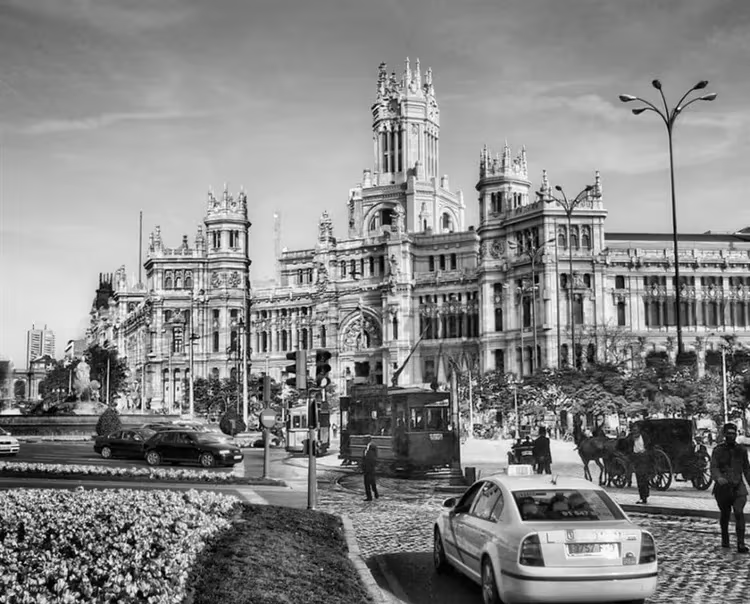
The lands around Madrid began to be ennobled and built up by King Philip II of the Habsburg dynasty (1556 – 1598). The appearance of the Plaza de Cibeles, which is now the hallmark of Spain, dates back to 1570. Construction continued in the XVIII century under King Carlos III – the territory was expanded, new buildings were built. Plaza de Cibeles is a circle of almost regular shape, framed around the perimeter by buildings of amazing beauty.
This place was not initially so graceful and elegant, they did not think about aesthetic significance – it played the role of an administrative center with banks and offices. Business meetings were held here, contracts were concluded, money transactions were made. People came to learn the news, chat with friends. Even the famous fountain, which people from all over the world now come to admire, was used for practical purposes – it served as a source of clean water for the inhabitants of Madrid.
sights
Plaza de Cibeles is located in the center of Madrid. On the territory there are historical buildings of complex architectural design, which are connected together by a fountain installed in the central part. Here are the palaces of Buenavista, Linares, Cibeles and the building of the Bank of Spain. The premises for the Bank began to be built in 1884, the grand opening took place in 1891.
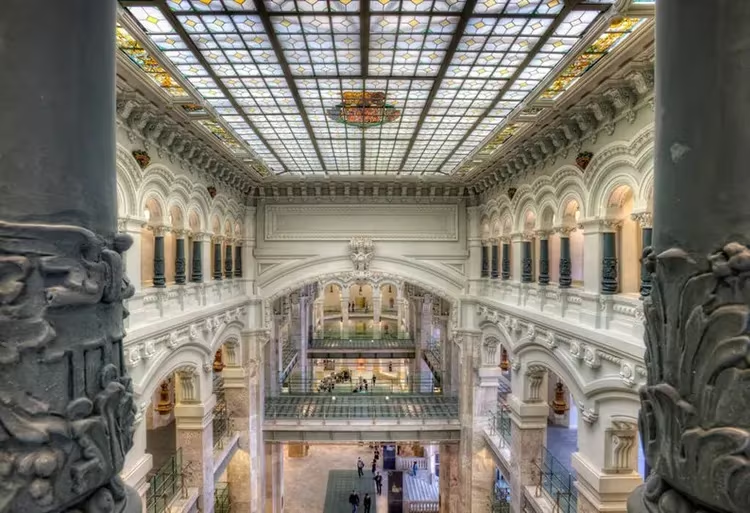
In the 20th century, the building was reconstructed – expanded, supplemented with elegant stained-glass windows, and a glass dome was installed. On the facade you can see the portals, decorated with stucco, arched galleries. They say that directly from the Bank through the underground passage you can get into a secret room – a treasury where gold is hidden. In case of danger to the safety of valuables, the room is filled with water from the fountain.
Palace of Cibeles
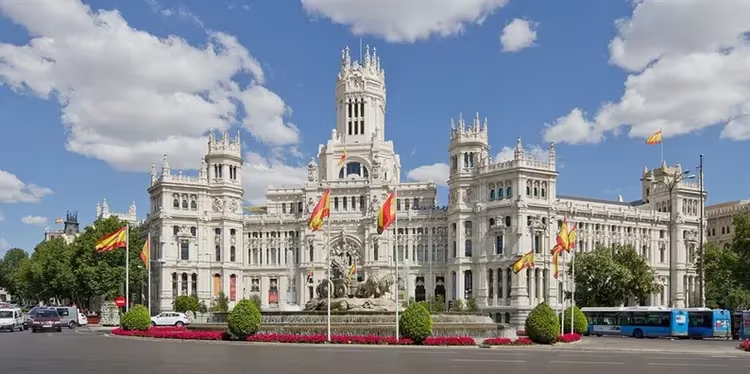
In 1918, a snow-white building was built in the Art Nouveau style, which was intended for the post office. The authors of the project were Joaquin Otamendi and Antonio Palacios. Majestic and elegant at the same time: with pilasters on the colonnade, openwork galleries, graceful turrets. The portal is decorated with the emblems of Spain and the seven provinces, surrounded by the apostles, and a round clock is mounted above the entrance. The interior is also richly decorated, has many original details in the decoration.
Interestingly, the name Cibeles appeared only in 2011, when the building became owned by the city hall. In 1993, a significant renovation was carried out, which was directed by the architect of Bethlehem, Ayuzo Icelandua. The interior is divided into several departments, they are not only office space. There is a cultural center with a seating area with comfortable sofas and free Wi-Fi.
Guests invariably like the exhibition, the main theme of the exposition is urban studies, in particular, Madrid. Vernissages are held, a library is open, a restaurant with excellent cuisine is open. The large area of the courtyard, where the postal transport used to be, is covered with a glass roof. Now it is used for recreational activities. If you go up to the roof, you will get to the observation deck, located at a height of 60 meters, from which the city opens in all its glory.
Cibeles Fountain
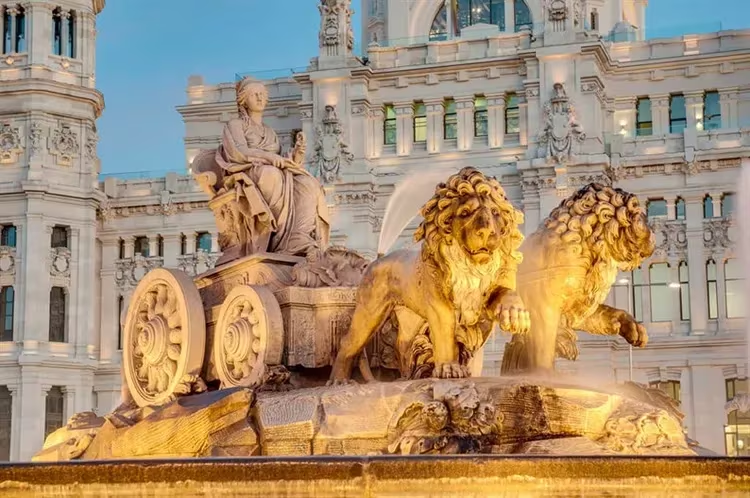
The popularity of the square is largely due to the famous fountain of the same name, installed in honor of the goddess Cybele. It was built during the reign of King Charles III, who carried out significant reforms in urban planning. By order of the ruler, lighting was installed, water pipes were installed, and the streets were paved with cobblestones. The project also included a fountain in the Salon del Prado – a place for walking in Madrid.
In the composition, the main person is the goddess Cybelu (in the Spanish manner – Sibela), who personifies mother nature, is the patroness of agriculture and fertility. The goddess is seated on a lion-drawn chariot. According to legend, Hippomenes and Atalanta were turned into lions by Aphrodite for their disrespectful attitude. As a punishment, they must always drive the chariot.
Designed in 1777 by Venturo Rodriguez. The sculpture of the goddess and the chariot were made by Francisco Gutierrez, the lions were sculpted by Roberto Michel, and the general design was made by Miguel Jimenez. In 1782, the building was built and installed in another place, only at the end of the XIX century it was moved to the current one. Now the figure of the goddess, which the people called the “eternal bride”, is framed by the most beautiful buildings, each of which is of value in the field of culture and history.
Palace of Linares
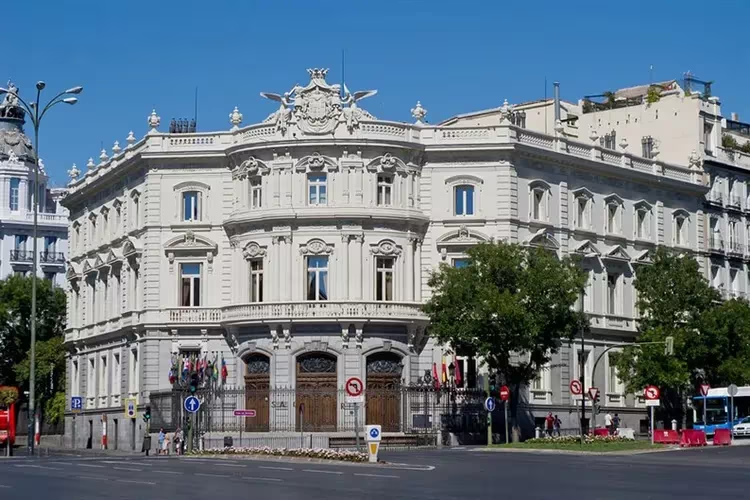
Linares was built at the end of the 19th century in the New Baroque style. It is believed that in the past it was a terrible, dead place. During the People's War of Liberation, there was a prison built by the French, where they not only kept, but tortured and executed prisoners. The Marquis de Linares purchased this piece of land in 1872. In 1877, construction began on a structure designed by the architect Carlos Colubi.
The co-author of the project was Adolf Ombrecht, invited from France. Calling other talented craftsmen to work, they quickly built residential and numerous office premises. The construction had both the features of a country villa and a city house. Stables and park pavilions were built here. They began to live in the house in 1884, but finishing work continued until 1900.
In the basement of the 4-storey building there were storerooms and utility rooms, a kitchen, rooms for servants. Above are the main halls, living rooms, a library, a smoking room, a music room, bedrooms, bathrooms – everything that must be in a rich house. On the top floor there is a guest room, a winter garden, a dining room, and offices.
The interior is decorated with tapestries made by the royal manufactory, Chinese silk and porcelain, the palace halls are decorated with embroideries and paintings by the most famous artists of that time. After the death of the Marquis, Linares was inherited by the Countess of Villapaderna. During the Civil War, the house was badly damaged and was prepared for demolition. Fortunately, this did not happen, because in 1976 the building was recognized as a historical monument, and by 1992 it was completely restored. Now the building houses the cultural center “House of America” to maintain ties with the peoples of Latin America, a museum and an art gallery.
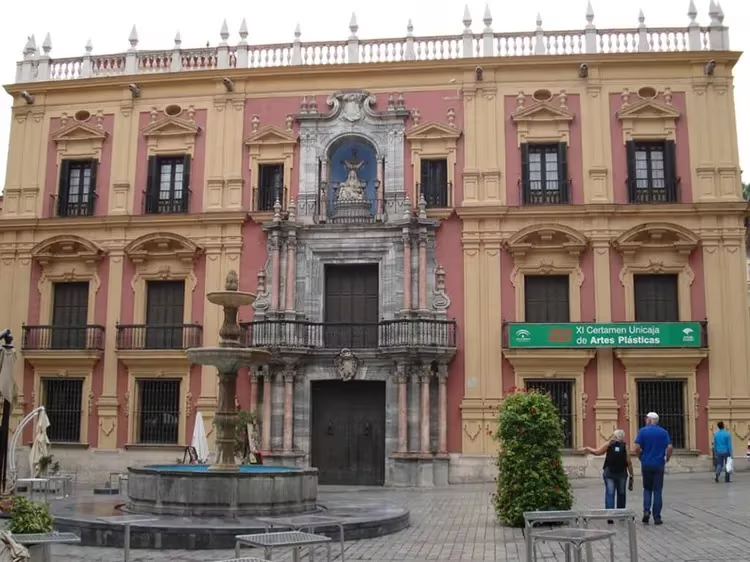
Another luxurious building surrounded by French-style gardens. This is the Buenavista Palace – the first building on the square, it was built in 1777 by Juan Pedro Arnal for the Duchess of Cayetana de Alba, a representative of one of the most noble families in Spain, the muse of the great Francisco Goya. The building is in brown tones, surrounded by an elegant metal fence. Today it houses the High Command of the Spanish Armed Forces.
Football is a national game for the people of Madrid, they love it and almost everyone is a fan of the Real Madrid team. After the match, to celebrate success or defeat, they gathered in the square, where they sang, danced and bathed in the fountain. Once they damaged the statue of the goddess – they tore off their hand. After that, the police strictly guard the monument, forbidding anyone to approach it.
Where is it located and how to get there
Plaza de Cibeles is located in Madrid, Spain. Located between Prado and De los Recoletos boulevards and Al street. It is convenient to get to it by metro (line 2), the nearest station is the Bank of Spain (Banko de Espana). By bus, using the routes NoNo 1, 2, 14, 27, 146, 202, 522 to the stop Passeo del Prado and Plaza de Cibeles.
Exhibitions of the Palace of Cibeles:
Madrid is beautiful at any time of the year and day. It is worth coming here and admiring the majestic monuments, palaces and cathedrals. Among them, Cibeles Square is a masterpiece of architecture and the main attraction, without seeing which, you lose a lot.
In Madrid we recommend the following hotels: