
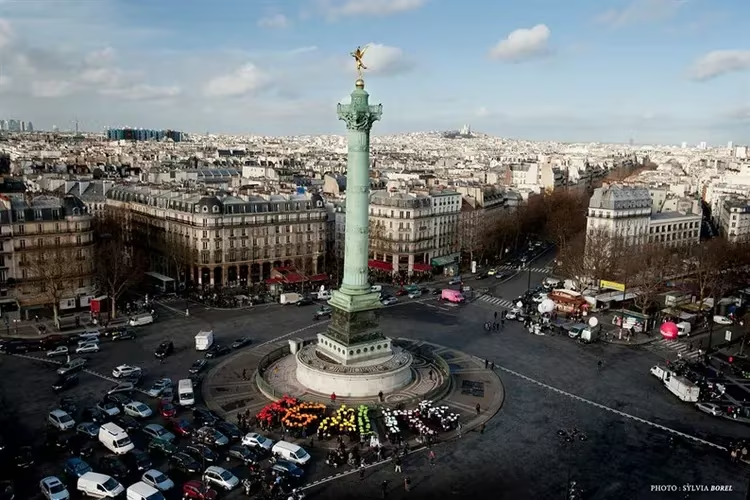
Only the lazy have not heard about the famous fortress under the sonorous name Bastille, but today in its place you can only find the square of the same name, which gladly welcomes tens of thousands of tourists, offering a lot of entertainment.
Story
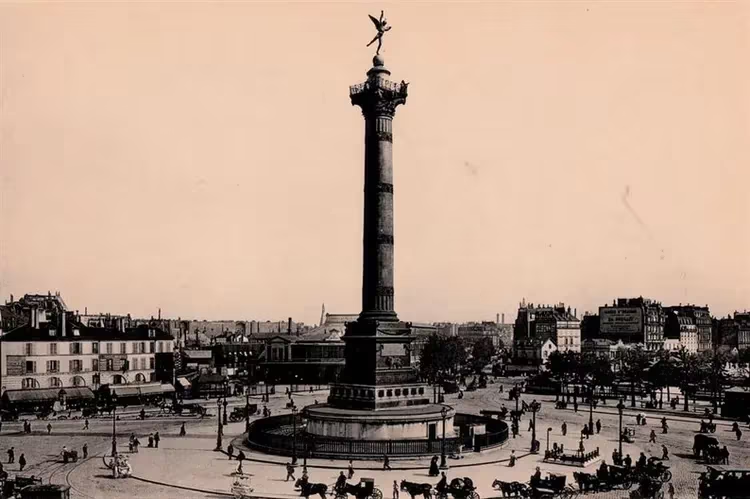
In the 14th century, during the Hundred Years' War, Paris was in dire need of protection. Charles V decided to build an impregnable fortress to protect the city. Its original name was “Chastel Saint-Antoine”, but after some time, the Parisians dubbed the fortress with the sonorous “la Bastille”, which is logical, because from the French “Bastille” means “tower” or “fortress”. Having served the troops, by the end of the Centenary During the war, the royal treasury was located in the Bastille, but with the permission of King Louis XIII, Cardinal Richelieu changed this.With his light hand, the Bastille became a prison.
First of all, traitors to the crown got there, as well as authors of overly frank opuses. However, their conclusion can hardly be called terrible, and it is just right for modern criminals to envy the then violators of the law. They were allowed to take food, clothes, furniture, books and even servants to the Bastille. Over time, however, more and more ordinary low-income people ended up in prison, which led to the spread of infectious diseases. During the French Revolution, the Bastille was stormed in order to free the rebels imprisoned in it at that time.
By the end of the 18th century, the Bastille was completely destroyed, and all that we have today is only fragments of the past splendor. In 1792, a spacious square appeared on the site of the impregnable fortress, in the center of which they planned to erect a column – a symbol of freedom. The first stone was laid by Pierre-Francois Palois, but the construction was never completed, and in 1793 a fountain was erected on this site.
In 1808, Napoleon seriously attended to the improvement of some areas of Paris. For Place de la Bastille, he conceived something original – to erect a monument in the shape of an elephant. According to the plan, it was supposed to be twenty-four meters high, cast in bronze from Spanish cannons. However, only a full-scale plaster model was built, which was demolished in 1846. In 1833, Louis Philippe ordered the construction of the July Column, which was opened in 1840.
Square today
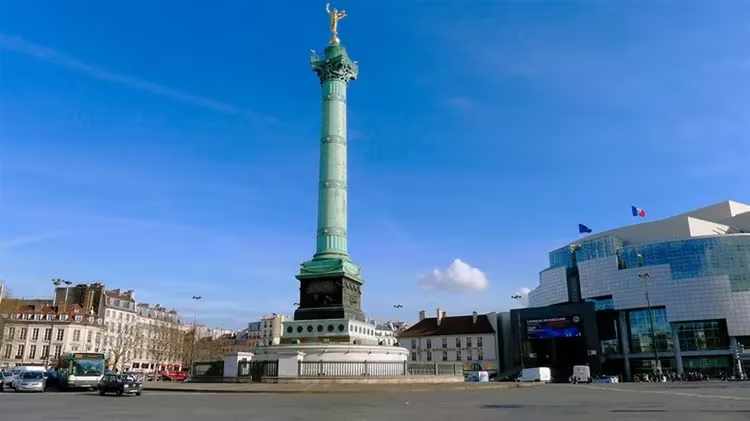
Today, La place de la Bastille is a stunning historic site with open markets, numerous shops, nightlife, a marina and a magnificent opera house. On Thursdays and Sundays, the largest open market is open, occupying part of the park in the north of the square.
Along the Richard-Lenoir Boulevard, you can buy the freshest fruits, mouth-watering meats, home-made cheeses and homemade bread along with clothes, dishes, souvenirs and other trifles. During excavations for the metro line in 1899, the remains of one of the towers of the fort were found, which were transferred to the Place Henri-Galli. Now, cafes and offices of small companies are comfortably located on the original site of the fort.
What to see
Dozens of streets of Paris are intertwined in Place de la Bastille, it is located on the border of several districts, and every stone is saturated with great history. Thanks to Palua, a sign “From now on they dance here” appeared here, which eloquently alludes to the fact that the square serves as the main place for entertainment. Of the main attractions that every tourist must see, the following are distinguished:
In the heart of Place de la Bastille is the famous July Column, fifty-two meters high and weighing one hundred and seventy tons, cast in steel and bronze. The project was carried out by the architect Jean-Antoine Alavuan in collaboration with Eugène Viollet-le-Duc. In their work, they were inspired by the magnificent Trajan's Column in Rome.
Before the July Column, in the center of the square, there was a model of an elephant made of plaster and wood, which Napoleon intended to replace with a bronze one. But the Empire collapsed before he realized this ambitious plan. In addition, street hedgehogs and hordes of rats, the main carriers of the infection, managed to settle in the elephant.
The July Column was built as part of the revolution of 1830, in particular, the three days of the battle, called the “Three Glorious Days” and which led to the overthrow of Charles X and the coming to power of Louis Philippe. In the foundation of the column rested five hundred and four people who died for the good of the revolution. These remains were later transferred. Their names are engraved on the surface of the monument. The top of the July Column is decorated with a gilded statue of the “Genius of Liberty” – the work of Dumont. A star burns in the forehead of the statue, a torch is in one hand, and a torn chain of shackles in the other. There is a spiral staircase inside the column, but ordinary visitors are not allowed to climb up.
Opera Bastille
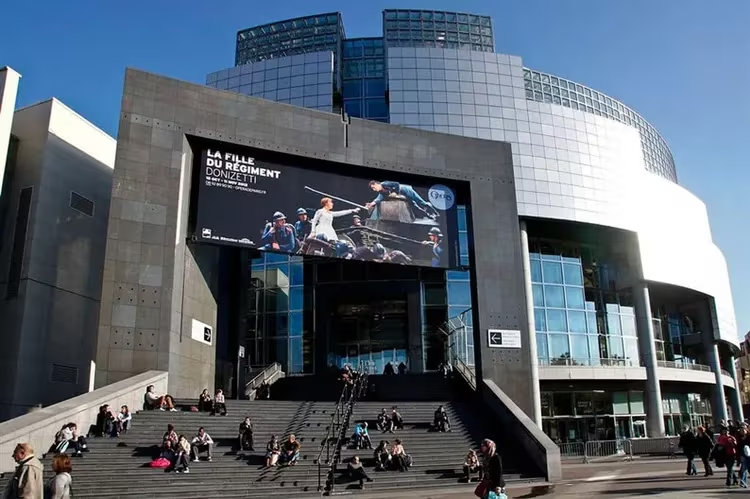
Opera Bastille is a modern opera house, one of the most famous and popular in Paris. It was opened in 1989 as part of the Grands Travaux project with the assistance of President Francois Mitterrand. Along with the “old man”, the grand opera Granier, the Opera Bastille is the main object of the Paris National Opera. However, while Granier presents mixed performances of opera and ballet, at the Opéra Bastille, opera performances are kept separate from symphony and ballet performances.
The building itself has a main stage for 2703 seats, as well as a small concert and chamber halls. So that the new building does not stand out too much from the architectural ensemble of the square, the left side of the facade was partially hidden behind older and smaller buildings, which gives the impression that the opera house has been here for several centuries. You can enter the foyer directly from the square, although a monumental external staircase and an underground entrance from the metro were originally built, which were subsequently closed.
Fortress Bastille
Built at the dawn of the fourteenth century and destroyed after the French Revolution, the fortress is today only a memory of the past. In its place, the famous square was deployed, and only records in the archives, drawings and old photographs remained about the building itself. But once the fortress not only protected the royal power from invaders, but later became a prison for political oppositionists and overly extravagant writers.
Her captives were Count Cagliostro, the Marquis de Sade, Voltaire, and, of course, the mysterious man in the iron mask, whose origin is shrouded in a halo of mystery to this day. When the fortress was destroyed, local craftsmen used small stones to make souvenirs, and large ones went to the construction of some objects in Paris. And Bastille Day is celebrated annually by the French in July and is officially recognized as a national holiday.
Port “Arsenal”
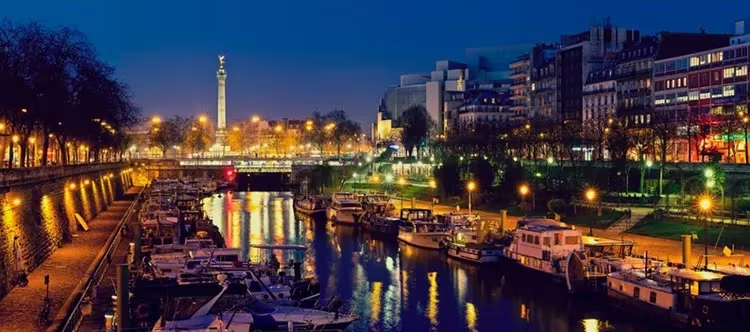
The port was named after the arsenal that was located on this very site before it between the sixteenth and nineteenth centuries. At a time when the fortress of the Bastille had not yet been destroyed, a moat was dug around it, directly connected to the Seine.
After the destruction of the castle during the French Revolution in 1789, the canal connecting the moat and the Seine was excavated even wider. Now here is the port. At the turn of the XIX – XX centuries, the port of Arsenal was given over to commercial needs. It was here that the wheat, timber and wine needed by the city were unloaded. However, in 1983 the supplies were diverted and the port itself was used for urban leisure.
Today it is a busy, medium-sized marina that can accommodate up to 180 pleasure boats. Built in 1895, the pedestrian bridge crosses the canal approximately in the middle, which allows you to see all the moored ships from it. In the western part of the port there is a cozy, small garden called “Jardin de l'Arsenal”, where you can relax a little, and children can play on a specially equipped playground. At the very end of the park there is a small cafe with a terrace serving amazing coffee.
Bastille metro station
The Bastille metro station is a notable attraction in itself. First, its design is unique. The platforms located on the first line are semi-underground – they go deeper, but at the same time above the channel level of the Arsenal port. Secondly, the walls of the station are decorated with magnificent drawings depicting scenes of the storming of the Bastille. It is strikingly different from the rest of the gloomy and not too clean stations of the Paris metro.
Where is it located and how to get there
Address: Place de la Bastille, 75011 Paris, France
The easiest and most affordable way to find the square is the metro station of the same name “Bastille” (lines M1, M5 or M8).
You can also use the bus number 86, 20, 65, 76, 69, 91.