


Moscow Kremlin: why we removed these guides
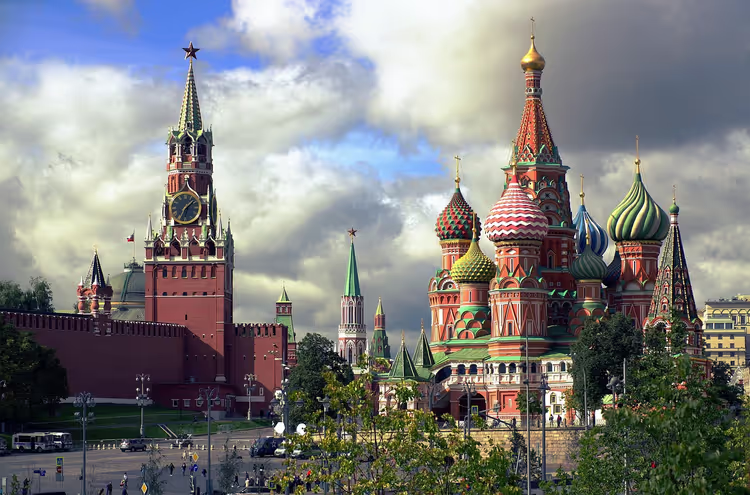
The six guides that used to live at this address are gone. They covered the Grand Kremlin Palace, the Diamond Fund, the Archangel Cathedral, the Ivan the Great Bell Tower, the Spasskaya Tower, and an overview of twenty-three "most interesting places" inside the walls.
A short answer for anyone who came here looking for a list of sights. The Kremlin stopped being a museum object for us not because its architecture changed, but because it is the working seat of power of a state that has been waging war against Ukraine since February 24, 2022. We no longer publish sightseeing text about this address, and we do not offer workarounds.
💡 At a glance:
- which six pieces were removed and where the old links now point
- what decisions were made about this address and how they are documented
- what exactly the International Criminal Court ruled and why a warrant is not a conviction
- which cities with palace ensembles remain in our live sections
- Last updated: 09/2026
Why we deleted these guides
We removed six pieces, and all of them were structured the same way: history of the site, photos, opening hours, how to get there. The old addresses in all language versions now have permanent redirects to this text, so that a reader coming from search lands not on an empty page but on an explanation.
The reason is not that the material became outdated. The reason is the genre. A guide to the Kremlin shows the reader not a fifteenth-century fortress but a working administrative core of a state, and it does so in a weekend-outing tone. We consider that tone impossible after February 2022, which is why we removed the texts entirely rather than adding a disclaimer to them.
The financial part of the argument should be stated precisely, because the common version is wrong. The share of oil and gas revenue in Russia's federal budget fell to roughly 22 percent in 2025 and 2026, down from 42 percent in 2022 (OSW Centre for Eastern Studies, 09.12.2025). The phrase "tourist money goes to oil and gas" does not describe reality. A different phrase does: the share of non-oil-and-gas revenue, which includes taxes from the services and trade sectors, has grown to roughly 78 percent, and spending by foreign visitors lands precisely in that part of the budget.
The address where decisions are made
Our previous text described the Kremlin as an ensemble of cathedrals, palaces, and towers. It did not describe what else is there: the apparatus that makes decisions of the kind addressed in UN General Assembly resolutions.
On October 12, 2022, the General Assembly, by 143 votes to 5 with 35 abstentions, adopted resolution ES-11/4: the attempted annexation of Ukraine's Donetsk, Luhansk, Zaporizhzhia, and Kherson regions was declared to have no legal validity (UN press release GA/12458, 12.10.2022). Earlier, on March 2, 2022, the same Assembly, in resolution ES-11/1, demanded that Russia immediately cease its invasion and unconditionally withdraw all armed forces from the territory of Ukraine within its internationally recognized borders (UN press release GA/12407, 02.03.2022). That demand has not been met.
The same city is also the source of decisions affecting people in the territories of Ukraine temporarily occupied by Russia. On September 29, 2016, the Supreme Court of the Russian Federation upheld the ban on the Mejlis of the Crimean Tatar people, declared an "extremist organization" (Human Rights Watch, 29.09.2016). That decision was made not on the peninsula but here, a short walk from the route we once offered readers as a pleasant stroll.
The international criminal court warrant
On March 17, 2023, Pre-Trial Chamber II of the International Criminal Court issued arrest warrants for Russian President Vladimir Putin and Presidential Commissioner for Children's Rights Maria Lvova-Belova on suspicion of the war crime of unlawful deportation of population (children) and unlawful transfer of population (children) from occupied areas of Ukraine to the Russian Federation, under articles 8(2)(a)(vii) and 8(2)(b)(viii) of the Rome Statute (UN News, 17.03.2023). A warrant is a procedural decision, not a conviction: article 66 of the Rome Statute establishes the presumption of innocence, and we use exactly that wording.
Two days after the warrants were issued, on March 19, 2023, Vladimir Putin visited occupied Mariupol (NPR, 19.03.2023).
The scale behind the warrant's wording is known from two independent sources. According to Ukraine's national database "Children of War," since February 2022 at least 20,000 Ukrainian children have been taken from occupied territories to Russia or to territories under its control, and just over 2,100 have been returned (Children of War platform). The Yale School of Public Health's Humanitarian Research Lab has documented at least 210 facilities in Russia and in temporarily occupied territories where these children were placed; in more than half of them, 62.9 percent, children were subjected to "re-education" (Yale School of Public Health).
We cite this not to link a specific cathedral inside the walls to a specific decision. We cite it because a guide to a seat of power is obliged to at least mention what that power is doing, and the "history, photos, how to get there" format cannot carry that mention.
What this means for you as an EU reader
Item | Status 09/2026 | Source |
|---|---|---|
Services related to tourism in Russia | Prohibited by Article 5n(2) of Regulation 833/2014 as amended by Regulation 2025/2033 of 23.10.2025 | |
Transition period | For contracts concluded before 24.10.2025, ended on 01.01.2026 | |
What the ban covers | Travel agency and tour operator services, guide services, and advertising of these services | |
German Foreign Office advisory | "Vor Reisen in die Russische Föderation wird gewarnt" | |
Risk of arbitrary detention | The German Foreign Office warns about it for German citizens and people with dual German-Russian citizenship |
For a publisher in the European Union, this means a simple thing: a text describing a route through the Kremlin cathedrals, with opening hours and ticket prices, is closer to the list of prohibited services than to neutral local history. We do not want to test that boundary ourselves, and we do not advise readers to test it themselves.
Where to go instead
The question readers came to these texts with was about a fortified residence in the center of the capital, state halls, and an armory collection. The live sections of the site answer it: Czechia with Prague and Prague Castle, Austria with Vienna, Hungary with Budapest, and Germany with Berlin and Potsdam. For those looking for crown regalia and treasuries, our closest materials are in the Austria and Germany sections. For example, the piece on the Schatzkammer in Vienna.
The general explanation for the whole section is collected in the section hub. Related texts: our position on Red Square and GUM and our position on Moscow routes and tours.
Where we stand
We believe that a guide to an active seat of power is not local history but participation in its normalization. In our assessment, the distinction between "a fortress as a monument" and "a fortress as an address" stopped being academic after February 2022, and no architectural value of the site removes that. We decided to take down all six pieces and explain the reason at the same address, rather than leaving them with a note at the bottom of the page.
We write about a state and its policies, not about people based on their passport. There are people in Russia who came out against the war and received prison sentences for it. Our decision not to publish guides to Russia is about money, sanctions, and reader safety, not nationality.
Publication date: September 3, 2026. Last updated: September 3, 2026.
⁉️🤔 Frequently asked questions
The Kremlin is a UNESCO monument, aren't architecture and politics different things?
Formally they are different, and we don't deny that. But the guidebook genre is not an architectural essay, it's an invitation to come and spend money. We removed the invitation, not the history. The legal framework for a person from the EU is described in the section "What this means for you as an EU reader".
Are you calling the president of Russia a war criminal?
No, and that's a matter of principle. We only write what is in the procedural document: on March 17, 2023, the International Criminal Court issued an arrest warrant on suspicion of specific war crimes. A warrant is not a conviction. The articles of the Rome Statute are cited in the section "International Criminal Court warrant".
Can a German citizen visit the Kremlin?
We don't provide travel advice and deliberately don't describe any procedures. We can only state the official positions: the German Foreign Office warns against travel to the Russian Federation and cautions about the risk of arbitrary detention for German citizens and dual nationals.
Why does the old address lead here instead of a "not found" page?
Because answering the reader is more honest than showing an empty page. They get an explanation, a list of documents, and a list of destinations we continue to write about.
In short
Six guides to the Moscow Kremlin have been removed, and the old addresses redirect to this text. The basis is not only editorial: since October 25, 2025, the EU has had a direct ban on services related to tourism activities in Russia, including their advertising. January 1, 2026 marked only the end of the transition period for old contracts. The same address also reflects the decisions recorded in UN General Assembly resolution ES-11/4 and in the International Criminal Court warrant of March 17, 2023. Cities with palace ensembles that we continue to write about are listed above.
How you can help
We don't collect money and receive nothing from the links below. These are official websites of organizations working with the consequences of the war:
- UNHCR, the UN Refugee Agency, unhcr.org
- UNICEF, unicef.org
- Ukrainian Red Cross, redcross.org.ua
Sources
- UN General Assembly, resolution ES-11/1 "Aggression against Ukraine", 03/02/2022. https://press.un.org/en/2022/ga12407.doc.htm
- UN General Assembly, resolution ES-11/4 "Territorial integrity of Ukraine", 10/12/2022. https://press.un.org/en/2022/ga12458.doc.htm
- International Criminal Court, arrest warrants in the situation in Ukraine, 03/17/2023, as reported by UN News. https://news.un.org/en/story/2023/03/1134732
- NPR, on the visit to occupied Mariupol on 03/19/2023. https://www.npr.org/2023/03/19/1164582418/vladimir-putin-surprise-visit-occupied-mariupol
- Ukraine's national platform "Children of War", data on deported children. https://childrenofwar.gov.ua/en/about-us/
- Yale School of Public Health, study of the network of "re-education" facilities. https://ysph.yale.edu/news-article/ukraines-stolen-children-inside-russias-network-of-re-education-and-militarization/
- Human Rights Watch, on the ban of the Mejlis of the Crimean Tatar people, 09/29/2016. https://www.hrw.org/news/2016/09/29/crimean-tatar-elected-body-banned-russia
- Council Regulation (EU) 2025/2033 of 10/23/2025 amending Regulation 833/2014, EUR-Lex. https://eur-lex.europa.eu/legal-content/EN/TXT/?uri=OJ:L_202502033
- Skadden, analysis of the EU's 19th sanctions package, 11/2025. https://www.skadden.com/insights/publications/2025/11/eu-adopts-19th-sanctions-package
- Auswärtiges Amt, Russische Föderation: Reise- und Sicherheitshinweise, as of 09/02/2026. https://www.auswaertiges-amt.de/de/service/laender/russischefoederation-node/russischefoederationsicherheit-201536?isLocal=false&isPreview=false
- Centre for Eastern Studies OSW, Russia's 2026 budget, 12/09/2025. https://www.osw.waw.pl/en/publikacje/osw-commentary/2025-12-09/russias-2026-budget-mounting-financial-challenges-and-economic
Link check date: 03.09.2026.

A small editorial team writing guides for independent travel. We travel ourselves, but we haven’t been everywhere, so we check prices, opening hours and how to get there against official sources.