
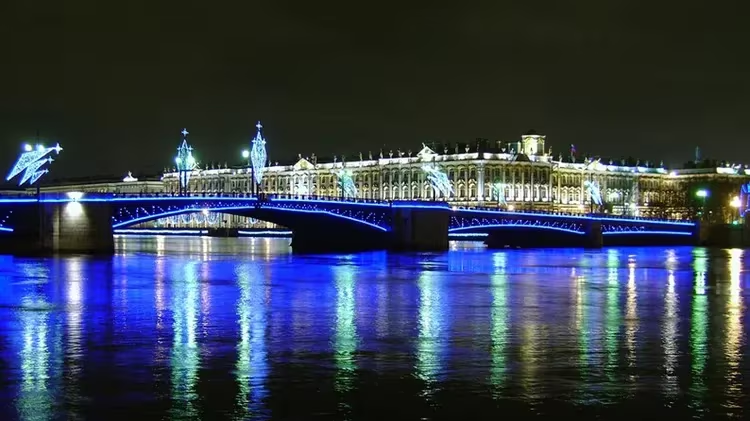
Palace bridge in St. Petersburg – history, photo, description, when the bridge is raised, how to get there, map
Numerous bridges and bridges are an integral part of the architectural space of the northern capital. A special place among them is occupied by the famous Palace Bridge in St. Petersburg. Its movable wings have long turned into a “visiting card” of the city. Bridge spans connect 2 large islands in the central part of St. Petersburg – Admiralteisky and Vasilyevsky. The length of the structure is 250 m, and its width is 27.7 m. The overpass owes its name to the Palace Embankment, in the neighborhood of which it is located. Between 1918 and 1952 was named “Republican”.
Construction history
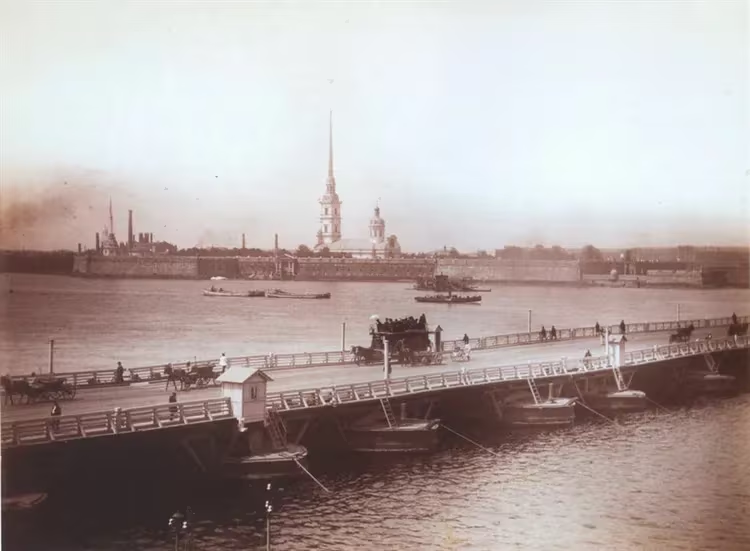
The insular position of St. Petersburg required the construction of crossings over channels and rivers. In 1727, a floating bridge was created, connecting the main state institutions (the Senate, the Synod) with the Menshikov Palace. The crossing was seasonal in nature and consisted of baroque pontoons moored close to each other. With the onset of cold weather, the bridge was dismantled. In winter, communication between the shores was carried out along the ice road. In the off-season (spring-autumn), moving from island to island was very difficult.
pontoon bridge
With the development of the city, the problem of the interconnection of its constituent parts has become urgent. At the beginning of the 19th century The government received a request from the St. Petersburg merchants with a request to establish a bridge from Admiralteysky Island to Vasilevsky Island. Its construction would allow for fast uninterrupted communication of the trading port, stock exchange and other important institutions.
In the early 50s. 19th century engineer I.K. Gerard developed a project for the construction of a pontoon overpass. The plan provided for the creation of a crossing consisting of wooden supports on the shore and 3 pontoons connected in a chain with a railing fence. To illuminate the road at night, it was planned to install lanterns on 6-sided pyramidal stands.
The design was put into operation after three years, in December 1856. The new floating bridge had the same drawback as the previous one: it did not function during the ice drift and freezing. Despite this, the ferry was actively used. The building has been constantly improved. It tested technical innovations:
At the end of the 19th century the decision was made to move the overpass downstream. The move started working at the new location in December 1897.
permanent bridge
At the request of the Petersburg public at the end of the 19th century. in the capital's government, the issue of building a stationary overpass was raised to provide permanent year-round communication between the main areas of the city. The construction of the bridge extorted solutions to a number of complex problems concerning geology and hydrology. In this regard, it was required to attract the best engineering and technical specialists.
At the beginning of the 20th century An open competition for projects for the future overpass was announced. Basic requirements for calculations and schemes:
28 models were submitted for consideration by the commission. However, not a single sketch received a majority of votes and the application was extended until 1904. Within three years, 19 more plans were developed. Additional clauses were added to the original rules, which provided for the presence of a draw span in the middle of the bridge.
The most advantageous option was the plan proposed by specialists from the Batignolles society, who had experience in building bridges in the conditions of St. Petersburg. It provided for the creation of an overpass structure of 5 parts with a split middle. The idea was not implemented due to a financial deficit in the city treasury. The construction of the bridge was discussed again in 1908. Previous requirements were clarified. They rigidly marked the parameters of the adjustable part. Among the contestants were:
A total of 9 developments participated. The tender for the construction of the Palace Bridge was won by the Kolomna Plant. The author of the project is engineer A.P. Pshenitsky.
Design work on the design of the external decor of the building was entrusted to the architect R. F. Meltzer. However, in the future, his sketches were abandoned due to excessive splendor and complexity of execution. Construction work continued from 1911 to 1916. After strength tests, the Palace Bridge was opened to traffic on December 23rd.
Design features
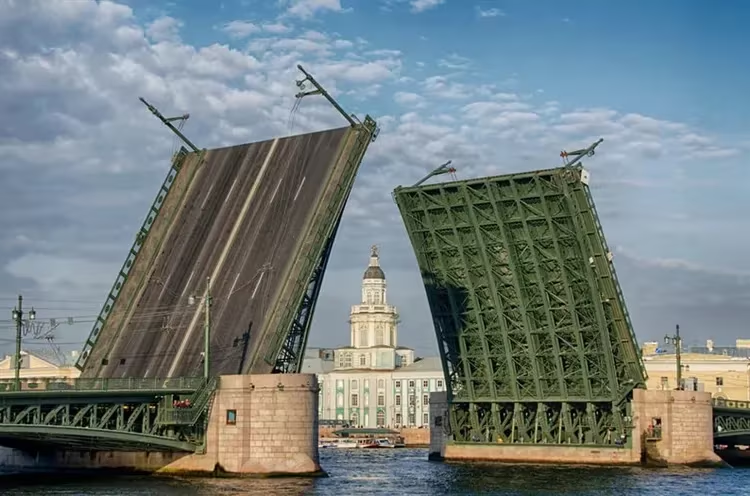
In architectural terms, the building consists of 5 parts. The central span is equipped with an adjustable mechanism. Fixed structures are equipped with a floor in the form of through trusses with 2 metal spans. According to the engineering and construction classification, this is a beam-continuous system.
Strengthening the structure is different:
The foundation is deepened into the soil up to 23.5–25.89 m. Fine-grained asphalt concrete was used to cover the road and sidewalks. There are railings along both sides of the bridge. Initially, they were made of wood, then they were replaced by cast iron and, at the end of the last century, by an aluminum grate.
In addition, separate parts of the overpass are equipped with a granite parapet. Fence height:
The lifting mechanism is operated by a hydraulic system. Multi-ton counterweights are fixed according to the Strauss system to the lower part of the overpass. During the lifting of the wings, they plunge into special underwater pits dug below the ground level by 6 m. In addition, the bridge is equipped with a backup drive. It allows, in case of failure of the main mechanism, to raise the structure within 30-40 minutes.
Specifications
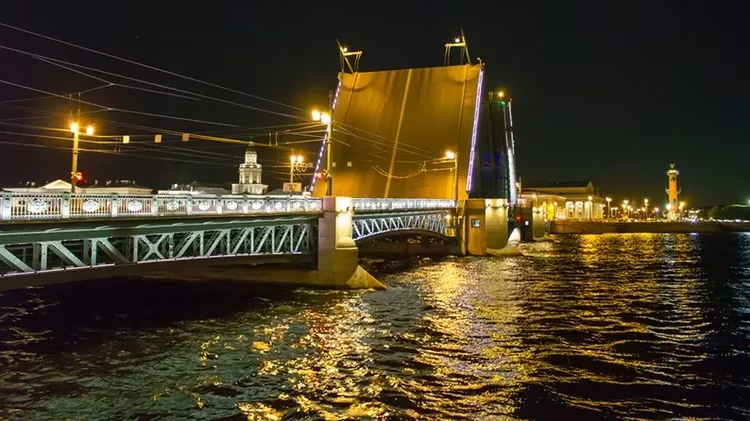
The Palace Bridge, which has a movable mechanism, is recognized as one of the most complex overwater overpasses in terms of engineering design. It consists of 5 parts. The central part with detachable wings has a width of 56.5 m.
Bridge options:
The bridge has very significant dimensions:
At night, lighting is provided by 28 lantern-type lamps. They are installed on 16 risers. There is a fence along the perimeter of the bridge. It consists of 156 parts.
Repair
After the opening of the crossing, the bridge underwent a thorough repair for the first time in 1967. In the 70s. it has been updated. The lighting fixtures, flooring, lifting part were replaced.
At the end of the 20th century The equipment of the outer part of the overpass has undergone changes:
At the beginning of 2000, technical expertise diagnosed the exhaustion of the service life of the mechanisms of the Palace Bridge. Repair was originally scheduled for 2008, but then moved to 2012-13.
Interesting Facts
The Palace Bridge is included in the list of cultural heritage sites of the Russian Federation. In the late 1930s, the wooden railing was replaced with a cast-iron railing. Design sketch created by I. Krestovsky. The work was carried out under the guidance of the architect L. Noskov. Popular Soviet symbols were used in the design of the gratings:
The raised wing of the bridge is sometimes used as a kind of “screen”. During film festivals, short films and cartoons are projected onto it. Unusual “panel” has an area of 400 sq.m. The rise of internal spans is carried out 2 times a day. The operation of the mechanisms is controlled by 6 people. Every night during the navigation period, about 25 ships sail under the bridge. The wings of the bridge, when raised, form an angle of 67 degrees.
Since the autumn of 1997, the bridge has been equipped with multi-colored illumination:
The minimum time for breeding and convergence of spans is 3 minutes. The Birzhevoy Bridge is considered to be an analogue of the Palace Bridge.
When bred
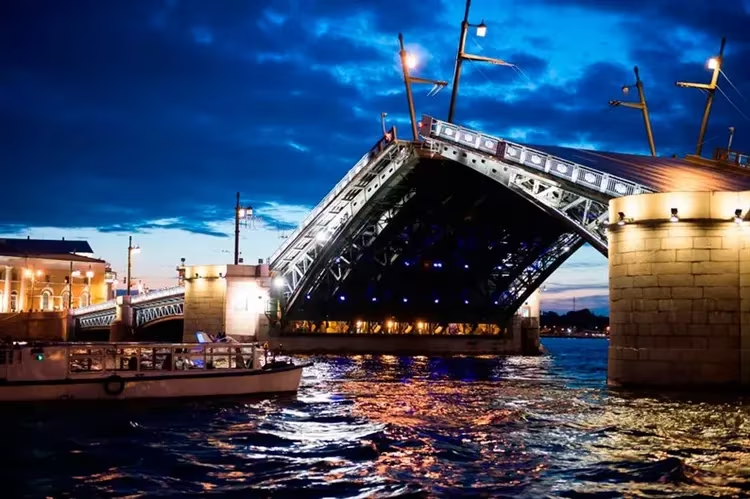
During the navigation period, the laying of the central span of the bridge is carried out strictly according to the schedule:
The breathtaking action of lifting the bridge wings lasts 10 minutes. To observe what is happening, it is important to correctly choose the place of inspection, since many tourists come to the bridge an hour before the start of the divorce.
Experienced guides offer places for the best view:
After the closure of navigation (November), the passage of spans at night ceases.
Where is the bridge and how to get to it
The official address of the Palace Bridge: University Embankment, 1. It is a connecting transport overpass between Birzhevaya Square and Palace Passage. It is convenient to drive up to the bridge using ground or underground transport: