
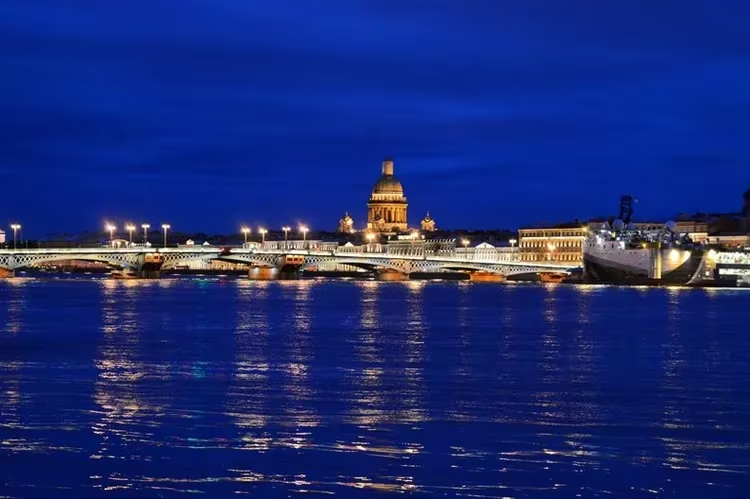
40 best sights of St. Petersburg – photo, description, map
The northern capital attracts the attention of tourists from all over the world. Significant historical monuments are located here. Their list includes the legendary Oranienbaum botanical garden, numerous cathedrals, museums and other interesting places. Architectural masterpieces amaze with originality and elegance. Other sights of St. Petersburg are also of interest.
Palace Square
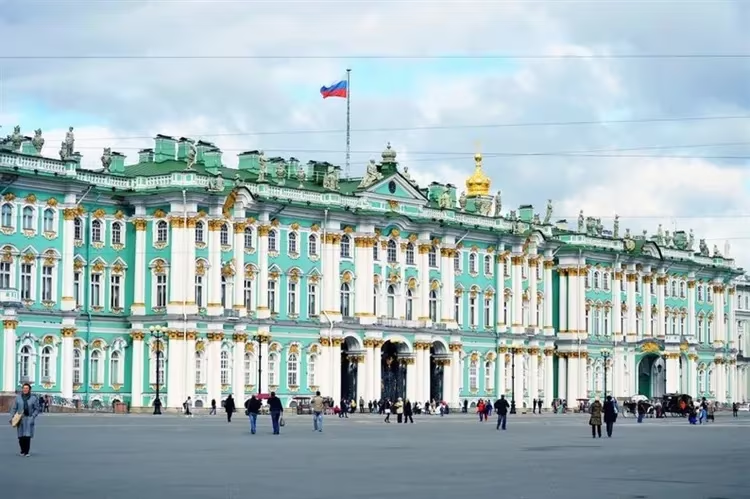
Today it is the heart of the city, a place that tourists must visit. And once there was a meadow overgrown with grass. Festive festivities were held here, pavilions and temporary fountains were built, from which wine spewed. It was only in the 18th century that the modern appearance of the square began to take shape.
The palace was not only built, but also reconstructed. During the last works, the foundation of Anna Ioannovna's wing was discovered. Archaeologists studied the find, then the base was covered again.
Palace Square is a wide space, the formal boundary of which is Palace Passage. Arch of the General Staff – the main entrance to the territory. Today, all significant events are held here. It is here that military parades are held on Victory Day, a Christmas tree is set up on New Year's Eve, and a laser show is arranged.
Winter Palace
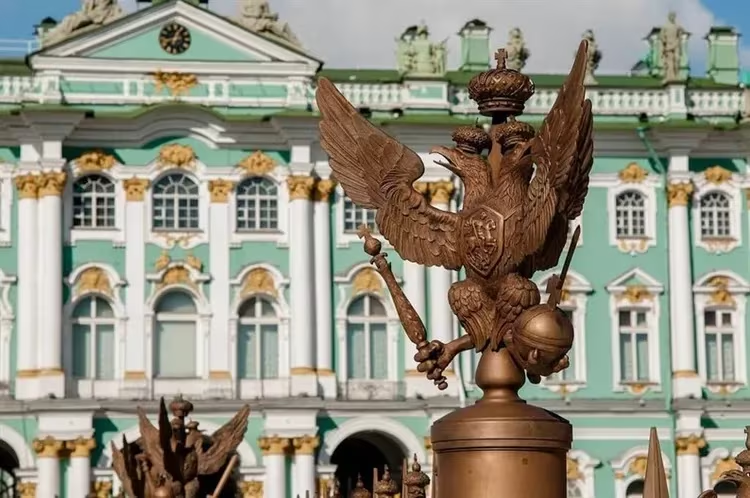
The majestic palace building, striking in its size and splendor of the Baroque, is the main symbol of the city. The ambitious heiress of Peter I, Elizabeth, ordered the construction of a royal palace that could outshine European counterparts. The Empress herself did not have to live in it, and Catherine II became the first owner of the Winter Palace.
The magnificent palace is the main one in the series of the Hermitage palace complex. It will take a lot of time to inspect all its premises. It is difficult to overestimate the scale of the richest heritage stored in this space. On the 1st floor, collections of archaeological finds placed in the rooms of the heirs of the last emperor are of interest.
The interiors of the rooms are a kind of decor monument of the 19th century. The decoration of the halls of the 2nd floor is amazing: the Throne, Petrovsky and Bolshoi. They show the art of Western Europe. Expositions on the 3rd floor introduce the culture, traditions and way of life of Asian peoples.
Rarities of the Buddhist religion, varieties of frescoes, stone idols, fragments of decor from Khorezm are exhibited here. It is impossible to leave the Winter Palace, filled with man-made miracles, indifferent.
State Hermitage
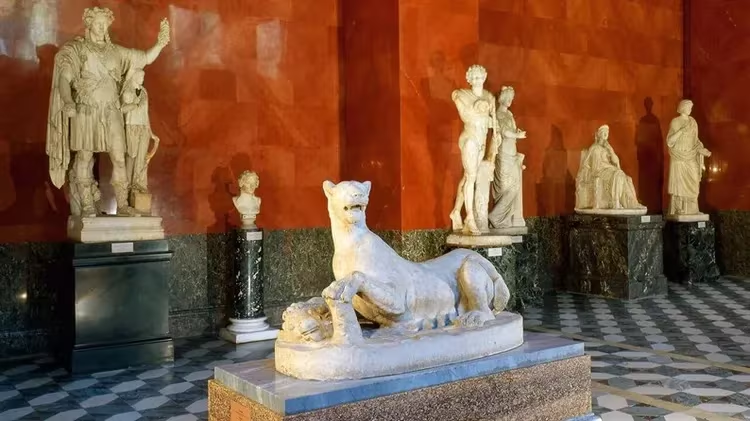
The world-famous museum complex, located on the Neva embankment, consists of 6 buildings, each of which is a magnificent architectural monument of the 18th-19th centuries. Founded by the progressive Empress Catherine II in the 18th century. the art museum today includes 365 showrooms. The richest collection of the Hermitage contains almost 3 million works of world art of various eras.
To inspect each exhibit, you need to devote more than one month and even a year to this. It is impossible to convey in words the emotions that you experience at the sight of the famous masterpieces of painting, sculpture, and applied art. The Hermitage is the pride and heritage of Russia, a symbol of its power and high culture.
Until the middle of the 19th, visiting the Hermitage was available only to a select few. The museum was opened to the general public in 1852, having built the building of the New Hermitage for this purpose. A huge role in the replenishment of museum funds, the compilation of catalogs was played in the 19th century by art historian A. I. Somov.
The entire palette of artistic creativity is presented in the richest collection of the mega-museum, from the era of primitive man to the present day. Scythian gold items, pottery, bronze and silver jewelry, unique archaeological finds illustrate the periods of human development. The collection of paintings, sculptures, graphics reflects almost all areas of art from around the world.
Nevsky Prospect
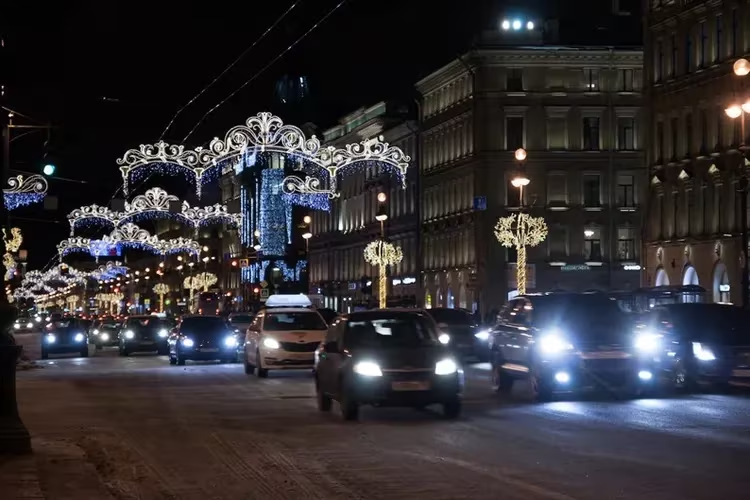
The main street of the city is a place of living history of the city and Russia. Literally every meter of its sidewalks and pavements remembers the epoch-making events of the country, legendary personalities of the world scale. Nevsky Prospekt excited the imagination of Russian poets, writers, artists, composers; delighted and continues to delight foreign guests.
The 5-kilometer avenue has something to be proud of and something to charm tourists. The most significant objects, architectural masterpieces are located on Nevsky Prospekt and adjacent squares and streets. A walk along the main thoroughfare of the northern capital is an immersion in the history and culture of the past and present, acquaintance with architectural styles.
The famous bridges across the Fontanka, the Moika and the Griboyedov Canal will reveal their secrets. On the Anichkov Bridge, get acquainted with the history of the world-famous Klodt equestrian sculpture. The majestic views of the palace complex on the square of the same name will impress. At the monument to the progressive Empress Catherine II, you can relax on a cozy bench and at the same time admire the facade of the Alexandria Theatre.
Many people go to the Literary Cafe, where Pushkin, the beacon of Russian poetry, liked to visit. You can't ignore the Stroganov Palace, visit the Chocolate Museum located on its 1st floor and refresh yourself with a sweet treat. Few people pass by Gostiny Dvor, Kazan Cathedral and other outstanding monuments.
Saint Isaac's Cathedral
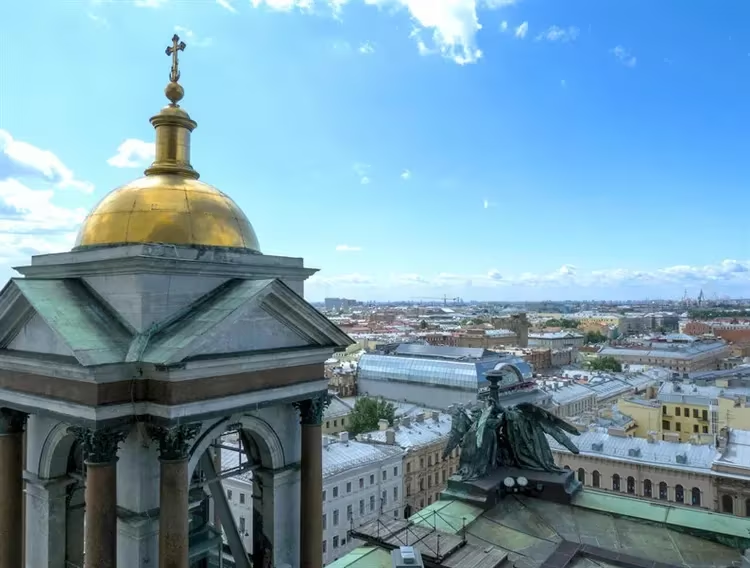
Recognized as the heaviest cathedral in the city. The grandiose building was erected for 40 years. The pouring of the foundation took 5 years. Only these facts speak about the scale of the building. There is a version that the price of malachite after the completion of the construction of the cathedral fell sharply. This was due to the fact that the columns were erected from this stone. All supplies were used up. Mining became unpromising and malachite lost its value.
The shrine was not damaged either during the years of Soviet power, or during the days of the Leningrad blockade. The communists decided to leave the building and convert it into an anti-religious museum. And the Germans used the domes as a guide and did not seek to destroy the object.
There is a legend. According to legend, the Romanov dynasty was to cease to exist at the moment when the scaffolding was removed from the cathedral. They were removed in 2016. A few months later, Nicholas II abdicated.
Now here are the collections of the Northern Museum. An observation deck is equipped on the colonnade of the shrine. A staircase of 262 steps leads to it. Those who have traveled the path will never be able to forget the sight of Peter sprawled below. Worship services are also held here.
It is especially crowded on the days of Orthodox holidays. Crowds of believers rush to give praise to the Lord. You can visit for free, but you will have to pay to enter the territory of museum objects.
Summer garden
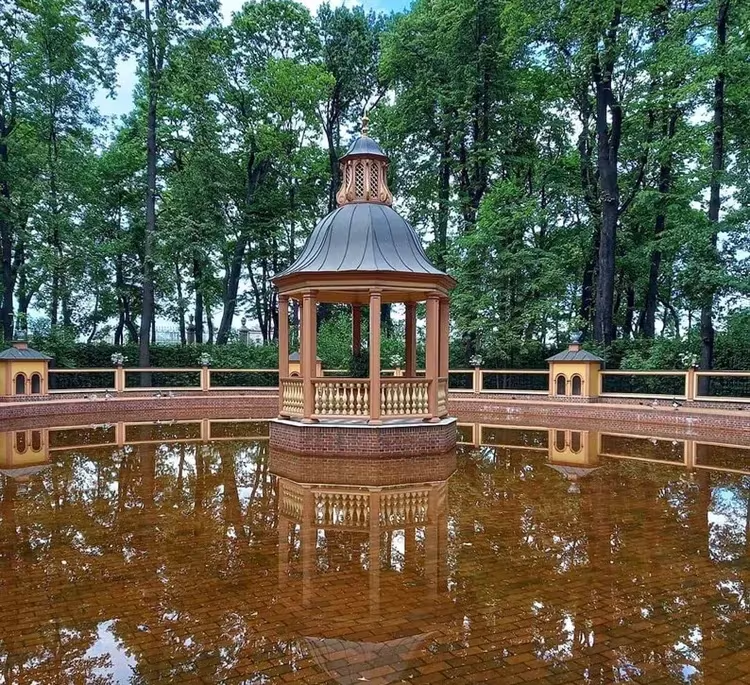
It is noteworthy that the modern Summer Garden is located in the same place as in the time of Peter 1. The emperor ordered to lay out a semblance of a Dutch park around his summer residence. True, the garden in those years was called a vegetable garden.
The oldest city park was planned according to the laws of landscape design:
Trees and shrubs were certainly trimmed. Flowers were planted in a certain range. And the linden alleys turned out to be so shady that lighting was required during the daytime. But pretty soon the Summer Garden fell into disrepair. He was less cared for. And the townspeople fell in love with the slightly neglected territory, they often began to walk in the park.
During the siege, beds were planted in the Summer Garden, where schoolchildren, under the guidance of teachers, grew vegetables. And one of the alleys has since been called School. At the beginning of the 21st century, the Summer Garden changed hands. This time, it was the Russian Museum. Another reconstruction took place, and the park is open for walking again.
Address: Kutuzov embankment, 2.
Peterhof
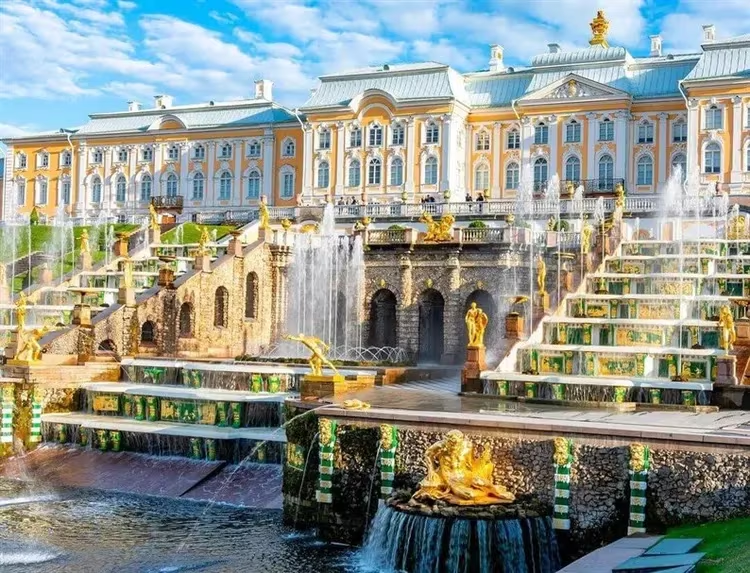
The idea to build a palace and park ensemble on the seashore, similar to European ones, and at the same time one that has no equal, belonged to Peter 1. Surprisingly, it took only 13 years to implement such a large-scale plan of the emperor. In 1762, Peterhof became a city under the control of the Palace. In the 19th century, the Peterhof district was formed. There were gymnasiums in the county center, and a railway was built for convenient access.
After the October Revolution, the complex was nationalized. Museums and sanatoriums for the proletariat were located on the territory. But the artifacts were saved. During the Nazi occupation, the ensemble was badly damaged. Part of the collection could not be evacuated, garden sculptures were buried in the ground without conservation. Subsequently, they were destroyed.
After the liberation, Peterhof was renamed Petrodvorets. So the Soviet authorities eradicated the connection of the first name with the German language. It was not possible to restore the buildings completely. This is especially true of the Lower Park. But the famous fountains, Peter's nursery rhymes and amazing palaces still receive visitors. It should be noted that in the rain, most of the expositions are closed.
Fountains open in mid-May and end in mid-September. It is important to note that the figures are conditional. Since everything depends on the weather, the colder – the earlier they close, and the warmer – vice versa. Therefore, before your vacation, be sure to find out the opening hours of the fountains.
You can get there in 3 ways:
It is better to visit the parks in the morning on weekdays, in early June and early September. However, due to seasonality and a short opening time, not only guests of the city, but also local residents want to enjoy the fountains. In this connection, there are almost always queues at the entrance to the lower park.
Kazan Cathedral
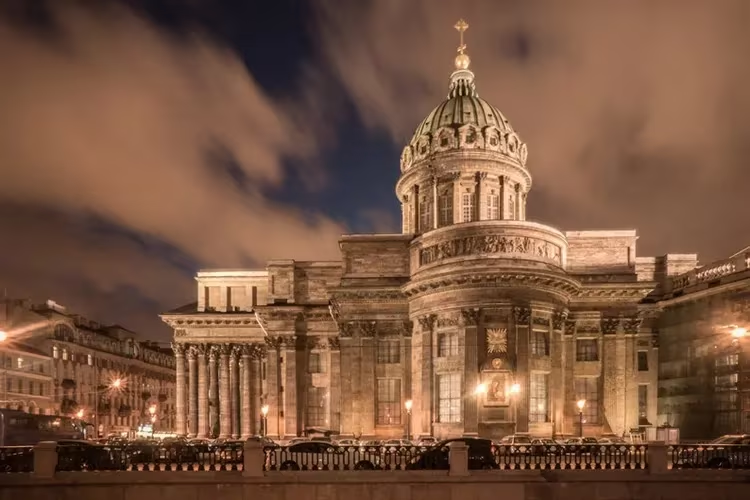
Included in the list of the largest cathedrals in the city. Within its walls is kept the great shrine of the Orthodox – the Icon of the Mother of God. The image is considered miraculous. Parishioners believe that everyone who touches the face will be healed. The history of the sacred icon is interesting. The Mother of God appeared in a dream to the Matrona of Moscow as a child. She pointed out the place where the icon is located. There she was found.
The frame of the image is decorated with jewels. They tried to steal the icon more than once. But she always returned to her native walls. Emperor Paul I in 1801 issued a decree in which he ordered the construction of a temple in St. Petersburg to begin. The cathedral was intended to store the Miraculous Icon. The monastery was built over 10 years. A. Voronikhin was the author of the project.
The cathedral was built by thousands of workers. Working conditions were extremely difficult. Despite everything, the cathedral was erected. Its height exceeds 71 meters. The majestic columns are especially admired. Each of them weighs almost 30 tons. The grand opening took place on the eve of the war with the French. Later, the conquered banners and standards will be stored here.
Now the cathedral is listed among the monuments of Russian military glory. Divine services are performed daily in the temple. Anyone can visit them. Excursions are organized for tourists.
mosaic patio
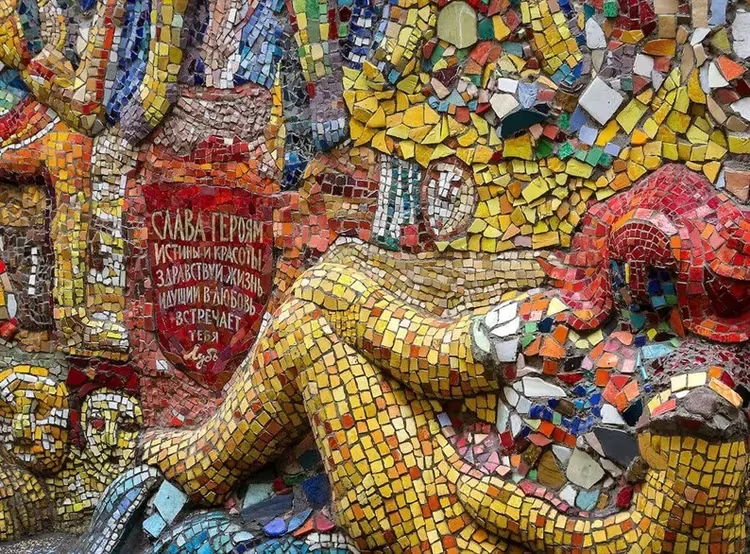
Disputes about an unusual art object do not subside for a long time. Some visitors are delighted, while others talk about uselessness and pretentiousness. That is why it is worth visiting the Mosaic Courtyard to make your own impression.
The object began to be created more than 25 years ago. Artist Vladimir Lubenko opened a school for children in the city. and at the very first lesson it was decided to decorate the yard with mosaics. Little schoolchildren actively participated in the creation of the project.
Lubenko used marble, tiles, smalt. Everything went into business: even porcelain cups with plates. Caring residents brought unnecessary dishes. And after a certain time, the courtyard was decorated with the first mosaic.
Today in the open air are located:
The main part of the composition is the Mosaic Olympic. Here you can see illustrations for the legends and fairy tales of the peoples of the world. And if you arrive before 22:00, you can visit the gallery of Vladimir Lubenko.
Address: st. Tchaikovsky, house 2/7.
Alexandrinsky Theater
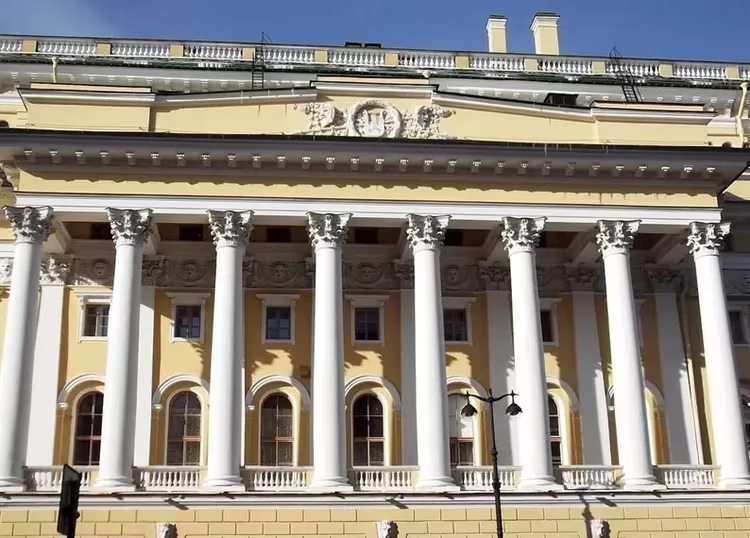
It got its name in honor of the wife of Emperor Nicholas I – Alexandra Feodorovna, but affectionately also called “Alexandria”, apparently out of respect for the centuries-old history of the theater from the time of ancient Egypt.
However, this is not the only interesting fact. The second name of the theater is the Russian State Academic Drama Theater named after the outstanding Russian poet, Alexander Sergeevich Pushkin. It is not difficult to notice that Alexandra Fedorovna and Alexander Sergeevich are namesakes, in this regard, confusion often arises, and many attribute the name of the theater to a completely different person.
But no matter how the guests call it, their opinions undeniably agree on one thing – the interior and exterior of the theater, its surroundings and exciting performances will not leave indifferent even the most avid theatergoer. The theater has 2 stages – old and new.
The old stage is located in the historical center of the city at pl. Ostrovsky 6. Opening hours: from 9 am to 18 pm. New stage – Embankment r. Fontanki 49 A. Working hours: from 11 am to 20 pm. Break with a break of 14 to 15 hours.
Both buildings are located in the historical center of the city and are located near its main artery – Nevsky Prospekt. The main stage of the Alexandrinsky Theater is adjacent to such masterpieces of architecture as the Anichkov Palace and Garden, Ekaterininsky Square.
You can get from s.m. Gostiny Dvor or Nevsky Prospekt and go towards Vosstaniya Square.
Kunstkammer
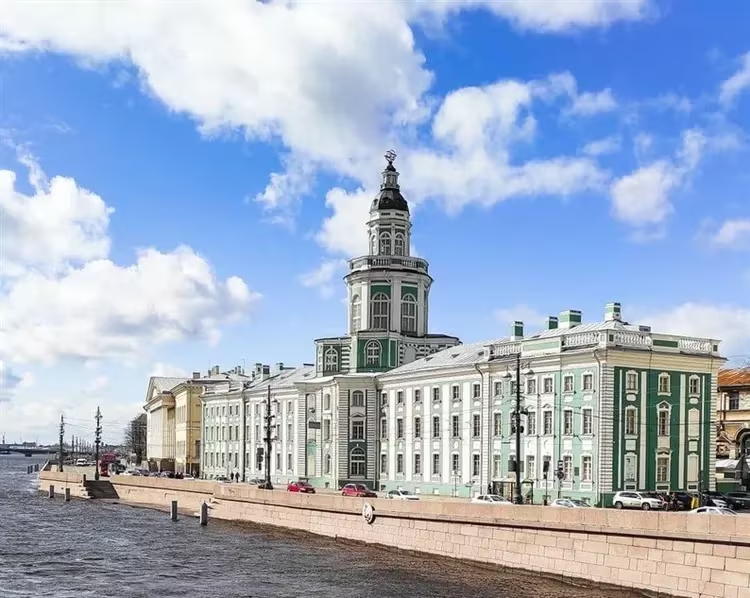
The first Russian museum, founded on the initiative of Peter I in 1714, was created as a repository of unusual items. From the German language, the name Kunstkamera is translated as “a cabinet of curiosities”. The first exhibits of the new institution were Peter's personal collection of curiosities. The collection included unique objects related to anatomy, mineralogy, zoology and having scientific value.
From all over the country, various rarities were brought here, the institution contributed to the development of science and education. Today, the Kunstkamera is located in an amazingly beautiful baroque building (1734), which is the oldest museum building in the world.
Officially it has the status of a museum of anthropology and ethnography. Its funds contain more than 1.2 million rarities. In the thematic halls, exhibits are presented that characterize the culture and life of the peoples of different countries: Japanese, Chinese, Mongols, Indians, Australians, etc.
Here you can see unusual tools, objects of applied art, natural phenomena, weapons. Of great interest is the Anatomical Hall, which demonstrates physiological and anatomical deformities, the consequences of mutation and genetic abnormalities. Particularly impressionable people are not recommended to visit the Anatomy Hall.
You can get there in 2 ways:
From st.m. Admiralteyskaya, walk across the palace and exchange bridge and be at the threshold of the museum (20 minutes) or by transport: trolleybuses – 10.11; buses – 24, 7. From the metro station Vasileostrovskaya, walking along the middle avenue and the cadet line (about 15 minutes) or by transport: buses 24 and 3 M.
As in other museums of the city, the most profitable days to visit are weekdays, the best time is in the morning. It is also recommended to choose periods in which the tourist flow is the least – this is November, February – April.
Trinity Izmailovsky Cathedral
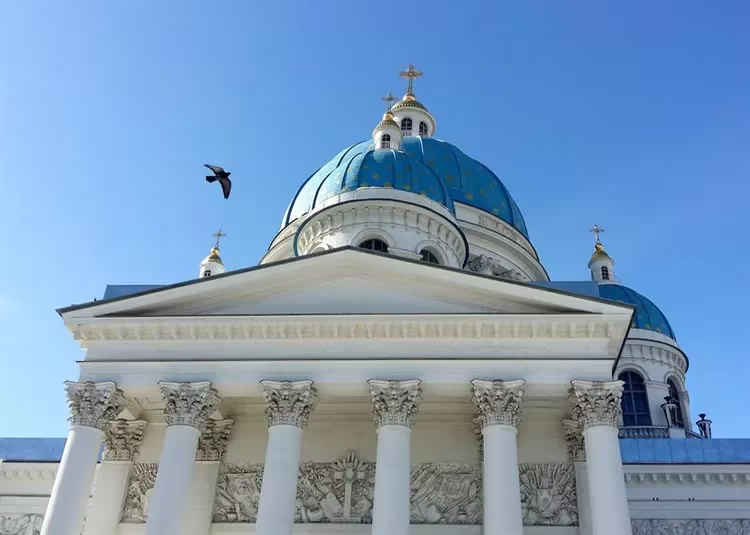
The cathedral was built from 1828 to 1835. It is located in the Admiralteisky district and impresses with its scale. Its main dome is visible from a distance of 20 kilometers. The history is closely connected with the Izmailovsky regiment, which was created in 1730 at the direction of Anna Ioannovna.
Initially, a wooden temple was built. If necessary, it was taken apart. He followed an elite regiment that was renowned for bravery and courage. But in 1824, the city was overtaken by a flood. The church was flooded. Then the current ruler issued a decree to build a new, stone temple.
The talented architect managed to preserve the style inherent in Russian wooden churches. The building was built in the spirit of late classicism with elements of the Empire style. Services were regularly held here. But later the communists came to power, and the building was adapted for other needs.
They even wanted to destroy the cathedral in order to make room for new buildings. But the war broke out with the fascist conquerors. The Trinity-Izmailovsky Cathedral was badly damaged during the Siege of Leningrad. Later, restorers returned the original beauty of the shrine. Now parishioners and all those who are interested in history are also welcome here.
Summer Palace of Peter I
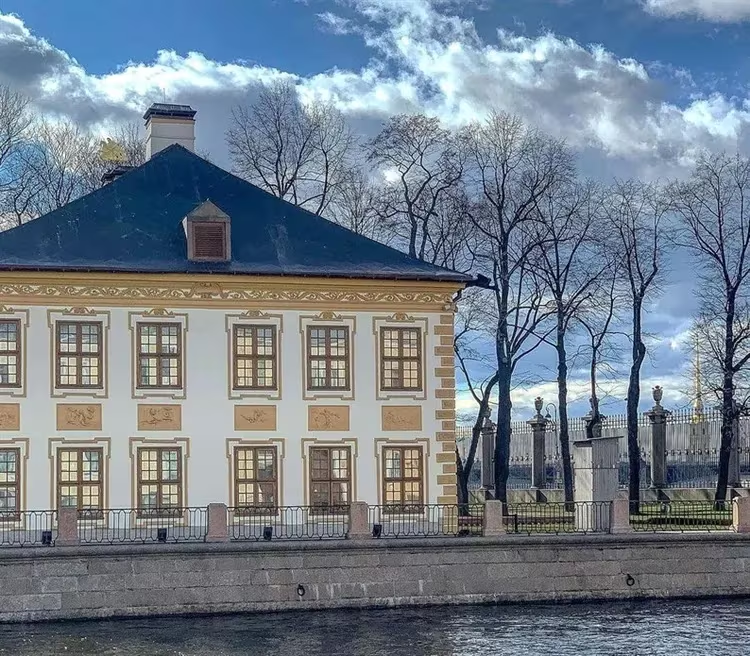
A building with a long history. If you want to visit the walls of the palace, which “saw” Peter I himself, then go on a tourist walk to the Summer Garden. It is extremely surprising that the house, founded in 1710, was unaffected by wars and revolutions – its foundation has been standing on the ground for more than a dozen years.
Only a few buildings in the city can boast such a centuries-old history. The walls of the Summer Palace are exquisitely decorated with bas-reliefs reminiscent of the brilliant victory of the Russian Empire during the Great Northern War.
It is worth noting that the victorious motives of the war with Sweden are reflected in more than one building built by order of Peter I. Called the Summer Palace, the house of Peter I is completely different from the gigantic buildings of the city. Its territory is several tens of square meters, and the number of rooms can be counted on the fingers.
The Summer Garden surrounding the palace is full of graceful flowers and plants. This is a real greenhouse, created by Peter I in the manner of Versailles.
Favorable months for visiting the palace itself are March and October, since the flow of tourists in these months is the smallest. However, the beauty of the Summer Garden can only be seen from May to September.
Mariinsky Palace
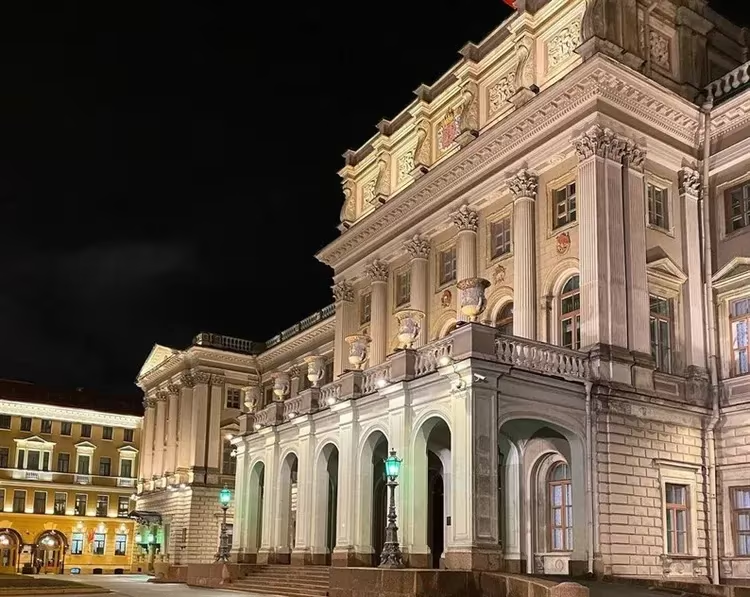
A palace shrouded in family secrets, unlike the rest of the imperial residences in the city, in terms of interior decoration. The main intrigue is in the question: why is the monument to Nicholas I installed with its back to the palace? Many believe that the emperor's daughter, having a bad temper, rejected her father's gift, thus inflicting a mental wound on him. But the facts passed away along with the witnesses of those events, and the palace still adorns the city with its beauty.
For the first time in the history of centuries-old construction in Tsarist Russia, the interior decoration of the premises was functional. It became a kind of “know-how” of the 19th century. Materials were selected specifically for the intended purpose of the premises. This approach was reflected in the later objects of architecture.
Mariinsky, the palace was named after the daughter of Emperor Nicholas I, Maria. Here she lived with her husband Duke Maximilian of Leuchtenberg, the grandson of Napoleon himself.
Remembering the bad character of Mary, it will not seem surprising that she lived with her foreign husband in St. Petersburg. Although it was customary to go to the residence to her husband, abroad.
Address: Isaakievskaya sq. 6.
Mikhailovsky Palace
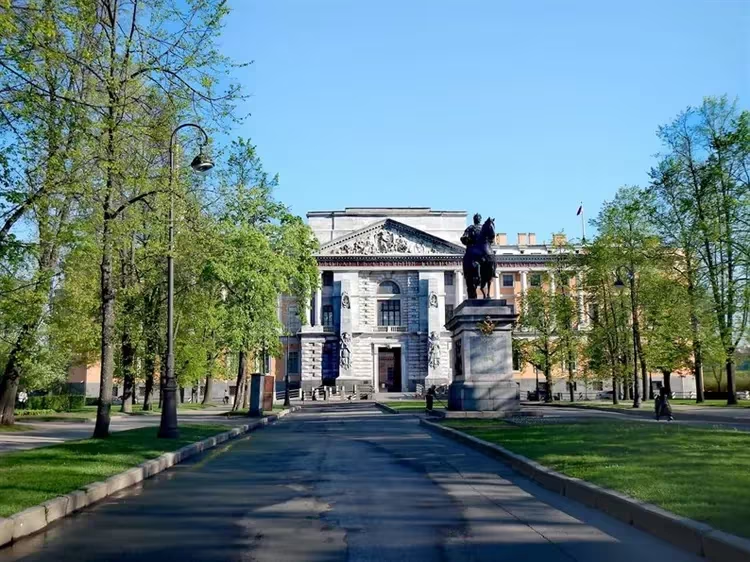
The palace, which has become a real art gallery, has collected many art paintings by Russian painters. However, even before the opening of the museum, the house of Mikhail Pavlovich, the son of Emperor Paul I, was the cultural center of the capital. It was visited by such famous historical figures as Pushkin, Tyutchev, Bryulov and Aivazovsky. The building, which carried, from the origins of its creation, art into the Petersburg world, and could not become anything other than an art museum.
The opening, on the basis of the Mikhailovsky Palace, of the Russian Museum, took place on the orders of Nicholas II. His father, Alexander III, during his lifetime wanted to dedicate the building to the needs of science and create the Kenya Institute in it. But the house of Mikhail Pavlovich was destined to become not a scientific, but a cultural landmark of the city.
The current building of the museum, almost 2 times, differs in size from its “predecessor”. The gallery grew so quickly that a few years later it became necessary to attach a new building to the palace.
Museum of the History of St. Petersburg
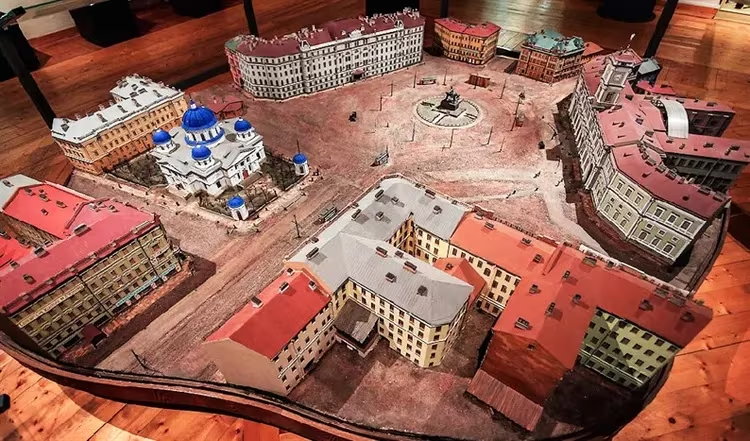
The Museum of the History of St. Petersburg is not a classic, single building that affably tells everyone about the fate of the city, it is a whole museum complex, which includes: the Peter and Paul Fortress, the Oreshek Fortress, the Rumyantsev Mansion, the Museum of Printing, etc. The main building is located on the territory of the Peter and Paul fortresses.
Unlike its “brothers”, the Museum of the History of St. Petersburg is a contemporary. More than 1 million historical testimonies of the life of the city are stored within its walls. Moreover, the museum itself is nothing more than another cultural monument of the architecture of the Russian Empire of the 18th century. After all, it was from the hare island, from the walls of the Peter and Paul Fortress, that the construction of the city began.
The building, over the century of its existence, regularly changed, and the name was renamed. The composition included new objects, creating a whole ensemble of historical monuments. Thematic exhibitions, cultural and educational programs, as well as lessons-excursions are regularly held within its walls.
Any schoolchild or adult will be able to lift the veil of the city's foundation and its development from the origins of 1703 to the present day. Each object has its own address, but they are all located in the city center, not far from the Peter and Paul Fortress.
Nearest metro stations: Admiralteyskaya, Sportivnaya, Gorkovskaya.
Museum “Grand Maket Russia”
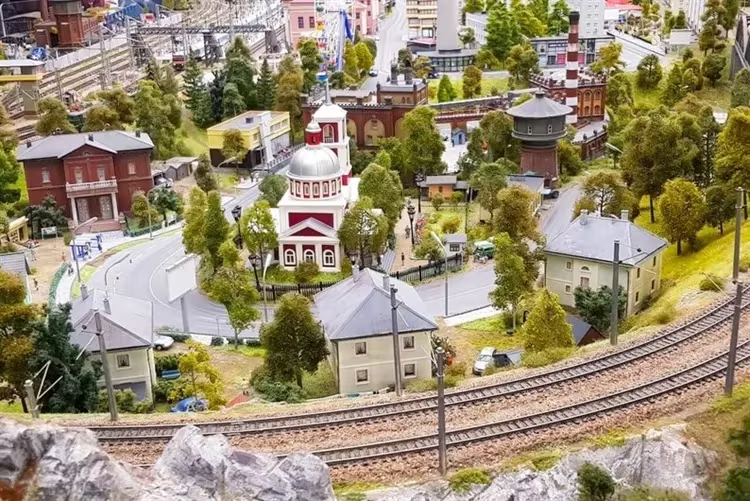
Grand Maket Russia – private exposition. Here, on an area of about 800 square meters, you can see all the regions of the country, presented on a scale. On the walls there are diagrams, tables, schemes showing the features of the region and economic activity.
You can still see the movement of road and rail transport, the harvesting of agricultural machinery, even the escape of prisoners from prison. And all this can be controlled by the visitors themselves: one has only to press the selected button on the end of the layout.
An audio guide is provided for the convenience of guests. This mechanism helps to navigate the stand. And around there are interactive screens where you can get acquainted with a specific object or historical period.
Technical equipment is organized in accordance with the latest developments. The stand is illuminated with LED lamps, and the objects are powered from the mock-up field. Every 13 minutes there is an automatic change of day and night. And it's all automated.
The organizers of the exhibition made sure that the guests visited it again. There are thematic expositions, live lessons (which are much more interesting than school ones). There is a room for watching videos. A birthday that takes place in the center is remembered for a lifetime.
Monument Bronze Horseman
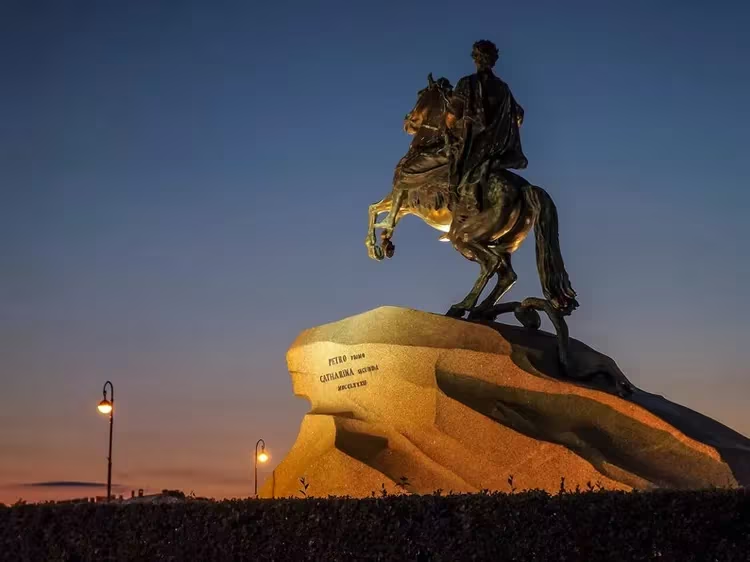
Horseman, cast in bronze, but called copper – a monument to the founder of St. Petersburg, Peter the Great. He owes his sonorous name to Alexander Sergeevich Pushkin, who created an “ode” about the Bronze Horseman. There are legends that the pedestal is not just the creation of the hands of the talented sculptor-architect Falcone, but a bronze statue of Peter I himself, created by magical powers, frozen in this place.
Extremely interesting is the fact that a medal was established for the delivery of the Thunder-stone-a piece of rock that served as the basis for the monument. The stone transportation operation went down in history, since in all modern times, rocks of this size have not been transported over long distances.
You can see the monument around the clock and absolutely free. Despite its fundamental importance for the city – there is a legend that the Bronze Horseman protects the city from ill-wishers, the monument is freely available to everyone.
The city felt all the incomprehensible power of its “guardian” during the trials of the 1st and 2nd World Wars, as well as revolutions and civil strife. Not a single projectile and not a single person attempted to overthrow Peter the Great from his pedestal.
The monument has never been damaged or dismantled, and during its restoration, the sculptors-architects noted that the monument is in very good condition. Therefore, you don’t have to worry – the Bronze Horseman will protect the city for more than one century.
Address: Senate Square.
Narva triumphal gates
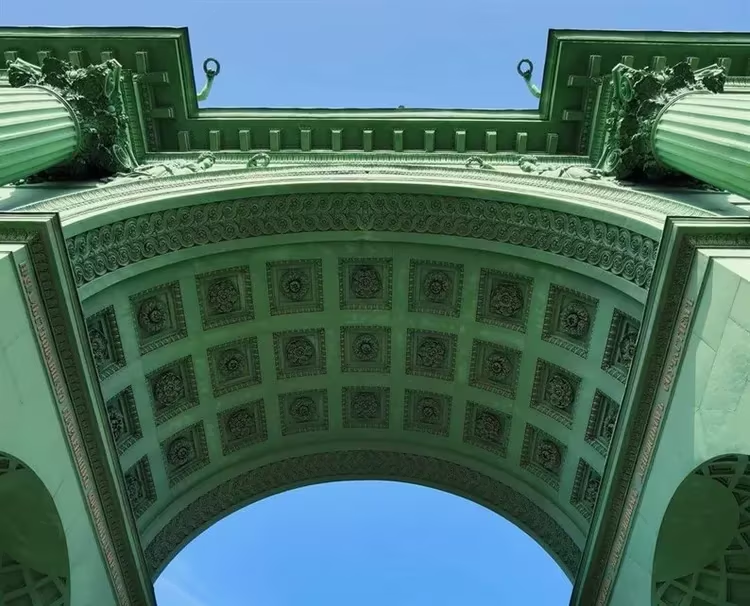
The first gate was built in 1814 as a sign of the victory of Russian troops over the Napoleonic army. That year the returning army marched through the gate 4 times. But alabaster and wood were used for the work, so the building quickly fell into disrepair.
For the construction of a new composition, a place was chosen a little further from the original. But the materials used are more durable: marble, granite and copper for cladding. It is the copper cladding that is the hallmark of the monument. And in August 1834, Russian troops marched in front of the emperor through the new gates.
The monument had interior rooms. They housed rarities of the Patriotic War. There was also a guard house in the building. In the 19th century, the archives of the State Duma were kept. Now the gate has been restored. There is an exposition inside. It is noteworthy that you have to climb here along a narrow spiral staircase: it is problematic for two visitors to disperse. Outside, guests of the city can see the building, which has been restored to its original appearance.
Address: Stachek Square, 1.
Mikhailovsky Castle
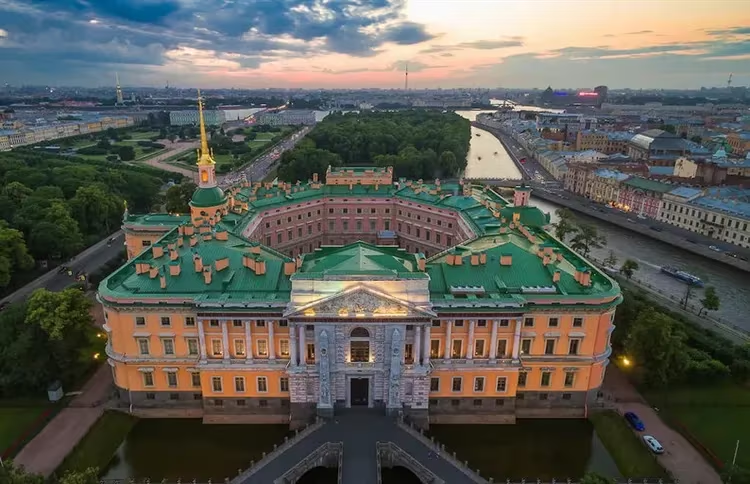
Mikhailovsky Castle was built by order of Paul 1. And the emperor also called the building a castle. The reason is prosaic: the son of Catherine II was passionate about chivalry. The result is a medieval fortress surrounded by water.
This is the only royal residence in Russia, made in this style. But the emperor did not live long in the new residence: it was in it that he was killed. Work on the interior decoration was immediately stopped.
For several years the house stood empty and dilapidated. But the Grand Duke Nikolai Pavlovich asked to transfer the castle to the corps of engineers. The request was granted, and the castle became known as Engineering.
At a time when classrooms and living rooms were located in the palace, legends arose. The most common: the appearance of the ghost of Emperor Pavel Petrovich in the night corridors.
Today the Engineering Castle is a branch of the Russian Museum. In the 1990s, the building was transferred to the center. The restoration took several years. The architects managed to restore the exterior, and the interiors – only partly.
Today, guests can see an exposition of paintings from the era of Paul 1. Works by Russian artists are also presented. But employees arrange thematic exhibitions. They are diverse and therefore interesting.
Erarta Museum
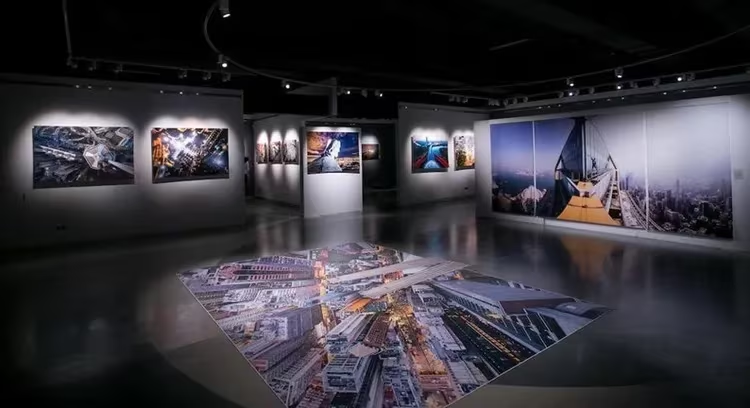
It is the largest private center in the city. Its organizers preached 3 immutable (in their opinion) truths:
The purpose of the exposition is to make you look for answers to eternal questions: who is a person, why does he live, what do eternal feelings represent – happiness, suffering, love? And visitors should be prepared in advance for the fact that searches can be quite unusual.
The permanent exhibition consists of almost 3,000 works. These are paintings and sculptures of urban art figures. The works of foreign authors corresponding to the given direction are presented. Thematic exhibitions are organized in the neighboring wing.
In addition, the administration of the center screens video films and arranges lectures for visitors. Here you can listen to concerts. But it is rather difficult to name the theme of the events. This follows from the general concept: to awaken the senses, through perception and memory.
Peter-Pavel's Fortress
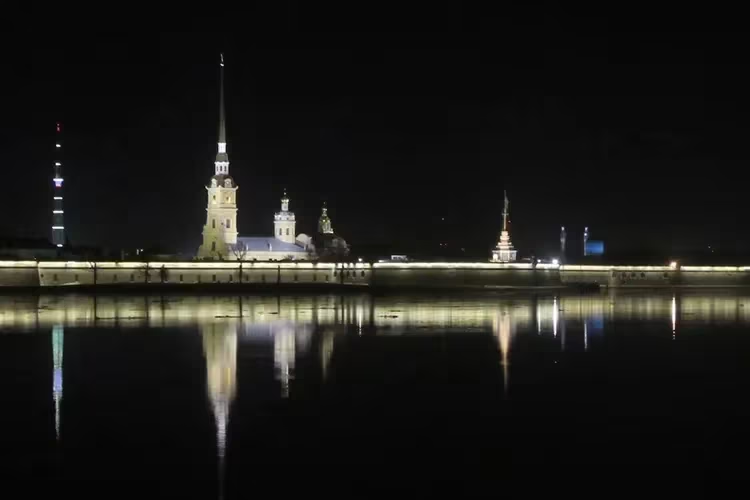
Like the zero meridian, which is considered the reference point of the geographic coordinates of the globe, the Peter and Paul Fortress is the zero meridian in the history of the city. It is with the laying of a brick on the hare island that the chronicle of St. Petersburg begins.
The historical name of the fortress is Zanht-Peter-Burh, and the historical significance is to defend the city from the attack of the enemy armies of Sweden. The main attraction of the fortress is the Peter and Paul Cathedral. During its history, the fortress managed to visit both the royal tomb and the holy place of worship. And also one of the worst prisons in the city. Especially dangerous criminals were imprisoned here, as they say – without trial or investigation. The basis for imprisonment in the fortress was the imperial decision.
Today, all representatives of the royal Romanov dynasty are laid to rest in the Cathedral. Many of the remains were brought to the fortress from all over the world.
Savior on Spilled Blood
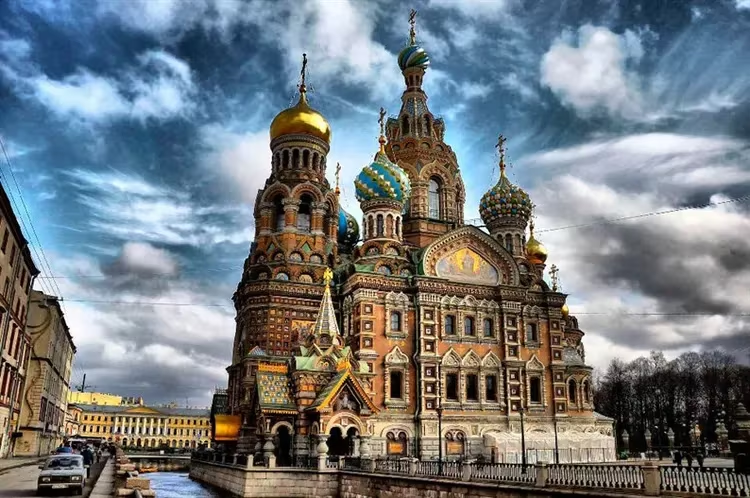
One of the most mysterious temples, keeping many secrets within its walls. His fate is not easy. During the years of the revolution, the Soviet regime and the war, the building managed to be a morgue, a vegetable base, as well as a storehouse of scenery for a small opera house. The cathedral has an asymmetric, non-standard form for Russian religious buildings. And its external decoration contrasts with the cathedrals in the style of Ancient Greece, stately decorating the city.
Despite this, the Church of the Resurrection of Christ (the second name of the cathedral) has more magical signs than any other. Petersburgers and guests of the city could even lose this attraction, if not for a happy accident – a shell that fell into the dome of the temple during the 2nd World War simply did not explode. He lay there for 20 years, after which he was discovered and neutralized.
The history of the construction of the temple is more tragic than its fate. The Church of the Savior on Spilled Blood was erected at the site of the terrorist act against Emperor Alexander II, as a result of which he died. But the townspeople believe that his spirit guards the city to this day.
If you decide to visit St. Petersburg at the beginning of summer, during the white nights, then you have a wonderful opportunity to go on an evening tour of the temple. The period of their holding is from May 30 to September 1.
Admiralteyskaya embankment
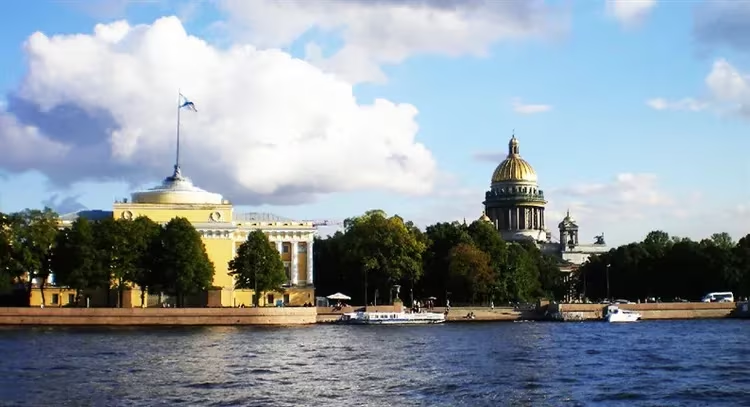
Having lost the “title” of the river gates of the city, the embankment has become another attraction of the front of St. Petersburg. Despite its venerable age, the embankment is quite young. Since initially it was a slipway for launching the Admiralty ships under construction.
As time went on, the building of the Admiralty was subjected to reconstruction, and with it the adjacent embankment. The main building on the embankment is the Admiralty. Now – the Dzerzhinsky Naval Institute. The maritime past of the embankment is confidently intertwined with its maritime present.
The sights of the Admiralty embankment can be considered its famous houses, namely:
It is also worth seeing the famous lions of the Palace Pier, located near the Palace Bridge.
Holy Trinity Alexander Nevsky Lavra
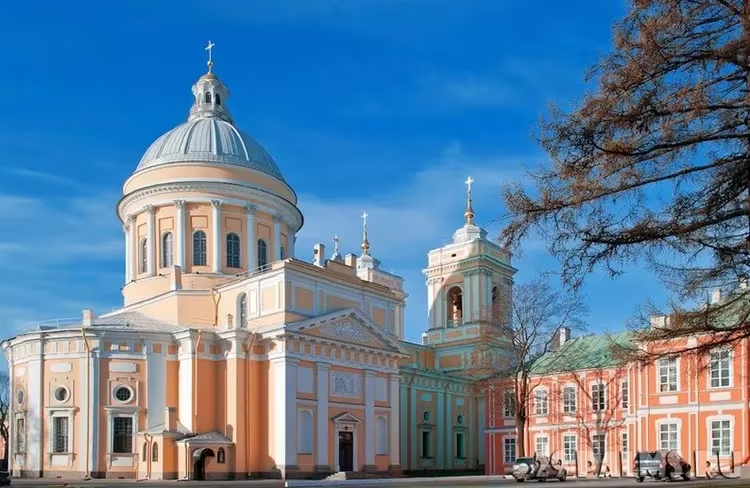
The monastery appeared by decree of Peter the Great. The emperor ordered the creation of a monastery in memory of the exploits of Prince Alexander Nevsky. For this, lands were allocated by the sovereign decree. Designed by Domenico Trezzini.
He realized the plan according to which the complex should become both a palace and a place where spiritual, educational and charitable work takes place. Soon, a printing house and a school began operating in the monastery, which later became the Slavic-Greek-Latin Seminary.
The monks connected the monastery with the Admiralty. After some time, this road was transformed into Nevsky Prospekt. From 1932 to 1996, Soviet institutions were located in the monastery. Only in the late 1990s, reconstruction began, which continues to this day.
Before nationalization, 12 churches worked on the territory of the monastery. But today services are held only in 3:
Visitors can venerate the holy relics, bow to miraculous icons, and study the unique tombstones of the Lazarevsky cemetery. Work continues on the improvement of the Metropolitan Garden. There are interesting sculptures on the territory of the monastery. A walk along the Lavra will be interesting for both believers and atheists.
New Holland
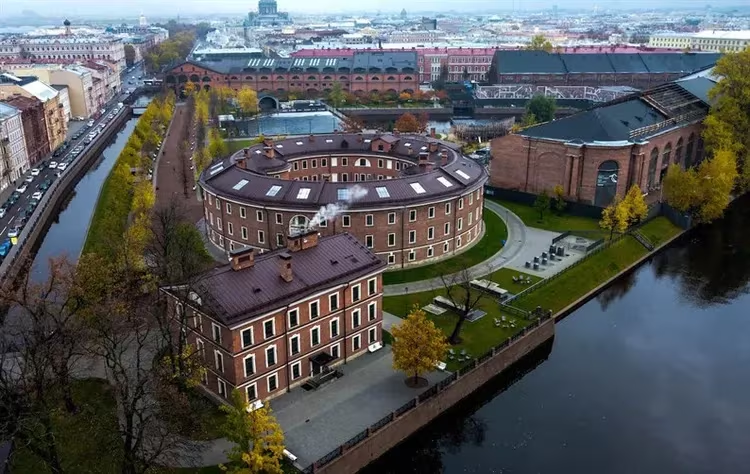
The name is given to an island located in the Admiralteisky district. Under Peter I, the territory was used for ship work. Mostly Dutch craftsmen worked here. That is why the island got such an unusual name. Over time, New Holland fell into disrepair. Buildings collapsed, everything was overgrown with grass. But the city authorities decided to adapt the territory for a recreation area. A park was laid out here, ornamental plants and trees were planted, playgrounds and sports grounds were equipped.
Local residents and guests of the city come here to relax after a hard day, breathe fresh air and enjoy the picturesque scenery. The lavender garden is a great area for a photo shoot in the summer. It is located in the center of the island. Reservoirs on the island have also been landscaped. Around them are sun loungers, umbrellas from the sun.
For the entertainment of children, the children's town “Fregat” is equipped. Both kids and older kids will find something to do here. In addition, year-round festivals dedicated to music and cinema are held, festive events are organized, and excursions are conducted. It won't be boring here even in winter. Here they fill the skating rink, set up a Christmas tree, erect ice and snow figures.
Pay attention to architecture. Some buildings can be viewed not only from the outside, but inside. Open for visiting:
Leningrad Zoo

The zoo was founded at the end of the 19th century. Until now, it is the oldest and one of the northernmost zoos in Russia. The original buildings have been destroyed, but during the reconstruction, the architects adhere to the original layout.
It was originally a private institution. The collection of animals was purchased at the Gebgardts' own expense. At that time, lions, tigers, bears, parrots and waterfowl could be seen here. The second husband of Sophia Gebgardt, Rost, turned out to be an excellent businessman: he used the proceeds from the theater and restaurant formed on the territory of the zoo to buy animals and landscaping.
After Rost's death, the zoo had to be closed. It was revived in 1910 by Novikov, a theatrical entrepreneur (now he would be called a producer). Novikov cleared the area, repaired the cages and dug a new bird pond. It is noteworthy that the animals acquired by Novikov are long-livers of the zoo. The elephant died during the raid of 1941, and the hippo survived until the Victory.
In memory of the heroism of the zoo workers during the Great Patriotic War, he forever remained Leningrad. Today, guests can not only see the animals that live in the zoo. Every month, employees conduct thematic excursions, arrange lectures and environmental games. And for young visitors, attractions are open throughout the year.
Smolny Cathedral
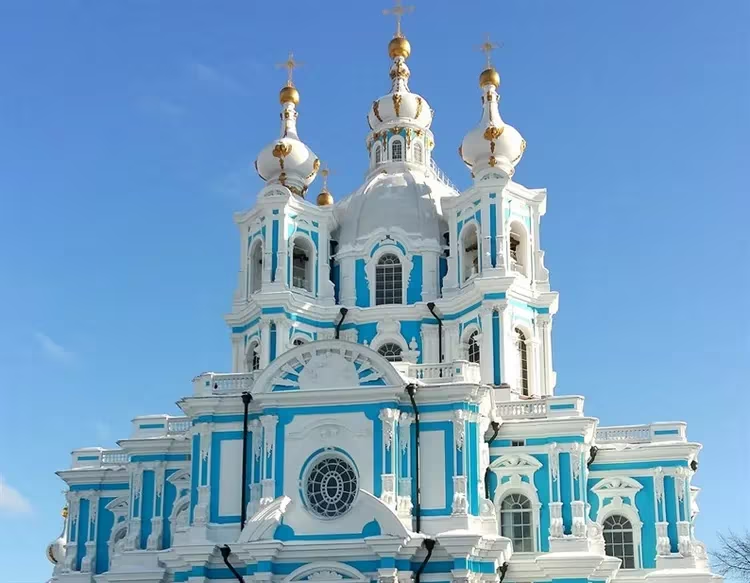
There are many legends associated with this building. Three curious facts will confirm the assumption of its uniqueness:
The cathedral owes its appearance to the daughter of Peter the Great – Elizabeth. She dreamed of becoming a nun and ordered the construction of the Resurrection Monastery. Later it will be called by its location – Smolny.
The architectural complex is made in the Baroque style, however, like all the other creations of the legendary B. Rastrelli. Namely, he became the author of the project.
Under Catherine II, an educational institution for girls was founded here, and later the Charity House for widows and noble maidens entered the complex. The construction of the shrine was completed only under Nicholas II. The temple amazed the eyewitnesses with its beauty. It was light, as if hovering above the ground, graceful, and at the same time solemn.
The interiors were of particular admiration. Gilding, crystal, sculptural compositions looked luxurious. There is a version that there are secret passages under the cathedral. They are created for the urgent evacuation of the authorities. Orthodox icons painted on Mount Athos are kept within the walls of the temple.
Since 2016, the church has been welcoming parishioners. Restoration work has not yet been completed. But you can appreciate the beauty and magnificence of the building even now.
Oranienbaum
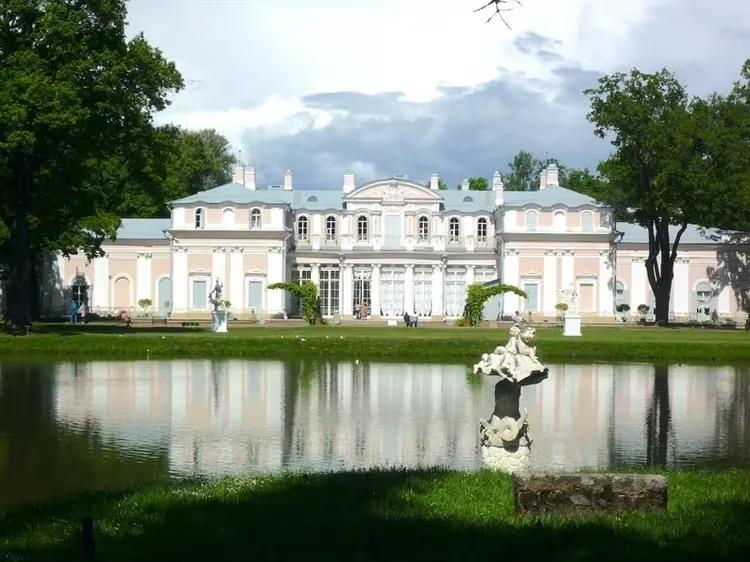
This is a historical place and a wonderful area for walking. On the territory of the palace and park complex there are amazing buildings that remember many historical events, and a luxurious garden.
Visitors are invited to see:
Conventionally, Oranienbaum is divided into Lower Garden and Upper Park. The second part occupies a more impressive area. There is even a river here. Guests love to relax by the ponds, sitting in the shade of thick trees. Also here is the dacha of Empress Catherine the Great.
Walking around the territory takes a whole day. Visitors will be able to get acquainted with the history of the complex, learn the details of the life of famous personalities who once visited here.
Spit of Vasilyevsky Island
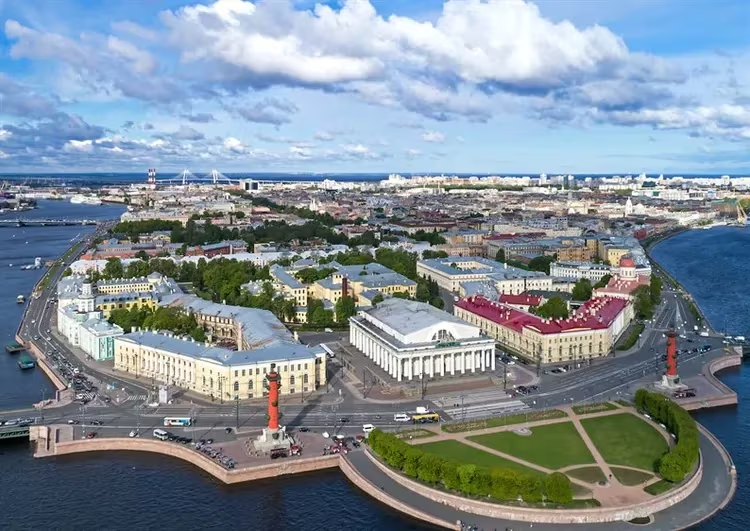
The arrow is the confluence of the Great and Lesser Neva. This place is definitely visited by all tourists. And the locals love it too. Newlyweds after marriage are sure to come here for a photo shoot.
The main architectural ensemble, consisting of the Rostral columns, the exchange square, the warehouse, the Exchange building, was supplemented by a modern monument – an anchor. It was raised from the bottom of Galernaya Harbor in 2003. Embossed at anchor: Olonets, 1723. This suggests that the Northern Palmyra and the anchor are the same age.
The Exchange building is unique. It was built as a business building, but it looks like a temple. But the area in front of him is artificial. To do this, part of the bottom was reinforced with piles and backfilled, and a descent to the water was arranged. The coast has moved, but it has become more convenient. For some time it was used as a front pier. Subsequently, a square was built here.
But the warehouses are buildings that were erected on the site of buildings washed away by the flood. The exchange needed strong warehouses that are not subject to the elements. Strelka offers an excellent panorama.
From here you can see the Peter and Paul Fortress, the Palace Embankment. And the place itself is amazing: there is a lot of water and air, a feeling of unprecedented space and freedom is created.
Oceanarium
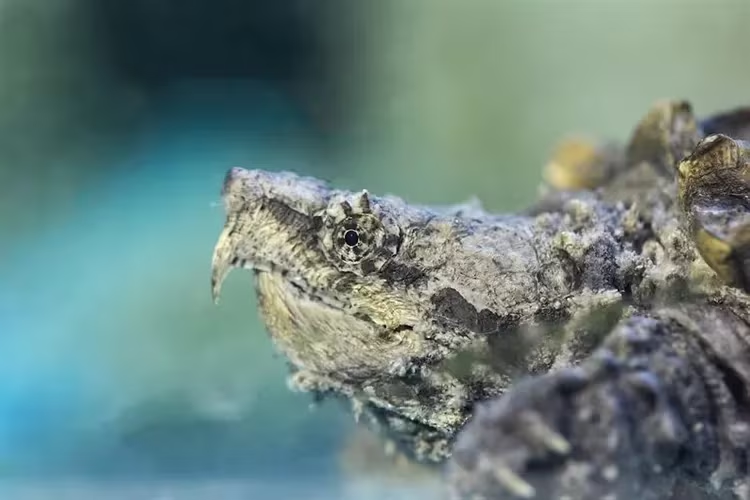
This complex is liked by citizens and guests of the Northern capital. And he started working in 2006. the organizers thought out the layout of the aquariums and pools perfectly, arranged competent lighting. As a result, the most secretive inhabitants of the deep sea are in full view.
People come here just to observe the inhabitants of the sea. But for those who love activity, the administration arranges show programs. Fur seals, dolphins and fish participate in the performances. And for guests who prefer a quiet tour, there is an audio guide. It can be obtained along with the entrance ticket.
There are scaffolds in front of the aquariums for children. These simple devices save parents from having to hold babies in their arms. Banquets are arranged in secluded places.
Tired guests can rest. But on the attraction Feeding the inhabitants of the place should be taken in advance. It is popular with visitors. While the inhabitants of the sea absorb food, the workers tell interesting stories about their habits and preferences.
Nicholas Palace
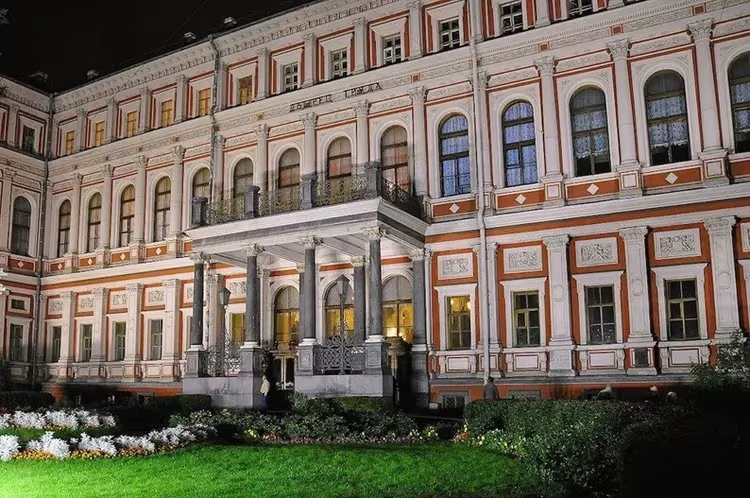
The building was built by order of Emperor Nicholas 1 for his eldest son, Grand Duke Nicholas Nikolaevich. The construction is a long-term construction of that time: the work lasted 10 years. Despite the exquisite decoration, the family was not happy here.
After the death of Nikolai Nikolaevich, the palace was returned to the treasury for debts. Before the October Revolution, the Kseninsky Institute for Noble Maidens worked in the building. And in 1918, trade unions were housed in the palace. And it became known as the Palace of Labor.
Today the Nicholas Palace has been reconstructed. The interiors have been restored in the traditions of the 19th century. And guests are always welcome here.
Visitors can:
If the need arises, then in the palace you can hold negotiations, arrange a meeting. A Christmas tree is organized for the little guests. Guests will be imbued with the spirit of the bright holiday of the Nativity of Christ. There is also a ballet school in the Nicholas Palace. Girls and boys are being prepared for admission to the ARB.
Field of Mars
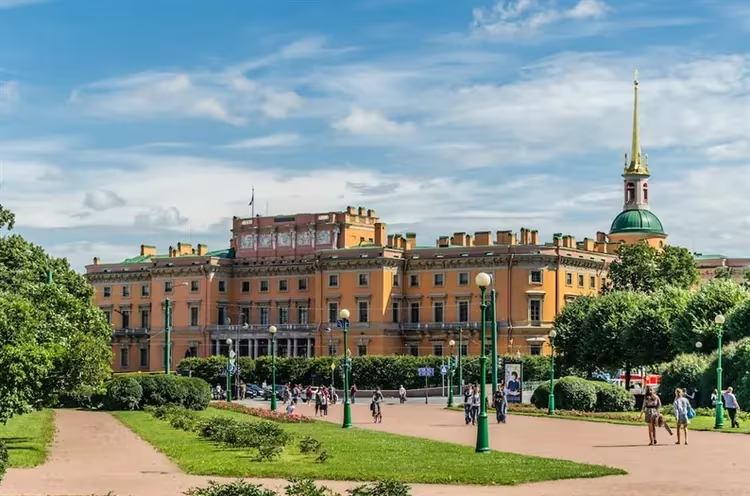
Many European capitals had the Champ de Mars. And Peter 1 did not want to lag behind. It was possible to drain the swampy meadow, and the vacant territory was called the Field of Mars. Under Catherine 1, there was a park here.
The Empress arranged paths, broke lawns. The field has turned into a park. But this did not last long. Under Pavel Petrovich, reviews were held on the Field of Mars. The territory has become a kind of parade ground. Subsequent emperors were so carried away by military reviews that all the meager vegetation was trampled down.
Local wits immediately renamed the field: in the summer it was called the Sahara, and during the rains – the Central Swamp. After the October Revolution, the victims of terror were buried here. And who to bury here was decided by a commission chaired by the petrel of the revolution – the writer Maxim Gorky.
During the blockade, the Champ de Mars turned into a vegetable garden. Leningraders grew vegetables necessary for life on the beds. The final ensemble was formed for the 40th anniversary of the October Revolution. And from the Eternal Flame burning on the Field of Mars, they lit the Eternal Flame on Red Square in Moscow.
Today, the Champ de Mars is a central meeting place for citizens and tourists. From here it is easy to get to any point of the historical center.
Alexander Park
Initially, this place was a wasteland. All vegetation was removed and the area cleared. This was required by strategic considerations: the approaches to the Peter and Paul Fortress should be clearly visible.
But subsequently the defensive significance of Petropavlovka ceased to be significant for the city.
On an empty dull place, at the behest of Alexander 1, a park was laid out. But the idea was realized only under Emperor Nicholas I.
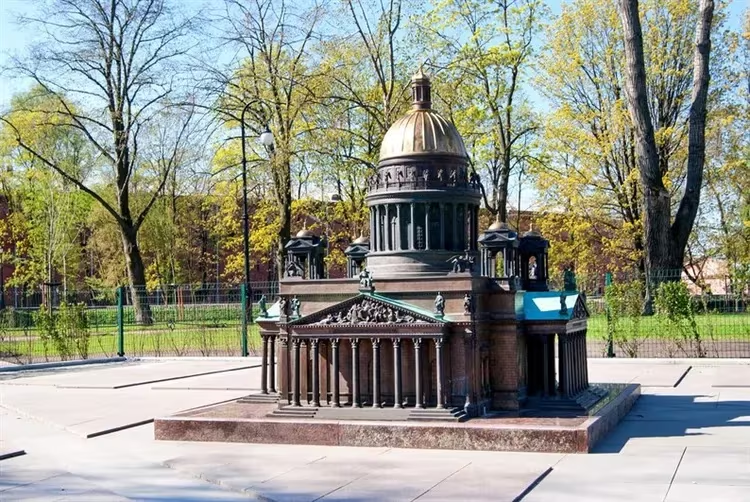
At the beginning of the 21st century, the park was reconstructed, and now there are many interesting things for guests and local residents. In 2012, the architect Taratynov, with the support of Gazprom, presented the city with an amazing model – St. Petersburg in miniature. The historic center has been reconstructed on a small area.
Nearby is a monument to famous architects. Architects are having a dialogue at the table, and any guest can sit on a free chair.
Planetarium. He has been working here since 1959.
Music Hall. The oldest venue where performances have been held since the beginning of the 20th century.
The territory is divided into sections by shady alleys, decorated with sculptures. It is pleasant to rest on comfortable benches. You can spend the whole day here.
Located between Kronverksky prospect and Kronverkskaya embankment.
Mariinskii Opera House
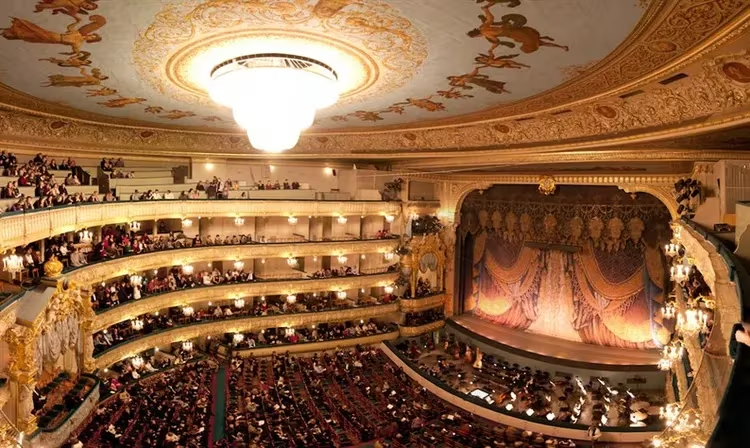
During its more than 200-year history, the Mariinsky Theater has been rebuilt several times. At first, the theater was designed by Rinaldi, then Thomon worked on the building. After the fire, the reconstruction was carried out again by Tomon. Subsequently, Kavos changed the hall. The acoustics have improved. Residents of Northern Palmyra enjoyed spending evenings at the Bolshoi Kamenny Theatre.
The theater got its name after the last fire in 1859. At various times, well-known choreographers worked here, staged works by Russian and foreign composers. And in the 30s, on the stage of the Kirov Theater, the audience saw modern stories.
The last reconstruction took place in the 70s of the twentieth century. The Mariinsky has acquired a modern look. Today there are performances for children and adults. And during the intermission, viewers can explore the stunning interiors of the foyer and hall.
Park of the 300th anniversary of St. Petersburg
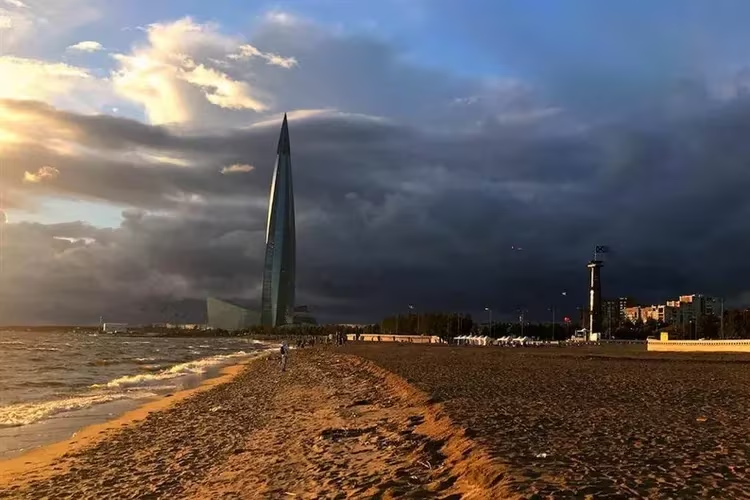
This is the youngest recreation area: it appeared on the 300th anniversary of the city. And in commemoration of this event, 300 young shrubs, apple trees, unique trees were planted, donated by foreign governments and institutions of the city.
The territory turned out to be free due to the fact that it was regularly flooded. That was the hardest part of the design. The whole area is an excellent observation deck. Visitors can see the panorama of the Gulf of Finland, the Lakhta skyscraper, the stadium, Vasilyevsky Island.
Guests with children willingly come here: the organizers have provided everything to make their stay comfortable. Those who cannot imagine life without modern communications will also rejoice: free Wi-Fi is provided on the territory.
Activity lovers will be happy to spend time on sports grounds or bike paths. Equipment can be rented here. There is also an amazing monument – the Tower-symbol of the 3rd centuries. This is a granite column 22 meters high.
3 tiers – a sign of three centuries. The top is crowned with a weather vane – St. Andrew's flag. Visitors to the park are happy to take pictures near the column.
Faberge Museum
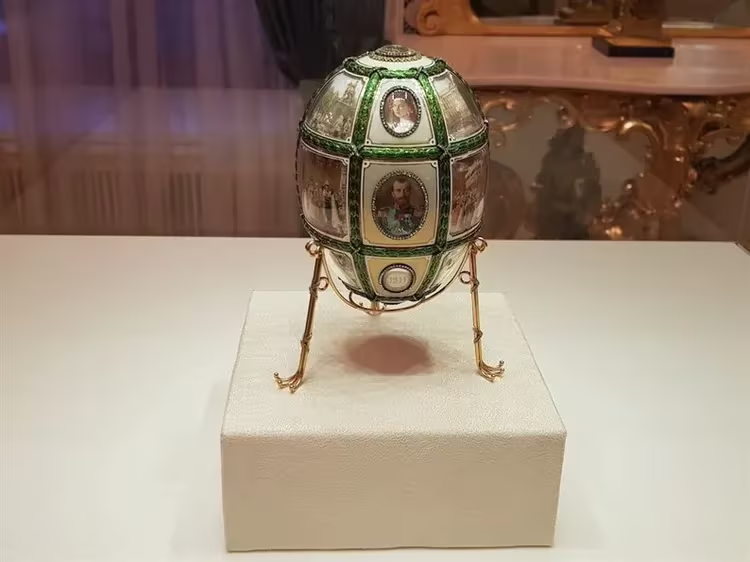
The exposition is located in the house of the Shuvalovs-Naryshkins. Previously, the building was reconstructed and restored. Therefore, the guests of the center admire not only priceless items, but also original interiors.
Russian philanthropist Vekselberg managed to outbid the collection of Faberge eggs from the American billionaire Forbes. That is why all the items returned home. It is noteworthy that when creating the center, Vekselberg did not set a goal to make money. He decided to just show the artifacts to people.
But this is not just an original exhibition. The center conducts scientific work, the results of which are introduced to guests and the public. Of course, you can sign up for a tour. An enthusiastic guide will lead visitors along a set route.
It is possible, having climbed the main staircase, to independently choose the direction of inspection. And to get additional information is real with the help of interactive screens and stands.
House of the Singer company
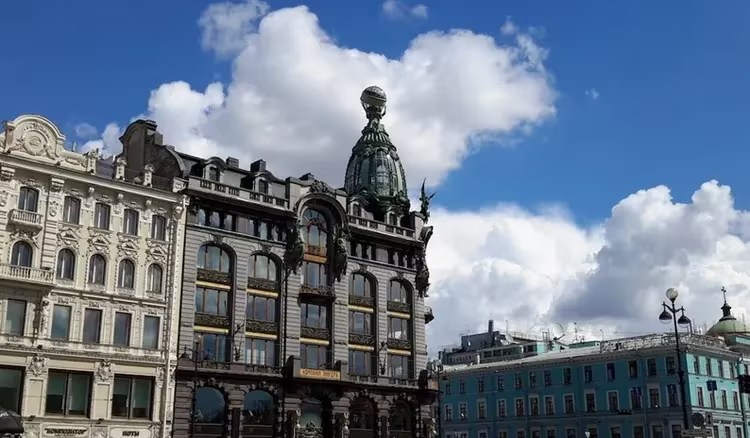
The well-known company Singer commissioned a skyscraper project. But at the beginning of the twentieth century in Northern Palmyra there was a ban on the construction of buildings higher than the Winter one. But Suzor easily solved the problem. The facade really rises to 6 floors. And at the top there is an attic and a glass dome.
The structure turned out to be too original. It simultaneously overlooked both the Nevsky and the Griboyedov Canal. The townspeople did not immediately get used to the unusual house. But subsequently, active trade developed here, and Petersburgers fell in love with a strange mansion. Now it is one of the symbols of the city.
After the October Revolution, the building was nationalized. And after a while, a bookstore began to operate in it. It is interesting that even during the days of the blockade, printed materials were sold in a badly damaged house. Today the center has been restored.
It still houses the House of the Book, while the rest of the premises are rented out. And visitors are happy to look at the unusual facade, climb the asymmetrical staircase, decorated with bronze details, to the atrium hall.
Address: Nevsky prospect, 28.
Kronstadt
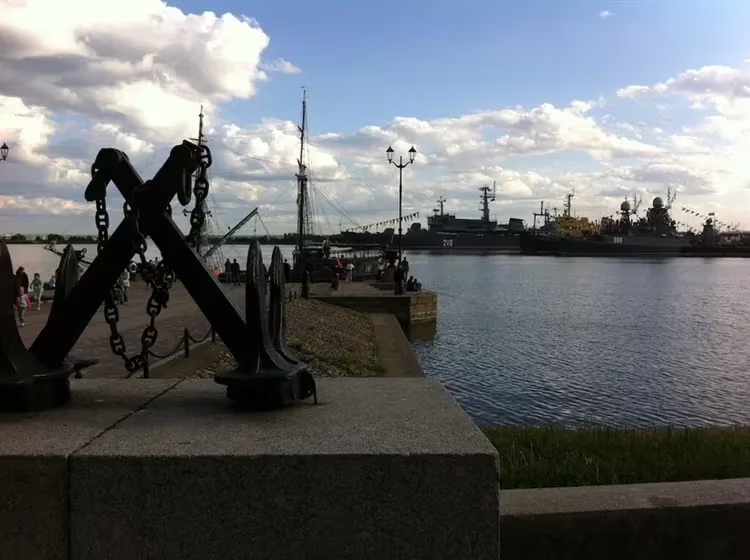
Since the beginning of the 18th century, Kronstadt has been part of the capital and at the same time a heavily fortified area. Since the time of Peter the Great, the base of the Russian Navy has been located here. Until 2011, it was possible to get here only by water, but the construction of the dam made the area accessible at any time of the year.
It is definitely worth coming here. The entire historical center is included in the UNESCO heritage list. And to see the once closed city for tourists is worth a lot. From the embankment, a panorama of the ships standing in the roadstead opens.
Kronstadt is strict and tidy. The streets are clean, there is no hustle and bustle, typical for the Northern capital. And the houses in the center are low, but neat and comfortable. All sights are located compactly: 1 day is enough for a cursory inspection. But usually tourists fall in love with this modest military town and return here for longer excursions.
Big Gostiny Dvor
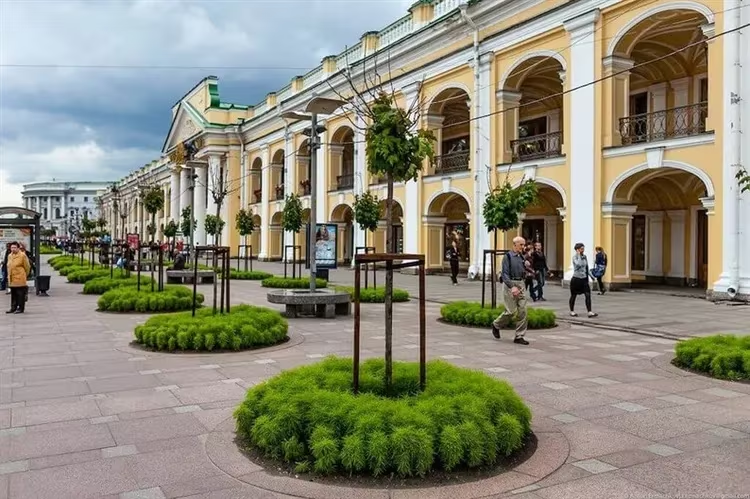
A city within a city is what Petersburgers call the Great Gostiny Dvor. And indeed it is! Lovers of shopping and fashion novelties definitely come here. Among the boutiques, you can get lost in time, looking at and trying on outfits.
History buffs will be happy to visit the Museum of the History of the Merchants, located in the central ring of the Courtyard. The exposition was organized in 2014. Here are personal belongings, photographs and documents of famous merchant families of the most important class of Russia. Nearby is the temple of Seraphim Vyritsky.
Before being tonsured, Vasily Muravyov was a prominent merchant, and he began working as a messenger in the Great Gostiny Dvor. The courtyard is not only a shopping center. There is an active cultural life here: in the International Academy of Music of Elena Obraztsova, children and adults receive specialized education.