
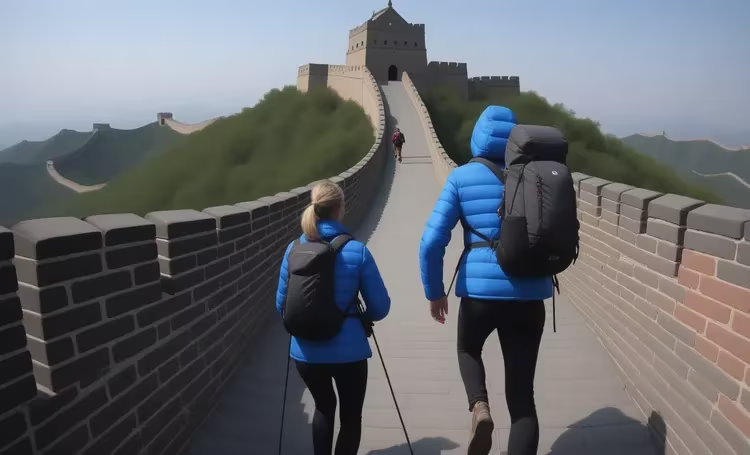
🧱 8 ways to conquer the Great Wall of China
The Great Wall of China is quite often a must-see for tourists who find themselves in China. Which is not surprising! After all, this is a historical monolith, where traces of wars and cultural events remain. You can climb it in different ways and at several points. We will offer several routes.
Jinshanling – Simatai
Distance: 11 km.
Time: one day hike
Features: adventurous hike through a ruined area.
This is a popular hiking area, although you won't find crowds of tourists here. Jinshanlin and Simatai are located approximately 110 km north of Beijing. Many hotels organize day excursions here without a guide. They deliver to the beginning of the route and pick up at the end.
On this route you can walk on a solid and unreconstructed wall for about three hours. Here you will see protruding sections of the wall, once built to separate large groups of invaders, and strong oval watchtowers.
Most of the route is easy, but in some places you will have to climb up or down steep and crumbly slopes. It is also worth considering that falling stones are possible.
The route ends in Simatai. As part of the hike, it is recommended to visit the Forbidden City, Summer Palace and Tiananmen Square. It's also worth strolling through the remaining hutongs (traditional old streets) and having a beer at a bar by Houhai Lake.
Near Mutianyu
Distance: 3 km.
Time: hike for several hours.
Features: An easy walk along one of the reconstructed sections of the wall.
This site is located approximately 90 km north of Beijing and is a popular day trip destination. Large tourist groups come here. There are a lot of tourists at the start, but if you move quickly, the crowds will be left behind. The site has been heavily reconstructed, it has convenient stairs and paving slabs.
This route is a pleasant ridge walk through forested hills. There's nothing special to see here. So just enjoy your surroundings. You will also pass through 20 watchtowers. Like most of the wall, the site dates back to the 14th century, but the first ramparts appeared here in the 6th century. There is also a cable car here.
Most hotels and hostels in Beijing will organize this trip. During the summer season, you can also take a tourist bus from Dongzhimen Station.
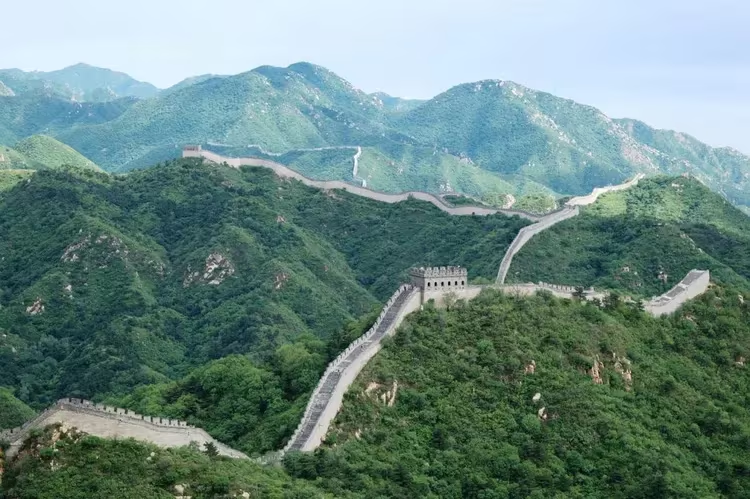
Huanghuacheng Wall – from Huanghua to the Eighth Watchtower
Distance: 3 km.
Time: one day hike.
Features: wild route with few people.
This unreconstructed site is located just 60 km northeast of the capital. A few years ago this part was called the wild wall and was completely uncontrolled. The only people you could meet here were locals offering drinks. Now this area is being looked after.
This route takes you through some impressive steep ruins. You need to be careful as the road is quite steep and dilapidated. It levels out after the fourth watchtower, from where desert mountains are visible. And after the eighth watchtower the path becomes impassable – here the path will lead to the road.
During your trip, visit the final resting place of 13 of the 16 Ming emperors – the Ming Tombs (30 km).
From Hexi Village to Gubeikou and Panlong
Distance: 36 km.
Time: 2 days
Features: Trek through beautiful scenery with the option to camp at a watchtower or stay in a local village.
Gubeikou is an attractive ancient and wild section of the wall. Hiking here starts from the village of Hexi, 80 km from Beijing.
One trail leads steadily up Mount Vohu. Most of the wall is destroyed, so you need to go around it. However, the watchtowers are well preserved. The highest of them, about 13 km from Hexi, offers magnificent views. It’s worth going there just for beautiful photographs.
In Hexi, you can take a different route and walk along the top of the wall on a fairly flat route for about 5 km. Heading north takes you to the 18th-century Chengde imperial retreat.
If you want to explore both, it makes sense to spend the night in Hesi. Many farmers rent out rooms, but the facilities are very basic. There's not even hot water.
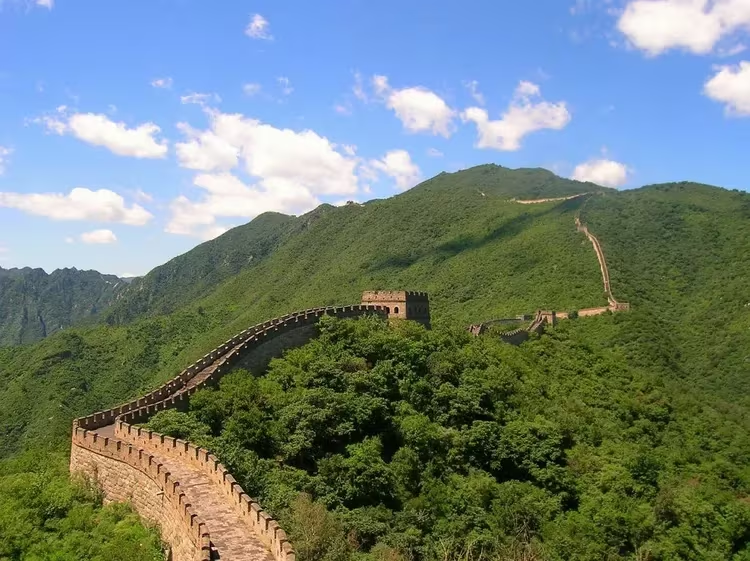
Great Wall of China Jiankou, from Xizhazi Village
Distance: up to 20 km
Time: 1-3 days
Features: Challenging and intriguing hike close to the capital
This route has only recently become available. It is chosen by intrepid travelers. The wall here is white because it is made of dolomite. But along the densely forested mountain ridges there is a pedestrian and scenic section.
Some sections are so steep that you have to climb them on all fours. Keep in mind that most of the stones may collapse. There are no amenities along the way, but no one will charge you an entrance fee. We also recommend looking for a local guide. In the small village of Sijazi, 55 km from Beijing, there are simple shelters with good home-cooked food. From Hijazi you can reach the wall in about an hour.
And only the bravest travelers decide to walk the full 20 km from west to east. Most people try to walk the first 10 km or choose the most impressive three-kilometer section somewhere in the middle. It is easy to get to and there are no difficult sections.
On this route you can camp on the Great Wall of China itself. Get the chance to see a magical sunrise alone. However, please note that you will need to take all the necessary equipment with you. It is not possible to find camping equipment in small villages.
From Shanhaiguan to Laoluntou
Distance: 4 km along the wall and excursions
Time: 2 days.
Features: See a sleepy town and impressive ruins where the wall meets the water.
Shanhaiguan, a pass between the mountains and the sea, is a small city just a few hours' drive from Beijing. In the center of the city stands the First Passage Under Heaven, one of the few gates to the Great Wall. With three outer walls around it and a tower above it, the defenders took no chances.
Following the remains of the wall 4 km south, you will come to Laolongtou – “Old Dragon's Head” – the place where the wall meets the sea. The location was named after the dragon sculpture that overlooks the beach and marks the eastern end of the Great Wall of China.
Rent a bicycle to explore the sights outside the city. Head to the kitschy seaside resort of Beidaihe (20km south). Also visit the Mengjiangnu Temple, dedicated to a woman whose husband died, on three walls. According to legend, upon hearing her sobs, the bricks scattered to the sides, exposing the bones of her husband.
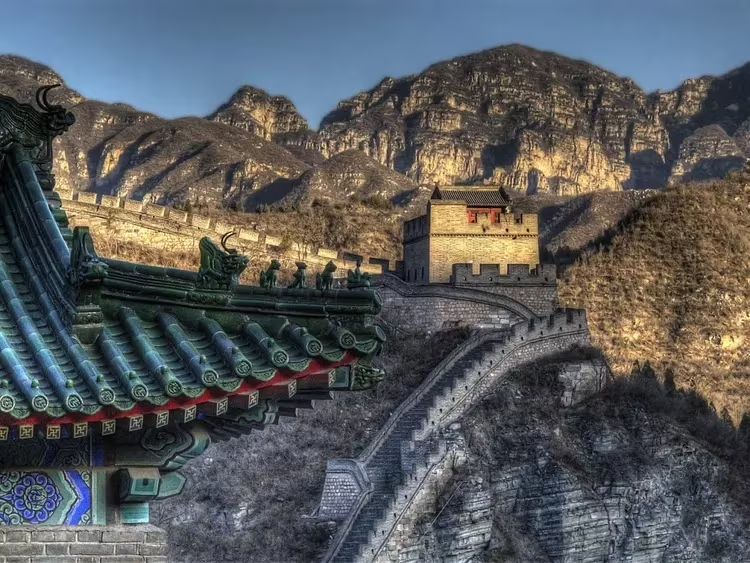
Around Fenghuang, Hunan Province
Distance: 4 km.
Time: 2 hours
Features:
The barbarian threat did not only come from the north. In Hunan Province in southern China, there is a section of the 16th century wall, almost 200 km long, designed to contain the Miao people. The wall is not as high and wide here as its northern counterpart, but it is much less visited.
There is a redeveloped site near the historical city of Fenghuang that makes an excellent base. The town has a strong Miao presence, and its narrow cobbled streets include many wooden houses on stilts and a 300-year-old covered wooden bridge. In summer it is lively and has cafes for travelers.
- Money question: financial life hacks for travelers
- The most popular street food dishes in Hong Kong
- Say no to simple walks: the most dangerous routes for real adventurers
Jiayuguan
Distance: no data
Time: a day for the fortress and a week if you want to thoroughly explore the surrounding area
Features: you will see huge fortifications, and also get acquainted with the culture of the Turkic-speaking Uyghur people.
Far in the wild west of China lies the last fort of the Great Wall of China. Here civilized China ended and the terrifying desert began. This was a strategically important point, since with the mountains of Tibet in the south and the arid desert in the north, all trade on the Silk Road to Central Asia was directed here through the pass.
The magnificent fort itself, known as the “Impregnable Passage of Heaven,” stands on a plain with mountains to the north and south, the same color as the desert around it. The fort was built in 1372. The outer wall is over 700m long and was previously patrolled on horseback. This was the last post on the way to exile for disgraced officials and fugitive criminals.
Here you can explore the murals and statues of the Mogao Caves in Dunhuang – a few hours west by train. In eastern Gansu province, visit the Tibetan Labrang Monastery, wander the Luomen Silk Road, and hike the Moon Canyon and Qilian Shan Mountains.