
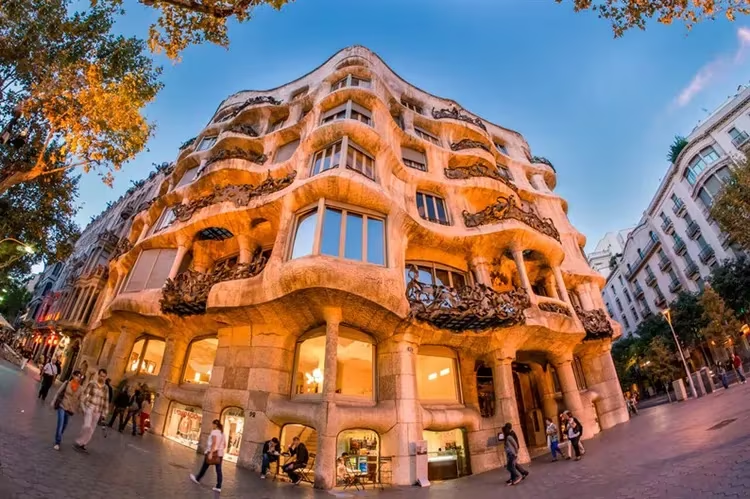
Casa Mila in Barcelona – history, photo, description, ticket prices 2021, how to get there, map
The first object, which, according to the decision of UNESCO, was included in the World Heritage List in 1984, was the house of Mila in Barcelona. Its inimitable architectural forms, created by the brilliant architect Antonio Gaudi, demonstrate the combination of bionics and art. Currently, Casa Milà serves as a museum and cultural center, where various events are held.
Inspiration from nature
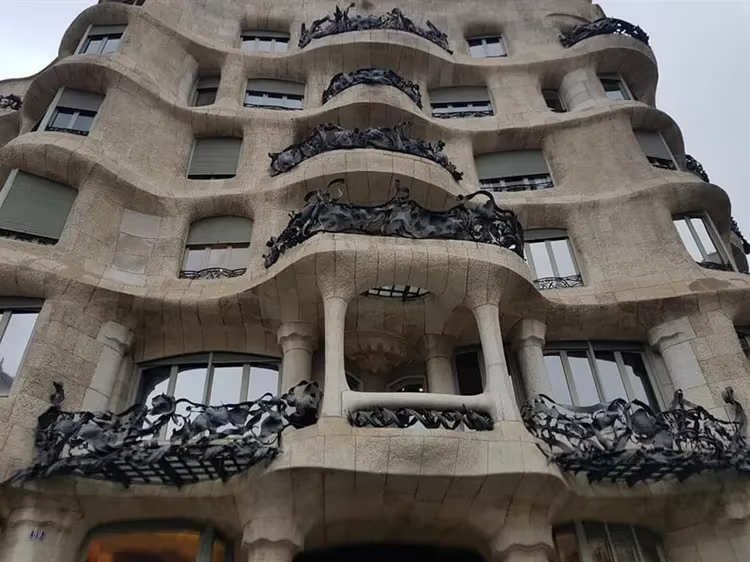
The fundamental leitmotif of the architectural work of A. Gaudi throughout his life was following nature. The master found ideas for his ideas in his environment. The building, commissioned by the businessman Pere Mil, was no exception. In its external forms, Gaudi decided to depict not one, but several natural objects at once:
The facade of the house looks like a heap of stone monoliths, for which the Catalans gave it the nickname “La Pedrera” (la pedrera means stone quarry).
At the same time, the protruding balconies, decorated with wrought-iron gratings, according to Gaudí's plan, should depict the seabed. The curvature of the lines on the facade, the author associated with the waves, and the patterns on the lattice – with seaweed. On the creation of metal attributes, the architect worked in tandem with Josep Jujol.
Bold ideas embodied by Gaudí
During the construction of La Pedrera, Gaudí first tried some of the techniques that later became widely used in urban planning. The weight of the structure was redirected to metal rafters and stone supports. Their use made it possible to free the facade from the load. In addition, the location of the walls inside the building did not affect its stability. This pioneering move made it possible to create open-plan apartments, which are now widely used in high-rise buildings.
To increase the interior living space, Gaudí suggested using sliding doors. Each room had a window, which made it possible to solve the problem with lighting during the daytime. Given the purpose of the building, Gaudí was the first to come up with a rational distribution of interior spaces:
The architect had an idea to build a ramp for cars to enter each floor. Unfortunately, the plan remained on paper.
Architectural features
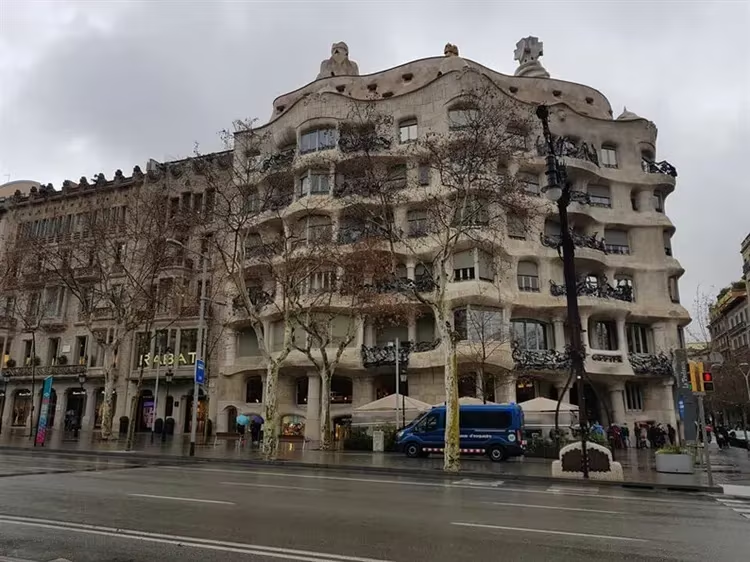
The project, developed by Gaudi at the beginning of the last century, combined the most revolutionary ideas of architecture of that period. The author tried to think over the smallest details that would provide comfortable conditions for the residents of the house. Casa Milà is a unique combination of aesthetics and practicality.
The creation of the house lasted for 6 years (1906-1912), but was never completed. The customer refused to sponsor the construction because it did not meet his requirements. The Mila family wanted to turn the building into an apartment building and rent out the premises. For construction, a piece of land was purchased in the most expensive area of Barcelona. The architect was required to develop and then implement the project of a well-maintained building.
House Mila consists of two buildings, united by a common facade. Each building has its own patio (patio). For the residence of the owners, one floor is allocated, passing through the entire structure. In addition, the buildings are interconnected by passages.
Curved lines hide the Casa Mila double box. Curvilinearity is inherent not only in the outlines of the facade, but also in the internal partitions. The uniqueness of the house is that it does not have load-bearing walls. Their functions are performed by columns holding the ceilings between floors.
The unusual shape of the roof is explained by the exit of numerous ventilation holes to it. Thanks to the pipes penetrating the building from top to bottom, Gaudí wanted to maintain a stable temperature regime in the interior. Regardless of the weather conditions outdoors, it is always warm and comfortable inside.
An interesting solution was the creation of elevator shafts with entrances through the floor, i.e. occupants were required to go up or down a floor to take the elevator. In this unusual way, Gaudí hoped to rally people, to push them to communicate more with each other. The total area of the house is 1323 sq.m. Thanks to its architecture, La Pedrera is one of the main attractions of the capital of Catalonia.
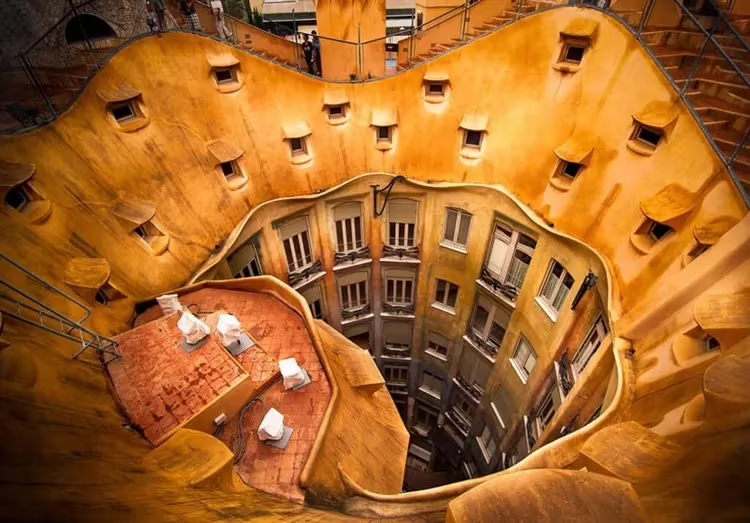
Patio
The yard space consists of three patios – round and oval. The presence of several courtyards made it possible to provide effective ventilation and lighting of the premises. The walls of the houses are covered with colorful stylized drawings with floral decorations.
roof terrace
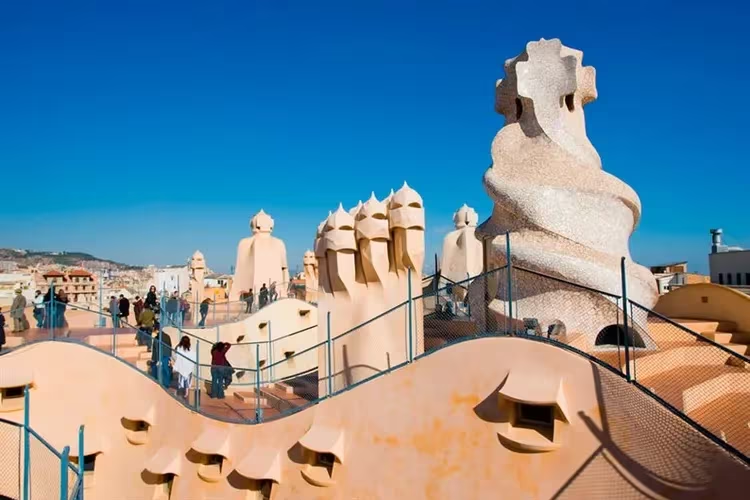
The terrace is open to the public. It offers a panorama of the central street of Paseo de Gracia. Visitors are interested in bizarre pipes of various shapes, decorated with mosaics of glass, ceramics, pebbles and marble.
Attic
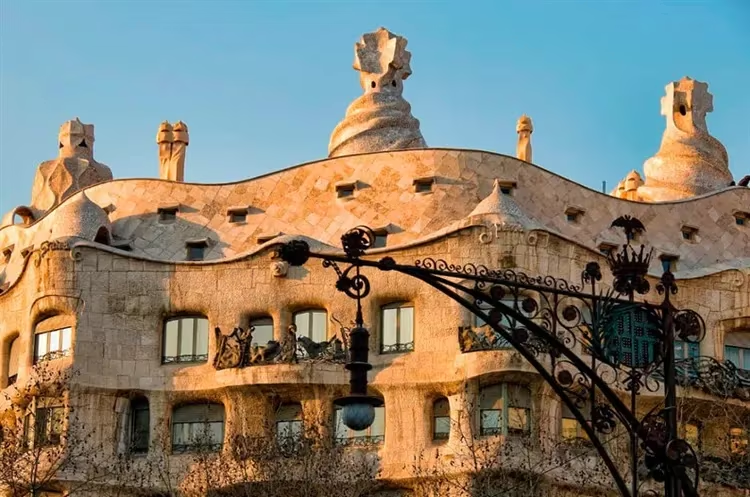
The attic of La Pedrera is a multi-arched space. It has 270 catenary arches. According to the project, it was intended for washing and drying clothes. Therefore, the architect provided free air circulation to avoid dampness.
Now the attic has been given over to hosting an exposition dedicated to the works of A. Gaudi. Here are models of structures and photographs of natural objects that served as a source of inspiration.
Museum apartment on the 4th floor
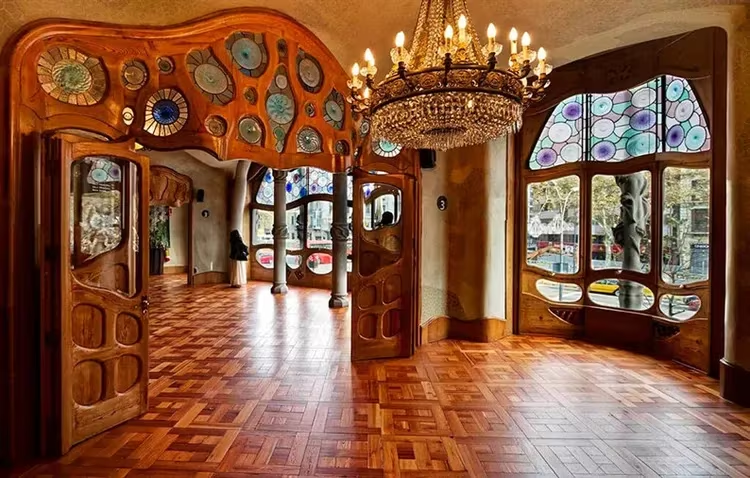
The museum exhibition recreates a typical apartment of a Catalan bourgeois family of the early 20th century. The rooms contain authentic household items, furniture and utensils. Of interest are the elements designed by Gaudí:
At the end of the review, the sightseers are shown a film about Gaudí.
Cafe
On the ground floor of the house there is a cafe of the same name – El Café de La Pedrera. Its visitors can fully enjoy delicious Catalan cuisine, see a magnificent example of modernist architecture.
Café de la Pedrera is open every day from 8:30 to 24:00.
Showroom
The Fundació Catalunya-La Pedrera uses the mezzanine as a cultural center. Exhibition Hall at St. 1,000 sq.m allows to host various art exhibitions and hold events. Columns with sculptural elements and inscriptions attract attention.
Casa Mila today
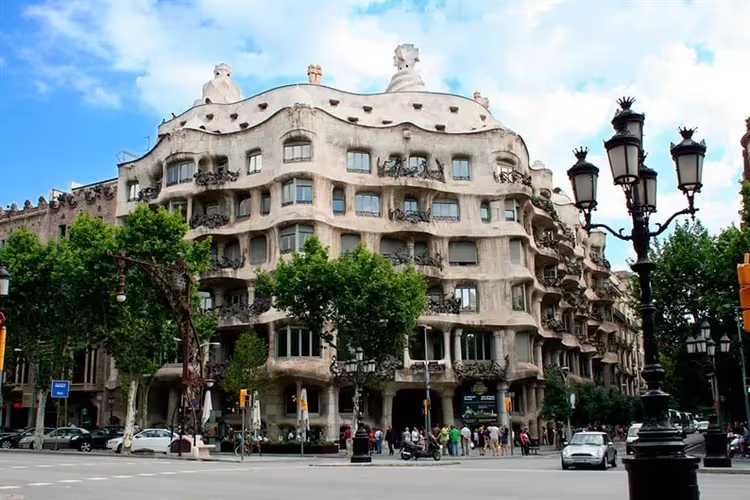
Casa Mila is constantly expanding its visitor program to include new modern attractions. In the summer, starting in 2015, the roof becomes the venue for an enchanting laser and musical show. The ticket price also includes a drink (a glass of red wine). The ticket price is about 34 €. Show starts at 20:00.
Opening hours and ticket prices
Casa Milà is open daily from 09:00 to 18:30 and from 07:00 to 09:00.
Exact opening hours depend on the season
| Period | Time |
| 15.01-1.03 | from 9 to 6:30 |
| 2.03-4.11 | from 9 to 8:30 |
| 5.11-24.12 | from 9:00 to 18:30 |
The ticket price is determined by the excursion program, the age of the visitor and possible benefits.
| Day ticket, € | Premium,€ | Day-night, € | With dinner, € | Night,€ | |
| Children from 7 to 12 years old | eleven | eleven | 20.50 | 17 | 15 |
| Adult | 22 | 29 | 41 | 34 | |
| Student | 16.5 | – | – | – | |
| Disabled person | 16.5 | – | – | – | |
| Over 65 years old | 16.5 | – | – | – |
On the official website of La Pedrera, you can purchase entrance tickets online. They are designed for different programs for visiting during the day and at night:
For the convenience of tourists, an audio guide is issued in Russian or English, which has a basic and advanced program.
Where is it located and how to get there
Casa Milà is located in the Eixample district, at the crossroads of Carré de Provença and Passeig de Gracia.
You can get to the specified address by overground and underground transport: