
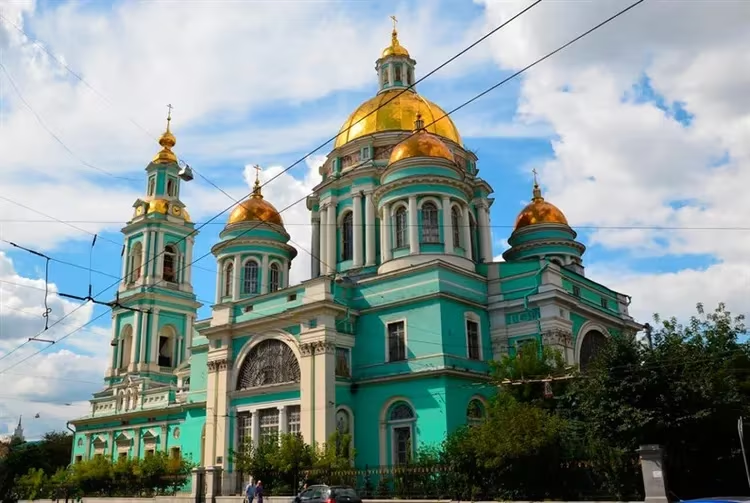
The Epiphany Orthodox Cathedral of the Moscow diocese is known and loved by all Muscovites. Many remember it from childhood, because it is one of the few places of worship in Russia that has never been closed, there have always been divine services.
Construction history
The Yelokhovskaya Church has a long, difficult, full of dramatic moments, fate.
Founding period of construction
In 1698, the inhabitants of the village of Elokha erected a small wooden prayer room, a little later, during the reign of Tsar Peter I, a stone building was erected on this site (1717 – 1722). In the 30s, in honor of the Annunciation of the Virgin, a chapel was attached to it. By the end of the 18th century, other outbuildings appeared – a bell tower and a refectory. But Moscow at this time is growing rapidly, during the service it becomes crowded, people coming from nearby and remote areas of the city cannot get inside.
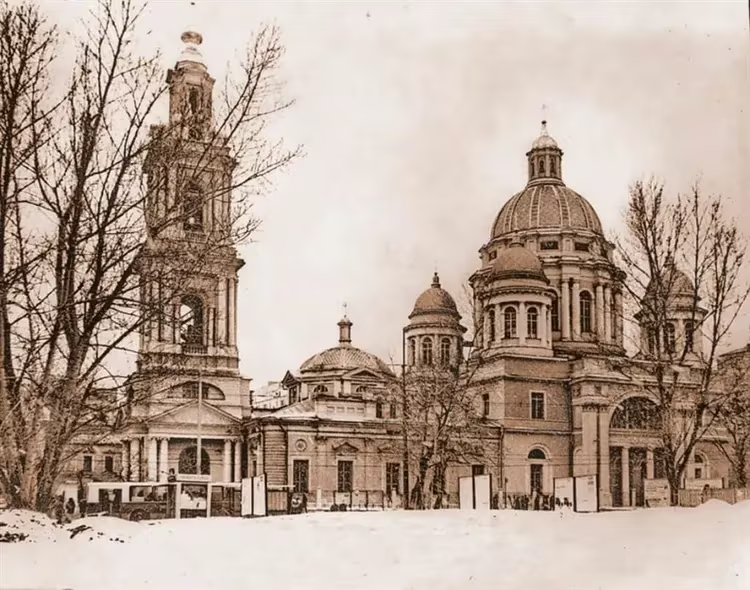
We decided to start building a new large temple building. The architect E. Tyurin was entrusted with preparing the project. There were not enough funds, so the construction continued for a very long time, but services were also held during construction or finishing work.
Subsequent restorations
By 1845, the construction of the main part of the building, which was crowned with five domes, was completed. With the help of the parishioners, mainly thanks to the donations of the merchant Shchapov, the church was completed. In 1853 she was consecrated by Filaret, Metropolitan of Moscow and Kolomna.
A few years later, the upper tiers of the bell tower were built, in the 19th century a dome was erected on the refectory, and attics on the side facades. The height from the foundation to the cross and the bell tower is 56 m, the area is 1164 sq. m, can simultaneously accommodate 3000 people.
Modern arrangement
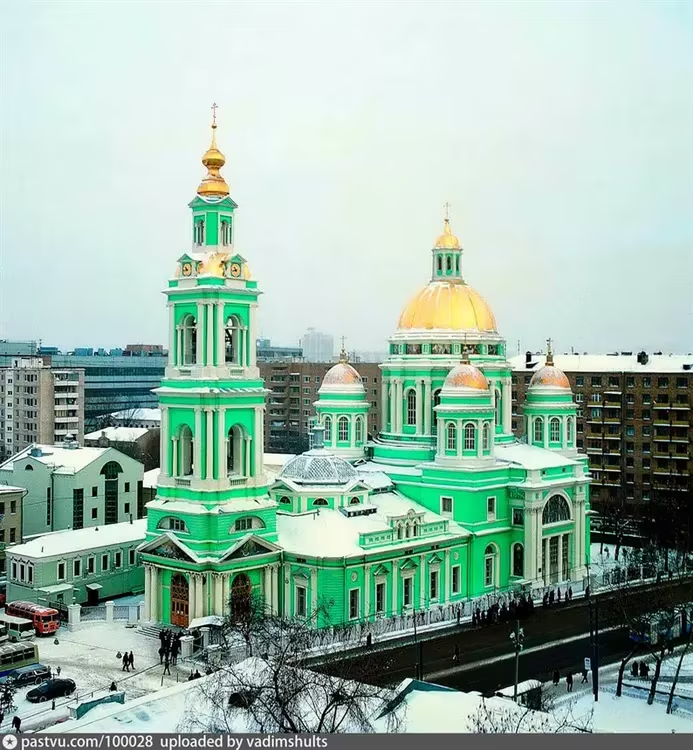
The most significant restoration was carried out in the late 60s of the twentieth century, which lasted 20 years. A lot of hard work has been done. The floor was replaced with marble, the gold leaf covering was renewed, the pulpit was equipped with a bronze fence. The iconostasis was restored, the wall paintings were cleaned and strengthened. They raised the floor under the altar and salts (elevation). The balconies were refurbished, adding a central one, and a room for singers was allocated. Elevators were equipped and broadcasted so that the faithful could hear the service better.
The façade and roof have been renovated. They landscaped the territory and reconstructed buildings for living, dining rooms, organized a place for the consecration of water. The restoration was carried out under the guidance of the chosen headman – N.S. Kapchuk.
Name history
According to Moscow legend, back in the 14th century there was a dense alder forest and the Olkhovka River and the Olkhovets Stream (now enclosed in pipes) flowed. As stated in Dahl's dictionary, the names alder and eloh have the same root. Obviously, this gave the name to the village of Eloh, located not far from the forest, known since the reign of Dimitry Donskoy.
It is famous for the fact that Vasily the Blessed was born here in 1469 and lived for a long 83 years, a man who was not afraid to denounce even Ivan the Terrible, pointing out the cruelty of the ruler. The saint was escorted on his last journey with honors, buried at the Trinity Church on Red Square, which since then has received the name of St. Basil the Blessed.
Architecture
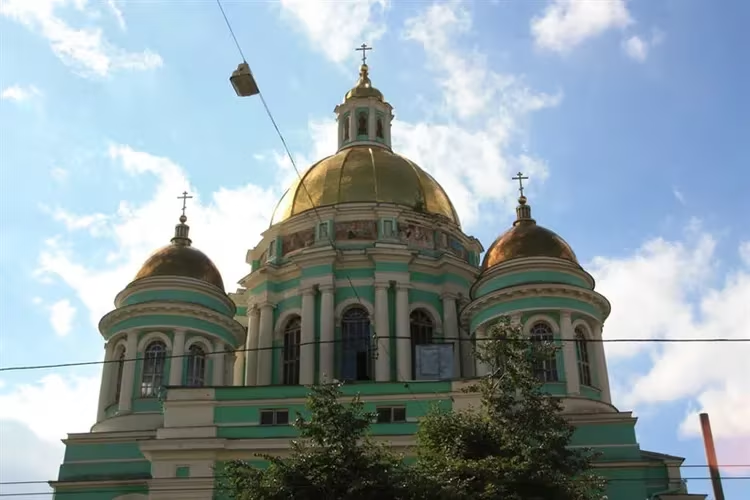
The building was built in the Empire style. The main part is in the shape of a cube, with five domes installed at the top. The domes are in the form of rotundas, in which window openings are installed. The rotunda in the center is decorated with skillful painting. From the north and south the building is decorated with pilasters and portals. Above are wide semicircular windows resting on two columns. The structure, thanks to numerous elements, has a light and airy appearance.
The arches passing through the bell tower make the structure elegant and graceful. Round columns are located at the corners of the upper tiers. The upper tier is not decorated; a dome covered with gold leaf and a cross are installed at the top. The interior is connected to the refectory by a small passage. The façade is decorated with attics on the side, and a baptismal hall has been built in the inner courtyard, where adults and children can undergo the rite of baptism.
Interior decoration
In October 1846, the parishioners applied to the Holy Synod for permission to decorate the interior of the new, newly rebuilt building. With the help of parishioners, the interior is richly decorated, golden colors predominate in the design.
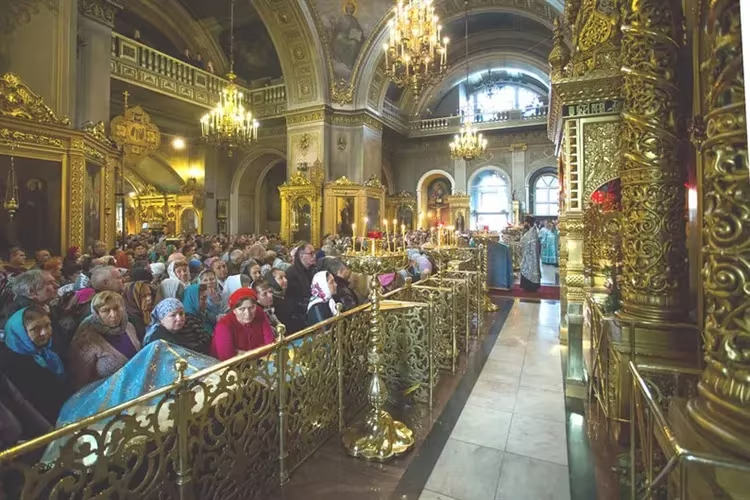
Ceilings and walls are richly painted with fine painting. By 1853, a multi-tiered iconostasis of complex shape, 18 meters high, was built on the eastern side. Masters of icon painting specially painted 65 images. Entering the room, a person involuntarily looks up – to the image of the New Testament Trinity, depicted in the domed part of the central rotunda.
The majestic rotunda in the interior plays a dominant role, based on huge supporting arches, which are supported by tetrahedral pillars and hold the vault. The main altar is dedicated to the Holy Theophany, there are two more chapels – on the left side it was installed in honor of St. Nicholas the Wonderworker, on the right – in honor of the Annunciation of the Mother of God. The painting of the cathedral walls was made in the first half of the 20th century by masters from Mstera, which is the largest center of icon painting.
Cathedral today
Church life here has always been active, even in difficult times of persecution and oppression. In 1925, at the Meeting of the Lord, with the permission of the Soviet leaders, Patriarch Tikhon held a festive liturgy. The building in 1926 received the status of “monument of church architecture” of the 1st category. Perhaps that is why it was not destroyed and a cinema or warehouse was not arranged.
The new government did not close the center of Moscow Orthodoxy either at the beginning of its reign or in subsequent years, but this threat always hung over ministers and believers. The first decision to close was approved in the spring of 1930. 5 thousand parishioners signed a letter to the authorities with a request to cancel such a decision, and the request, oddly enough, was granted.
In 1935, they decided to refurbish the building and arrange a cinema, but this plan also did not materialize. The last time the closure was scheduled for June 22, 1941. On this day, as you know, the war with Nazi Germany began, which prevented the implementation of the decision of the authorities. Immediately after the declaration of war, Metropolitan Sergius appealed to the parishioners to go to the defense of the Fatherland from the invaders.
At the initiative of church ministers, a fundraising was organized for the defense of the country. The Metropolitan set an example – he gave away a cross with a hood and a pectoral, richly decorated with precious stones, donating them to the needs of the state in difficult wartime. Despite the attempts of the authorities to close the religious building, constant harassment and persecution, church ministers helped their country during the four years of the war, collecting more than 835,000 rubles for defense and purchasing gifts for the soldiers of the Red Army for more than 500,000 rubles.
In the spring of 1942, with the permission of the authorities, a service was held on Holy Easter, attended by more than 6,500 believers. Since 1943, Metropolitan Sergius was elevated to the rank of Patriarch of Moscow and All Russia. In 1945, the department passed to Alexy I, who by decree assigned the status of the Patriarchal Church of the Epiphany (it remained until 1991). During the Patriarchate, important events for the Russian Orthodox Church were held – the enthronement of metropolitans, the transfer of the relics of St. Alexis from the Assumption Cathedral in 1947, and others.
With a divine liturgy celebrated in the temple in 1988, festive events began to celebrate the millennium of the baptism of Russia. Orthodox shrines were often exhibited for worship – the relics of Seraphim of Sarov, the head of Panteleimon the healer, the “Vladimir” icon of the Mother of God. In 1991, the temple was given the status of a cathedral, in 1992 a memorial plaque to the poet A.S. Pushkin, who was baptized here.
In 1990, a significant restoration was carried out, the internal territory was landscaped, various household services were placed in the nearest houses (after the residents were resettled). Here rests the ashes of Patriarch Alexy II, who was buried here in 2008. Today, the cathedral hosts daily services, Sunday and holiday services, a Sunday school, and a church singing class.
Shrines and icons
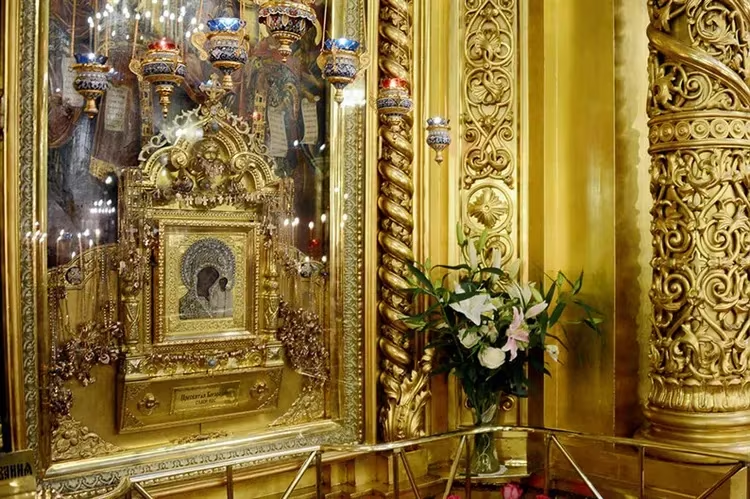
The light from the large windows falls on the images of saints arranged in a circle – Grand Duke Vladimir and Grand Duchess Olga, Alexander Nevsky, Sergius of Radonezh, Saints Michael, Peter, Blessed Basil and many others. The Kazan Icon of the Mother of God, which used to be in the Kazan Cathedral, is especially revered. In the main aisle there are icons:
The relics of St. Alexis were delivered in 1947 and met by Patriarch Alexy I. In 1944, Patriarch Sergius was buried in the northern aisle.
Clergy
The clergy of the Cathedral of the Epiphany changed many times, always protecting the interests of the flock.
In the XX-XXI centuries the abbots of the cathedral:
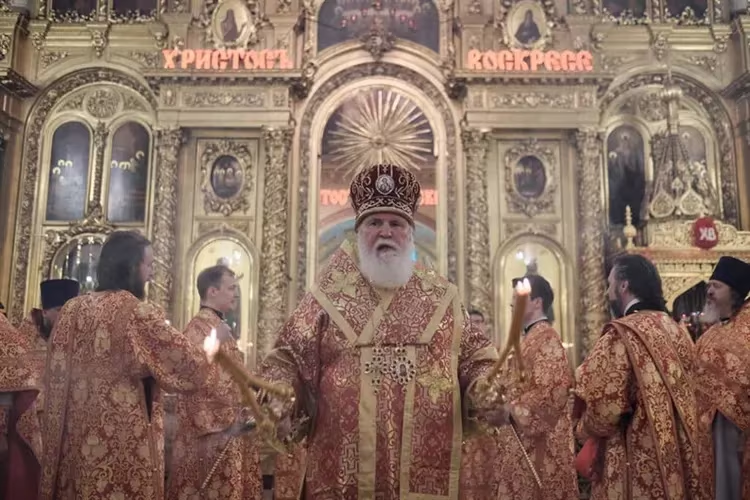
The archdeacons who served here were: Georgy Antonenko (1943-1958); Vladimir Prokimnov (1963-1990); Stefan Gavshev – (1975-1990); Andrey Mazur – since 1990. These people, serving God, defended the interests of the Church in difficult times for her, when she was under pressure from the authorities. In many respects thanks to their activity the temple managed to be defended from closing.
Working hours
Worship Schedule for Weekdays:
- 08:00 – Liturgy
- 17:00 – Evening and Matins
Sunday worship schedule:
Baptism on weekdays at 11:00 and 15:00, on weekends – at 09:00, 12:00, 15:00.
Weddings are held on Monday, Wednesday, Friday and Sunday.
Where is it located and how to get there
The cathedral is located on Spartakovskaya street, 15, in the Basmanny district of the Central Administrative District of Moscow, Russia.
You can get there by metro:
- Go to Krasnoselskaya station, then walk along Nizhnyaya Krasnoselskaya street. Or use the tram, routes NoNo 37, 45, 50 to the Baumanskaya stop.
- To the Baumanskaya metro station, then walk along Baumanskaya and Spartakovskaya streets.
- Get to the metro station “Komsomolskaya”, then from the stop “Bolshevik Factory” by bus No. 88 or trolleybus No. 22 go to the stop “Elokhovskaya Square”.
The Church of the Epiphany is one of the few in Russia that has managed to avoid closure and desecration; services have always been held in it. Believers will always find support and understanding here in joy and sorrow.
In Moscow, we recommend the following hotels: