
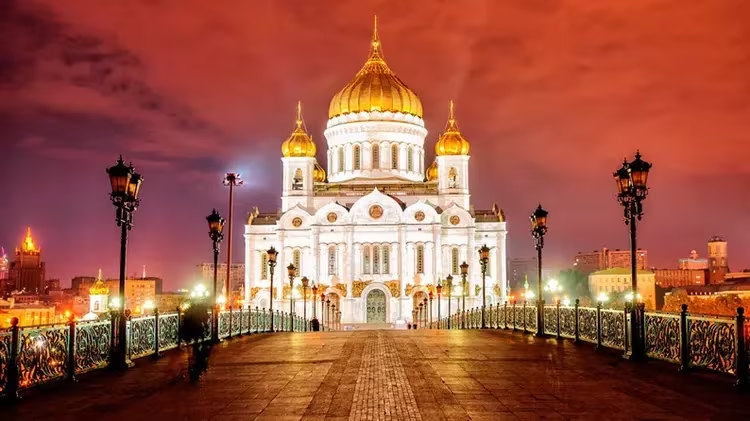
Today it is impossible to imagine the center of the capital without the famous building. It is visible from everywhere. At any time of the day, golden domes welcome residents and guests of the city. It's hard to imagine how things used to be different. The Cathedral of Christ the Savior in Moscow is a restored Orthodox shrine. The history of the cathedral is complex and tragic. The first monument to Russian weapons and the valor of the people of this type did not immediately acquire its familiar form today. And in its current place the cathedral was not immediately.
Construction history
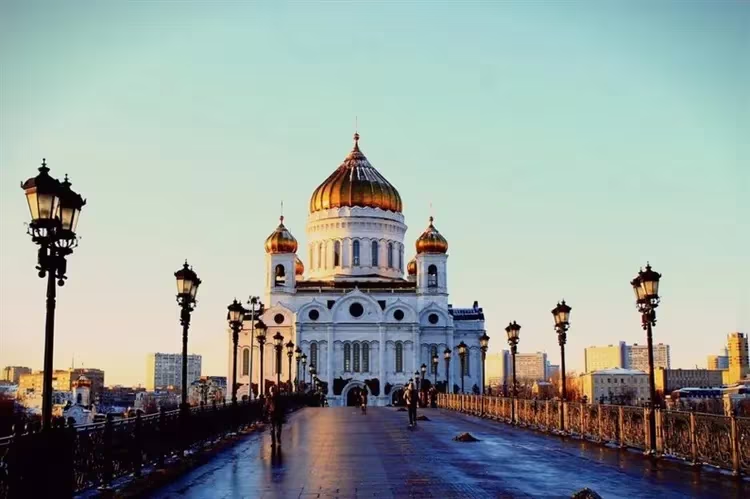
In the 18th century, glorious Russian weapons were immortalized more than once. Columns, arches, obelisks were dedicated to him. But after the expulsion of the Napoleonic troops, it became clear: this time the monument should be very special.
Creation idea
The victory over Bonaparte's army was undeniable. She glorified Russian weapons for centuries. However, without the intercession of God, it would be impossible to defeat an army accustomed to conducting operations on foreign territory. General Kikin was the first to express the idea that it was necessary to leave to the descendants a temple-monument, where the fallen would forever be commemorated. He instructed General Shishkov to acquaint Emperor Alexander 1 with the idea of building a cathedral.
It cannot be said that earlier there were no temples dedicated to glorious victories. Known:
What was new was that Russia for the first time waged a Patriotic War, in which all classes, all people, from young to old, participated. And so the monument had to be special. Alexander I published the Manifesto, where he prescribed the idea and purpose of building the temple. He assumed that such a monument would stand for centuries, and it was here that descendants would come to commemorate their heroic ancestors.
Temple on Sparrow Hills
The place for the first temple was chosen symbolically: the cathedral was planned to be built on Sparrow Hills, between the Smolensk and Kaluga highways. It was here that Kutuzov forced Bonaparte to turn onto the devastated Smolensk tract, bypassing the rich Kaluga.
All the famous architects of the 18th century took part in the announced competition:
The commission chose from 20 options, but approved Witberg's work. The first stone was laid in 1817. But when linking the project to the terrain, difficulties immediately arose. It turned out that the soil is mobile, and the soil itself is penetrated by underground streams and small rivers. In 1826, after the death of Alexander I, the new autocrat, Nicholas I, stopped construction.
Temple on Volkhonka
This time, Nicholas I personally chose the place for the temple. He pointed to the coastal territory of the Moskva River not far from the Kremlin. True, the Church of All Saints and the Alekseevsky Monastery were located on the site of the proposed construction. The church was demolished, and the monastery was moved to Sokolniki. The contest was announced again.
Participated:
Nicholas I approved Ton's project. In 1839, the first stone was solemnly laid. The construction took 44 years. At the same time, some work was carried out in parallel: for example, the embankment was created simultaneously with the painting of the interior.
Such a large-scale construction was controlled by emperors: Nicholas I, Alexander II, Alexander III. The hierarchs of the church: Metropolitan of Moscow and Kolomna Filaret and Bishop of Dmitrovsky Leonid, blessed the undertaking, and the Commission and Governor-General of Moscow Golitsyn supervised all the work.
Destroyed building
Initially, the cathedral was built according to the centric type with the main dome and 4 corner bell towers. The architectural “highlight” of the building was the arrangement of external and internal space in the form of equal-ended crosses. This made it possible to leave the center of the cathedral unoccupied.
The parameters of the original building were:
The total capacity is 7.2 thousand parishioners.
According to the developments of K. Ton, the entrance to the building passed through the galleries. However, later this idea was abandoned and the open loggias were replaced with glazed massive doors. The surface of the walls was covered with plaster, on top of which painting was carried out and various elements of decoration were placed. Marble for decoration was brought from the Kolomna district. High reliefs depicted stories on historical and biblical themes.
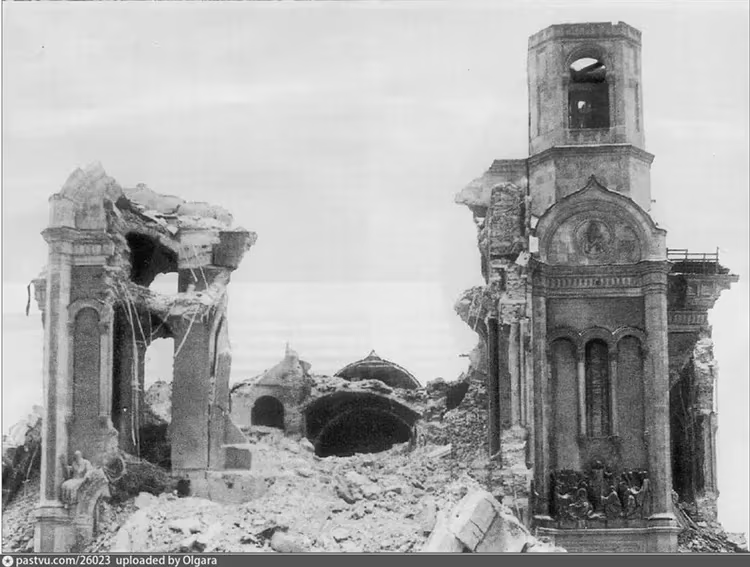
In 1931, as part of the struggle against religion carried out in the Soviet state, the Cathedral of Christ the Savior was blown up. According to the plan, it was planned to build the Palace of Congresses on its territory. However, the outbreak of war in 1941 prevented the implementation of the plan. In the 50s. The pit was converted into a swimming pool.
Recreation
After the 1000th anniversary of the Baptism of Russia was celebrated on a grand scale in the Soviet Union, the public calls for the revival of the destroyed shrines, primarily the Cathedral of Christ the Savior. The program of the fund for the revival of the capital indicates the requirement to rebuild the cathedral in the old place.
The building is being designed by a group of architects led by M. Posokhin and A. Denisov. Later they are replaced by Z. Tsereteli, who makes some changes to the already approved plan. On the part of the ROC, Archpriest L. Kalinin supervised the construction.
According to its concept, the temple is votive, i.e. created in memory of a significant event, as a memorial to the soldiers who died during the Patriotic War of 1812. A tribute to the memory of the heroic past are marble plaques, which contain detailed information about the battles on Russian territory:
Memorial plaques are posted along the Lower Corridor. In addition, the texts of the main imperial manifestos are presented separately. For the first time, a solemn service dedicated to the Nativity of Christ was served in the new building of the cathedral in 2000. It was performed by Patriarch Alexy II. In August of the same year, the cathedral of bishops consecrated the church. Here the canonization of the executed royal family was carried out and the names of the new martyrs and confessors of Russia were named.
Architecture and interiors
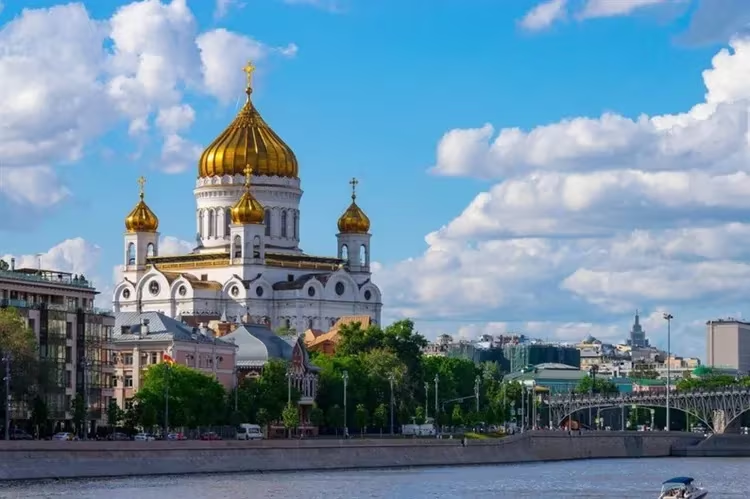
Any person who has seen the building will say that it is original. This is natural: architects did not just draw sketches and then prepare drawings. In their projects, they embodied the ideas that they saw in the victory over Napoleon. A victory that was won not only by Russian weapons, but by the whole people.
original temple
The creator of the original project, Witberg, was a Freemason. But the ideas of the masons brothers did not distort the image he created. Witberg believed that the temple should be triune and consist of three connected and complementary parts:
- Underground, shaped like a coffin. This part is dedicated to the Nativity of Christ. Here constant funeral services for the dead heroes were to be performed.
- Ground. This part is dedicated to the Transfiguration of the Lord and had a cruciform shape. It symbolically reflects the mixture of light and darkness in the human soul. There were supposed to be many statues in this part.
- Upper, dedicated to the Nativity of Christ. It should have been round.
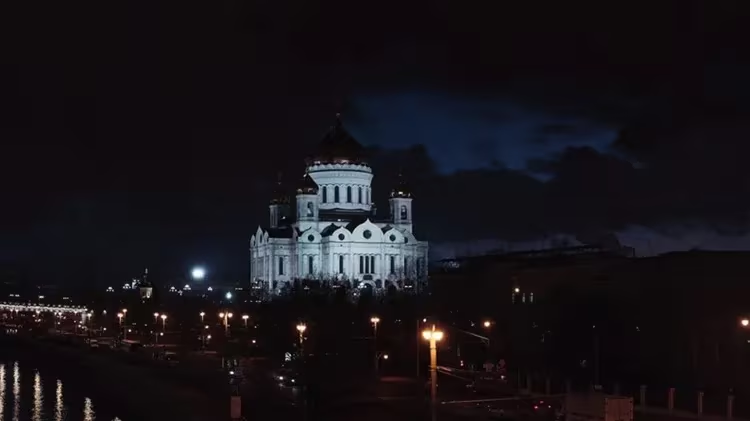
The temple was supposed to stand in front of the Moscow River. Ton's project also assumed a similar arrangement. But the scale was very different. In those days, the tallest building was the Ivan the Great Bell Tower. Contemporaries noted that all of it could enter inside the cathedral under construction.
Ton managed to organically fit the temple into the ensemble of the Kremlin and Moscow churches. This became possible because of the successful construction site. The building was located at a distance from the Kremlin, at the same time harmoniously combined with it.
The characteristic features of the temple of that period are:
These elements were borrowed from churches built by Russian architects in the 15th and 16th centuries. In the project, Ton moved away from the classics, giving preference to folk traditions. The architect managed to successfully combine elements of ancient Russian architecture and Byzantium. The author thereby showed the continuity of forms and at the same time new fashion trends.
modern temple
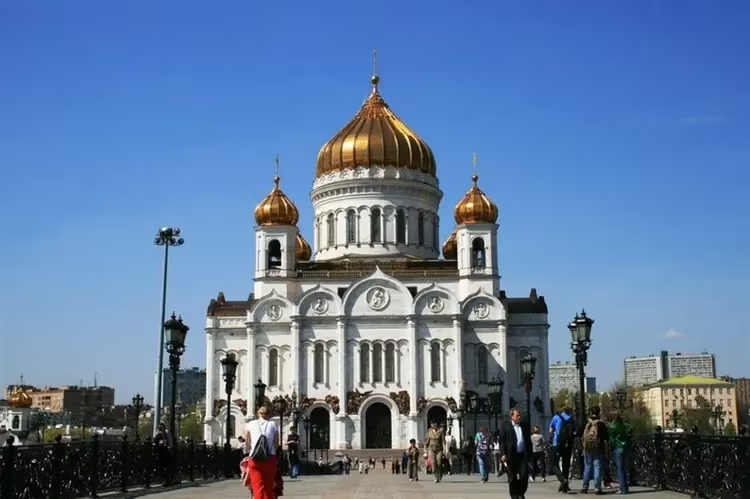
The modern building was erected on a powerful stylobate. The construction of this part was required in order to restore the hill on which the original cathedral was located. The natural elevation was destroyed after an explosion in the 1930s.
Actually, the cathedral is a complex of several buildings that are connected by an architectural solution:
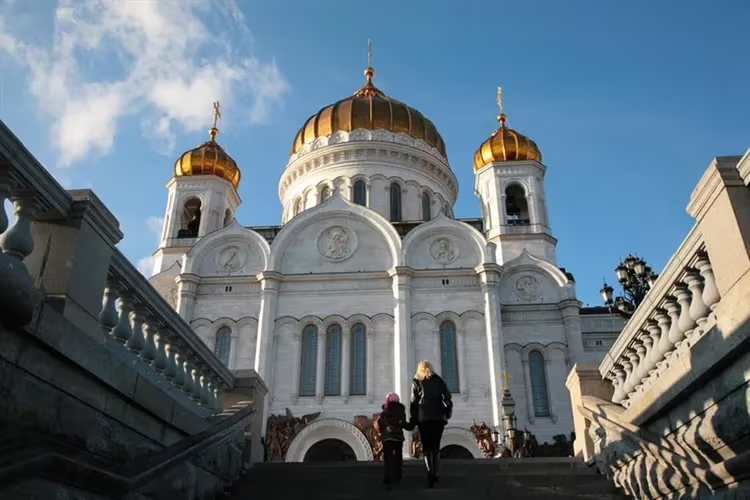
The Church of the Transfiguration of the Lord is located in the stylobate part. There are office premises, a museum, refectories, halls of Councils and Cathedrals. A cathedral was erected above the stylobate. The chapel is a separate building. The building has 4 porches. To climb them, you have to overcome 15 steps. The porches are lined with dark red granite. Lamps were installed on the upper platforms for illumination.
The interior is well lit by daylight. For this, 60 windows are provided. The facade is decorated with kokoshnik arches. They are supported by 36 columns. The architectural illumination of the building deserves a separate description. Powerful lanterns send beams of soft light close to daylight onto the facade. The domes are illuminated by lamps mounted on masts 30 m long each.
sculptures
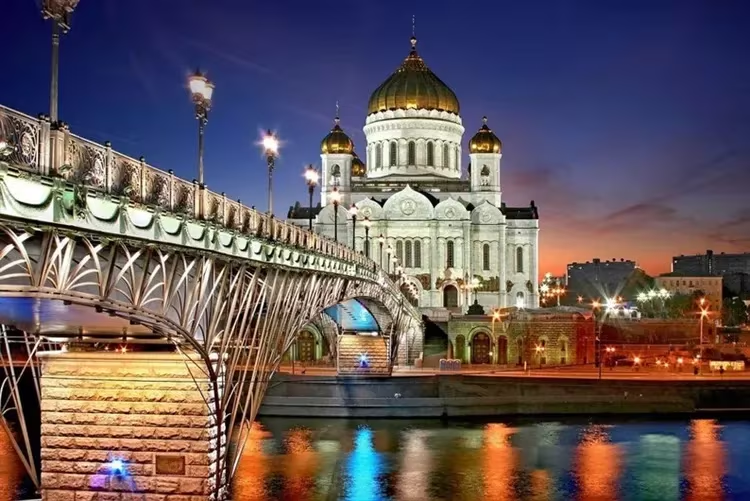
The cathedral is oriented to the sides of the horizon. Each facade is decorated with special sculptures:
The western façade is easily recognizable by the figure of Jesus Christ blessing the people. The high relief is located in a large central arch. On the sides of the central one there are 4 small arches. In them, the sculptor placed images of Alexander Nevsky, Nicholas the Prelate, Saint Elizabeth, Nicholas of Novgorod.
Below, above the middle gate, 4 angels are depicted. Their wings are open, in their hands is a cloth on which is written: the Lord is with us. Figures of 4 angels are depicted above the small gate. This is a dedication to the fallen soldiers of 1812.
Archangels Yehudiel, Varahiel, Gabriel, Uriel are located in the window arches. Jehudiel holds a wreath, the rest are flowers. In the corners there is a symbolic composition – the wedding of Solomon to the kingdom and David, handing over the drawings to Solomon. This is an allegorical image of the promise of Alexander 1, fulfilled by the successor.
The eastern façade faces the Kremlin. Here are depicted the intercessors of Russia and those who prayed for her. In the central arch there is a sculpture of the icon of the Vladimir Mother of God. On the sides, in small arches, are the images of the Holy Empress Alexandra, the Great Martyr Catherine, Mary Magdalene, Anna the Prophetess.
In the arch of the large gate there are sculptures of St. Stephen of Perm, St. Sergius of Radonezh, Metropolitans of Moscow Jonah and Philip. In the window arches are Joseph Volokolamsky, Nikon of Radonezh, Mikhail and Theodore of Chernigov. In the corners of the composition are the Resurrection of Christ and the Nativity of Christ.
The northern facade faces Prechistenka. There are sculptural groups of enlighteners, saints, in whose days there were battles during the campaign of Russian troops abroad. In the center is the image of the Iberian Mother of God. Along the edges are sculptures of Laurus, Gregory, Chrysanthus, Sergius. Below are 4 evangelists and the Apostles Peter and Paul. In the corners is a sculpture of Sergius of Radonezh, blessing Dmitry Donskoy for the battle, and Dionysius, blessing Minin and Pozharsky.
The southern façade faces the Moscow River. Saints are depicted here, on whose days the battles of 1812 took place. In the center is the image of the Smolensk Mother of God. On the sides are John the Baptist, Thomas the Apostle, Roman Ryazansky, Jonah Novgorodsky.
In the lower part – the appearance of the Archangel Michael to Joshua. Deborra, Barak, Moses and Miriam are depicted above the small gate. Compositions are depicted in the corners: the return of David after the victory over Goliath and Abraham with his allies, returning after the victory over the kings.
bells
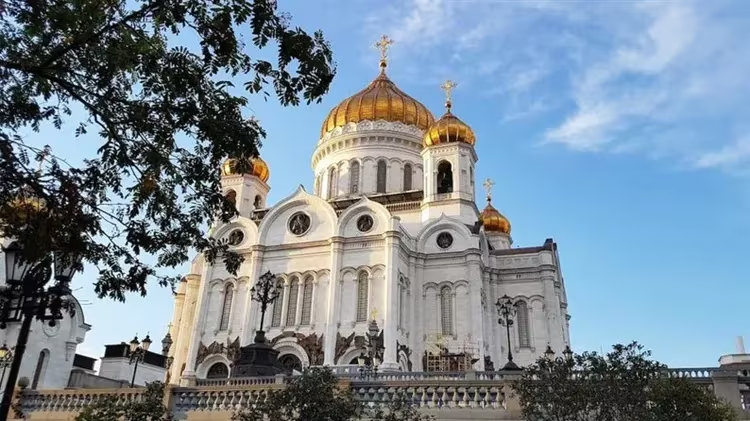
Of course, it would be better to return the old bells to the temple. But of all those in the belfry, only one has survived. And it is located in the Trinity-Sergius Lavra. From the rest, only vague images and approximate descriptions in local history literature remained. Therefore, a competition was announced for the creation of bells. Foundries from Russia and abroad took part in it.
The conditions were pretty strict. It was necessary to present the produced bells to the commission in a short time. Weight should be from 8 kg to 3.5 tons. Number of copies – 10 or more. And what is important: they had to work with their own material and at their own expense. 13 enterprises presented their options. But only 2 companies reached the final: ZIL and LITEX.
Unfortunately, the commission was unable to draw an unambiguous conclusion. Therefore, the competition was extended, and historians and acousticians were involved in the work. Only for the second time the commission in an expanded composition was able to determine the winner. It turned out to be ZIL. The trial bell took pride of place in the museum. In order to fulfill the order, the prototype was tested and the error in sound was eliminated.
For 10 months, ZIL produced:
Such a turnaround time for a complex order is a record. Contractors from Italy said that it would take at least 3 years to make the bells.
Worship Schedule
Services are held in the city's cathedral. Here pass:
A detailed schedule is posted on the website of the cathedral.
shrines
Pilgrims from different parts of Russia, near and far abroad come to the temple to bow to the shrines stored in it:
For the access of believers, particles of relics are presented:
Believers have the opportunity to see miraculous icons:
In addition, the following are on display:
The throne of the Patriarch of Moscow, St. Tikhon is placed in the main altar. One of the main shrines of the temple are the relics of the Metropolitan of Moscow, St. Philaret. From time to time, relics known in the Orthodox world are brought to the Cathedral, which become available for worship within a few days.
Observation deck
The viewing platform is located at a height of 40 m. This is a great way to view Moscow from an unexpected point. Entrance here is paid, and you have to climb on foot. (Sometimes tourists manage to take the service elevator. How lucky.) But the efforts spent will be more than rewarded with an amazing panorama.
There are vending machines on the stairs. They sell coins with the image of the cathedral. Buying souvenirs will brighten up a boring climb. The site encircles the building around the perimeter. The territory is closed from precipitation and bright sun. Moving around the site, you can view the capital from different angles. There are surveillance cameras everywhere, the railings are high enough, there are additional fences. Therefore, to consider the city is not at all scary.
Photo and video shooting is allowed on the viewpoint. Binoculars are installed in some places for the convenience of observations. You have to pay to use them. The time spent on the observation deck is limited. It is half an hour.
It is important to remember: since the entrance to the site goes through the temple, you will have to follow a certain dress code.
Excursions
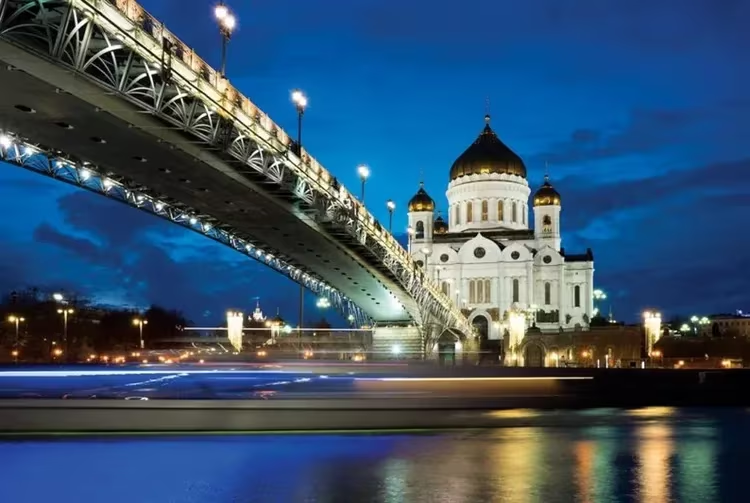
The shrine is of interest to tourists. You can visit the attraction with a group or alone. The following excursions are popular:
An interesting tour. It involves visiting all Orthodox churches in the center of Moscow.
Christmas tree
The New Year's performance is one of the most impressive in Russia. The performance is staged both based on well-known fairy tales and specially written scripts. Actors of the best metropolitan theaters are invited to play the roles. The scenery is pre-made for the performance. There are also 3D effects.
A feature of the festive action is that the plot is connected with biblical stories. Children unobtrusively get acquainted with the basics of Orthodoxy, the feast of the Nativity of Christ. For the little guests, the holiday begins already in the yard. They are met by fair buffoons, fabulous animals. The guys lead round dances, play, and then go to the hall.
It is important that kids 6+ can attend performances on their own. They are helped to undress, escorted to the place indicated on the ticket. After the performance, the mummers hand over the children to their parents. The performances are new every time. For all the time of the festive events, there were no repetitions of the performances. On one of the days, Patriarch Kirill watches the performance together with the small audience.
Some tickets are distributed free of charge. They are received by children who find themselves in a difficult life situation: the disabled, orphans, children from poor families with many children, children of fallen military and police officers. The rest of the audience buy tickets.
Working hours
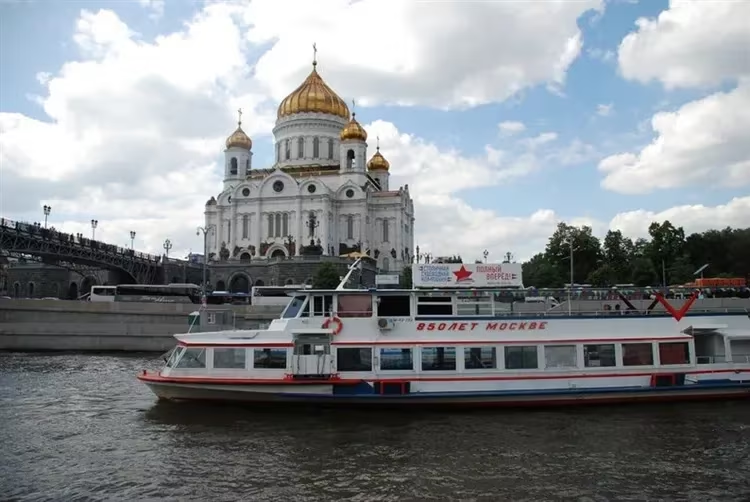
The Cathedral is active. You can visit daily from 10:00 to 19:00. Services are held here, during which it is impossible for tourists to visit the interior. The schedule of services can be found on the official website.
How to get there
The Cathedral of Christ the Savior is located near the center of the capital on the banks of the Moskva River, next to the pedestrian Patriarchal Bridge. The official address is on Volkhonka street, 15.