
History of Turkey
The history of Turkey begins with the formation of the Turkish state in the XIV century on the territory of the Asia Minor peninsula, although the history of the Turkish people goes back far back centuries.
This peninsula, in whole or in part, was part of various states of the early Middle Ages and ancient times. At the beginning of the 14th century, a feudal principality was formed in the northwest of Asia Minor. It was named Ottoman in honor of the founder of the dynasty, Osman the First. The nation that lived in this state, consisting of various Turkic tribes, began to be called the Seljuk Turks. The conquest of the territories of the Eastern Roman Empire by the Turks occupies an important place in the history of Turkey.
The Ottoman state originally had a military-feudal system. The dominant class consisted of feudal lords, warriors and vultures. The primary task of the Ottoman state at that time was the expansion of existing possessions and the subsequent plunder of new territories.
In the second half of the XIV century, Eastern Thrace and several Bulgarian cities became part of the Ottoman Empire. In 1389, the Ottoman Turks won the battle on the Kosovo field, which was near Serbia and ordered Serbia to pay tribute. As a result of the expansion of their territories by the Ottomans, Macedonia, Thessaly and the Bulgarian principality fell. European expansion has taken an important place in the history of Turkey.
By the end of the XIV century, all the principalities (beyliks), including Janik, Sivas and Karaman, were forced or voluntarily joined to the Ottoman Empire. Timur's invasion of Asia Minor in the early 15th century shook the power of the Ottoman Empire.
In 1402, Sultan Bayazid the First was defeated in the Battle of Ankara with the troops of Timur. Most of Anatolia (Asia Minor) again turns into separate principalities (beiliks). The clash with Timur became a significant event in the history of Turkey.The
Ottoman Empire began to recover only after the suppression of antifeudal uprisings and the end of the internecine wars of the sons of Bayezid the First, and by the middle of the 15th century the Ottoman expansion in the Balkans resumed. The advance of the Ottoman Turks into Europe is trying to stop the army of the crusaders, but it is defeated in 1444 and 1448 by Sultan Murad II.
Read: Attractions of Bodrum
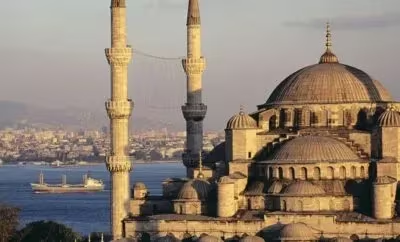
On May 29, 1453, the troops of Mehmed II took Constantinople after a two-month siege. After that, the Eastern Roman Empire disappeared on the world map, and Constantinople was renamed Istanbul, becoming the new capital of the Ottoman Empire. This was a truly significant moment in the history of Turkey.
In the 50s-70s of the 15th century, the Ottoman expansion continues. By this period, Serbia is losing its independence. Bosnia, Morea, the Trebizond Empire and Attica were also conquered, and a vassalage over the Crimean Khanate and Wallachia was also established.
After defeating the troops of Sanderberg's resistance, Mehmed II conquered Albania towards the end of his reign. The expansion of the lands of the Ottoman Empire leads to an increase in land taxes, the estates of sultans, hasses (high dignitaries) and representatives of the sultan's clan, as well as the expansion of the possessions of the clergy. Selim the First (ruled 1512-1520) and Suleiman the Legislator (ruled 1520-1566) incorporated Armenia, Kurdistan and Northern Mesopotamia into the Ottoman Empire up to the city of Mosul, including it.
At the beginning of the 16th century, the Ottoman Empire subjugates Palestine, Syria, Egypt, Hejaz and part of Algeria. In the 16th century, the Ottoman fleet became the full-fledged ruler of almost the entire Mediterranean basin. In 1521, Turkish troops occupied Belgrade, and after the defeat in the Battle of Mohacs (1526), the Turks occupied most of the Kingdom of Hungary. This was one of the great victories in Turkish history.
In the middle of the 16th century, the Ottoman Empire absorbed Rhodes and the other islands of the Aegean archipelago, as well as Tripolitania and all of Algeria. The Ottoman Turks by this time had grown to incredible proportions: vast territories in Africa, Asia and Europe (about 8 million square kilometers). The peoples conquered by the Ottomans experienced a heavy yoke that hindered their social and economic development.
The preconditions for the fall of the Ottoman Empire began to appear precisely during the period of its power. The history of Turkey during the period of the Ottoman expansion is a continuous war that led to the ruin of the peasantry and the ruin of the economy. A significant balance of power has emerged in the ruling class. The new feudal landlords began to oust the military fiefs. The power of the highest religious clergy increased. All this, directly and indirectly, led to a decrease in the fighting qualities of the army and a reduction in its number. Landowners began to shy away from military service, and discipline among the sipahi began to decline. In addition, the Janissaries, for the first time in the history of Turkey, breaking the established customs, began to acquire families and turn into one of the social strata, engaging in crafts and trade. Gradually, the entire feudal elite began to decay.
Never again will the history of Turkey know such an upsurge as in the period from the XIV to the XVI centuries.
During this period, discontent in society also grew, which afterwards would develop into major uprisings that took place in the late 16th – early 17th centuries. In the Battle of Lepanto in 1571, when the Turkish fleet was defeated, the country's military weakness became apparent. In 1569, the Ottoman Empire was defeated in the war with Russia. However, despite all this, the borders of the Ottoman Empire remained more or less stable until the end of the 19th and beginning of the 20th centuries. After the end of the First World War, the Ottoman Empire ceased to exist and for the first time in the history of Turkey, this state adopted a republican system.