
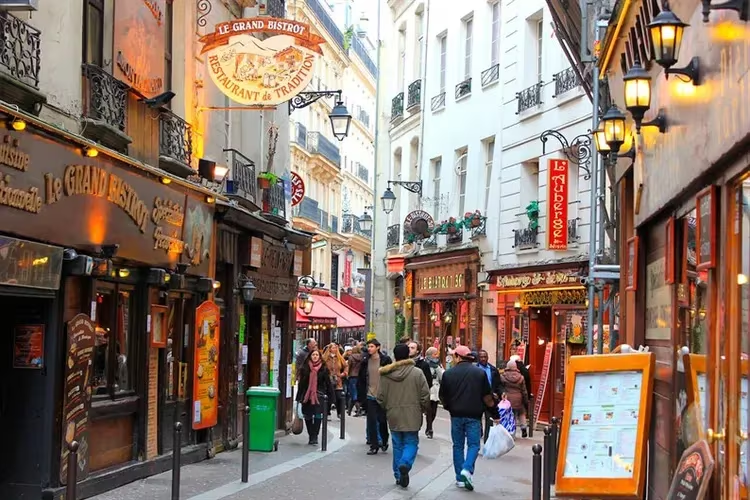
The Latin Quarter in Paris is considered one of the most historic, lively and popular areas of the French capital. Schools, universities, libraries and museums have long been located here.
Story
Medieval Paris was the cultural and intellectual capital of Western Europe. The city, which reached unprecedented prosperity, attracted scientists, philosophers and artists. The scientific thought of France was concentrated here. Beginning in the 11th century, young people seeking higher education were provided with such an opportunity in church schools.
Initially, teaching was carried out on the island of Cité. Students and teachers have never had enough money. Housing on the left bank of the Seine was much cheaper than in the central district of Paris. Therefore, new colleges began to open on the slopes of the hill of St. Genevieve, in which they studied theology, medicine, painting and philosophy. Education was conducted in Latin, which is why the district was named the Latin Quarter.
sights
Today, the “student town” attracts tourists with narrow and cobbled streets, along which there are interesting sights. This is the main university of France, the tomb of historical figures, a medieval museum, a Gothic chapel, ancient monuments, as well as numerous shops, cafes and restaurants.
Sorbonne
The most famous and largest educational institution in France is the Sorbonne University. This is a complex of high school buildings scattered throughout Paris. The main buildings are located in the Latin Quarter.
In 1257, the clergyman Robert de Sorbon, who was the spiritual mentor of King Louis IX, founded a college for the study of theology for the poor. The educational institution became popular among the youth of the whole country and was soon transformed into a university with the name of the Sorbonne. He was famous for his teachers, who formed the intellectual elite of the state. The institution accepted students from families of different social classes.
In 1625, Cardinal Richelieu initiated the restructuring of the university buildings. A baroque chapel with four belfries appeared among the educational buildings. Its facade with an elegant dome was decorated with columns and sculptures.
The external and internal decoration of the main building of the Sorbonne corresponds to the university atmosphere. The facade of the building is decorated with figures symbolizing science. Lecture audiences and lobbies are decorated with picturesque panels describing scenes from student life.
Place Saint-Michel
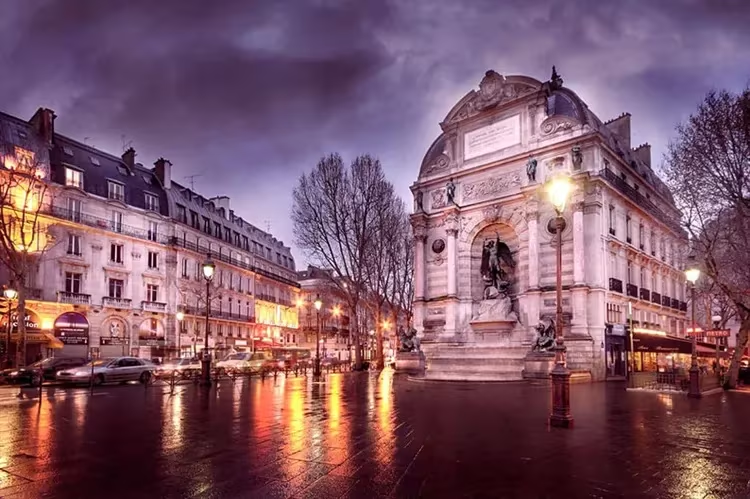
Around the Sorbonne University there is a small and crowded Place Saint-Michel, named after the Archangel Michael. Framed on all sides by shops, cafes and bookshops, the area has become a haven for the cultural beau monde of Paris. Students like to gather here after classes and spend their free time.
The pearl of the square is a monumental baroque fountain, originally built into the end of the house, the facade of which is decorated with red columns, an ornate attic with bas-reliefs and sculptures. The central figure of the fountain is the statue of Saint Michael slaying the devil with his sword. At the foot of the composition, griffins are installed, spewing endless streams of the purest water into the pool.
Boulevard Saint-Michel
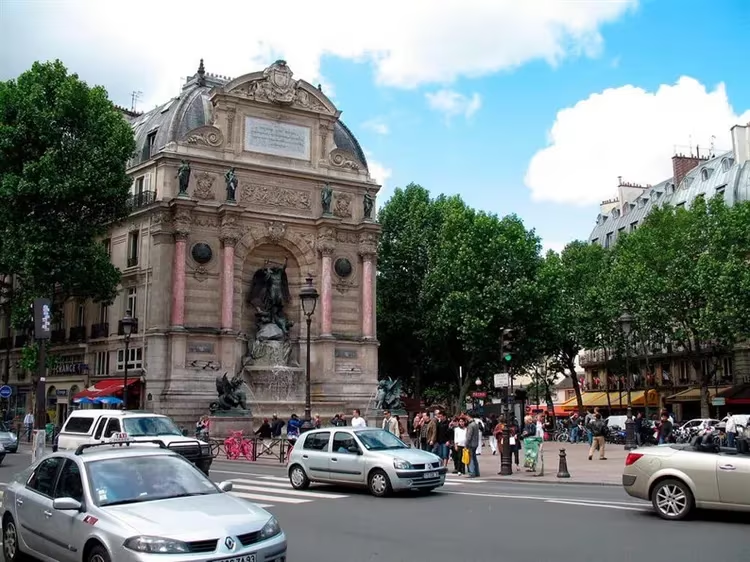
The main artery of the Latin Quarter is the Boulevard Saint-Michel, which stretches for one and a half kilometers. This is a favorite place for Parisians and visitors to the city. Old houses built in the middle of the 19th century and cobbled streets are covered with romance. There are numerous shops, boutiques, hotels, restaurants, coffee houses, cinemas and nightclubs.
Church of Saint-Severin
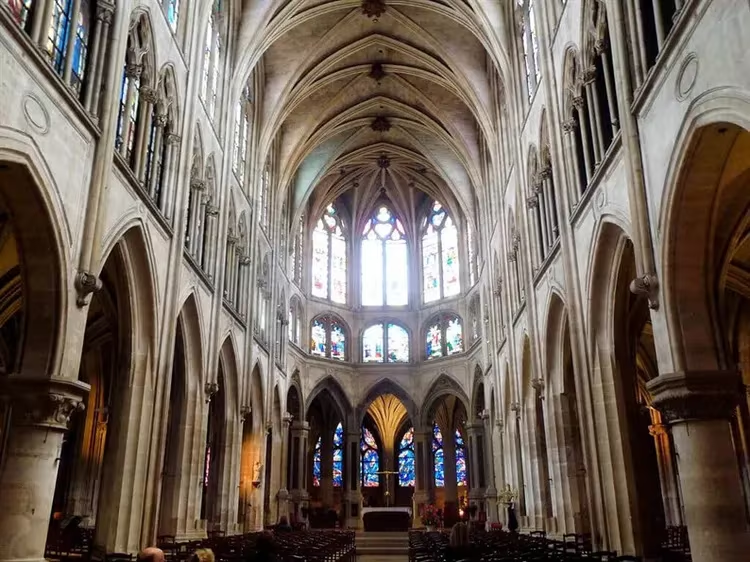
Surrounded by the narrow medieval streets of the Latin Quarter, you can see the austere church of Saint-Severin, named after the patron saint of travelers Saint Severin. This Gothic building, built in the 15th century, was the first parish basilica on the left bank of the Seine.
The church is a disproportionate building with five naves. Its width prevails over its length. In the external appearance of the basilica, wide arched windows, flying buttresses, portals, a high spire, decorative turrets (pinnacles) and protruding ribs stand out. The center of the façade is decorated with a semi-rosette consisting of ornate petals resembling flames.
The interior of the church is especially impressive. The walls of the hall are framed by an arcade, and the ceiling is decorated with a ribbed vault. Behind the altar are spirally twisted columns, visually similar to palm trees. The main decoration of the temple are stained-glass windows on biblical scenes.
Cat-fisherman street
The narrowest and shortest street in Paris is located in the Latin Quarter. It is 1.8 meters wide and 26 meters long. It goes to the embankment of the Seine. The street is famous for its legend. In the 15th century, the clergyman Father Perle lived here with his black cat. The animal was surprisingly dexterous in catching fish in the Seine. The priest was actively engaged in alchemy, which was equated with witchcraft.
Three students of the Sorbonne, being convinced that a man and a cat are one, killed the animal. After that, the priest also disappeared. The young men were sentenced to hang for the murder of a canon. Three days later, Perle and the cat appeared, continuing to calmly go about their business.
Pantheon
Above the entire Latin Quarter rises majestically a well-known architectural structure, which is the best example of the ancient style. This is the Pantheon. In the 18th century, on the initiative of King Louis XV, a temple was erected in honor of Saint Genevieve. After the revolution, the basilica was turned into a mausoleum for the great French.
The monumental building, which is 110 meters long and 83 meters high, has a cruciform shape in plan. The temple is crowned with a massive dome mounted on a drum, which is framed by Corinthian columns. The staircase in front of the entrance leads to the Pantheon through a portico with 22 columns supporting a pediment decorated with bas-reliefs.
The interior of the temple is replete with luxurious picturesque panels and sculptural compositions based on historical motifs. Under the church there is a crypt that stores the ashes of many famous people: Dumas, Voltaire, Hugo, Rousseau, Curie.
Arenas of Lutetia
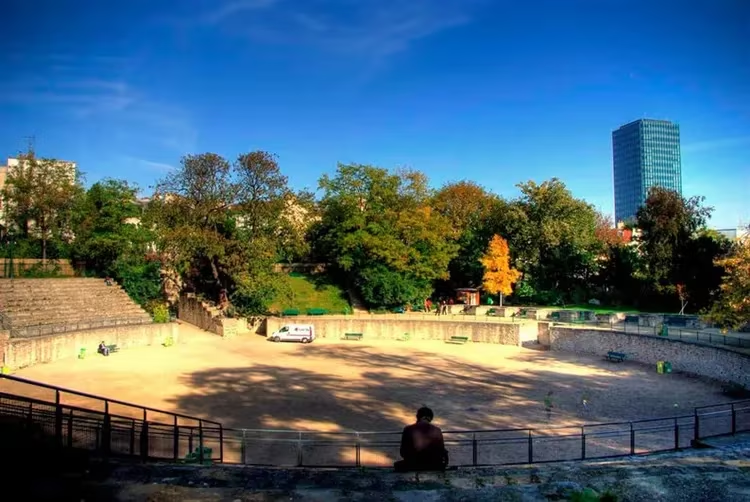
The Romans, having conquered the Celtic tribe of the Parisians and founded the city of Lutetia, left their historical mark on the appearance of Paris. The only surviving ruins of that era are located in the Latin Quarter. This is a semicircular amphitheater for 15,000 spectators, dating from the 1st century AD. It was discovered under a layer of earth in 1869, when work was being done to lay the pavement.
Today, only a third of the arena is truly Roman. The area was intended for circus and acting performances, and today is used by Parisians as an active recreation area.
Cluny Museum
In the old mansion, erected on the site of the Roman baths in the 15th century for the abbey of Cluny, there is a museum of the Middle Ages. Here you can see many unique exhibits: tapestries, manuscripts, a collection of stained-glass windows, armor of knights, wooden sculptures, jewelry, household items and much more.
The main decoration is the hall with the tapestry “Lady with a Unicorn” – a masterpiece of medieval weaving. The museum building is also of interest. Its courtyard impresses with skillful stone carvings.
luxembourg garden
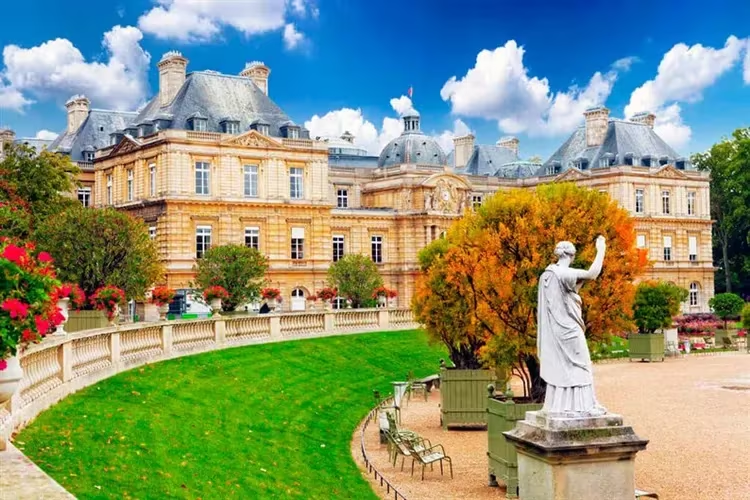
Among the Parisian streets, filled with human bustle, there are oases of silence and bliss. One of these places is the Luxembourg Gardens, founded in 1612 on the initiative of Marie de Medici (wife of King Henry IV).
On the spacious territory of the garden there are shady alleys, flower beds, flowers, sculptures, statues of French queens, a pond, fountains, playgrounds. Parisians love to relax and play sports here. If you wish, you can sit on the chairs scattered around the park, or have a picnic on the lawn.
The shops
The Latin Quarter is full of various shops. From all over France, the best products are brought here: cheeses, wine, fruits, sweets. Fairs are held on the Boulevard Saint-Michel on weekends. In addition to grocery stores, there are also souvenir, book, jewelry, flower, perfume shops and boutiques. The abundance of sellers and buyers has long been one of the characteristic features of the Latin Quarter.
Cafes and restaurants
The Latin Quarter is famous for its cozy cafes and restaurants, the interiors of which are made in their original style. It is here that the real spirit of Paris is felt with its good cuisine and charm. Each visitor to the area will find an institution according to their gastronomic taste – from vegetarian food to exquisite seafood delicacies.
Which hotel to choose
Many of the quarter's medieval houses have now been converted into hotels. The comfortable rooms, decorated in soft colors with old-fashioned furniture and interiors, add sophistication to the colorful atmosphere of the medieval area. Here you can find cheap hostels and hotels with luxury apartments.
Where is it located and how to get there
The Latin Quarter is located on the left bank of the Seine, within walking distance of the main attractions of Paris. You can get here by metro (Saint-Michel – Notre-Dame, La Sorbonne stations) or by buses No. 21, No. 24, No. 27, No. 63, No. 89.