
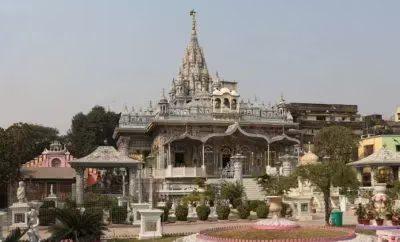
Northern Kolkata, attractions. India
In this part of the city, between the Eden Gardens and the Howrah Bridge, there are many historic buildings and monuments. You can see it while walking. We will start it at the intersection of Council House Street and KSRay Road (formerly Hastings Street) at the entrance to the territory of the Church of St. John (St John's Church, 1787). The church was built according to the project of Lieutenant James Ugg, who took as a basis the appearance of St. Martin's Church in London. In the old days, the entrance to the church was located in the eastern part, but in 1797 it was made from the western side. The original altar was a painting “The Last Supper” by Johann Zoffani, which depicts noble inhabitants of Calcutta as apostles. Now it is located in the south aisle of the temple.
The first bishop of Calcutta, Middleton, and other noble British are buried in the church. The gravestone of the alleged founder of the city Joba Charnock (died around 1695) has been preserved in the church cemetery. The mausoleum is an octagonal two-story pavilion. One of the four tombstones in the pavilion indicates the burial of Dr. William Hamilton (d. 1717). According to legend, he became famous for having healed the Mughal emperor Farrukhsiyar. The recovered emperor, in gratitude, granted the British East India Company the right to free trade in Bengal in 1717. In fact, this achievement belongs to J. Surman, in 1714-1717. who was at the Mughal court in Delhi and negotiated the status of Madras and Calcutta.
North of the church cemetery on Hare Street is the Small Causes Court, built in 1878 by William White. Ionian capitals are reminiscent of intertwined snakes and dolphins.
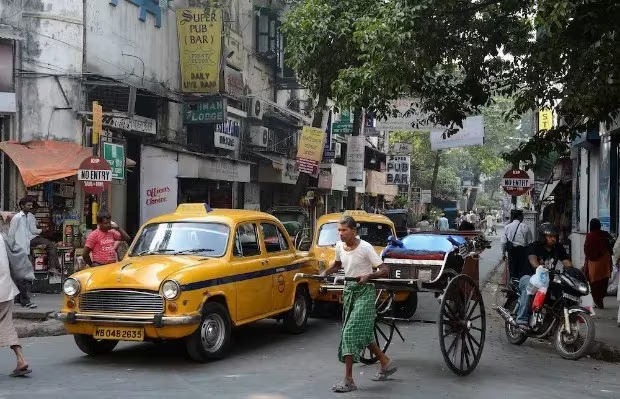
At the intersection of Hare Stree and Strand Road we see Metcalfe Hall (1840-1844). Its western side resembles the Tower of the Winds in Athens. The building was built in the style of the Greek Renaissance according to the project of the head of the municipality of the city K.K. Robinson for the Agricultural and Horticultural Society and the Calcutta Public Library.
Slightly south towards Esplanade Row West is the High Court (1872), a Gothic-style building designed by Walter Grankill. At the main entrance stands a statue of Sir Edward Hyde, Chief Justice from 1813-1822.
To the east of the Supreme Court is the City Hall (1813), designed by Colonel John Garston. It houses the Kolkata Panorama Museum. Interactive exhibits are dedicated to the 500-year history of Bengal.
Further east, at the end of Esplanade Row is the seat of the Governor of West Bengal, Raj Bhavan. It was built in 1799-1802. designed by Captain Charles Watt. As a model, Watt took the Kedleston Hall building in Derbyshire, erected by Robert Adam. The residence is located in the northern part of the park and at one time was the center around which city construction was carried out. The entrance to Raj Bhavan is closed, but it can be viewed from the roads adjacent to the complex.
Adjacent to the east side of Raj Bhavan, Old Court House Street leads north past the Great Eastern Hotel to BBD Park. (BBDBagh), named after the three independence fighters Binoy, Badal and Dinesh. In 1930, these young men attempted the assassination of Police Commissioner Charles Tegart at the Scribes' House, located on the north side of the park, and died fighting overwhelming police forces. Before this place was called pl. Dalhousie in honor of Count Dalhousie, Governor General of India from 1848-1856.
In the center of the park B.B.D. we see a large pond (Lal Dighi Tank), dug in 1712. Further down the street to the right is the St. Andrew's Church (St / Andrew's Kirk), built in 1818. Like St. John's Church, it is copied from St. Martin's Church in London, however, is much more successful.
East of B.B.D. Park Mission Row, one of the oldest streets in Calcutta, is dominated by the Old Mission Church (Lala Girja), founded by the Swede Johann Zachariah Kirnander.
Behind the church is the Nilhat house (lit. “Indigo Market”), built in 1886 on the site of the indigo trade center. Until now, tea auctions are held here, which can be visited by obtaining permission from one of the brokerage houses.
The northern side of the park B.B.D. occupies the Writers' Building, erected in 1777-1780. Thomas Lyon. It housed the headquarters of the British East India Company, where scribes-clerks worked, hence the name. In 1880 this huge structure was faced with terracotta tiles.
В северо-западном углу парка находится Главпочтамт (General Post Offise), построенный в 1864-1868 гг. на месте «черной ямы» Калькутты. Так называлось тесное тюремное помещение (около 2 кв.м, с одним-двумя небольшими окнами) первого форта Уильяма. Жарким днем 20 июня 1756 г. в него заточили 146 британцев мужчин и женщин. Они попали в плен после взятия форта армией бенгальского наваба Сирадж-уд-Доулы. Когда пришла весть о приближении войск наваба, губернатор Калькутты Роджер Дрейк и старшие офицеры в спешке покинули форт, укрывшись на военном корабле. Оставшийся без командиров гарнизон крепости попытался оказать сопротивление, но оно было быстро сломлено. Утром 21 июня из пленников, заточенных в тюрьму, в живых осталось только 23 человека, остальные задохнулись или умерли от обезвоживания. Со временем эта трагическая история обросла множеством легенд. Большинство современных историков сходится на том, что количество жертв несколько преувеличено.
Philatelicists can visit the small Philatelic museum on Kalighat Street, next to the Central Post Office.
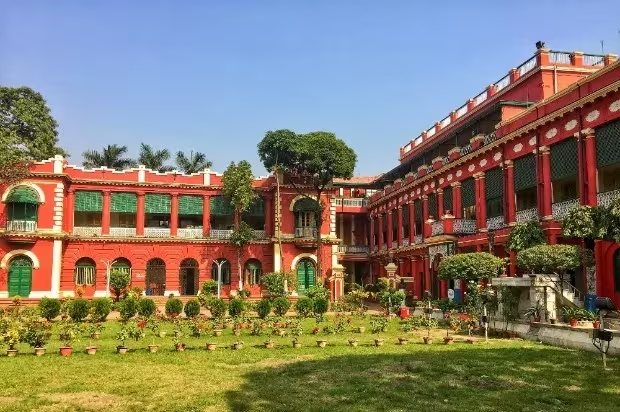
Jorasanko Thakur Bari – museum
Netaji Subhas Road runs north past the General Post Office to the huge East Indian Railway Office building. It was built according to the project of R. Roskell Bine in the 19th century. The cornice crowning the building is copied from the Palazzo Farnese in Rome. 4 panels with frescoes depict Architecture, Sculpture, Music and Trade.
Nearby we see the building of the Royal Exchange (Royal Exchange, 1916). Located at the Howrah bridge, Armenian Street, is the oldest church in Kolkata, the Armenian Church of Holy Nazareth. It was erected in 1724 on the site of a burnt wooden church in 1707. The temple was designed by an Armenian from Persia named Kavond. In 1790, Kacic Arakiel added a room for the clergy to it and installed a clock on the bell tower. To the east is the Roman Catholic Cathedral of Our Lady of the Rosary.
Further north, Strand Road leads over Howrah Bridge to the old Silver Mint, built in 1824-1831. in the style of the Greek Renaissance, designed by Major W.N. Forbes.
Howrah Bridge (or Rabindra Setu, length 457 m) was built in 1943 by Hubert Shirley-Smith on the site of the old pontoon ferry. It is believed to be the busiest bridge in the world. During rush hour, it will take 45 minutes to cross it. Another bridge (Vidyasagar Setu) was built in 1994, 2 km down the river in South Calcutta.
The bridge leads to Howrah Station.
A short detour back along Mahatma Gandhi Road leads to the Nakhoda Mosque (1926-1942) on Rabindra Sarani, modeled after Akbar's tomb at Sikander near Agra, Uttar Pradesh. The mosque accommodates about 10 thousand believers. The height of the minarets is 46 m.
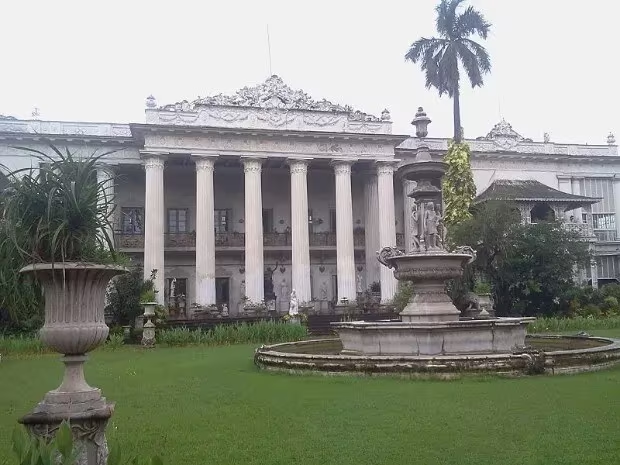
Marble palace
North of the mosque, off Chittaranjan Avenue on Muktaram Babu Street, is the Marble Palace. It was erected in 1835 for the wealthy landowner Raj Rajendra Mullik Bahadur, who traveled extensively in Europe. The palace is still owned by the Mullik family. It houses a huge collection of antiques and old paintings, including real gems from paintings by Rubens and Joshua Reynolds, but they are difficult to find without a guide. A permit from the West Bengal State Department of Tourism is required to visit the palace.
To the north of the Marble Palace is the home of the famous poet Rabindranath Tagore Jorasanko (614). Nowadays, it has been expanded and turned into the Rabindra Bharati University, specializing in the study of Bengali culture. The building has a small museum of the Tagor family (more correctly, the Thakurov).
Further north on North Chitpur Road is Kumartuli (lit. “Potters' District”). Here, in a labyrinth of narrow streets, there are workshops where idols of Indian gods are made. The most interesting visit to this area is in August and early September, when on the eve of the 10-day Durga Puja festival, beloved by Bengalis, the masters make idols of the goddess. Nearby is the old shrine of the god Shiva Buro Shiva. It is the only surviving urban sanctuary made of terracotta.