
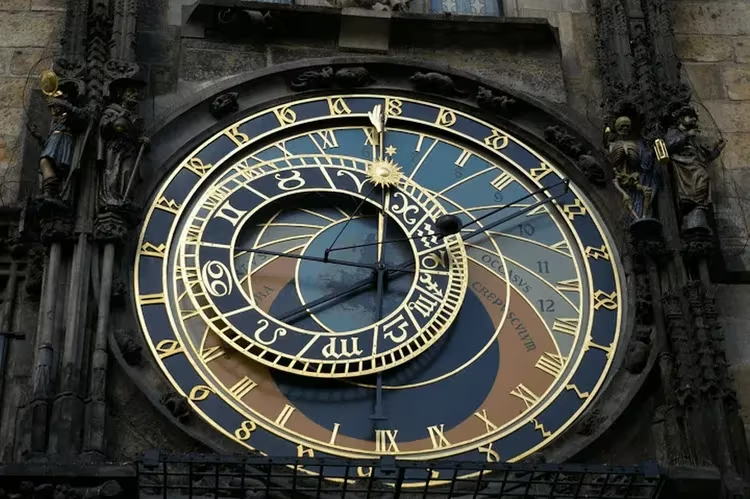
Orloj astronomical clock in Prague – photo of chimes, history, location, map
The astronomical clock Orloj, or as they are also called the Prague Astronomical Clock, is one of the symbols of the Czech capital. Tourists constantly crowd around them, hoping to see a small colorful performance that takes place every hour.
History of the Orloi astronomical clock
The first mention of the Orloi clock dates back to 1402. Since then, they have experienced countless reconstructions, restorations, upgrades, but never left the Old Town Square. It is difficult to say how the watch looked originally. It is known for sure that in 1410, thanks to the efforts of the astronomer and mathematician Jan Schindel, they became mechanical and acquired the legendary astronomical dial. After 80 years, in 1490, the clock was modernized by the master Ganush, who added a lower dial to it, and also “brought gloss” by decorating it with Gothic sculptures. In the 17th century, they were accompanied by figurines of the apostles. As a result, the mechanism turned out to be really complex.
A special person was responsible for maintaining the watch in good condition, but it was not always possible to find a worthy specialist. Because of this, the chimes often broke, and sometimes even stopped for a while on the orders of the king. In 1945, a serious test awaited the clock – it burned down along with the Old Town Hall. Perhaps this was one of the most tragic moments for the inhabitants of Prague during the years of the Second World War. For three years, the best craftsmen in Europe have been assembling Orloi literally piece by piece. As a result, today 75% of the parts in watches are old, original, and 25% are new. However, the mechanism was completely preserved – it remained the same as many years ago.
Astronomical dial and statues
Orloi's astronomical dial is a whole system that shows time in 4 dimensions.
1 Old Czech, the outer circle with Schwabacher numbers is responsible for it. It is easy to see that it moves relative to the main dial. This is due to the fact that in old Prague the countdown of the day began at sunset, which means that this happened at different times of the year in different ways.
2 Central European time – the second (if you count from the outside) circle with Roman numerals is responsible for it.
3 Arabic numerals of the third circle indicate sidereal time and denote daylight hours.
4 And finally, the most difficult measurement is the so-called Babylonian time. It is indicated by the ring of the Zodiac moving around the planet Earth (blue circle in the center). Thanks to him, you can find out in which constellation the Sun is currently located.
The dial is surrounded by 12 animals – real and fictional. They did not appear here by chance, each has its own meaning, many are called upon to perform a protective function. There are 4 sculptures on the sides: a magician, a miser, a skeleton and a Turk, which are the personification of human vices. The lower dial of the Orloi is the Manes calendar. There are also 4 sculptures around it: Archangel Michael, philosopher, chronicler and astronomer. Every hour from 8:00 to 20:00, the astronomical dial of the Orloi clock turns into a place where a real theatrical action is played out. Sculptures of Christ and 12 apostles appear in the upper windows, then a real “struggle” with human vices unfolds.

Where are and how to get to the Prague Astronomical Clock
The astronomical clock Orloj is located on the Old Town Square, right on the tower of the City Hall of the same name. You can get here by metro (the nearest station is Staromestska), trams No. 1, 2, 14, 17, 18, 25, 53 (the stop is named the same as the metro station) or bus 194 (the stop Staromestske namest? – it is closest to area).