
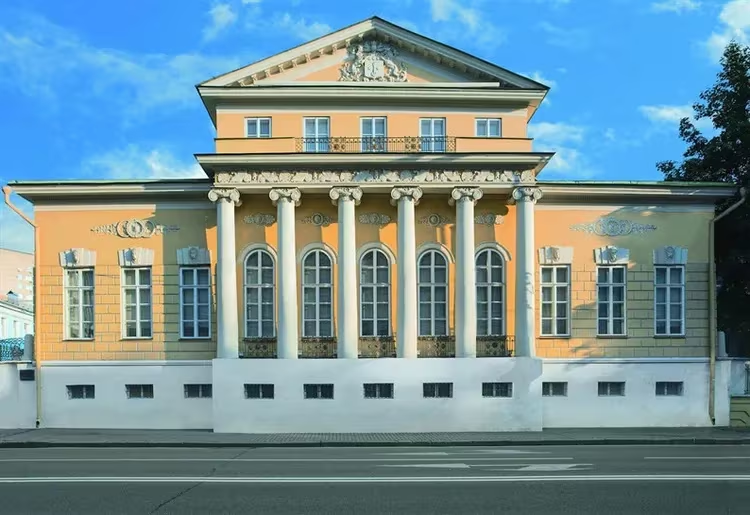
Muscovites know and love the building, located in the very center, not far from the Cathedral of Christ the Savior. People come here to admire the unique collections. Many children begin their first acquaintance with sculpture here. Future artists and sculptors feel at home here. No wonder: after all, today the State Museum of A. S. Pushkin is rightfully considered one of the famous museums in the world. In terms of importance, his collection is not inferior to the collections of the Metropolitan Center and the Louvre. Excursions to Pushkinsky are included in the cultural program of every guest of the capital.
Story
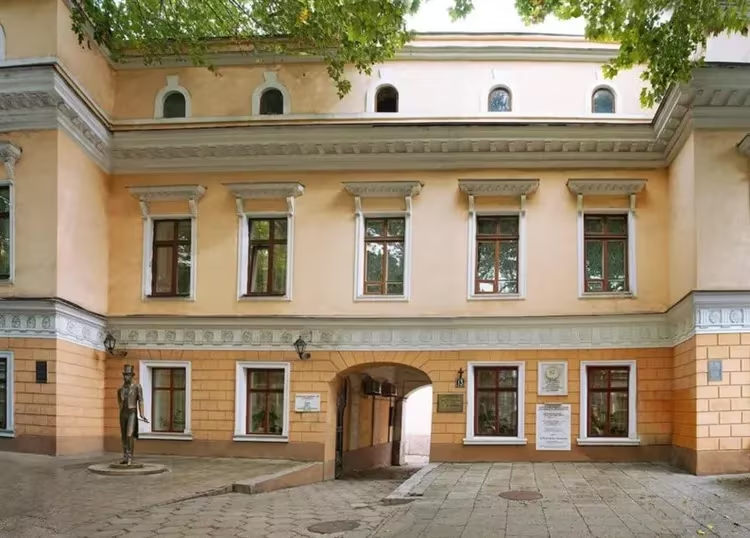
Every guest of the capital knows the building located in the center. Once there were stables of the oprichnina army, then – Kolymazhny yard, where horses could freely ride. Later the building was turned into a prison. It soon fell into disrepair and was demolished. For some time, a wasteland flaunted in the center of the city.
Through the efforts of Ivan Tsvetaev, a professor at Moscow University, at the end of the 19th century, the site was transferred to the university. It was Tsvetaev who came up with the idea of creating the Museum of Fine Arts. For the construction of the building, it was decided to hold a competition. The rules were developed by the same Tsvetaev. 15 architects responded. 7 projects received high marks from the jury.
The commission consisted of famous artists:
Klein's project won, and engineer Rerber was appointed to oversee the work. Klein received an advance from the university. With this money, he should go to Europe to study architectural styles.
Work began in 1898. They paid by subscription. However, in 1904 the building burned down. Some of the exhibits were destroyed. The patrons renounced their obligations. Further work was carried out at the expense of Nechaev-Maltsov.
The October Revolution added to the grief of the director of the museum. For several years, firewood was not allocated for heating the building. The exhibits were damp, mold started on parts. During the Great Patriotic War in 1941, the glass vault was destroyed during the bombing. Until the end of the reconstruction (in 1945), the building stood without a dome.
The proximity to the huge open-air swimming pool Moscow did not add health to the exhibits. The management of the center has repeatedly appealed to the Moscow City Council with reports on the alarming state of the paintings and sculptures. But the decision to dismantle the reservoir was made only in the post-perestroika years.
Architecture
The special value of the building lies in the fact that it is the last in the city, made in the traditions of the neo-Greek style. The building resembles the Athenian Acropolis, and the portico is copied from the Erechtheion temple. Building materials were paid for by almost one Nechaev-Maltsov. And it turned out to be quite difficult.
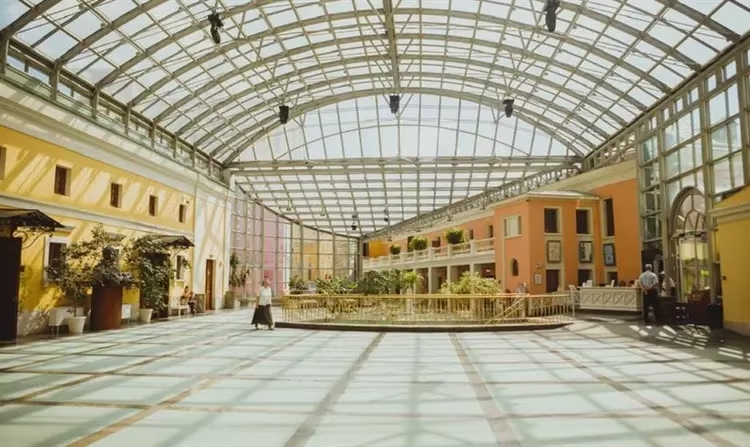
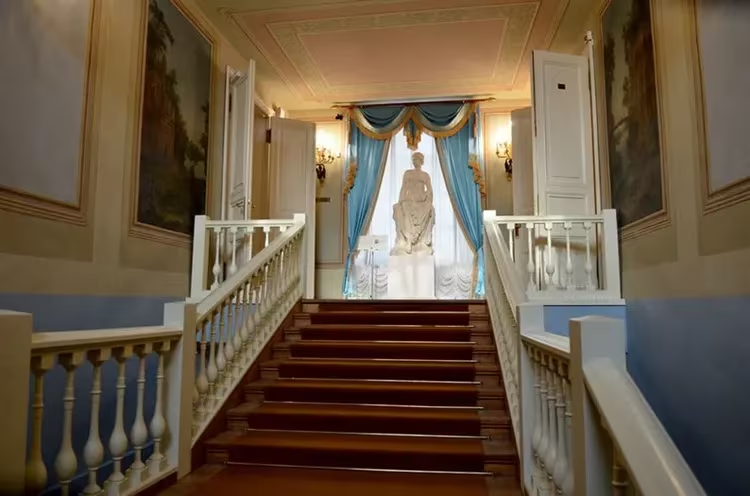
Suffice it to mention that the marble mined in the Urals was processed in Norway and from there went to Moscow. I had to overcome first the sea, and then the river part of the path. For the central staircase, marble was brought from Austria-Hungary. At first, it was decided to open expositions only during daylight hours. A huge convex glass roof was provided to illuminate the artifacts.
It was separately designed and calculated by the famous Shukhov. The facade was decorated with sculptures by Zaleman. Subsequently, the center was equipped with ventilation and artificial lighting. The internal layout suggested the location of the exhibition of ancient and ancient Greek art in the halls of the second floor. The halls of the first floor were devoted to the art of the Renaissance, Assyria, and Egypt. The center also has its own library. It was possible to get into it through a separate entrance from Kolymazhny Lane.
Hall decorations
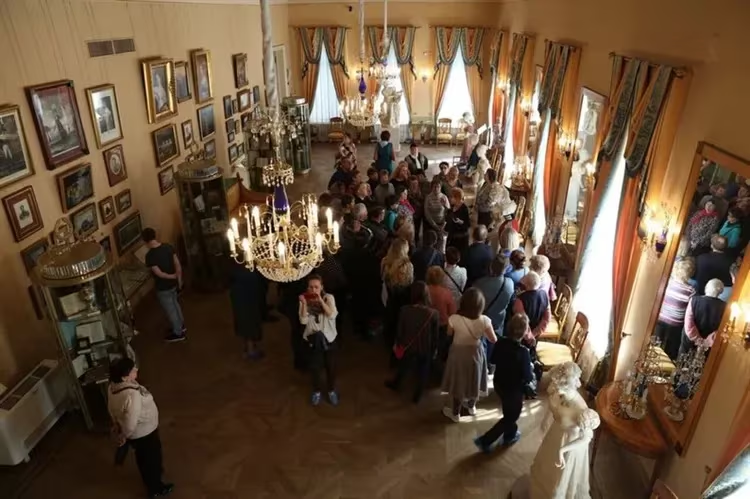
The interiors were supposed to be designed in accordance with the theme of the exposition:
The center is currently undergoing renovation. According to the project, the old and new buildings will be connected by an underground passage. A museum town will be created. The exposure will expand.
Permanent exhibitions
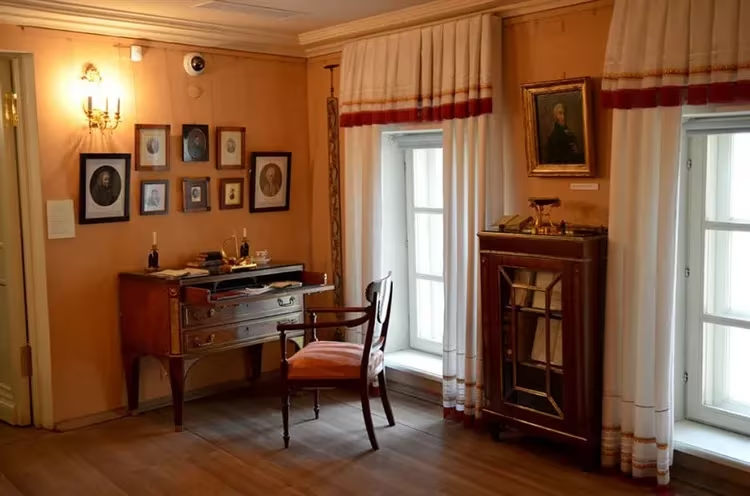
Guests are presented with collections of artifacts from various historical periods. Here you can see plaster casts from priceless items:
But the originals are also exhibited in the center. The halls have:
It is noteworthy that each hall has an interior corresponding to the theme. The exposition of European and American art of the 19th-20th centuries is highlighted separately. The center's collection was based on private collections of Russian patrons Shchukin and Morozov.
Now, thanks to them, guests can see the creations:
All areas of art of the 19th-20th centuries are represented in the halls. Visitors will see the works of followers of romanticism, symbolism, abstractionism, academicism and realism of the period located at the turn of two centuries.
Branches
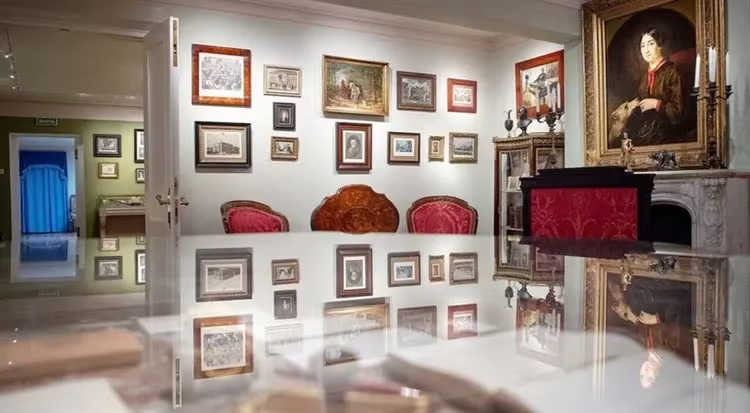
The Pushkin Museum has several branches:
- The memorial apartment of Alexander Sergeevich Pushkin is located in Moscow at 53 Arbat Street. In a small mansion owned by Khitrovo, the first months of the family life of the sun of Russian poetry passed. The house is a cultural monument.
- In Moscow, there is another 1 branch associated with the name of the Pushkins. Vasily Lvovich, the uncle of the great poet, lived at 36 Staraya Basmannaya Street. Vasily Lvovich was a writer, was the headman of the Arzamas society.
- The Museum of Ivan Sergeevich Turgenev is located at 37 Ostozhenka Street in Moscow. The writer's mother lived in a small wooden mansion. The same house is described in Mumu's story. The miraculously preserved building is a monument of regional importance. In 2007, it was decided to create a permanent exhibition dedicated to the writer. After the reconstruction of the mansion and nearby territory, the exposition received guests in 2018.
- House-Museum of Andrey Bely is located at 55 on the Arbat. The future poet, philosopher, writer, one of the founders of the symbolist movement was born and raised here. Subsequently, Bely often changed addresses. But he considered only the house on the Arbat to be his homeland. It was here that the poet experienced the first most vivid emotions.
Interesting Facts
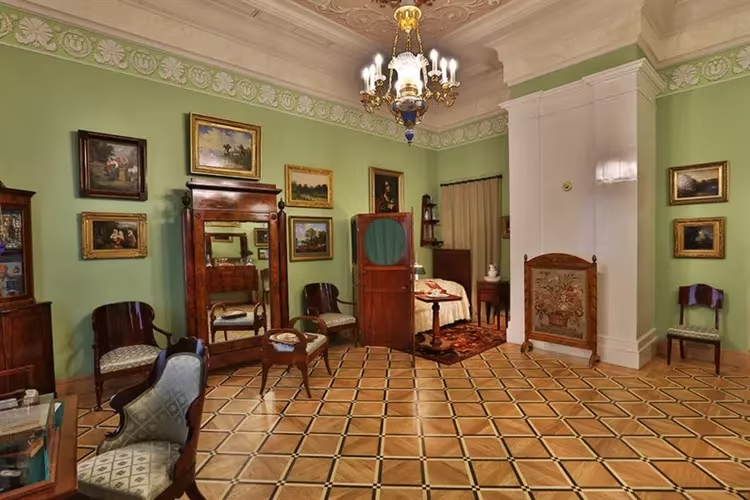
Now it is difficult to imagine what thorns the organizers of the famous exposition had to go through:
- The center was created not for the general public, but for students of Moscow University who aspired to study sculpture. The creation committee included all the management of the institution. Professors worked on one enthusiasm, their work was not paid.
- The construction was funded by private individuals. Ivan Tsvetaev was personally involved in the search for patrons. At first, he turned to the merchants of the First Guild. But met inertia and unwillingness to spend money on art. Financing was led by one person – the breeder and diplomat Nechaev-Maltsov. Even the fire that occurred at a construction site at the beginning of the 20th century did not frighten him.
- When designing, artificial lighting was not planned. There was an opinion that sculptures look realistic only in natural light. To ensure that there was enough light, Shukhov designed a massive glass dome.
- The architect Klein lost the competition announced by Tsvetaev. But it was Tsvetaev who insisted on accepting Klein's project. After the completion of the work, the architect received the title of academician.
- It was assumed that it would not be a separate building, but a whole town. Coming here, visitors could spend the whole day in the center.
- In 1941 the exhibits left for Novosibirsk and Solikamsk. They returned only in 1944, but the exhibition did not open to the public: the house stood without a roof. The first visitors came only in 1946.
- From 1946 to 1953, the building housed an exhibition of gifts presented to the father of nations. Permanent units have moved to storage.
- The paintings began to be exhibited only after the October Revolution. Prior to this, the center offered visitors to admire only the sculptures. Some canvases, without which it is impossible to imagine the Pushkin Museum, came from private collections. they were simply saved from destruction.
- The center has unique treasures, the main of which is the treasure of the Trojan king Priam. He came here from Germany in 1945. The general public saw the treasures found by Schliemann only in 1996.
- For its centenary, the center received a luxurious gift. The Ministry of Culture paid for the purchase of Van Balen and Brueghel's painting The Baptism of Christ. 20,000,000 rubles spent.
Excursions
The staff of the center conduct excursions for people of all ages:
Events are held both in the main building of the center, on Prechistenka, 12/2, and in branches.
Visiting Rules
Before visiting the center, you should familiarize yourself with the basic rules:
Visitors who violate the established rules may be removed from the center.
Working mode
Main building and branches of GMP:
Ticket price
Tickets to the Main building and branches of the GMP can be purchased by citizens at the following prices:
Days of free admission: June 6 (Pushkin Day in Russia) and February 10 (A.S. Pushkin Memorial Day).
How to get there
The complex is located at st. Volkhonka, 12. To get to the museum by metro, you need to get off at the Kropotkinskaya station and walk 100 meters. The museum complex is located just opposite the Cathedral of Christ the Savior. The same walking route (within walking distance) is necessary if you need to get to the museum from Red Square and from the Kremlin.
If you go from the Belorusskaya metro station, it is best to take the trolleybus number 1 and get off at the thirteenth stop. But you must be sure that the trolleybus is heading in the direction of the Taganskaya station.
If you want to get to the museum from the “Library of Lenin”, then the walk will take you no more than 10 minutes, but from the station “Park Kultury” you need to prepare for a twenty-minute walk. From the Marksistskaya station you can get to the museum by trolleybus N 16 in fifteen to twenty minutes. In the same period of time you can walk here from the Old Arbat – the walk will take about 20 minutes.
Distance from train stations. Farthest is the Kursk railway station. The route will take at least half an hour. Kazansky, Yaroslavsky and Leningradsky railway stations are within a fifteen-minute metro ride from the museum. The closest railway station to the museum is Kievsky. The journey from it to the museum will be some ten minutes.
The exhibits of the museum – sculptures, artistic photographs, paintings and graphics – number more than 560 thousand items. Therefore, the Pushkin Museum in Moscow rightfully occupies a leading place in the ranking of the best sights of the capital.