
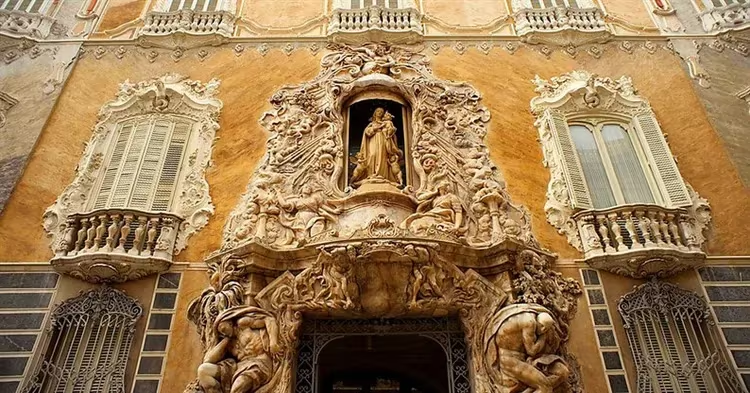
The museums of Valencia deserve to be visited. They reflect all periods of the city‘s development: from its foundation to the last days. Expositions are updated, you can come to the same center several times. When organizing presentations, the administration uses technical progress: events are held interactively. Children of all ages and their parents are sure to find something to their liking.
Prince Felipe Science Museum
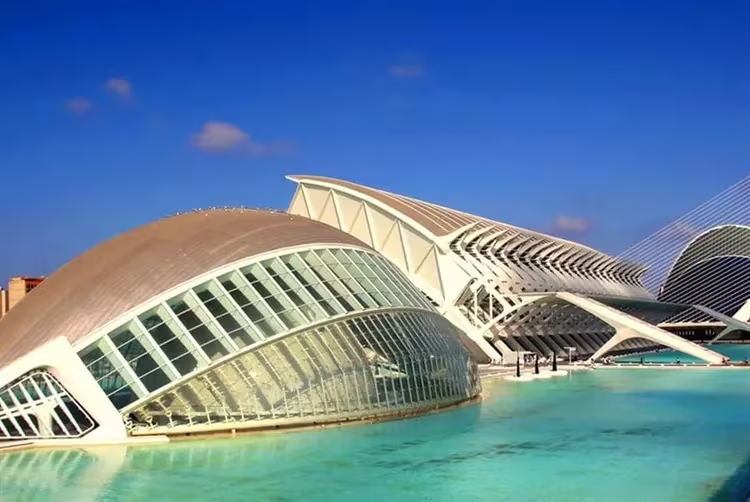
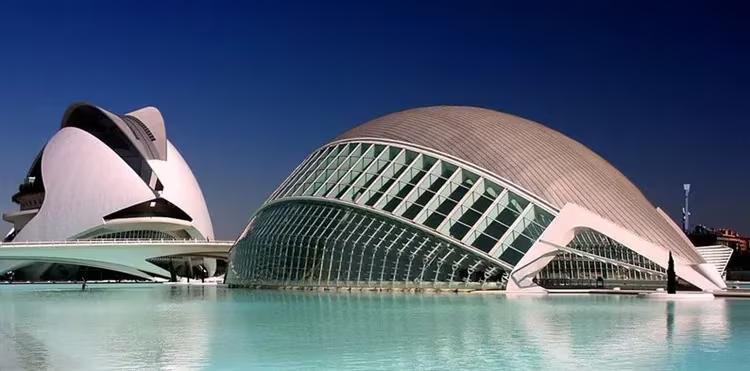
It is the largest science museum in Europe. The area it occupies exceeds 26,000 square meters. The design of the structure is interesting: the building looks like the body of a deep-sea fish and an alien ship at the same time. It is part of a complex called the City of Sciences and Arts. The expositions tell about the history of our planet from ancient times to the present day. The latest achievements of science are presented. All exhibited items are interactive, they allow you to see real paintings.
But that's not all. Visitors participate in quests that are equally interesting for children of all ages and their parents. In laboratories, physical and chemical experiments are carried out, which are always waiting for active participants in the process. And you can relax in the cinema hall, where films about the history of the planet Earth are shown. It is noteworthy that all exhibited items are allowed to be touched: this is one of the conditions for participating in excursions. You can visit the exhibition from Monday to Sunday from 10 am to 9 pm.
Book a private transfer from the airport to your hotel for 2 512 RUB
Museum of Fine Arts
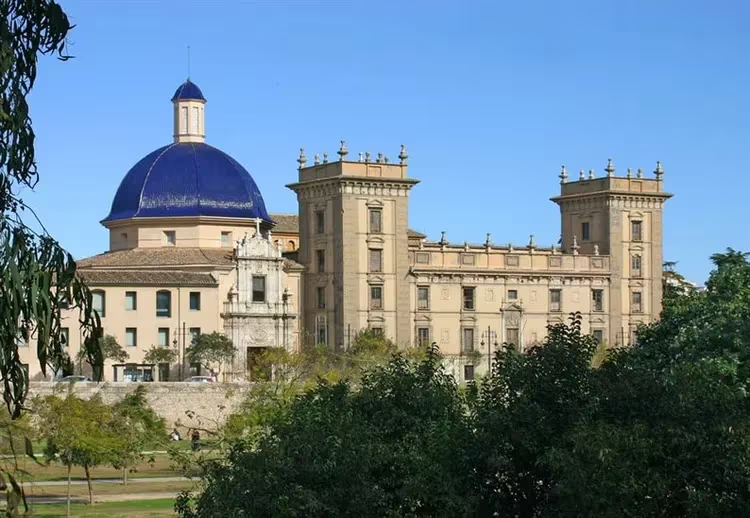
The museum is located in the palace of Pius 5. This building was built in the 16-17th centuries. And the foundations deserve admiration. They have been replenished for 250 years! Tourists can get acquainted with permanent and thematic expositions.
Presented here:
- Paintings by Goya, Velasquez, Sorolla, Ribera, El Greco
- sculptures
- Engravings, drawings
The surprise is that there is a restaurant on the territory of the Museum. It serves national cuisine. Tired visitors can relax and enjoy culinary delights. You can visit the exposition from Tuesday to Sunday from 10 am to 8 pm.
Museum of Ceramics
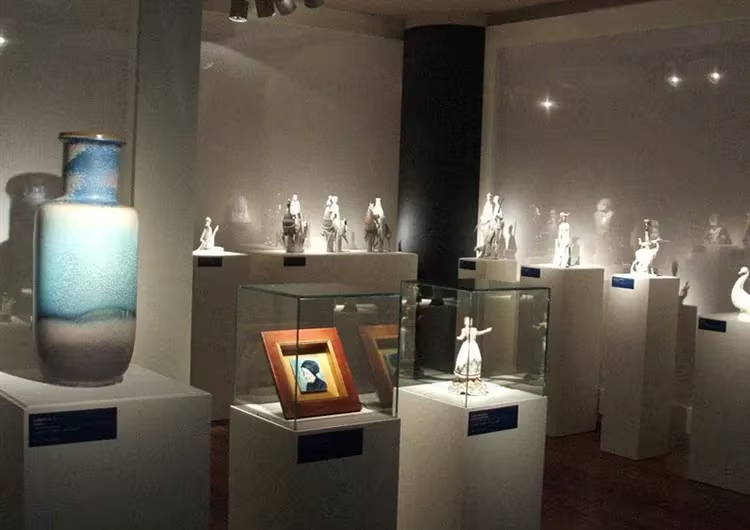
The exhibition is located in a mansion that once belonged to the Dos Aguas family. It was built in the 15th century. This building is an architectural monument, so you should start viewing the exposition of ceramics from the outside. In the 15th century, the merchants of the Rabassa family were among the first rich people in the state. They made their initial capital in trading, and then supplemented it with interest from real estate transactions. Subsequently, they received the title of marquis.
Such a family did not deny themselves anything, and in the 15th century they built a mansion in the Gothic style. It was a composition of 3 houses located around a patio. The building had a tower. But in the 18th century, the 3rd Marquis of Dos Aguas reconstructed the building. Now the building has a quadrangular profile, with towers in the corners. The central portal is especially noteworthy: it is made in the late Baroque style. The facade was painted with frescoes, but they have not been preserved.
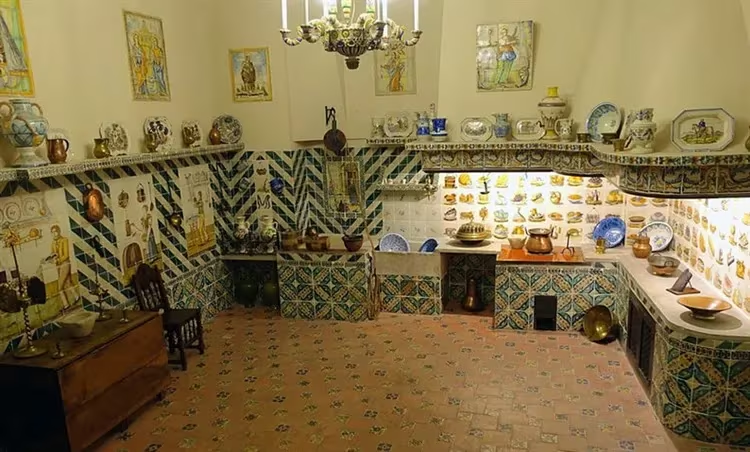
In the middle of the 20th century, the Italian government bought the mansion and housed the State Museum of Ceramics in it. This national craft is able to tell about the history of the country's development and the customs of the people. The exposition has unique samples. The exhibition is complemented by interior items: furniture, tapestries, paintings, crockery and kitchen utensils. For visitors, the doors are open from Tuesday to Saturday from 10 am to 2 pm.
Museum of the History of Valencia
Tourists are attracted, first of all, by an unusual building. This is the former reservoir authority that supplied the city with drinking water. It was built in 1850. In 1998, the city authorities restored the premises and gave it to a place where temporary and permanent exhibitions are held. The combination of traditional and modern technology helps visitors to immerse themselves in history. The exhibitions are complemented by interactive screens, demonstrations of films on the required topic. Tourists do not just passively immerse themselves in the era: they participate in the events that are described on the stand.
The expositions cover certain periods of the city's history:
- Roman dominion. Artifacts from 138 BC are exhibited here. e. to 711 AD
- Muslim conquest of the city and Moorish rule. The storage units are dated from 711 to 1238.
- medieval period. Items from 1238 to 1519 are on display here.
- Early Christianization of the country. The exhibits represent the period from 1519 to 1707.
- Belonging to the city of the Bourbon dynasty. Visitors study the period from 1707 to 1833.
- Time for an economic boom. The exhibits are dated from 1833 to 1917.
- New story. The development of the city from 1917 to 1975 is presented.
- Recent history.
The premises are planned very rationally: some of them have the opportunity to receive guests and hold thematic seminars, lectures and master classes. The doors of the center are open to visitors from 10 am to 19 pm from Tuesday to Sunday.
IVAM Museum – Institute of Contemporary Art
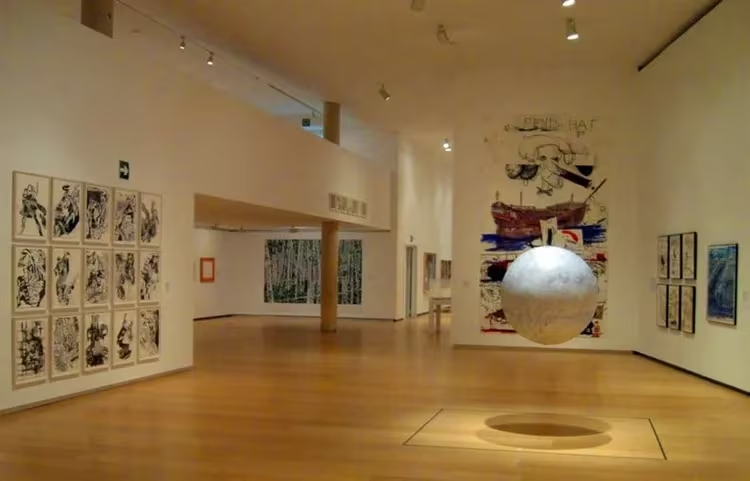
The Institute of Contemporary Art of Valencia has an impressive permanent exhibition. It is located on 2 floors and consists of 11,000 items.
Visitors can see:
- Paintings by famous artists: Pablo Picasso, Julio Gonzalez and Joaquin Sorolla. These expositions are open for viewing throughout the year.
- Drawings, photographs, sculptures. These exhibitions are periodically changed and updated.
- Various planned activities. The staff of the center offer thematic events to tourists. Literary readings are held in the halls, lectures on artistic and scientific topics are organized.
- New works of Spanish authors. Valencian writers get the opportunity to present their works.
- Retro films. Screenings are often organized in the cinema hall of the Institute.
- Unique books and documents. The center has a library with a reading room. There you can see rare editions. The library funds exceed 47,000 items.
The Institute has a unique exhibit – a fragment of the fortress wall, which once ran along the perimeter of the city. It was discovered during the construction of the building and organically fit into the ensemble. The exposition is open from Tuesday to Sunday from 10 am to 7 pm.
Fallas Museum
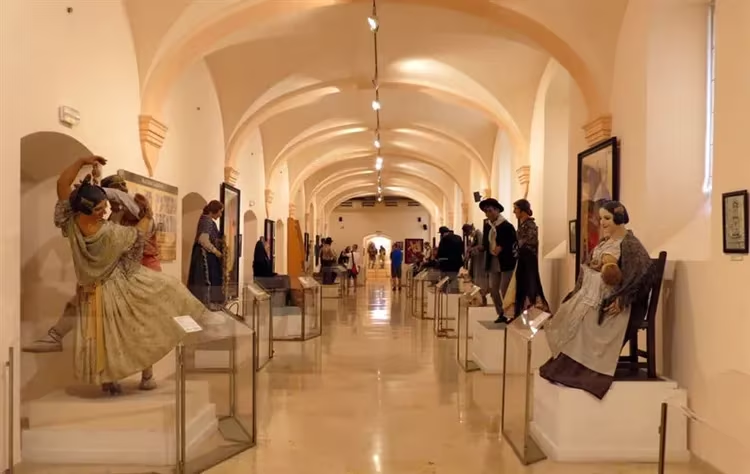
This exposition was formed quite unexpectedly. In Valencia, an annual carnival is held, which ends with the burning of a monument – fallas. These grotesque compositions are exhibited at all crossroads of the city, they ridicule the vices of modern society. The burning is carried out on St. Joseph's Day: on the night of March 19, all fallas are burned. Moreover, this process has a moral significance: society gets rid of its shortcomings.
But one monument still remains. This is decided by the citizens by popular vote. Fallas, who escaped the fate of other sculptures, is transported to the museum. Therefore, any visitor who did not participate in the carnival can join the colorful event. It is symbolic that the exposition is located on the territory of the monastery not far from the City of Sciences and Arts. For tourists, the exhibition is open from Monday to Saturday from 10 am to 7 pm.
Archaeological Center of Almoina
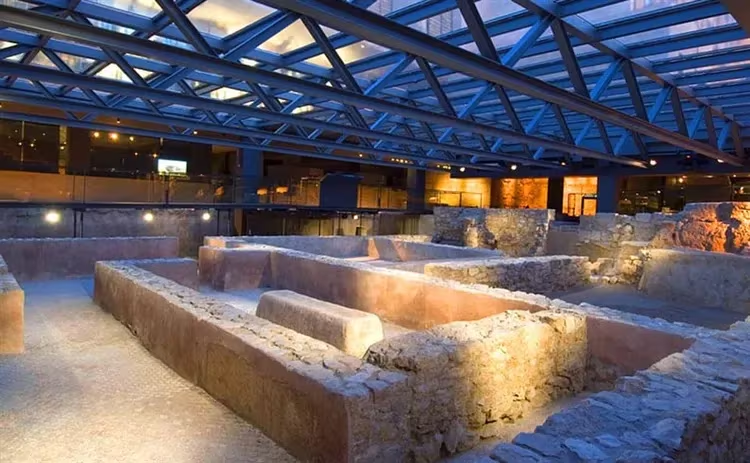
This unique underground center allows visitors to literally touch the history of Valencia:
- Having descended several tens of meters down, tourists plunge into the times of the foundation of the city. Then he was called Valentia. The remains of residential buildings, shops, the temple of Asclepius, the term are perfectly preserved.
- Subsequently (in 75 AD) the city was destroyed by Pompeii. But Valencia was rebuilt a century later. Stone-paved roads, a judicial chamber, and a central square with fragments of columns remind of this period of the city's life.
- The period of Christianization left a baptismal font, the altar of the church of St. Vincent, who is considered the patron saint of the city.
- Moorish rule brought the remains of a paved courtyard with a fountain in the center.
After the expulsion of Muslims and the return of Christians, a building was erected on the site of the modern center, which was called “La Almoina”. It was used as a shelter for the poorest residents.
Museum of Enlightenment and Modernism MuVIM
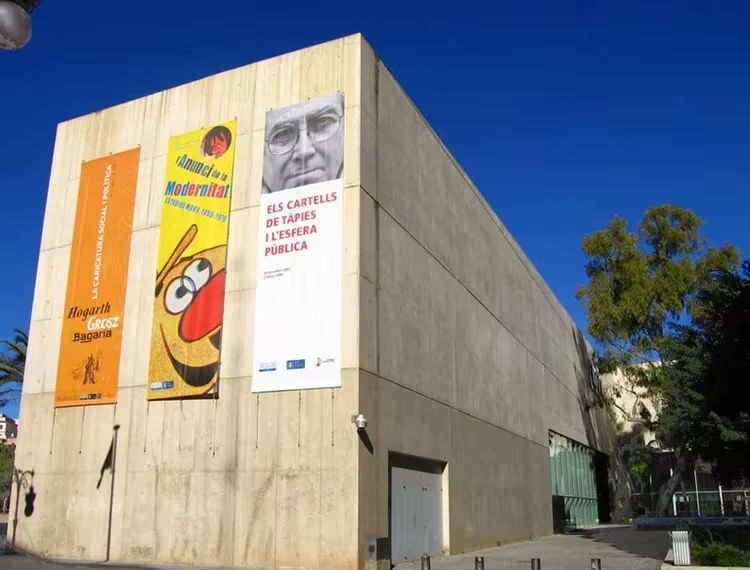
MuVIM is a center for those who think about how to think. The building itself sets you up for reflection: it is uncomfortable, the floor is gray, concrete, the walls are practically unfinished. These modernist ideas belong to the author of the project – Guermo Vasquez Consuerga. According to his idea, nothing should tune the sightseer to the perception with the “+” sign. The visitor must understand that thinking is a complex process.
The central place in the exposition is given to what is now called advertising. The development of the world is reflected through comics, films, photographs – what the media describe. The journey through the epochs is not organized by an ordinary guide: visitors are accompanied by an actor dressed in a costume of the corresponding period. The tourist will look through the telescope of Galileo Galilei, listen to the philosophical disputes of the monks of the Middle Ages, visit the secular salon of the 17th century, and be imbued with the revolutionary spirit of Paris.
The most significant events of the 20th century are also reflected in the center. After such an intense journey, tourists begin to perceive long-known historical events in a different way. MuVIM is an interesting center for children and adults. MuVIM is open to the public from Tuesday to Saturday from 10 am to 2 pm. It then opens from 4pm to 8pm.
Museum of Natural History at the University of Valencia
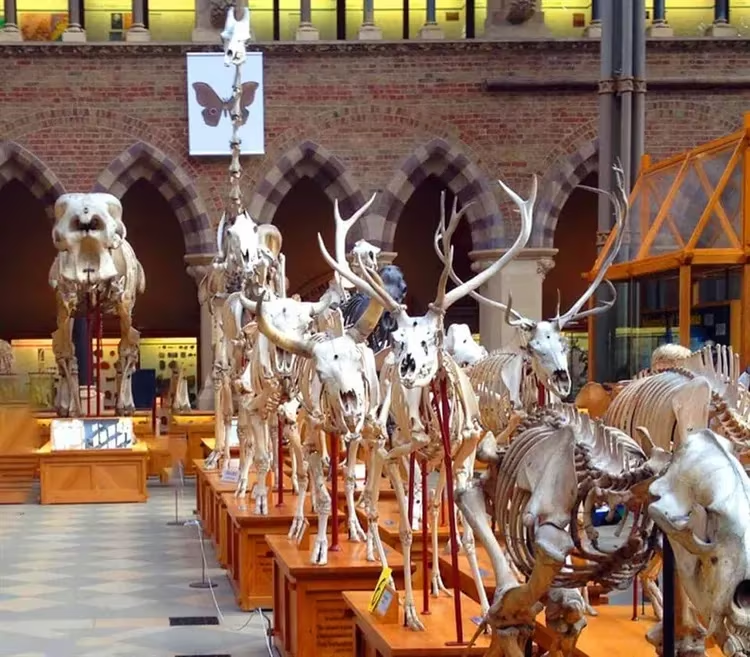
There is continuous research going on here. Professors and students bring priceless artifacts from scientific expeditions. For many years they were simply kept in the storerooms of the institution, but now the items are on display for inspection by everyone. The collection represents several branches of science: paleontology, geology, zoology and botany. The university administration spent a lot of effort to ensure the required safety of the finds, but now on the territory of the Burjasot campus all conditions have been created not only for the maintenance of the collection, but also for its unhindered inspection.
Visitors will see:
- A giant meteorite formed 4,600,000,000 years ago. Its mass is more than 30 kg.
- Skeletons of prehistoric animals discovered during expeditions.
- Imprints left by a giant prehistoric tortoise. They were discovered during work in the municipality of Domeño.
- Fragments of the skeleton of a prehistoric man who lived on the territory of modern Spain.
- Stuffed rare animals and extinct species.
- The skeleton of a flying pangolin – pterodactyl.
The exhibition covers an area of more than 900 square meters. Not without modern technology. At the entrance, visitors are given glasses that simulate virtual reality. This is how tourists travel through time.
Museum of Prehistory and Ethnology
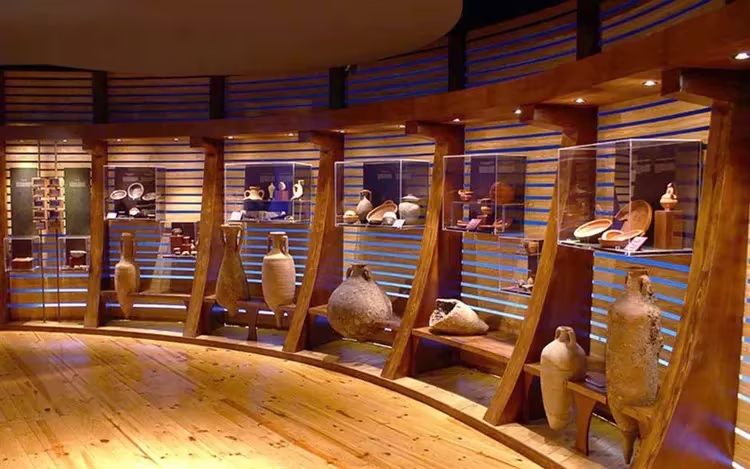
Artifacts describing the period of appearance and development of Homo sapiens are presented here. Visitors have the opportunity to explore:
- Ancient dishes, kitchen utensils, furniture.
- The first coins, jewelry. Visitors will see a full display of the history of money in Valencia and Spain.
- Agricultural implements.
- Of particular interest is the recreated peasant hut.
All storage units were found in the territory of the province of Valencia. The exposition is complete, it is interesting to study the life history of the people inhabiting the area. But anthropologists and people interested in anthropology and ethnography will especially appreciate the quality of the presented artifacts. The exhibits are divided into periods, the selection is complete and wide.
Military Museum
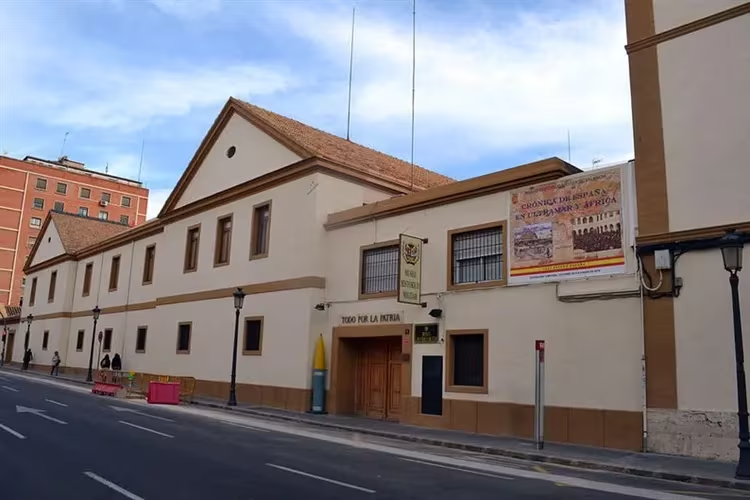
In the center, all exhibitions are dedicated to the Spanish army. They are located in 22 rooms. Here the visitor is invited to familiarize himself with:
- Firearms and edged weapons, ammunition, uniforms, awards.
- Pictures painted on military themes.
- Miniatures reproducing important battles for Spain.
None of the periods of the country's history has been bypassed. Visitors get acquainted with the panoramas of the battles of the Napoleonic wars, in which the Spaniards participated, an exposition dedicated to the period of Franco's rule. For artifacts of the Second World War, a separate stand is allocated. The study of exhibited items of storage will be interesting even to a visitor far from the army.
Museum of the Patriarch
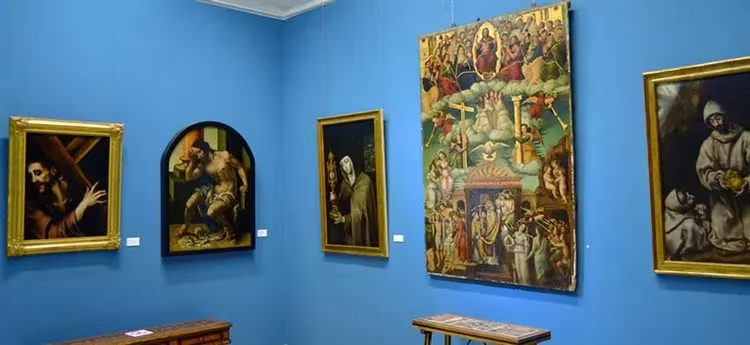
The complex of buildings that houses the Museum of the Patriarch was rebuilt by Juan de Ribera in the 16th century. The original purpose was a seminary for the training of priests during the Counter-Reformation. Ribera was an ambiguous historical figure: he simultaneously held the secular title of Viceroy, the spiritual title of Archbishop of Valencia and Patriarch of Antioch. Ribera was fond of collecting. Gradually, many art objects accumulated in the seminary. Basically, these were paintings and sculptures.
Subsequently, the exposition became public, and the center was named after the Patriarch. Tourists can get acquainted with the paintings of El Greco, Moralis, Ribalt. There are also church relics: a boxwood cross made on Athos, and the last manuscript of Thomas More, which he wrote in custody before his execution.
Museum of Tin Soldiers

The first visited the exposition in 2017. The basis was a private collection of tin soldiers, owned by Alvaro Joger Jimenez. Now the exhibition consists of 95,000 items. The creator of the museum did not just place the figurines on a pedestal: he presented the tourist to see a miniature theater of military operations.
Here you can see:
- Battle of Austerlitz. On the battlefield are the armies of France, Russia and Austria. Soldiers stand in battle formation, in the distance you can see carts, sutlers, sanitary tents.
- The legendary battle of Gaugamela, which schoolchildren read about in history lessons. The armies of Alexander the Great and Darius 3 oppose each other.
- Large-scale installation of the Battle of Almansa. It involves 9,000 soldiers.
- Defense of a medieval fortress. Here is a vivid picture of the battle.
- Parades of various armies of the world. In this picture, it is easy to see the smallest details of the uniforms of soldiers and officers.
- Hunting scenes of a primitive man, ritual dances of the Indians.
- The battle of primitive lizards with each other.
- Pictures of the peaceful life of the military. It depicts cities with shops, transport, civilians.
In order for the visitor to get an idea that making figurines is a painstaking task, there is a stand with tools. With the help of quite ordinary items, small soldiers are created. Those who wish can purchase collectible soldiers in the shop at the museum. But the price of products is quite high. The exposition awaits visitors from Wednesday to Sunday from 10 am to 2 pm and from 4 pm to 7 pm from September to June. In July and August – from 10 am to 2 pm and from 3 pm to 8 pm.
Cultural Center Bombas Gens
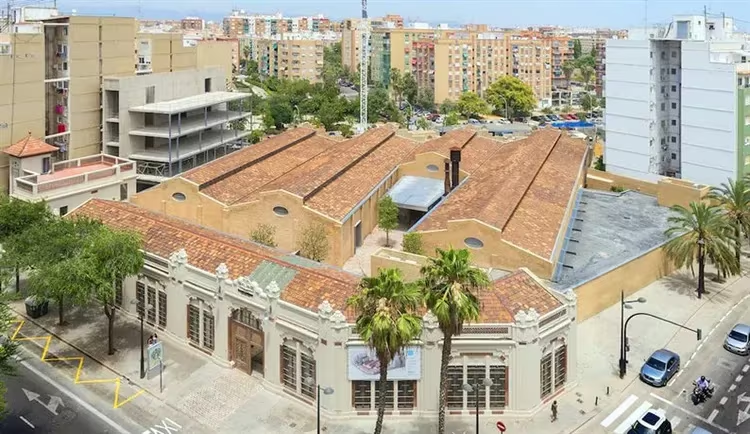
The center is located on the territory of a plant that produced hydraulic pumps. After reconstruction, the premises of the enterprise are used for:
It is noteworthy that the architecture of the enterprise is maximally preserved. Visitors are immersed in the factory world of the last century. The highlight of the center is a trendy restaurant with specialties from the chef.
Bankai Cultural Center
The exhibitions take place in two buildings. There are permanent and temporary exhibitions. The central hall is given over to the paintings of Joaquin Sorolla. The rest of the exhibitions change. A quick tour will take 2-3 hours. The building itself is interesting: three floors are decorated with baroque elements. It is truly a cultural center: the owners organize lectures, presentations and seminars. But photography is not allowed inside. Impressions from what he saw are ambiguous: some tourists are dissatisfied, others like it. It all depends on tastes and preferences.
The center is open from 9 am to 2 pm and from 4 pm to 9 pm.
Lladro Porcelain Factory
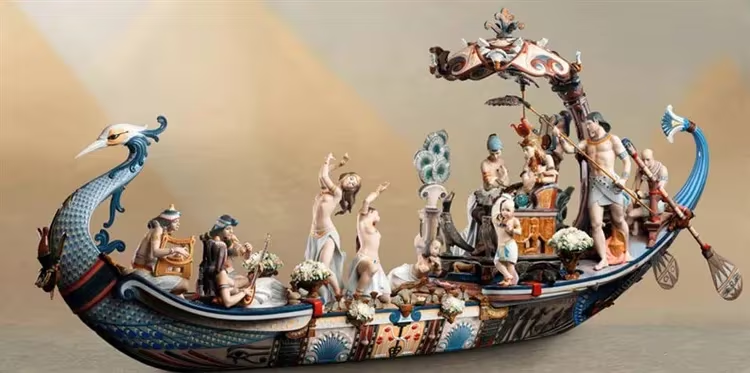
Today Liardo is a world famous brand of porcelain. And in 1953, 3 brothers began the usual production of figurines. The workshop was at home; a kitchen oven was used for firing. Now the factory is operating at full capacity, it has a shop and a museum. The premises are small, so no more than 10 people can visit the exhibition at the same time. The tour starts with a film screening. The screen tells about the stages of creating a workshop and the features of the technological process. A feature of production is that mechanization and automation are minimal.
Most of the operations are manual labor. This achieves the uniqueness of the figures: it will not be possible to find exactly the same. Before the release of the next series, the factory council considers drawings that they like. The size of the series is immediately specified. Then a layout is made, a mold for casting is created from it. This is where the mechanization of production ends. Porcelain mass is poured into the mold. After hardening, the parts are removed, connected with porcelain mass, and polished.
Small parts are made separately: this is painstaking work. The painting is done by hand. The colors are almost transparent, after firing they appear. You can recognize Liardo figurines by the abundance of flowers. Moreover, each petal is made by hand from porcelain dough rolled into a thin layer. Then the buds are connected and painted. The finished bouquet is attached to the required place.
After the series is over, the casting molds are destroyed. Therefore, it is impossible to produce an identical figurine later. The value of the collection increases. This is one of the features of the Liardo brand. After the tour, tourists are invited to visit a store where product samples are sold. Feature of the Llardo store: if the figurine breaks within 1 year after purchase, the company replaces it with a similar one for free. You can visit the porcelain factory only as part of an organized group. You can book a tour on the official website. The total price includes transfer from the hotel.
bullfighting museum
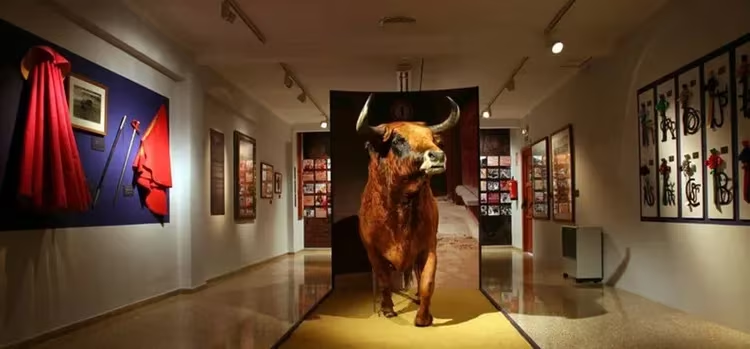
This museum appeared at the beginning of the last century. The date of its creation is 1929. The basis was the private collections of Luis Peiro and bullfighter José Badil. The exposition is located near the arena where bullfights were held. Tourists can bypass it and feel the full intensity of the passions raging here. The halls contain all the items that are used in bullfighting. And so that an inexperienced tourist does not have confusion, an audio guide will help. He will name all the exhibited items and artifacts.
One of the halls represents the entire bullfighting ceremony. Here in the center stands a bull, ready to fight with a man. The whole situation sets up that the battle is going to be serious. The bullfighter is armed with knowledge of the habits of bulls, has excellent physical training, but he must not only defeat the animal, but also present a bright and memorable show to the public.
Audio recording allows you to immerse yourself in the world of bullfighting in its entirety, to feel the soul of this action. You can visit the museum from March 1 to August 31 from 10 am to 7 pm from Tuesday to Saturday. From September 1 to February 28 – from 10 am to 6 pm from Tuesday to Saturday.