

6 Fun Facts You Don’t Know About Airplanes
Fact 1
Modern airliners are not afraid of a lightning strike.
The skin of a modern airliner is capable of repelling electrical discharges. Even if they get on the plane, this situation remains imperceptible for passengers.
Fact 2
Alas, there are no safe seats for passengers in the cabin of the plane.
“If I knew where I would fall, I would spread straws” – alas, this proverb is not for air passengers. Some studies publish questionable statistics on the deaths of passengers sitting in different compartments during a crash. But experts from the US Federal Aviation Administration say that, alas, all seats in the cabin are subject to the same danger.
Fact 3
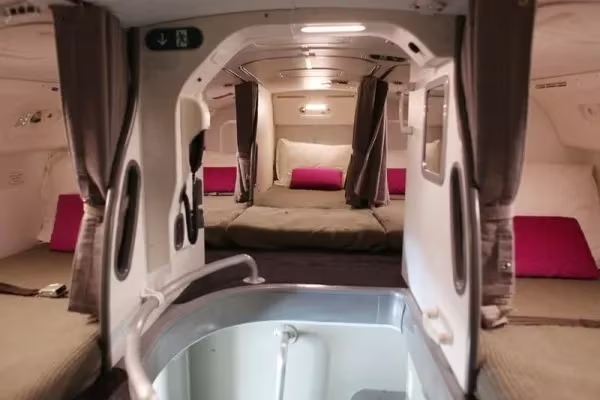
The Boeing 777 and Airbus A340 have compact crew sleeping quarters.
A number of aircraft, capable of non-stop long-distance transoceanic flights, are equipped with rest rooms for crew members. Their capacity is 6-8 tiered berths.
Fact 4
The super
-durable tires on the aircraft landing gear guarantee secure landings of 500 landings – the life span of aircraft tires that are capable of withstanding over 38 tons of load at tremendous speeds. Aviators argue that modern aircraft tires are so high-tech that the wheel itself is more likely to fail than to damage the tire.
Fact 5
A modern plane is capable of flying on one engine. This
is an encouraging fact! If during the flight there is a force majeure and the aircraft suddenly fails the engine, then the airliner will safely fly with one engine running. A Boeing Dreamliner can fly on one engine for 5 hours, and a Boeing 747 will stay in the air for 3 km, even if both engines fail – during this time an experienced pilot will be able to land.
Fact 6
What the flight attendants are silent about: the oxygen mask is designed for only 15 minutes.
During flights, the flight attendants give instructions on the rules of behavior in the cabin, the use of an oxygen mask, but they do not mention that their effect is designed for only 15 minutes. Do not worry! This time is enough for the pilots to restore the normal pressure level in the cabin, dropping to the desired altitude.