
Campanile Giotto in Florence – history, photo, description, opening hours, map
The architecture of Florence is a special kind of art. Walking around this ancient Italian city, you can study the history and main sights of the Renaissance: temples, palaces, bridges and squares. It is not for nothing that Florence is considered the “cradle of the Renaissance”. Here is Giotto's campaign in Florence – one of its most recognizable architectural sights.
What is Campanile
People who are far from art usually find it difficult to answer this question. Meanwhile, there is nothing complicated here: the campanile is a bell tower, which has the shape of a square or a circle at the base, and stands apart from the building of the temple itself. Initially, the city towers of medieval Europe, similar in shape, were called campaniles, and the campaniles-bell towers are already inherent in the Late Middle Ages and the Renaissance. Even if you don't know about Giotto's Campanile, you do know another Italian Campanile: the Leaning Tower of Pisa. Yes, the famous building in Pisa also belongs to this type of architecture.
Campanile Giotto is a favorite place for all tourists who come to the city of Da Vinci and Alighieri for impressions. The ancient building of the 14th century, tall, majestic, with its grandiose history and the works of the greatest masters of the Renaissance, is admired by everyone who appreciates art and beauty even a little.
Construction history
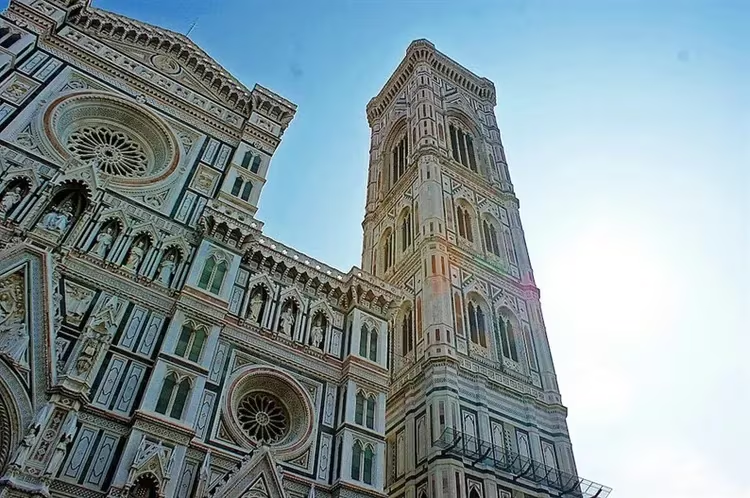
The bell tower was conceived, designed and laid in the last years of the 13th century and was supposed to be a logical addition to the Catholic Cathedral of Santa Maria del Fiore, which was already under construction at that time. The initiator of the initial project and the author of the drawings of the campanile was Arnolfo Di Cambio, the architect of the cathedral itself. But Di Cambio's plans were not destined to come true: he soon died, and without his sensitive leadership, the construction of the campanile was suspended. For more than thirty years she stood in a barely begun state.
In 1334, another architect, Giotto Di Bondone, took over the work – it was his name that the bell tower later received. Giotto by that time was almost seventy years old, and behind him was the construction of the Basilica of Santa Croce, the Florentine abbey and the Basilica of St. Francis. In a word, it was a well-known throughout Italy and a seasoned master.
It is known that the first stone was laid in the summer of 1334, and the grandiose construction quickly unfolded and gained momentum. Giotto's project was, according to the confessions of his contemporaries, delightful: the tower under construction looked exactly “painted on a heavenly canvas.” To achieve this effect, the architect used several techniques at once: polychromy (multicolor), chiaroscuro (gradation of color distribution according to the principle of bright-pale, dark-light) and perspective (light-shadow relations and relationships between objects of the architectural ensemble).
In 1337, Giotto died, leaving the bell tower still unfinished: only the first tier of the future tower was erected. On three sides are graceful bas-reliefs, the authorship of which is still not known for certain: perhaps it was Giotto himself, or one of his assistants. In addition, there is a version that some of the bas-reliefs are already the work of Luca della Robbia and Andrea Pisano.
Pisano's work
Pisano is the third architect to take up the Campanile. With respect and reverence, approaching the work of his predecessor and his drawings, Pisano strictly erected the bell tower as it was written and drawn in the plans of Giotto. Under his leadership, the second and third tiers of the bell tower were erected and high windows were cut down. However, this time the construction lasted only five years: in 1348, a pandemic of the bubonic plague began in Florence, then nicknamed the Black Death. Pisano himself died during the pandemic, and with him the many workers who built the tower.
Contribution of architect Talenti
The fourth and last Italian architect who made his significant contribution to the construction of the bell tower was Francesco Talenti. It was he who erected the fourth, fifth and sixth levels and in 1359 solemnly completed the work. Campanile was faced with three types of marble: Carrara white, Pistoian red and Pratskoe green.
Unlike Pisano, Talenti did not strictly follow Giotto's blueprints. For example, he decided not to put a spire on the tower. The total height of the bell tower is 84.7 meters, according to Giotto's plans, it should have been about 122 meters. Also under Talenti, a long and narrow staircase leading to the top of the tower was completely cut down. This staircase has 414 steps. What is curious is that it is not a screw, as many people think, so the climb really turns out to be very steep and very dangerous.
Timed entrance ticket for Michelangelo's David – €16
Uffizi Gallery entrance ticket – €20
Uffizi Gallery: Priority entrance – €40
Florence Cathedral: Dome entrance ticket – €29
Palazzo Vecchio entrance ticket and audio guide – €19
Tour Hop- on Hop-off. Ticket for 24, 48 or 72 hours – from 23 €
Leonardo da Vinci Museum: entrance ticket – 7 €
Tour to the Duomo with a guide and climb to the top of the dome – 40 €
Entrance ticket to the Basilica of San Lorenzo – 8.50 €
Air flight balloon over Tuscany: Florence – 250 €
Architecture
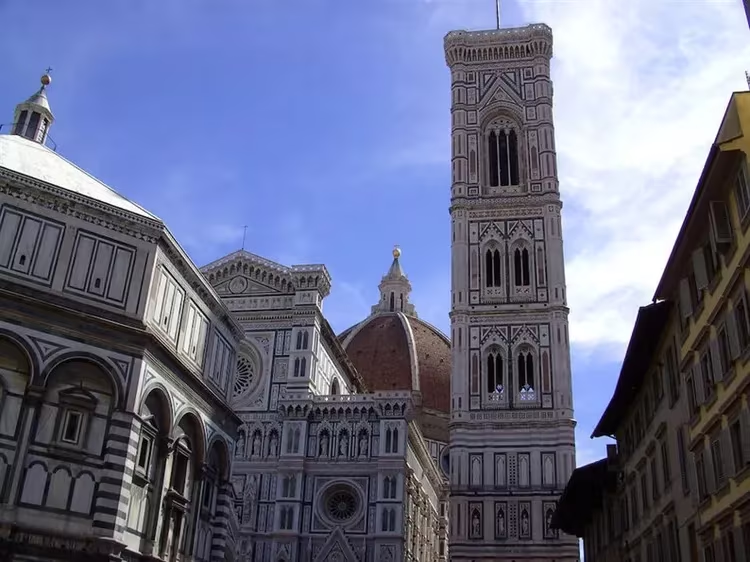
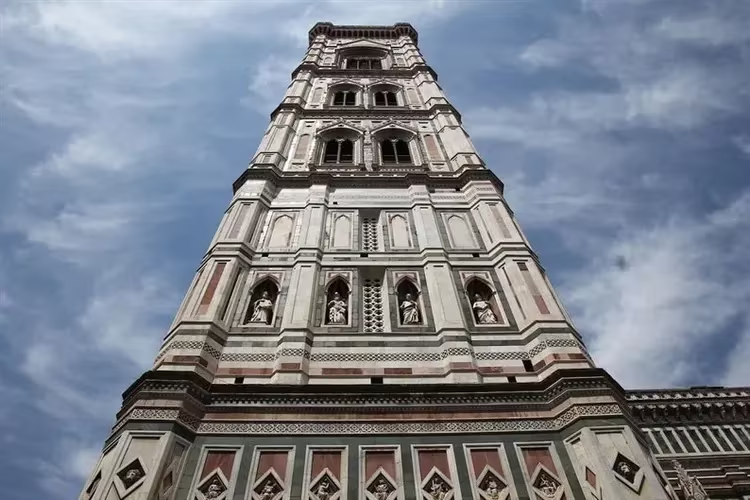
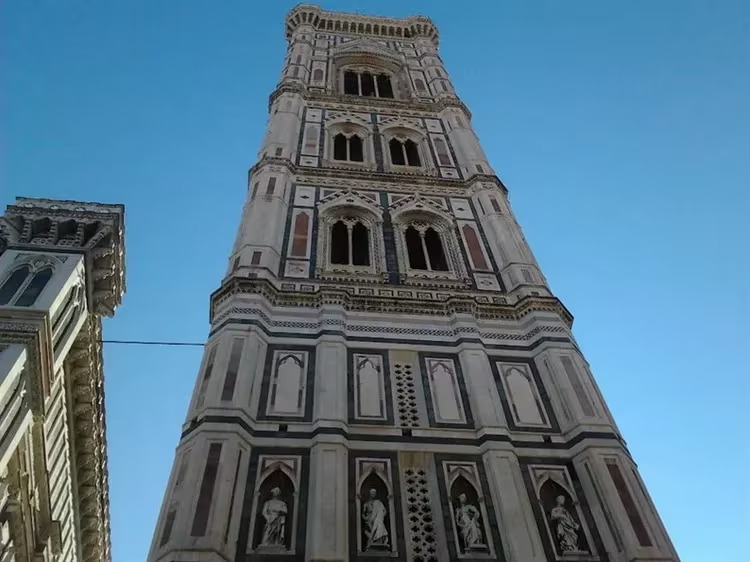
Architecturally, Giotto's campanile is an example of Florentine Gothic. Each of its tiers is a separate work of art and a separate attraction. For example, the bas-reliefs on the first tier carry an almost biblical, cosmic, universal meaning: here is the creation of man, and human virtues, and a demonstration of professions, and sciences, and art, and even space with its innumerable multitude of planets.
The second tier has its own beauty: 16 statues by Andrea and Nino Pisano, Donatello, Nanni di Bartolo and other masters. Today, the originals have been removed and placed in the Duomo Museum, and their exact copies have been raised to the bell tower.
The third tier is empty, and the top three are good for their high lancet windows trimmed with stucco and openwork. Each next tier is higher than the previous one, and this creates the impression that the bell tower stretches up into the heavens, and even heavy stone slabs and noble marble do not prevent it from being airy and light.
Observation deck
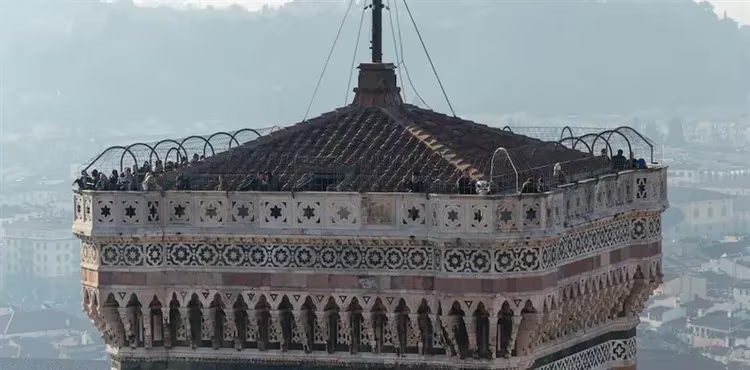
The observation deck of Giotto's campanile is multi-level and allows tourists to view Florence from different heights. On each tier there is an opportunity to go up to the windows and admire the picturesque views. The most dizzying picture, of course, opens from the sixth tier. To get here, you will have to overcome on your own two feet – neither more nor less! – 414 steps.
But from the top of the bell tower you can see Florence from horizon to horizon: its even square little houses with red tiled roofs, old winding streets, temples, palazzos, green hills. The spectacle is truly bewitching, as if admiring the gingerbread village from a European Christmas card.
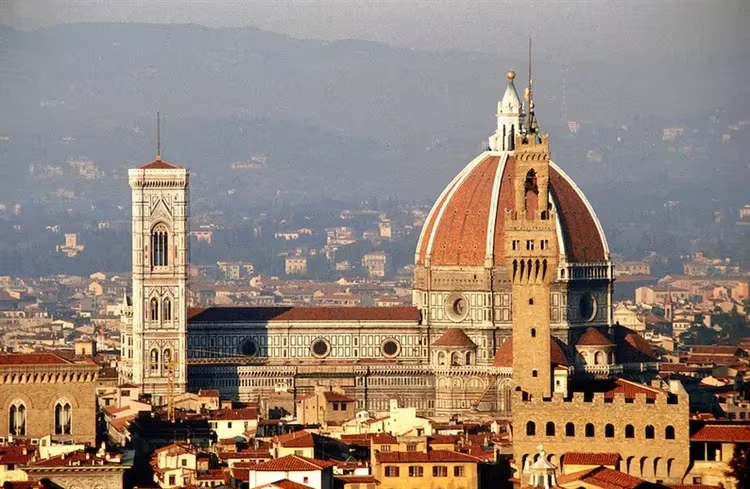
In addition, from the observation deck of the bell tower there is a special view of the nearest sights located directly on the Cathedral Square. For example, from here you can see in all details the dome of the Cathedral of Santa Maria del Fiore, which is the work of Brunneleschi. It is curious to see from above the squat building of the baptistery with its pyramidal roof. In addition, it is on the upper tier that the bell is located.
In the campanile, including on the observation deck, everything is done for the convenience and safety of tourists who come here from all over the world. For example, you can rent small binoculars to see in great detail the dome of the cathedral, the tiled roofs of houses, and the hills on the horizon. There are also stationary binoculars, they serve as a kind of spyglasses. To prevent tourists from accidentally falling out of the fence, all dangerous spans are covered with bars. The lattice is strong, but thin enough not to interfere with admiring the beauties of the city.
Significance for the city
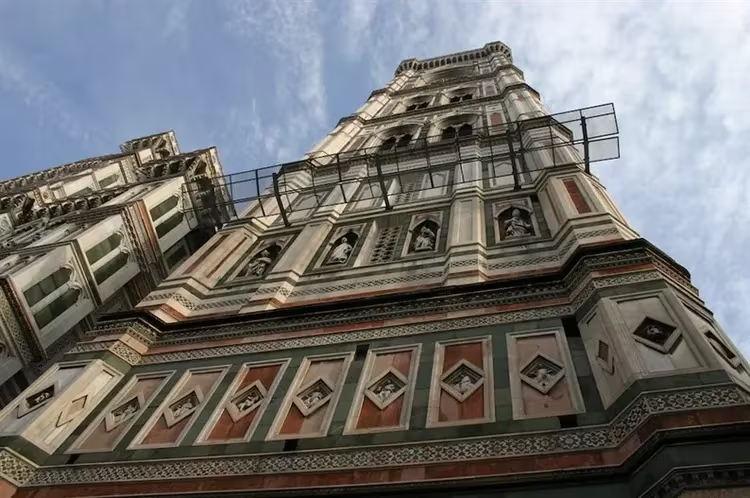
It is impossible to overestimate the importance of Giotto's campanile in Florence: one of the oldest architectural sights of the city, which has preserved the work of the greatest masters of the era – architects, sculptors, artists – a favorite place for tourists, the best observation deck of the city, a building without which the whole silhouette of Florence will be different.
Cathedral Square, part of the architectural ensemble of which is the bell tower, is one of the most visited places in the world. It's like the Eiffel Tower for Paris, Big Ben for London, the Hermitage for St. Petersburg. Grandiose, majestic, beautiful. Florentines tremblingly cherish the historical and cultural heritage of their city, including Giotto's campanile.
Opening hours and ticket prices
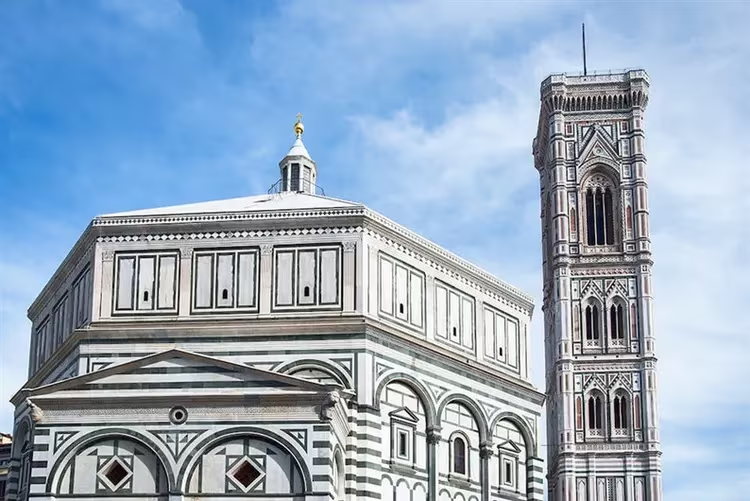
With the exception of public holidays (Christmas, Easter, Holy Mary's Day) and special occasions, Giotto's campanile is open every day. The entrance for tourists is open from 08.15. until 20.00. Unfortunately, a separate ticket to the bell tower is not for sale. A tourist needs to buy a general museum ticket in the amount of 18 euros. This ticket includes access to the following attractions:
The ticket gives the tourist the opportunity to visit each of the listed attractions once. You can buy it both at the box office on the square and on the official website, and the owners of electronic tickets skip the line. The ticket must be used in full within 72 hours of visiting the first attraction. In addition, for a fee, you can order an excursion, individual or group.
Where is it located and how to get there
Campanile Giotto, like all other attractions that are part of the overall architectural ensemble, is located on Cathedral Square in the historic center of the city. Any bus or minibus going to the square will take the tourist to the destination. If you walk around Florence on foot, finding the bell tower is also not difficult: it proudly rises above half of the city, and in the historical center it is visible from any point.