
Palazzo Pitti in Florence – history, photo, description, opening hours, map
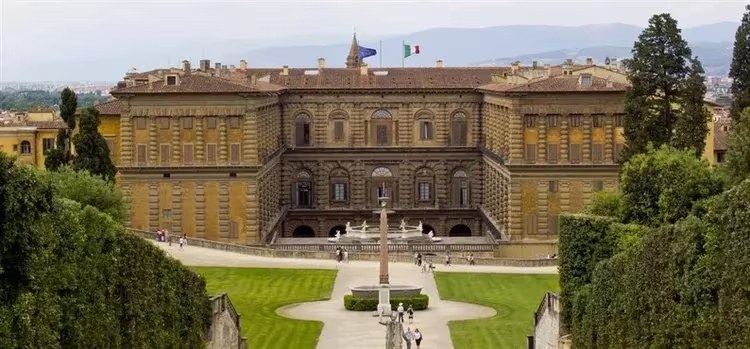
Going to Florence – the birthplace of the Renaissance and the greatest masters of this era: Da Vinci, Michelangelo, Machiavelli and Dante – you must definitely stay in this city for at least a week: in less time you simply will not be able to get around all the sights: palaces and temples, museums and squares… Behind each new turn of the ancient streets, more and more new wonders will open, for example, the Pitti Palace. Palazzo Pitti in Florence is the largest palazzo in the city and one of the largest and most majestic in Italy, its history goes back 560 years, and today it is a storehouse of museum expositions that will be of interest to every curious tourist.
What is a palazzo?
Many people who do not know the Italian language, or at least the basic cultural and art terminology, for some reason make the assumption that this is a square. But no: a palazzo is a palace. In general, Florence could publish art history dictionaries with terms from the field of painting, sculpture and architecture, because many of the “cultural” words that are used today around the world, and many of the phenomena denoted by these words, were born in this Italian city.
What characterizes the palazzo:
Well, now, already with knowledge of the matter, we will return directly to the Pitti Palace.
Construction history
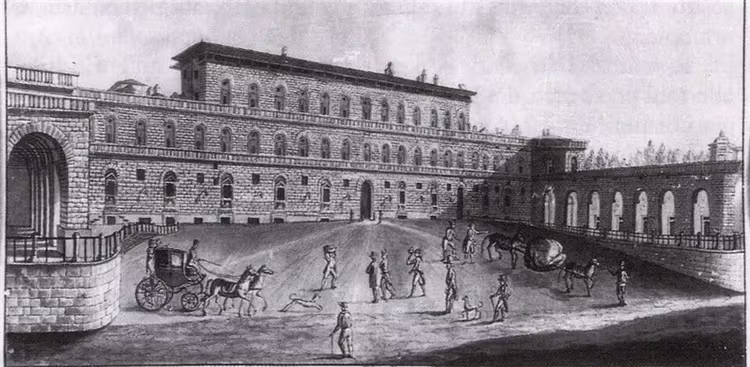
The first stone of the new palace was laid in 1458, the construction itself lasted six years – quite a bit for those times. But even this was enough for the history of the construction of the palazzo to be shrouded in a whole bunch of legends and assumptions. Unfortunately, today historians can no longer say for sure where is the truth and where is fiction?
Luca Pitti, the richest Florentine banker who rivaled Cosimo de' Medici in power and wealth, was both a friend of the latter and a rival at the same time. It is known that Pitti even conspired against the Medici – not to overthrow him or kill him, but to force him to listen to his opinion in political matters.
And the Medici was forced to listen: it was under the influence of Pitti in the middle of the 15th century that a democratic system of power was temporarily restored in Florence, and elections again began to be organized by lot, and not by the right of kinship and inheritance. At the same time, in the last years of his life, the Medici bestowed generous gifts on Pitti.
The construction of a new palace was a matter of honor for Pitti: they say that he wanted to “outdo” his friend's palaces in size and majesty. With the size – it definitely turned out: the Pitti Palace, even after five and a half centuries, is the largest in the city and one of the largest in the country. With majesty – fifty-fifty: although the building looks majestic and monumental, it has always been accused and is still accused of dullness and bulkiness, and that the Medicis still failed to “overtake”. The taste and color, as they say…
Legends say that Pitti ordered the windows of his new palazzo to be larger than the gates in the Medici palaces, and also that for the entire six years while construction was underway, fugitive criminals hid here: Pitti and his people covered swindlers, thieves and even murderers in exchange for that they will work at a construction site, and the construction itself, allegedly, was carried out day and night, without breaks and days off. Whether all this is true or not is impossible to say now.
In 1464, construction was forced to stop. Most of the palace was ready by that time, but some improvements were still required, the design of the facade and interior decoration. But Pitti could no longer invest in his life's work: his friend and patron Cosimo Medici died, Girolamo Savonarola, known in history as a ruthless dictator, came to power, and he also zealously condemned wealth and luxury, and the former banker began to have serious financial problems. He could not cope with them, and in 1472, having noticeably lost his fortune, he died, leaving the unfinished palace to his descendants.
But the descendants of Luca could not keep the building in the family heritage either: in 1549, the finally ruined Bonaccosro Pitti – it is not known for certain who he was Luca: son, grandson or other relative – was forced to sell the palazzo. Eleanor of Toledo, the wife of Cosimo Medici, became its new owner, and it was under their patronage that the building was completed and expanded.
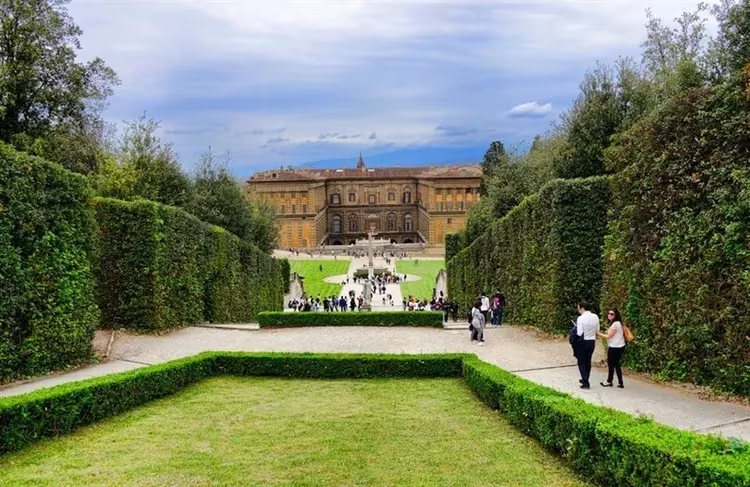
Who was the architect of the original version of the palazzo is unknown. There are suggestions that these were Brunelleschi and his apprentice Francelli, but modern historians agree only with the second name: Brunelleschi himself died a few years before the laying of the first stone of the future palace. In the time of Cosimo and Eleanor, construction was carried out under the guidance of Giorgio Vasari and Bartolomeo Ammanati themselves. The most remarkable fact is that between the Palazzo Pitti and the Palazzo Vecchio, the previous residence of the Medici, a huge corridor was built, allowing you to move between the palaces without going outside.
Under the son of Cosimo and Eleanor, Ferdinand the First Medici, all the main wealth and a huge collection of jewelry of the famous dynasty were stored here. Even later, the building belonged to the Lorraine and Savoy families. At the beginning of the 20th century, the palazzo was nationalized, that is, transferred to the state, several museums and art galleries were opened here. Today Palazzo Pitti is one of the most visited tourist places in Florence. Various excursions are held here every day.
Timed entrance ticket for Michelangelo's David – €16
Uffizi Gallery entrance ticket – €20
Uffizi Gallery: Priority entrance – €40
Florence Cathedral: Dome entrance ticket – €29
Palazzo Vecchio entrance ticket and audio guide – €19
Tour Hop- on Hop-off. Ticket for 24, 48 or 72 hours – from 23 €
Leonardo da Vinci Museum: entrance ticket – 7 €
Tour to the Duomo with a guide and climb to the top of the dome – 40 €
Entrance ticket to the Basilica of San Lorenzo – 8.50 €
Air flight balloon over Tuscany: Florence – 250 €
Architecture
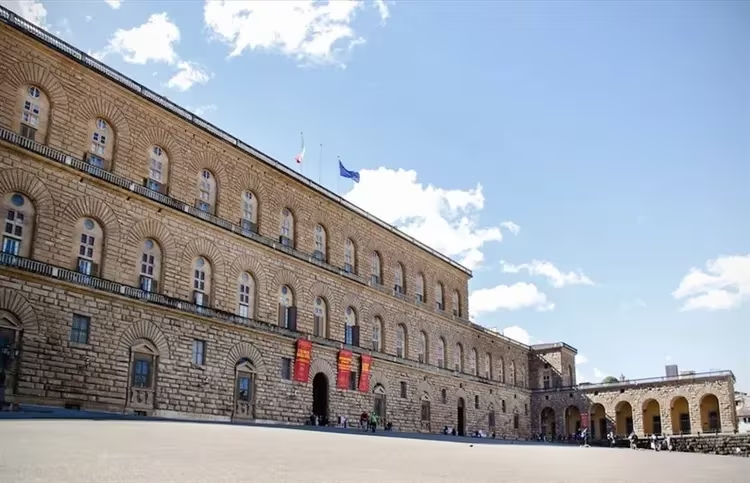
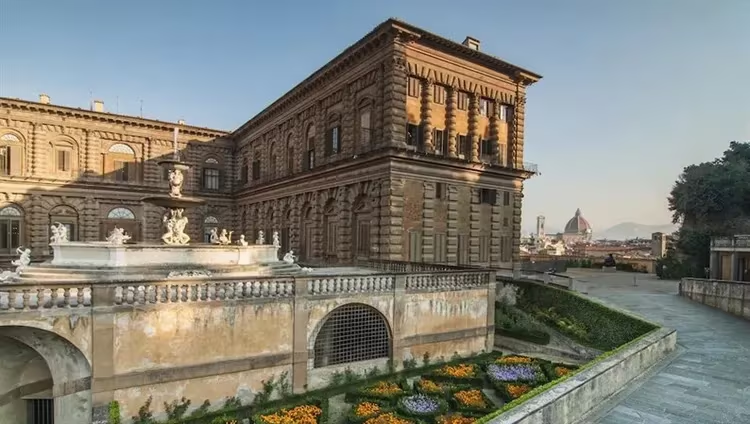
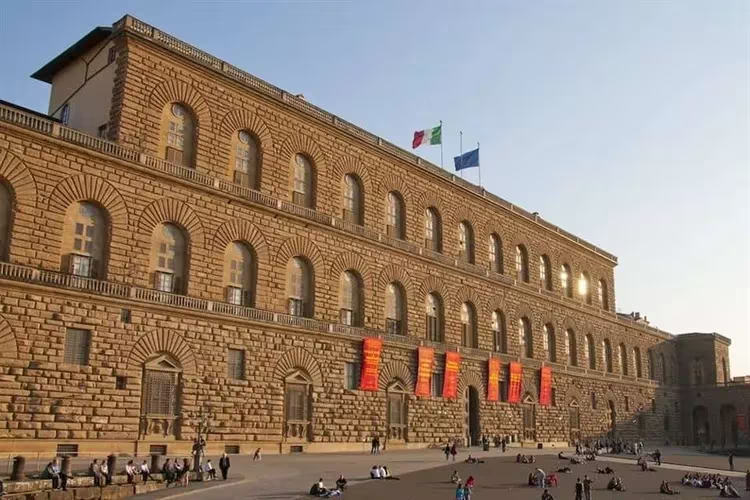
Stylistically, Palazzo Pitti belongs to the Quattrocento (this term, by the way, was also born in Florence): it combined the imagery of the Middle Ages, the norms of Christian culture and the trends of the Proto-Renaissance. The powerful and majestic building of the palazzo seems to be pressing from above, forcing you to obediently lower your eyes. But Luca Pitti achieved this: the same facade cladding with rustication – roughly hewn stone – hints that the palace, in his understanding, should have made a formidable and harsh impression.
The building has three floors, and each upper floor is smaller than the previous one, so the palace seems to go up, like an Egyptian pyramid. Also, this clear division is noticeable thanks to the semicircular arches and pilasters, which were already made during the time of Eleanor of Toledo. However, it is believed that Vasari and Ammanati followed the original plan and plans made during the life of Pitti.
Palatine Gallery
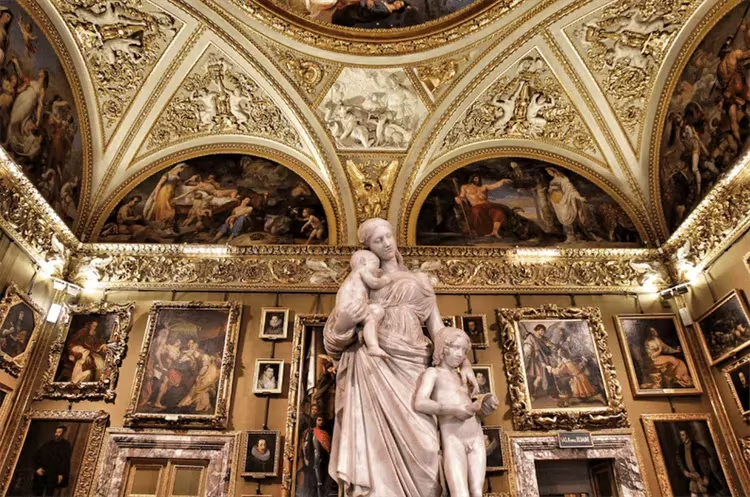
The Palatine Gallery – or the Palatine Gallery – in itself, even without the masterpieces of painting exhibited there, is very beautiful and original. Some rooms, painted by the Italian Pietro da Cortona, represent a general mythological pattern and are even named after the ancient Roman and Greek gods: Venus – the goddess of beauty and fertility, – Apollo – the god of light and patron of the arts, – Mars – the god of war and agriculture, – Jupiter – the supreme god, – and Saturn – the god of agriculture and time.
As for the paintings of the gallery, the Medicis began to collect them, then the work was continued by the Lorraine. It is here, in the Pitti Palace, that the world's largest collection of Raphael's masterpieces: as many as eleven paintings! There are also works by such famous masters as Titian, Rubens, Van Dyck and Caravaggio.
Gallery of modern art
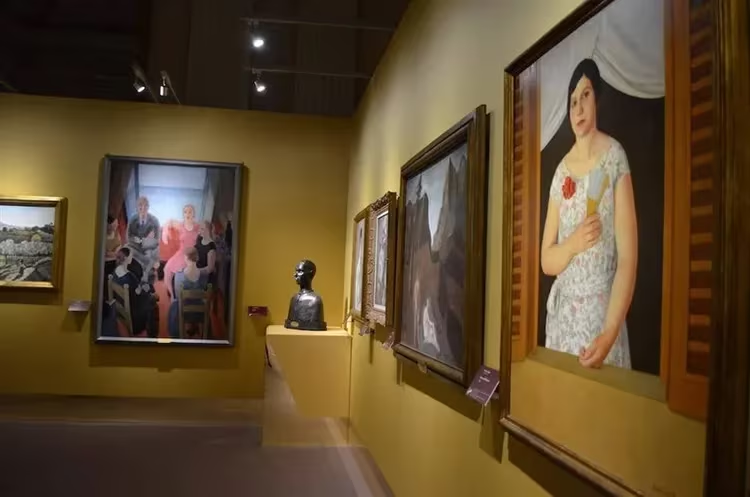
In addition to the masterpieces of the Renaissance, Palazzo Pitti is famous for its modern art gallery, which exhibits paintings by artists of the 19th century. Most of them wrote in the macchiaioli technique (another Florentine word!) – a special style, characterized by a free manner and pronounced “spots”. It is quite possible that Impressionism grew out of Macchiaioli.
Treasures of the Grand Dukes
The second name is the Silver Museum. The museum is quite impressive: almost thirty rooms, and one more luxurious and richer than the other. This collection is also assembled by the Medici family: here are masterfully cast, carved, elegant silverware, and jewelry of the legendary dynasty, and coral and pearl souvenirs, and miniature figurines carved from cherry stones and ivory, and Byzantine vases, and amphorae from oriental countries, and masterpieces of Venetian jewelry, and precious and semi-precious stones, and amazing transparent amber… Similar luxurious and rich collections can only be found in the halls of the Louvre and the Hermitage.
Fashion and Costume Museum
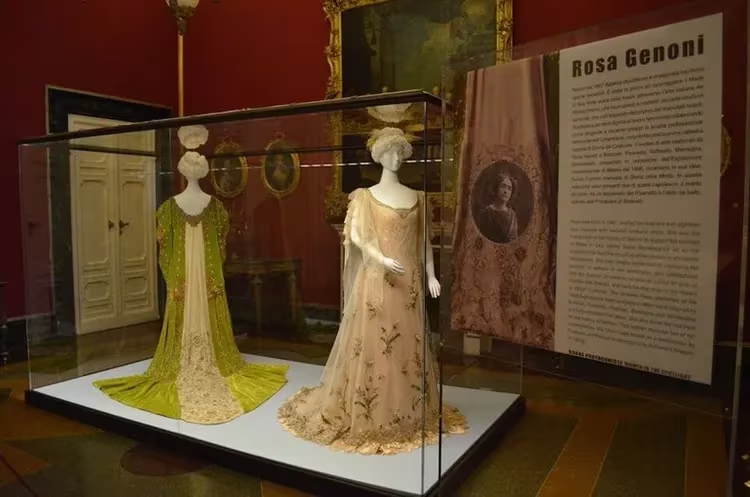
This collection is relatively young – the museum opened only in 1983. Nevertheless, today it already has more than 6 thousand exhibits, and every self-respecting publication has long included it in the lists of the best fashion and costume museums in the world.
Of course, most of the collection's costumes are Italian: masterpieces by Mariano Fortuny, Maria Galenga, Elsa Schiaparelli. All these women are well-known designers and fashion designers of the late 19th and early 20th centuries. It was their efforts that modern Italian fashion developed. There are also costumes of the aristocratic society of the 18-20th centuries, and theatrical costumes, and some jewelry, and clothes of famous Italian actresses, for example, Eleonora Duse. Here are the famous works from the collections of the magnificent Coco Chanel.
In addition, the Fashion Museum also has vehicles: carriages, wagons, the first cars. One can see whole compositions when next to the female and male mannequins in costumes of certain years there is a vehicle of the same time.
Since the fabric is very quickly destroyed in the light, all the exhibits are under glass, and the room itself is twilight and cool. In addition, so that the costumes do not stay on the mannequins for too long, the entire exhibition is completely changed every two years. Temporary exhibitions change even more frequently. You can take pictures here, but only without a flash. In addition, when going to the Museum of Fashion and Costume, be sure to dress warmly.
Royal and Imperial Apartments
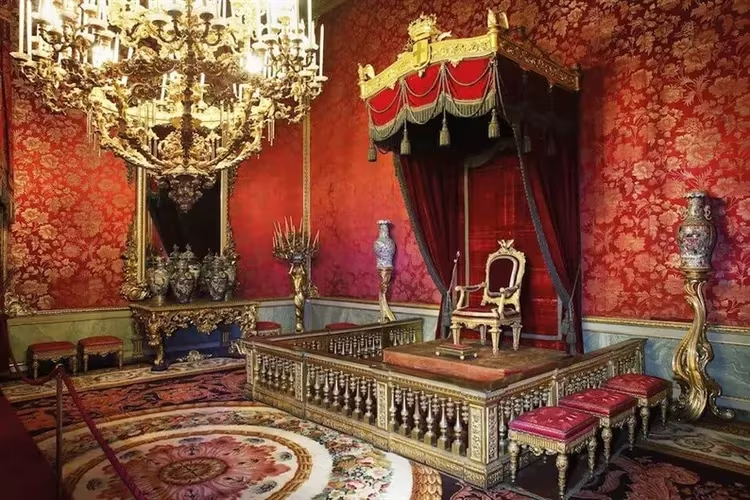
In the right wing of the palazzo are the apartments of the Savoy dynasty that ruled in the 19th century. In those days, Florence was the capital of Italy, and King Vittorio Emanuele II lived here for some time with his family as a private residence. It was then that luxurious vintage furniture was installed in the chambers and various art objects were brought in – paintings, sculptures and reliefs – from the 16th-19th centuries.
Opening hours and ticket prices
There are always a lot of tourists in the Pitti Palace, but one consolation is that the square and the palace itself are so huge that you hardly have to push around.
The mode of operation is:
Ticket offices close an hour and a half earlier. Expositions may also be closed on major holidays. The cost of a general ticket for seeing all the sights of the Palazzo Pitti and the famous luxurious Boboli Gardens adjacent to it is 38 euros. However, there are options for 16, 18 euros, etc., allowing you to view only part of the territory in various combinations. In addition, a ticket can be booked on the official website of the palazzo (the cost of the reservation is another 3 euros), then it will be possible to go to a special queue with an electronic voucher or printout.
Excursions – individual, family and group – are purchased with separate additional tickets.
Where is it located and how to get there
The exact address of the palazzo: Pitti Square, Florence. Buses No11 and No36 run past it, in addition, you can get to the palace by taxi. If you are walking around the city on foot, then the square and the palazzo will certainly be on your route, because they are located in the historical center of Florence, and you will definitely not pass by such splendor.