
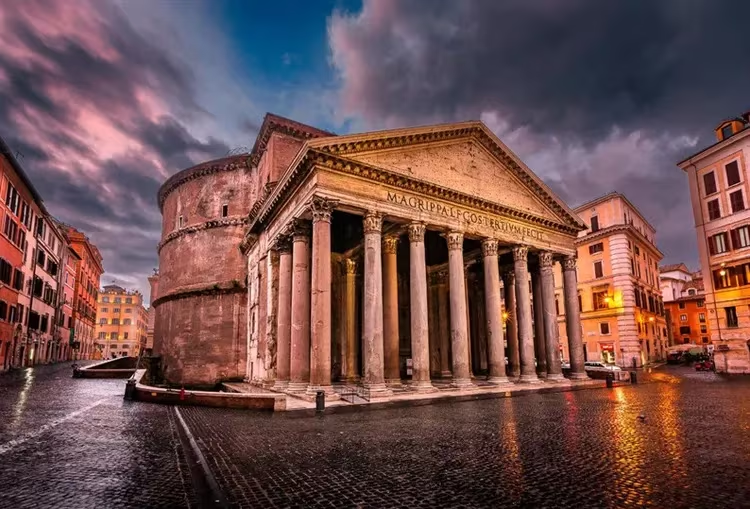
Pantheon in Rome – history, photo, description, how to get there, opening hours, map
Rome, or as it is called, the Eternal City, is rich in its sights. Historical monuments are carefully protected by the state and are open to all people who are interested in antiquity. One of the significant places is the Pantheon – the current temple and the burial place of great people.
Construction history
The meaning of the word Pantheon is “a temple dedicated to all the gods”. The first building of the Pantheon was built by Marcus Agrippa, the Roman consul. It was erected in memory of the victory over the army of Antony and Cleopatra. The Pantheon of Agrippa was surrounded by a small round square, paved with slabs, opposite the temple of Neptune. In the first centuries of its existence, the building often burned. Approximately in 110, it almost completely burned out in a severe thunderstorm. In 126 AD Emperor Hadrian rebuilt the magnificent and majestic temple. From the previous building, only a few fragments remained – 16 columns, a portico in the front part and an inscription in the upper part of the pediment, which said that this building was erected by Marcus Agrippa.
In 202, during the reign of Emperor Septimius Severus, the building was restored, Caracala, the son of the ruler, also took part in this. Mainly, wall finishing and facing works were carried out.
From Pagan Temple to Christian
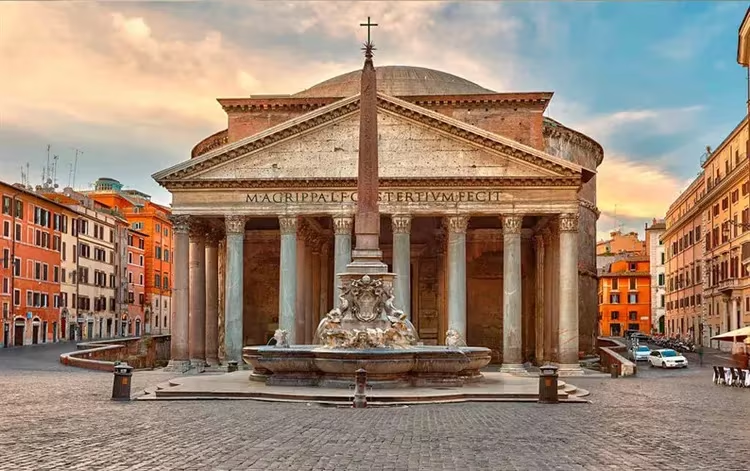
The building of the Pantheon is well preserved due to the fact, according to scientists, that it was used for its intended purpose – it has always been only a temple. The first building of the Pantheon was intended for the Romans, who were not yet Christians and prayed to their pagan gods. Offerings were made here – sacrificial animals were burned on the altar, which was strictly under the dome. Agrippa owns an innovation of great importance for believers, which violates an age-old tradition. In ancient Rome, this was the first place of worship, where not only priests, but also ordinary citizens could be. Before Agrippa, all ritual actions were performed in open areas. The emperor ordered the construction of a building in the form of a triumphal arch, and every person entering it became a “triumphant” himself.
In May 609, the temple was consecrated, it became a Christian shrine, which received the name of St. Mary and the Martyrs. This event happened when the Byzantine emperor Phocas gave the church to the use of Boniface YI, who converted it into a Catholic one. After the transformation of the Pantheon into a Christian church, the attributes of paganism were removed: all pagan sculptures were knocked down from the pediment and taken out. They were replaced with statues of Christian saints. The walls were decorated with paintings based on scenes from the Bible.
In 655, the emperor of Constantinople, Constantine, ordered some metal fragments and gold-plated tiles to be taken from the temple. Since that time, the church gradually began to fall into disrepair. The Pantheon was revived in the 13th century under Pope Gregory III, when he consecrated the chapel of St. Peter. The event took place on November 1, this day is now celebrated as All Saints' Day.
Architecture and architect
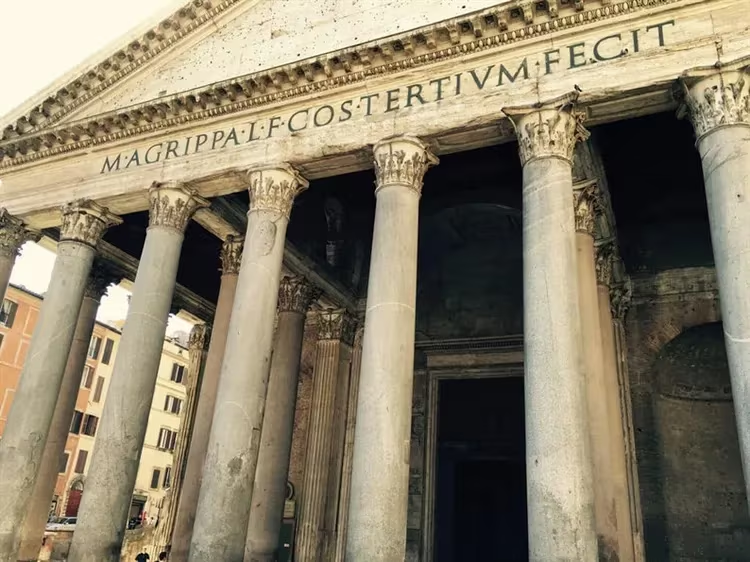
The Pantheon is famous for its majesty and integrity, it is unique in its compositional solution. It consists of figures of geometry – a hemispherical dome, a portico in the form of a parallelepiped and a rotunda, which is a cylinder. The building was built of concrete and brick, covered with a hemispherical dome with a diameter of more than 43 meters. The portico is decorated with two rows of columns, giving volume to the structure and making it more elegant. The walls of the rotunda have a thickness of 6 m, installed on a foundation with a depth of more than 4 meters. The dome and walls form a single whole, supporting the entire interior space. Niches separated from the main building by Corinthian columns adjoin the temple.
140 caissons are located high under the dome (recesses on the ceiling on the inner surface of the arch, used to improve acoustics, and for artistic processing). Carved recesses decorate and lighten the weight of the caissons. Scientists examined the markings used in the construction of bricks and concluded that the work was carried out under the guidance of the outstanding architect of antiquity, Apollodorus of Damascus. The building is unique for that time; until the 19th century, not a single structure with a domed architecture of the same size, much less surpassing it in size, was built.
Pantheon outside and inside
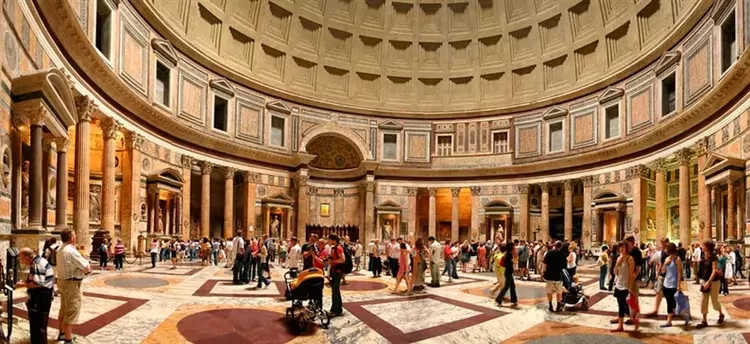
The builders used 16 columns for the external decoration of the building. They are made of granite brought from Egypt and Greek marble. The hemisphere of the dome is covered with gilded plates. Beautiful and majestic seven-meter gates made of bronze, preserved since antiquity. The ancient architects wanted to make the interior decoration the most magnificent, so that it would amaze a person. The interior walls and floor are made of ocher-colored marble with white splashes. The walls are two-tiered, the columns draw attention to the dome, giving harmony to the entire structure.
Inside the hall, along the perimeter of the walls, seven niches are equipped, giving variety to the interior, one of them plays the role of an entrance, the others contain statues of Catholic saints. At the entrance there are sculptures dedicated to the founding fathers Agrippa and Hadrian, the builders of the Pantheon. The square in front of the entrance to the temple is beautiful. Here you can admire the ancient Egyptian Obelisk, which was installed during the Renaissance. The fountain added to the composition in the 17th century.
Dome
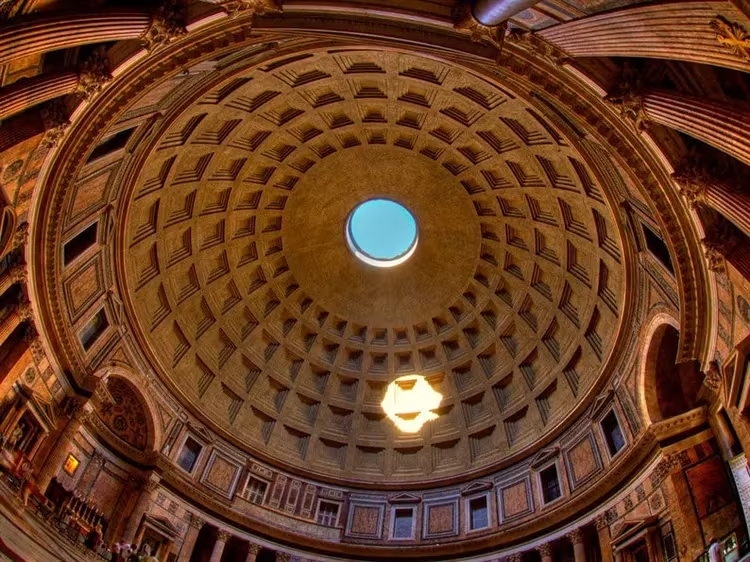
The dome is divided into well-marked circles. Historians believe that it used to be decorated with stars and flower rosettes, but no evidence has been found for this. In the center of the dome there is a hole – oculus, its diameter is 9 meters. There are no window openings in the building and light enters only through it. Since the hole does not close during rain, the building is equipped with a drainage system. Engineering calculations are made in such a way that raindrops do not interfere with the flow of warm air when it moves up. The dome is an ideal hemisphere, it occupies almost half the volume of the entire building, it is decorated with a bronze border.
At noon, a column of bright light entered the church through the dome, illuminating the entire space. According to legend, the hole was formed during the service. When the divine music sounded, the dark forces that entered the building could not withstand the sounds of the liturgy and rushed up with a howl. Having destroyed the ceiling, they disappeared forever from this sacred place for believers.
What is the hole in the dome for?
Ancient builders erected a temple for cult rituals, so the hole in the center was made on purpose, it is called the “eye” and is a symbol of the Sun. For practical purposes, it was created so that the smoke during the burning of sacrificial animals would pass unhindered through the hole – the oculus. According to the pagan religion, it was believed that along with smoke, all prayers reach the gods more easily, they quickly accept offerings and fulfill their requests. An interesting hypothesis was put forward by scientists, they are sure that the eye is a sundial. Throughout the year, the Sun enters the temple from different angles and its rays penetrate into different areas. April 21 (foundation of Rome) illuminates the main entrance.
A person entering the room found himself in the bright rays of the star, it was a majestic, bewitching and symbolic sight. According to one version, the architecture of the temple prompted Copernicus to the theory of the heliocentric structure of our universe. After that, the scientist proved that the Earth is not the center of the universe, it rotates along with other planets around the Sun. On the fiftieth day of Easter, an unusual action takes place in the temple – rose petals of a bright scarlet color fall on the parishioners from above through the oculus. This holiday is called Rose Sunday.
Who is buried
World-famous people are buried in the Roman tomb: representatives of art – artists, musicians, architects, as well as the royal family. The burial place of the outstanding painter Raphael Santi (died in 1520) is especially revered. His beloved bride Bibbiena is buried nearby. Painter Giovanni de Udine, architect Baldasare Peruzzi and other prominent people. Persons from the royal Savoy dynasty are buried here.
One of the first buried in one of the chapels is Victor Emmanuel II, the first king of united Italy. The temple contains the tomb of his son and heir, King Umberto I, who was shot dead by anti-monarchists in 1900. His wife Margarita Savoyskaya, who died 36 years after the tragic death of her husband, is buried nearby. The memorial is decorated with a funerary urn designed by Sacconi.
Where is it located and how to get there
The Pantheon building is located in Piazza della Rotonda in Rome. How to get to the Pantheon:
You can take pictures in the Pantheon, admission is free, but you should follow the rules for visiting:
The temple for visitors is open from 8:30 to 19:30. Sundays from 9:00 to 18:00. On holidays, the entrance is open to tourists from 9:00 to 13:00. The temple is closed on Easter and on Catholic Christmas – December 25th. The majestic and grandiose building of the Pantheon attracts the attention of all the people of the planet. One of the few structures that has survived to this day almost unchanged and gives an idea of ancient Roman architecture.