
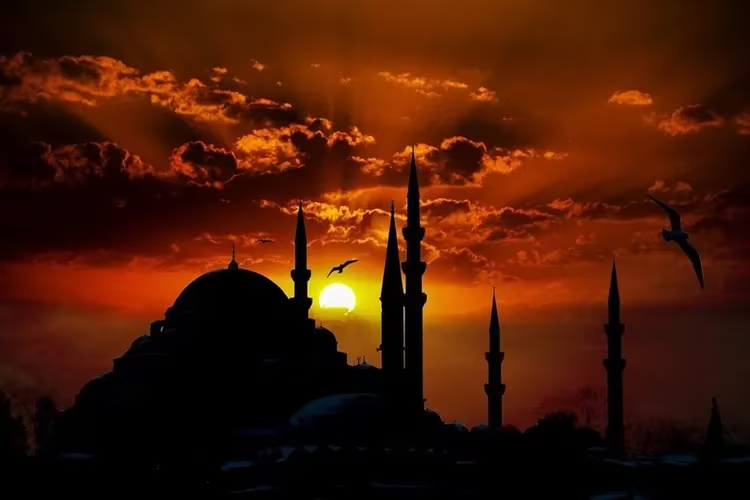
Suleymaniye Mosque in Istanbul – history, photo, description
Admirers of beach tourism have long managed to take a fancy to the gentle sun and warm water on the shores of Turkey. But in this country there are historical and architectural monuments that are appreciated by travelers. One of them is the Suleymaniye Mosque. This grandiose building was built in 1557 by an outstanding urban planner of that era named Sinan. For almost a century of his life, he served five Turkish rulers, under his leadership dozens of masterpieces of architectural creativity were created.
Construction history
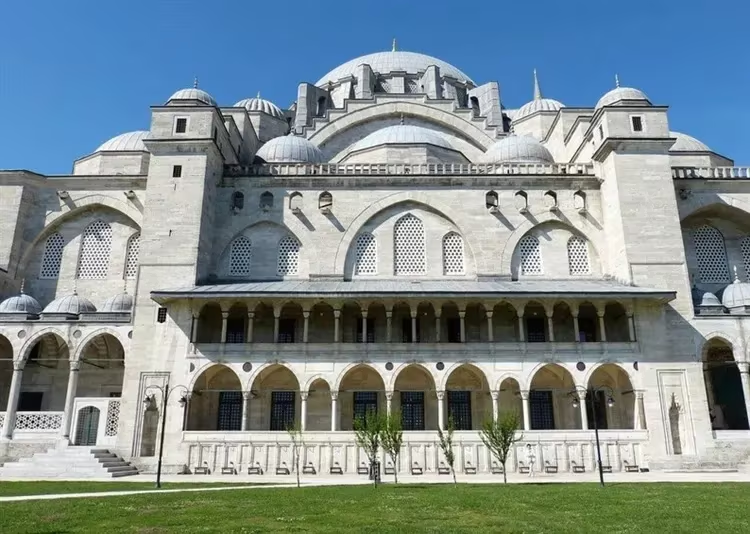
Sultan Suleiman the Legislator made a great contribution to the flourishing of the Ottoman Empire. The construction of the mosque, rather the whole complex, was another evidence of the greatness and brilliance of his reign. Several legends connected with the construction of this monumental temple have survived to this day. According to the ruler, the work went too slowly, he even hinted to Sinan about the fate of the architect Ayaz, who was executed for sluggishness a century earlier by Mehmed II.
There was a time when the padishah generally wanted to stop construction work. But ambitions did not allow to do this. The fact is that the Iranian Shah Tahmasp sent ambassadors with gifts and jewelry. In the attached letter, he indicated that he was contributing to the construction, since Suleiman did not have enough strength and money to complete it. The enraged ruler distributed gifts to merchants, and ordered expensive stones to be invested in the foundation of one of the minarets. Everything went much faster.
As a result of the colossal work of hundreds of craftsmen and artisans, Sulemaniye pleases Muslims, enabling more than 5,000 people to reunite in such a beautiful place at the same time through prayer. And it delights the guests of the city, who saw this amazing confirmation of the significance of faith in the power of the ruler and the prosperity of the state.
Description
The construction of the building was carried out for 7 years. The reason for this is by no means a lack of funding. Magnificent gave the architect unlimited credit. No, the architect Sinan built for centuries. He understood that it was impossible to create a masterpiece in an area with constant earthquakes. There were no construction methods in earthquake-prone areas at that time.
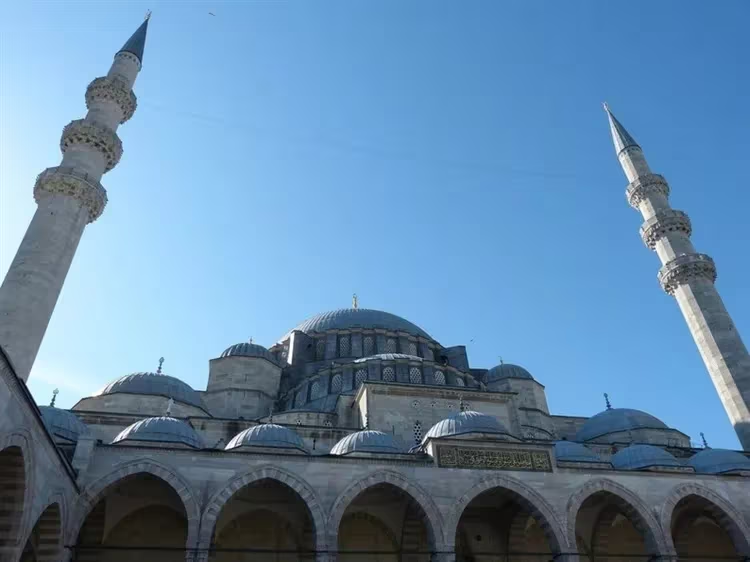
Sinan made all the calculations himself. And they turned out to be absolutely true: Suleymaniye stood for more than 4 centuries, withstood more than one earthquake with a magnitude of 7-8 points. Many tourists see the similarity of the structure with Hagia Sophia. Looks like 4 minarets, details of the facade. Perhaps Sinan voluntarily or involuntarily copied the features of the world-famous building.
It occupies an area of more than 4 thousand square meters. Here, in addition to the mosque, are located:
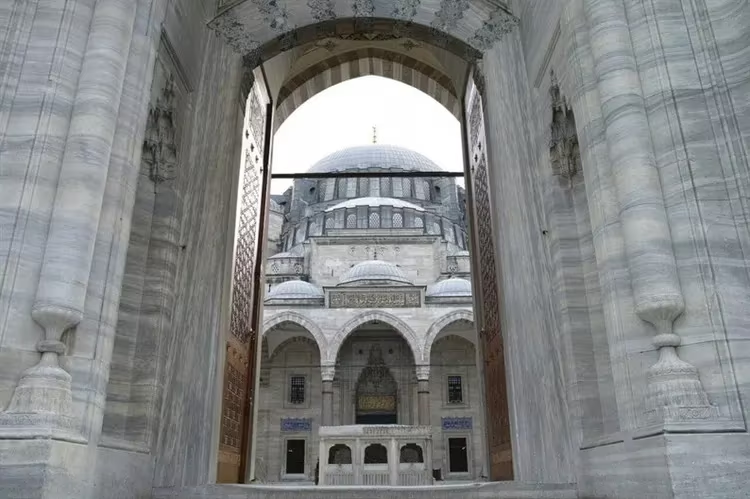
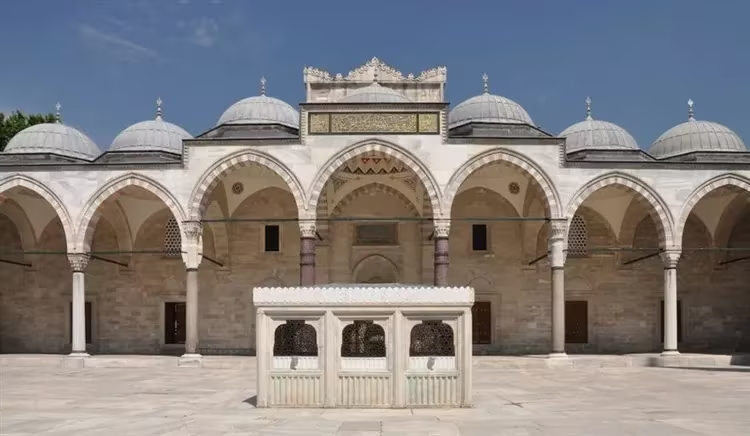
There is also a mosque in the middle of a flowering well-groomed garden. You can go inside through 11 gates. There are fountains on the territory. Some of them (Shadyrvan) are intended for ablutions before prayer. You can get inside by entering through 1 of 3 gates into a special courtyard. It is surrounded by columns. There is another back yard.
It is on it that the pavilions of merchants and artisans are arranged. Passing through the backyard, tourists get to the mausoleums of Suleiman the Magnificent himself and his wife, Alexandra Anastasia Lisowska, who converted to Islam Roksolana. There is a terrace in the garden. Some guests use it as an observation deck. From here a marvelous panorama of the Golden Horn Bay opens. For photography lovers, this is a great place.
Architecture
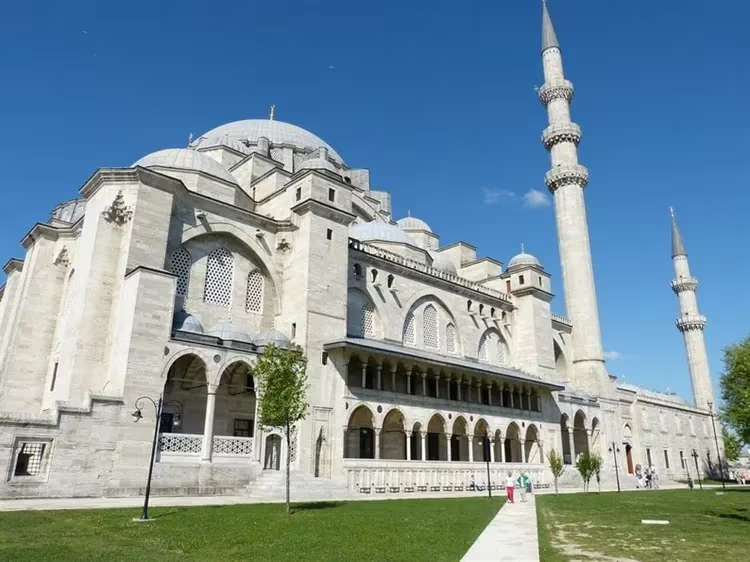
The mosque was built by an Armenian converted to Islam – Kemal ad-din Sinan. The customer was Suleiman the Magnificent. Therefore, it is not surprising that all architectural solutions are aimed at exalting the ruler:
The building is decorated with columns that once adorned the churches of Constantinople. Kemal Sinan successfully entered them into the design, perpetuating the victory of the Ottomans over Byzantium. 5,000 Muslims can pray at the same time. Despite the fact that the minarets vary in height, their remote location makes it invisible to the eye. The building itself is built on a hill, dominating the surroundings. Trees are planted in the yard to create a pleasant shade, and not overshadow the beauty of the main building.
Interior decoration
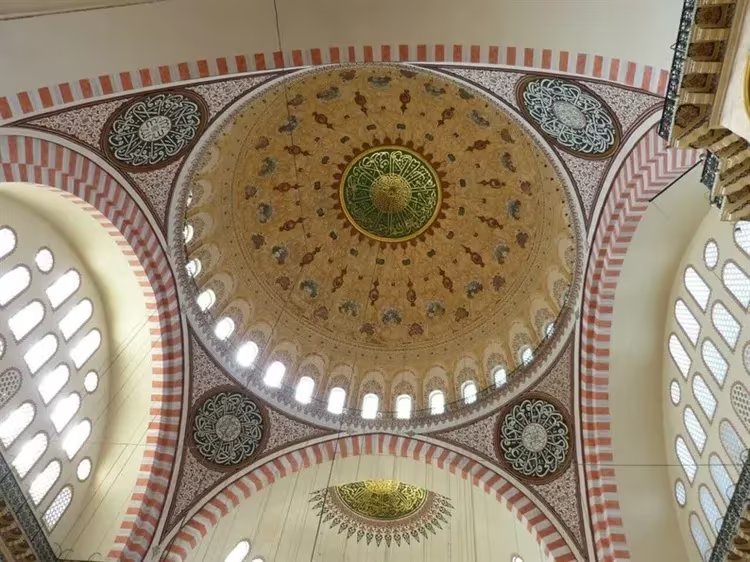
Despite the fact that Sinan could not resist copying Hagia Sophia, he managed to embody amazing things in the interior. He organized the lighting in such a way that those who entered fall from the column of light. This illusion is the result of a thoughtful arrangement of windows: 32 of them are cut into the dome, and 136 let in sunlight along the perimeter.
4.5 centuries ago there were no microphones and amplifiers. To organize amazing acoustics, Sinan built empty jugs into the walls. They resonate, so the sound propagates with the same force throughout the room. At night, the building is illuminated by an amazing chandelier. Previously, candles were used for this, now they are electric lamps.
If you look up, the dome will seem to go up into the sky. This is also the result of the design of the windows.
The walls were painted by Hasan Celebi himself. The ornaments that he wove into the suras of the Koran are still impressive. For stained-glass windows, the finest colored glass was used. Marble and valuable wood were used for partitions.
Interesting Facts
Such an amazing building could not help but acquire mysterious stories. Now it is difficult to say whether all this actually happened. But interesting legends are passed down from generation to generation:
What else can you see
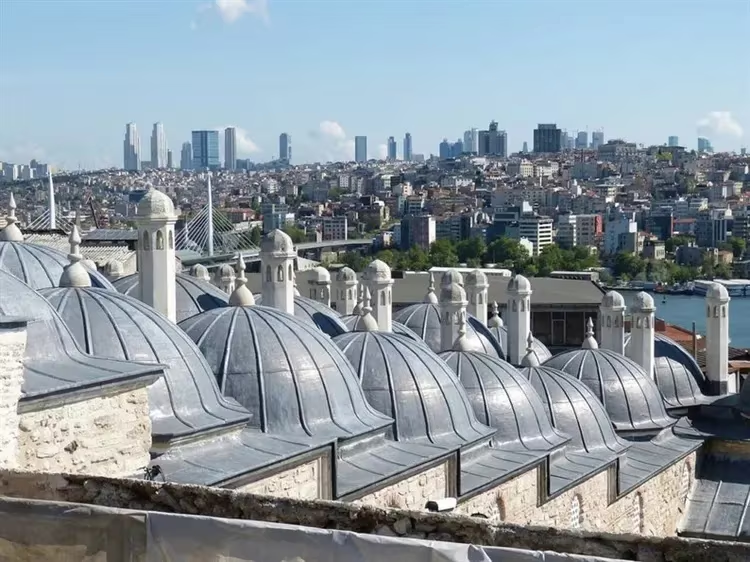
A number of buildings adjoin the mosque. This is a library, an observatory, a hospital, several kitchens, baths, schools. Schools (madrasas) occupy a large area and have a serious impact on the life of local residents. The courtyard with fountains for ritual washing before prayer on the south side plays an important role in Islamic culture.
All these buildings, built together with the mosque, are also works of art, decorated with elegant carvings, slabs, and frescoes. From the western part there is a forecourt, 24 marble columns of painted arches support 28 domes. Four minarets (one “precious”) with ten carved balconies indicate that Suleiman is the tenth padish of the Ottoman Empire, and the fourth after Istanbul was conquered.
The wide building in front of the courtyard is also decorated with domes. Previously, there was a caravanserai here, where visiting merchants and guests were received, who could eat in it for free for three days. Today, a chic restaurant “Daruzziyafe” with national cuisine is set up here. It is noteworthy that the Turks do not consider vegetables a secondary product, although they respect meat (not pork, of course) very much.
They treat bread very carefully, throwing it away is a great sin, even if you accidentally drop it, you must immediately pick it up, kiss it and put it on your eye. Here are the traditions. There is no need to talk about Turkish sweets, because these are our favorite dishes: sherbet, baklava, Turkish delight…
Very close to the restaurant there is a small street, where trading stalls have been standing since those very times. It was only then that opium was sold here, but now you can buy snacks, water and many charming souvenirs that delight tourists and their loved ones back at home.
There is an old cemetery in the backyard. Despite the fact that these are burial places, there are always many visitors. They are attracted by the originality and sophistication of these places. Each tombstone was made by artists, as rich nobles and nobles were buried here.
Mausoleums
Two mausoleums contain the bodies of Suleiman the Legislator himself and his beloved wife Khaseki Khurem, we know better her other name – Roksolana. She is surrounded by exquisite ceramic tiles depicting the Garden of Eden, texts of poems dedicated to the beauty and lively mind of this woman. Turbe of the Sultan, of course, is much more magnificent. In addition, it contains the tombs of two more padishahs: Sultan Ahmed II and Sultan Suleiman II.
Suleimeniye occupies a huge area, about 4.5 thousand sq.m. Luxurious architectural monuments lavishly decorated with priceless creations are located on its territory. The creator of all this, Sinan, is also buried here. He promised his master that the mosque would stand forever, as he used a special technology that protects the walls from destruction during earthquakes. For almost 500 years, there have been 89 such disasters, and quite large ones. But until now, this architectural masterpiece performs its main functions. And who knows how many more generations will admire its beauty.
Behavior rules
When planning a visit, it is important to understand that the mosque is active, so it is unlikely that you will be able to go inside on an excursion at any time. On Friday, prayer lasts a good half of the day, so excursions are limited. There is a special area for guests, you should not go beyond it.
On normal days, guests can explore the pearl of Istanbul from 9 am to half past one and from half past two to half past four. The feelings of believers should be respected. Before entering, you will have to take off your shoes, put them in a bag and leave them on the bench. Women are advised to cover their bare arms and shoulders and wear a headscarf. For men, wear a hat.
Too revealing outfits are not welcome. In such toilets, they may not be allowed inside. Capes, scarves and shoe bags are provided free of charge at the entrance. The same rules are recommended to be observed when visiting the mausoleum of Suleiman the Magnificent and his wife Alexandra Anastasia Lisowska. In addition, it is forbidden to speak loudly near the burial.
How to get there
The mosque is located in the historical district of Fattih (Vefa), along Saddik Sami Onar street, house 8. The closest landmark is the Eminonu ferry crossing. It is easier to get here from the central Sultanahmet Square. You should find the tram stop T1. You need to get off at the Eminonu stop.
Some tourists prefer to take the same T1 at Sultanahmet Square, but get off at the Laleli University stop. In this case, you will have to wade through the narrow streets of the city. The third way is to get to the Egyptian Bazaar. You have to go not far and almost all the time straight. Landmarks – minarets, which can be seen from any part of the area.
Some guests prefer to use the metro. In this case, it is recommended to take the M2 line and move towards the Vezneciler station. Bus enthusiasts are advised to take routes 26A, 26B, 70KE and 336 to the Eminönü Kantarcılar stop.