
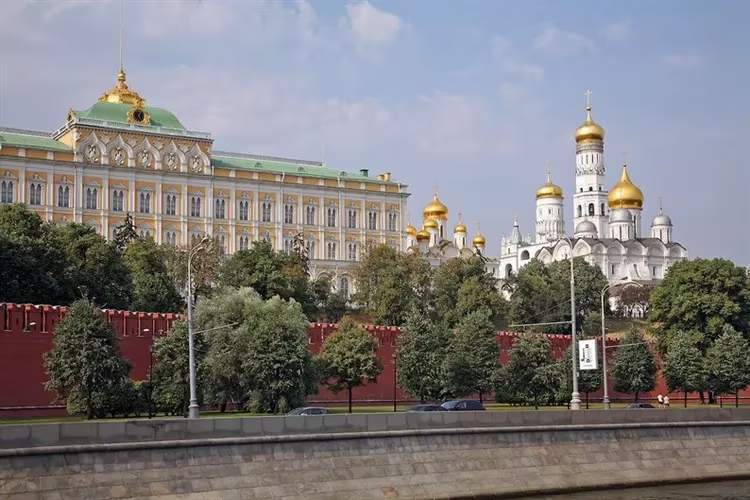
This building is known not only to Muscovites. It is shown on central television before the annual congratulations by the President of the Russian people. The massive building is located on the top of the Borovitsky hill. The Russian flag flies over the dome. The Grand Kremlin Palace in Moscow is a monument of history and architecture and at the same time the official residence of the President. Every guest of the capital dreams of visiting its ceremonial halls. I would like to see the magnificence of the interiors created by architects at different times.
Story
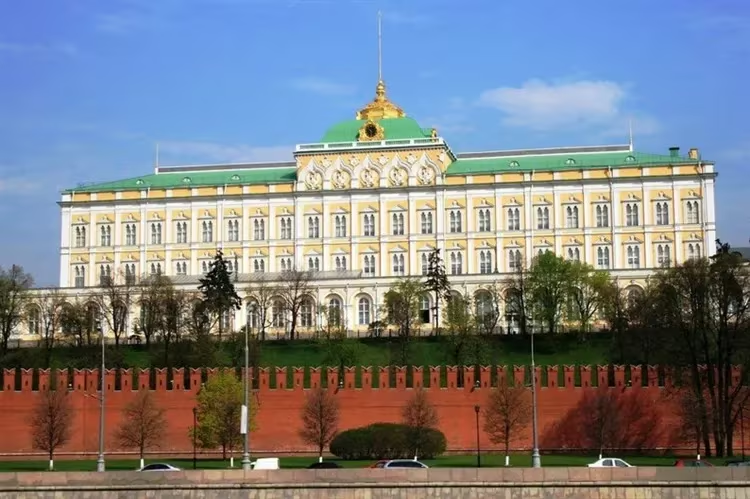
The Grand Kremlin Palace was created as a symbol of imperial power and a monument to the Russian army and weapons. This was necessary for Nicholas 1, whose kingdom was overshadowed by the Decembrist uprising. According to the autocrat, the new unusual building fully met the objectives.
The architecture clearly traces the traditions of Byzantium. This, according to the creators, should emphasize the continuity and inviolability of the power of the Russian emperor. A series of halls dedicated to Russian weapons and military victories showed the strength of the state. The palace was built by the architect Ton. It took almost 10 years to complete the work.
Early palace buildings
The palace of early times was arranged according to the custom of the princely choirs of that time. These were separate buildings, which were connected by winding passages.
The buildings had a tiered structure:
It was the third tier that was called the tower.
12th-15th century
The conducted research suggests how the building looked at different times:
The period of the Muscovite state
During the formation and strengthening of the Moscow state, the structure was completed and rebuilt several times:
The latest development of this period is the Embankment Garden, laid out on the roof of the Reserve Palace.
Early 18th century
In 1712 the capital moved to St. Petersburg. Officials were housed in part of the building. The rest were not properly cared for. Buildings fell into disrepair, often burned. During Anna Ioannovna's visit to Moscow, her courtiers lodged in the building. The empress quickly appreciated the inconvenience of the construction. By her order, Rastrelli erected the Winter Annenhof. But after the Summer Annenhof appeared in Lefortovo, the Winter was moved there.
Winter Palace Rastrelli
Elizaveta Petrovna often came to Moscow. She quickly realized that it was inconvenient to live in the Grand Palace during the cold season. Therefore, she commissioned Bartolomeo Rastrelli to build a building suitable for winter living. Fortunately, the main ensemble was saved. But to implement the plan, the Embankment and the Middle Golden Chamber had to be demolished. The baroque complex of Rastrelli was remade several times, but it never became suitable for life in cold weather.
Bazhenov Grand Kremlin Palace
At the end of the 18th century, Catherine the Great decided to rebuild the building. She received Bazhenov to carry out the project. The architect came up with an amazing plan. The palace and the Kremlin were to become a single structure. It was supposed to descend to the embankment in terraces. The price of such a large-scale project was huge: 30,000,000 rubles.
For clarity, Bazhenov made a layout. Its dimensions were 10×17 meters. Nobody has done this before. Now fragments of this model are stored in the Shchusev Museum of Architecture. But the population was not happy with such changes. When they began to dismantle the wall of the Kremlin, angry Muscovites began to attack Bazhenov. They demanded a halt to construction.
Nature itself, too, seemed to be against it. In 1771, the plague broke out in Moscow. The epidemic was followed by a riot. Construction was temporarily stopped. Work resumed the following year. They dug a huge pit. But there was no money in the treasury. Therefore, after 4 years, the empress ordered the foundation pit to be filled up. The architect was offended. He retired from building the facility.
pre-revolutionary era
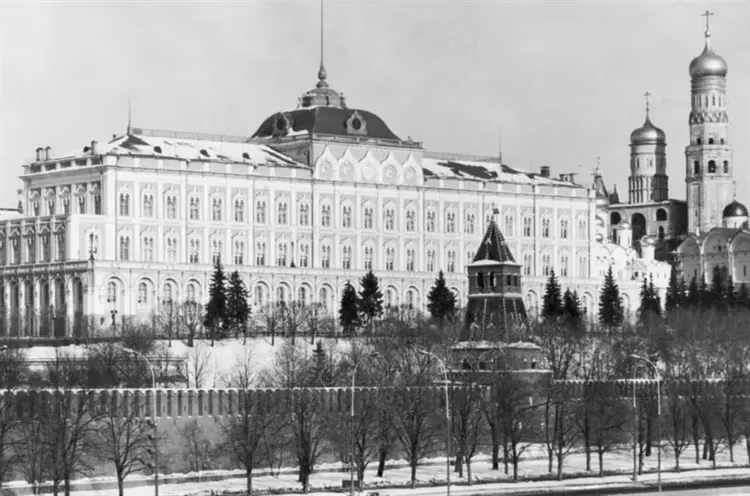
The next architect to work on the project, Ton. He worked on it for almost 10 years. Ton was able to combine the ideas on which the building was built for 500 years. Nicholas 1 personally supervised the project, his signature is on each drawing. Unfortunately, the emperor did not manage to live in a new residence: he died earlier. The building turned out to be impressive. The buildings united around the courtyard. There are 700 rooms in the building.
5 are named after Russian orders:
The palace stretches along the Moskva River for 125 meters. The facade was decorated with bas-reliefs with the coats of arms of the Russian Empire and its possessions. The height of the building is 37 meters. Surprisingly, the building has 2 floors, and on the facade there are 3 rows of windows. This is the idea of the architect Ton. So he achieved excellent lighting of the room. The southern part is the private quarters of the imperial family.
They consisted of:
Before the October Revolution, the imperial apartments were restored and regularly updated:
The Terem Palace was restored. During the work, furniture was replaced, oak window frames were inserted, wall paintings were updated. Everything was done according to the alleged standards of the 17th century. Unfortunately, due to the lack of in-depth study, the appearance of Terem has not changed for the better.
The façade and interior were renewed annually: primed and painted. Carried out work on the safety of the canopies of thrones made of ermine. They poisoned insects and animals. In the late 80s of the XIX century, temporary illumination was organized. Cables were laid from the Raushskaya embankment from the power plant. Permanent electric lighting was installed in the late 90s of the nineteenth century.
At the beginning of the 20th century, the building was drained. In 1913, the celebration of the 300th anniversary of the Romanov dynasty took place in the Grand Kremlin Palace. Significant funds were allocated from the treasury to carry out the work. In 1917, the imperial residence entered into excellent condition.
The seat of the Soviet government
During the October Revolution, the building suffered from shelling. Part of the destroyed wall could not be restored. But the general condition of the building was satisfactory. A year later, the Soviet government moved to Moscow. It was decided to turn the palace into an official residence.
Despite the protests of artists, historians, architects and Lunacharsky personally, the building housed offices of government members and apartments for the families of party workers and service personnel. Due to the fact that the premises were used to store evacuated rarities, part of the building was free from barbaric exploitation.
True, some details of the interior were lost forever: the ermine canopy was moved to a thrift store. Interest in the heritage of the emperors of the Romanov dynasty was high. Tours began to be given to the building where the Soviet government worked. The first guests visited the former royal residence in early 1919.
Reconstruction
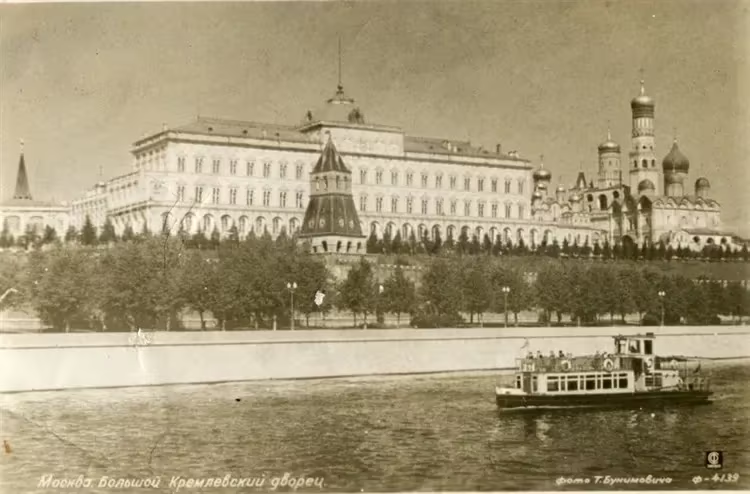
Already in 1934, a decision was made on the next reconstruction. Its goal was to organize a canteen for the deputies of the party congress. To implement the plan, the Red Porch was demolished. Freeing up space for the construction of a hotel, the Church of the Savior on Bor, built in the 14th century, was destroyed.
In the same 1934, it was decided to unite the Alexander and Andreevsky halls. The architect Ivanov-Shits undertook the implementation of the plan. He was the only one who agreed to carry out the blasphemous reconstruction. The workers also refused to dismantle the partitions. For this, the military was brought in. The employees of the museum complex were able to save some details of the interior. A panel from the wall of the Andreevsky Hall has survived.
The work was carried out in violation of building codes. Therefore, after their completion, the facade was covered with cracks. The collapse was prevented by building a balcony. Instead of imperial thrones, a statue of Lenin was erected.
Unfortunately, the hall for 1600 seats turned out to be inconvenient. The last rows were located so far from the speaker's platform that the deputies often did not hear the speaker. Subsequently, the hall was radio-equipped. This partially solved the problem.
Palace during the Great Patriotic War
The Kremlin ensemble stood out too much against the background of other buildings in Moscow. After the start of the Great Patriotic War, the garrison began to prepare for camouflage and protection of the fortress from air raids. Unfortunately, not all events were successful. A shell weighing 100 kilograms damaged the entrance, part of the Own Half, windows and a door.
A bomb weighing 250 kilograms flew into the St. George's Hall, damaged the ceiling, beams, but did not explode, but fell apart on contact with the floor. The garrison regularly extinguished land mines that fell on the territory. The government was still working in its offices during this difficult time.
A reception was given in the building in honor of the participants in the historic Victory Parade, which took place on Red Square in June 1945. To do this, they used the premises of the Faceted Chamber, the Vladimir Hall, the St. George Hall, the upper and lower dining rooms, the Holy Vestibule.
Restoration of the historical appearance
Fortunately, the technologies of the 20th century made it possible to restore the historical appearance lost during the works of the 19th century. After the research, the following were returned:
After the collapse of the USSR, the first President of Russia Yeltsin instructed to restore the original appearance of the Alexander and Andreevsky halls united in the 30s. Instead of the statue of Lenin, the thrones of the imperial family were returned again. Such a large-scale reconstruction became possible thanks to the drawings preserved in the archives. The facade of the palace, facing the Moscow River, was restored to its former appearance. It is again decorated with bas-reliefs with the coat of arms of Russia knocked down at the beginning of the 20th century. The premises of the 1st floor were the last to be restored. This happened in 2008.
Building
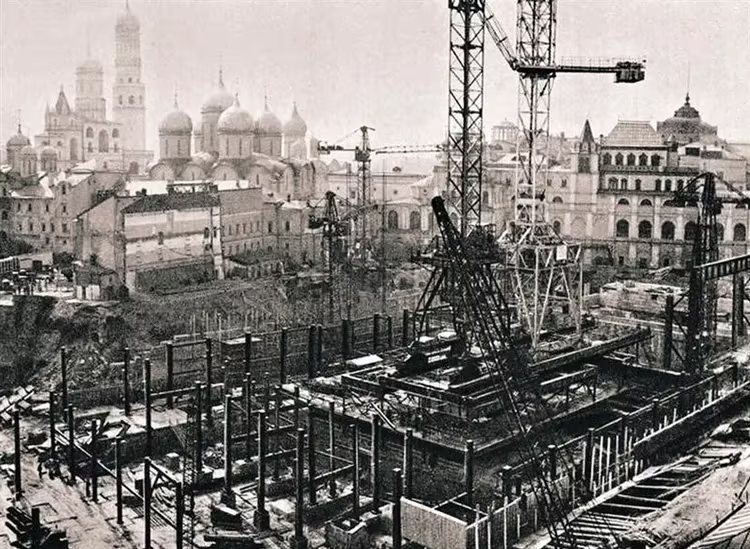
The first princely tower appeared on the site of the modern palace in the 14th century under Dmitry Donskoy. The only clock in Moscow, which was perceived as a foreign wonder, was installed on it, and the roof was covered with gilding. The Terem was replaced by grand ducal stone chambers, erected under the guidance of the Italian architect Aleviz Fryazin. Construction began in 1499 under Ivan III, completed in 1508 under his son Vasily III.
In 1730, Empress Anna Ioannovna contributed to the reconstruction of the chambers. On the old basement, a baroque-style wooden apartment called “Winter Annenhof” was built. Elizaveta Petrovna, who ruled after her, in 1752 increased the area of the building. The new residence, outwardly similar to the Great Peterhof Palace, was called the “New” or “Winter Palace”. Under both queens, work was carried out according to the designs of architects K. B. and F. B. Rastrelli (father and son).
Catherine II, who replaced Elizabeth, considered that the palace was outdated and did not have a sufficiently majestic appearance. It was decided to build a building of grandiose size, occupying the entire riverine territory and covering Borovitsky Hill. In 1768 the architect V. Bazhenov made a layout. In accordance with the plan for construction, they freed up space by demolishing the building of orders, several ancient churches and part of the Kremlin wall with the Tainitsky Gates, Petrovsky, First and Second Nameless Towers.
In 1773, the first stone was solemnly laid and construction began. However, in 1774 he was stopped, recognizing the project as expensive and untenable. There was no money in the treasury, the plague epidemic (1771) and the Russian-Turkish war (1768-1774) affected. In addition, during the earthworks, the nearby Archangel Cathedral cracked and almost collapsed, it was necessary to urgently support the walls.
The foundation was partially dismantled, instead of a grand structure, a modest building of the Senate was built. The demolished part of the Kremlin wall with towers was restored. Facades, interiors of the old palace were updated, a mezzanine and a portico were added. In 1812, in honor of the victory in the Patriotic War, it was decided to erect the majestic Cathedral of Christ the Savior near the Kremlin. Along with this, the question arose of updating the architectural ensemble inside the Kremlin with the construction of a new palace and the preservation of the ancient Kremlin buildings.
In 1837, Nicholas I set this task for the architect K. Ton, the author of the project for the Cathedral of Christ the Savior. He started its implementation together with a team of architects and artists, which included: F. Solntsev, P. Geresimov, F. Richter, N. Chichagov, I. Kaminsky. In terms of style, the new building was supposed to repeat in many details the Kremlin Teremnaya and its enlarged version of the Kolomna Palace. Construction under the leadership of chamberlain L. Bode began in 1838. In April 1849, on Easter, Metropolitan Philaret consecrated the palace in the presence of the tsar.
Architecture
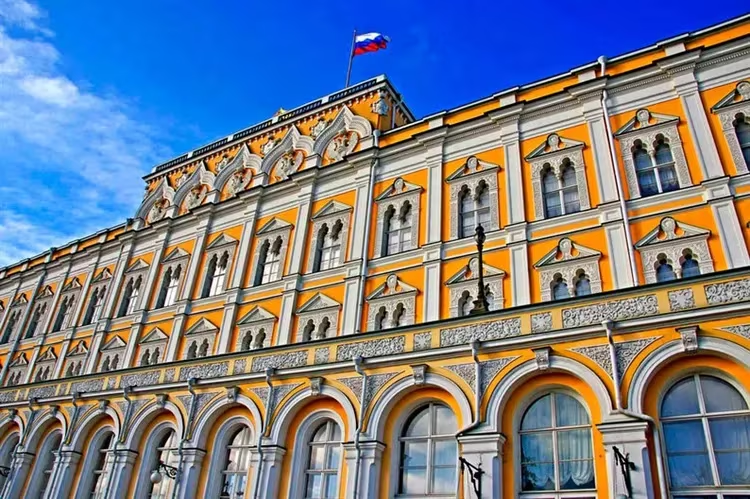
The constructed Grand Kremlin Palace included a complex of buildings consisting of the palace itself and ancient structures dating back to the 14th-17th centuries: the Faceted and Golden Tsarina's Chambers, the Terem Palace, and nine churches. In 1851, the Armory and apartments were added to it, connected to the palace by a gallery. Next to the main entrance is a magnificent marble vestibule, the vault of which is supported by four polished gray Karelian granite columns.
The building faces the Moscow River with its main facade. Its length is 125 m, height is 47 m, and its area is 25,000 m². The rectangular building with a courtyard has two floors, although it appears to be three stories high due to the two tiers of windows on the second floor. The first floor protrudes somewhat forward, the basement is lined with dark granite, above which there are large arched windows. The tiers of the second floor are separated by pilasters. The windows, made in the style of the 17th century with narrow double lancet arches separated by a figured weight, are decorated with carved white stone architraves.
In the center above the roof there is a tribune with kokoshniks, fenced with a gilded balustrade, next to it on the site is a flagstaff. Before the revolution, kokoshniks had double-headed eagles and coats of arms of large Russian cities. On two sides of the figured roof there are clocks, on the other two – bells (not currently in use). For the first time in architecture, such modern solutions as large spans covered with metal structures were used, and when laying walls, previously unknown cement.
Palace today
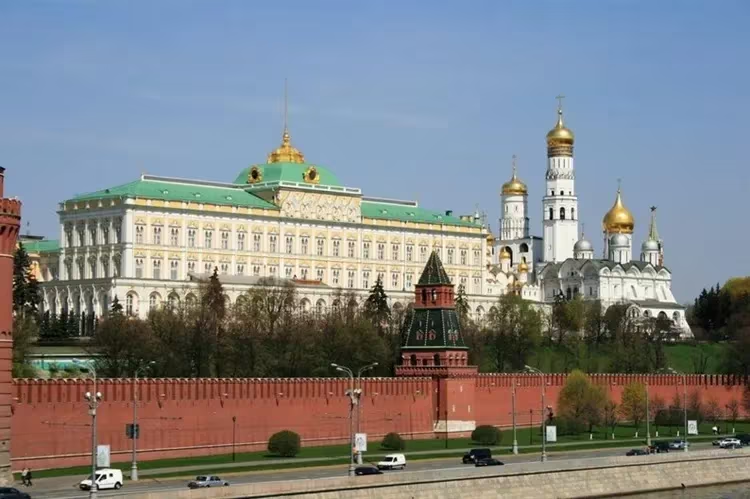
At present, it is the current residence of the President of the Russian Federation. Official events take place here:
The monument of history and architecture is open to visitors. But you can get here only with a guided tour by prior request. Date and time of visit may be subject to change due to official events.
For guests are available:
Halls
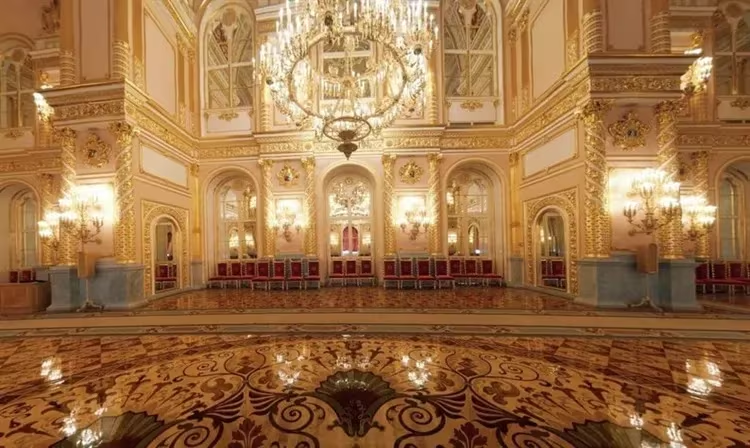
There are about 700 halls in the Palace, made with impeccable taste and originality. These are the front, service, reception, living quarters of the royal family, servants, courtiers. The interior combines different styles: Renaissance, Baroque, Rococo, Classicism, Russian-Byzantine. Service premises (kitchen, servants' rooms, etc.) were located in the basement.
The first floor was occupied by the emperor and his family, adjutant wing on duty, courtiers, there were also pantries and dressing rooms. The second floor was intended for crowded receptions, balls, ceremonial events that took place in richly decorated front rooms. The most famous: Andreevsky, Vladimirsky, Georgievsky, Aleksandrovsky, Ekaterininsky, have names associated with Russian orders. For the upholstery of each hall, fabrics of a certain color, made specifically for the interiors of the palace, are used. A magnificent staircase made of Revel stone leads to the second floor.
The five-meter doors, made of fine wood, are skillfully inlaid with mother-of-pearl and tortoiseshell inserts and decorated with unique carvings. Magnificent interiors are complemented by crystal chandeliers with original pendants, mirrors in gilded frames, three-meter porcelain vases, marble and malachite fireplaces.
Andrew's Hall
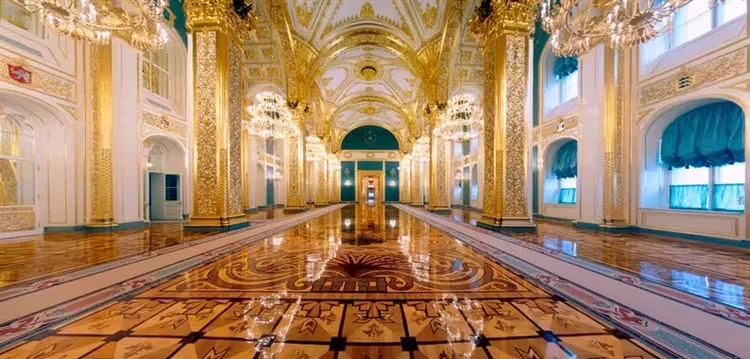
The hall is named after the Order of the Apostle Andrew the First-Called – the most prestigious award of the Russian Empire since the time of Peter I. Its second name is the throne room. He was considered the main one, here the emperor received congratulations after the coronation, the most solemn events took place. The magnificent room is located on the southern facade, the light penetrates through 18 two-story windows. The hall is divided into three naves by five pairs of tetrahedral columns.
At the east wall of the wide central nave, under a canopy of ermine and gold brocade, there are three thrones. Above the canopy is the Russian coat of arms with the inscription “God is with us”, and above – the all-seeing eye, a symbol of the life-giving Trinity. The columns and plafonds are covered with gilded ornaments, the walls are upholstered in moire silk, decorated with titular coats of arms, bronze candelabra. In the hall there are two fireplaces of extraordinary beauty made of jasper, which has a unique purple hue.
Alexander Hall
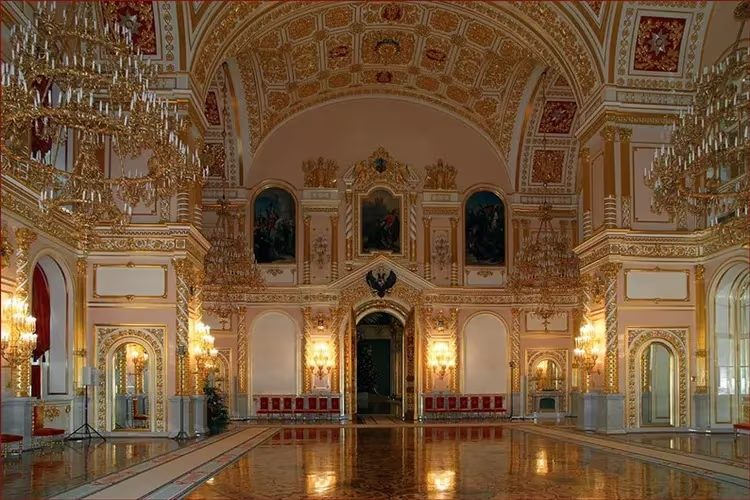
The hall is dedicated to the Order of Alexander Nevsky, which has been awarded since 1725. It has dimensions: 31*21 m and 20 m in height. The gilded hemisphere of the dome is decorated with order crosses, stars, images of a double-headed eagle and the letters “SA”, which means St. Alexander. The walls are finished with pink marble, the chairs are upholstered in red velvet to match the color of the ribbon of the order. On the walls are the coats of arms of the lands of the empire, the coat of arms of the Romanov dynasty. In the upper niches above the doors there are six paintings by the artist F. Moller on the theme of feats of arms, the life of the Grand Duke and his acceptance of monasticism.
Vladimir Hall
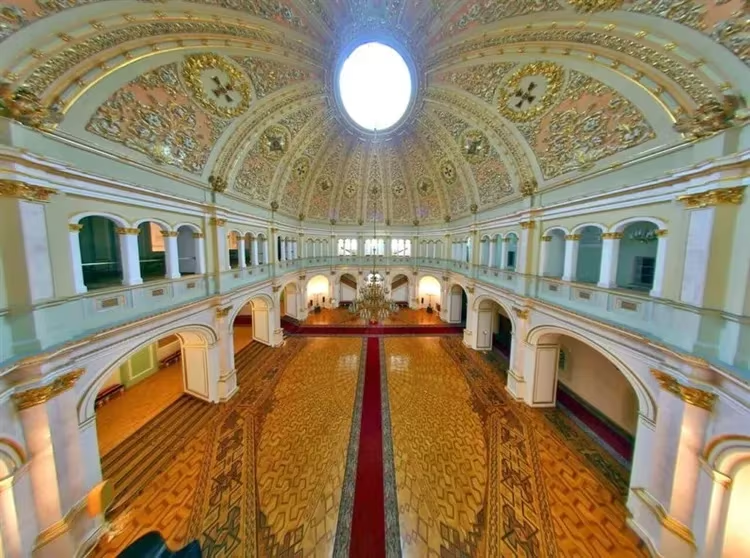
The hall owes its name to the Order of St. Vladimir – the Baptist of Russia, established in 1782. It has dimensions of 16*16 m and an original shape resembling a rounded octahedron. The walls are lined with marble panels.
Daylight passes through a huge hipped dome with a glazed opening at the top, at night the hall is illuminated by a three-ton chandelier made of gilded bronze. The dome is decorated with bas-reliefs of the order. The hall is located in the middle of the building, it is a link between the old and the new part of the palace. It has several doors leading to the St. George's Hall, as well as to the Golden Tsaritsyna and the Faceted Chamber, the Terem Palace.
St George's Hall
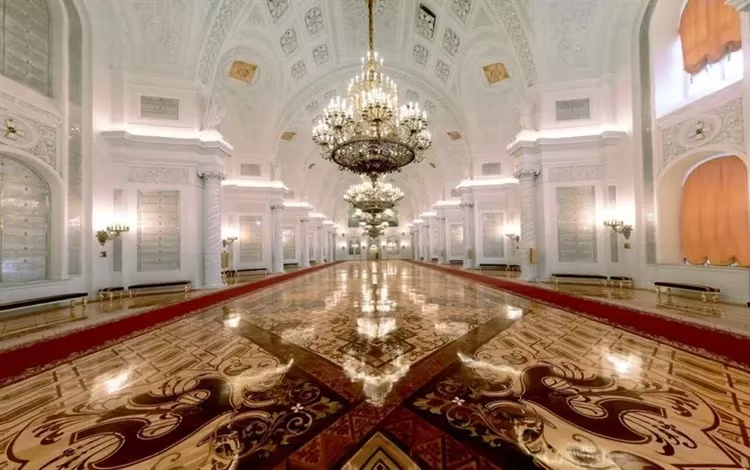
The Hall of Military Glory is associated with the Order of St. George the Victorious, established in 1769. It is the largest in the palace: its length is 61 meters, its height is 17 m, and its area is 1250 m². On the walls there are marble tablets with the names of 10 thousand Knights of St. George, incl. A. Suvorov, M. Kutuzov, P. Bagration, F. Ushakov, P. Nakhimov and the names of 545 distinguished military units.
Twisted columns with female statues are installed along the entire length, symbolizing the victories of the Russian army. The room is illuminated by six bronze chandeliers weighing 1300 kg each and 40 wall sconces. Their light is reflected in the parquet made of 20 types of precious wood. The hall has 2 white marble fireplaces, on which a bronze clock with a sculpture of George the Victorious is installed on one, a miniature monument to Minin and Pozharsky on the other.
own half
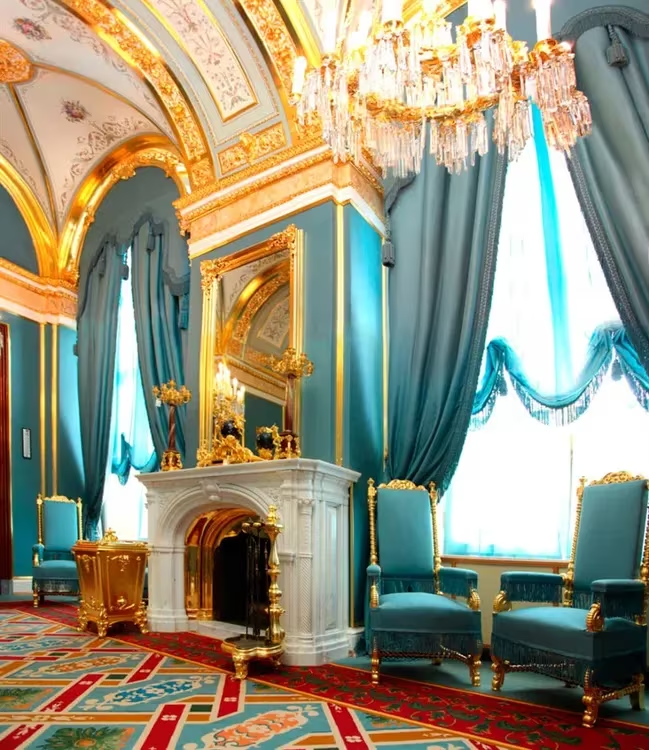
The private half, located on the 1st floor, was intended for the residence of the royal family. It consists of seven residential and four walk-through rooms for duty and meetings with courtiers. The living quarters include: a boudoir, the offices of the Empress and the Emperor, a dining room, a living room, a reception room, and bedrooms. They are decorated with luxury and taste, at the same time there is an atmosphere of home comfort.
The rooms are decorated with porcelain vases, floor lamps, figurines, elegant clocks, mirrors. Each room has its own color and interior solutions. Despite the fact that the rooms are made in different styles, they represent a single ensemble.
Catherine's Hall
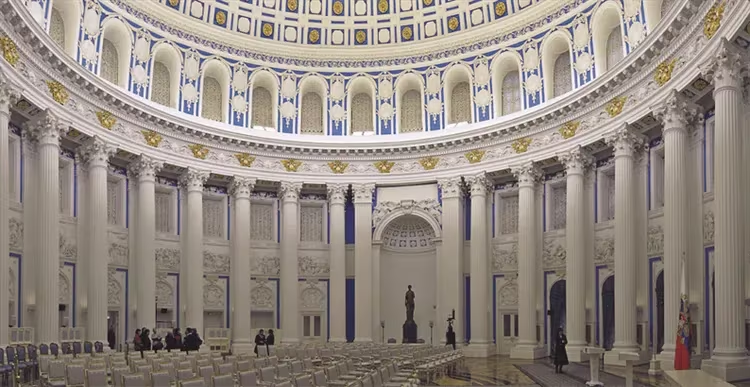
The 21 m long hall was named after the Order of St. Catherine, which since 1714 was awarded to outstanding women. In the hall stood the throne of the Empress (now it is gone) under a red canopy. The parquet, doors and walls of the hall are decorated with images of the order. At the entrance there are pilasters inlaid with malachite, the walls are upholstered in light gray moire. The hall is illuminated with bronze chandeliers and crystal candelabra.
Excursions
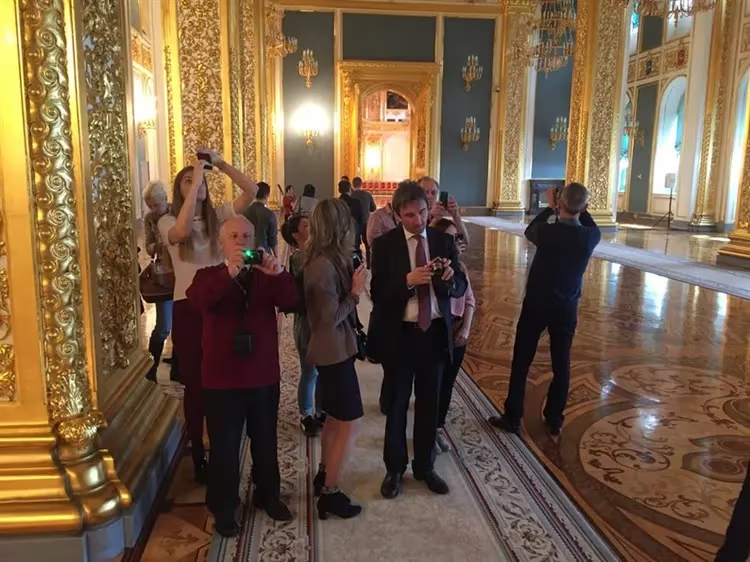
The palace is not a museum, so its visit is allowed only a few times a month. To do this, you must pre-register no earlier than 30 days, specifying passport data and pay in advance through a travel company or the Internet. The group is 20-25 people, the tour is held only on weekdays in the morning (usually meeting at 10 am), lasts an hour and a half.
Before entering the palace, visitors are subjected to a thorough screening. Photographing and filming is allowed only in certain permitted places. Ceremonial halls (except Catherine's), the Terem Palace, the Faceted Chamber are available for inspection.
Working hours
The palace does not have a specific work schedule; it is not an object of free visiting (except for the Armory). The time of excursions is set by the Kremlin administration on days when there are no state events.
How to get there
The building is located at the address: Moscow, Tverskoy district, Kremlin, 1p. Nearest metro station: Lenin Library, then walk 5 minutes towards Moskvoretskaya embankment. There are two more metro stations within a 10-minute walk: “Borovitskaya” and “Aleksandrovsky Sad”.