
Underwater pyramids of Yonaguni in Japan – history, photo, description, map
In 1985, a sensation appeared in the world of amazing discoveries: on the Japanese island of Yonaguni, washed by the waters of the East China and Philippine Seas, a similarity of pyramids was discovered in the coastal underwater zone. Yonaguni is the westernmost island of Japan, occupying only 28.88 square kilometers of territory, with a population of 1581 people. The outlines of the island resemble a compass needle stretched from west to east; its eastern tip bears the symbolic name “Agari-zaki”, meaning “place of sunrise”. The western edge is called “Iri-zaki”, which in translation sounds like “the place of sunset.” In the coastal waters of the island, diving and watching hammerhead sharks are practiced.
The underwater world in these places is very picturesque: the abundance of colorful fish with exotic colors among the red “bushes” of corals is a magical picture that attracts the attention of many diving enthusiasts.
Sensational find
Diving instructor and owner of a small hotel Kihachiro Aratake often plunged into the blue waters, taking pictures of especially beautiful corners of the underwater world for tourists. In the spring of 1985, once again descending to the bottom in a new place, he suddenly saw some kind of stone mass rising up and stretching quite far in breadth. Shocked, Kihacharo realized that he had some kind of unusual object in front of him that required serious study, and informed the official authorities and the press about this. Newspapers and magazines began to publish this news, interpreting the emergence of this mysterious underwater structure in different ways. From that moment, a detailed survey of all objects located in the near-island waters began, which became a sensation in scientific archeology.
Description of underwater pyramids
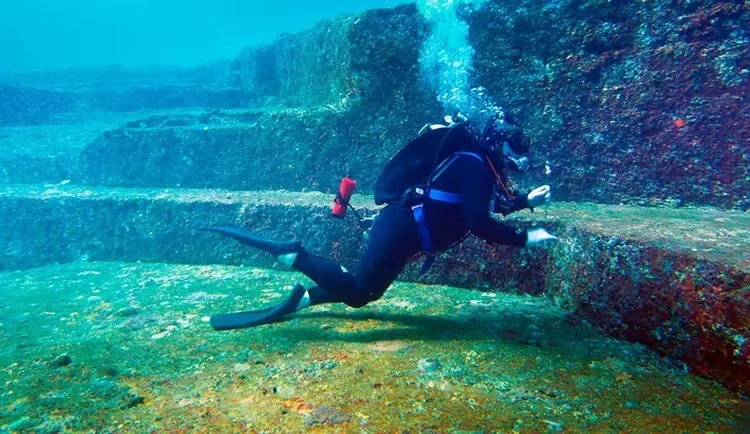
The first studies revealed that stone objects occupy a vast area almost around the entire southern coast of the island. The central structure is a stone mass, called a monument, and is a rather complex structure, the base of which is a high platform 200 meters long, 150 meters wide, and 25 meters high. There are flat terraces on it, descending down with massive steps. The architecture of this structure resembles the pyramids of the ancient Incas, confirming the hypothesis of the man-made origin of the underwater city, as the strange object was called later.
This name is not accidental, because ongoing surveys discovered a stone fence made up of huge boulders of rock and a road, as if encircling the city-monument. Masaaki Kimura, a professor of geology at the Ryukyus University of Okinawa, who has been studying the underwater city for many years, found that part of the original fence was made from pieces of limestone that had never been found here. This observation allowed him to assert that limestone was brought here from other places specifically for construction.
He cited a lot more evidence of the artificial formation of stone pyramids: round holes up to 2 meters deep, traces of an ornament of geometric figures on rock stones, remains of sculptural images with traces of carving, and even, according to Kimura, traces of welding. As well as the creation of Egyptian pyramids to this day Since it remains a mystery, so the construction of underwater giants is also difficult to explain. The correct clear edges of the structures, the strict symmetry of the arrangement of the steps also indicate the man-made origin of the objects, so now scientists are looking for an explanation of why and for how long they are under water.
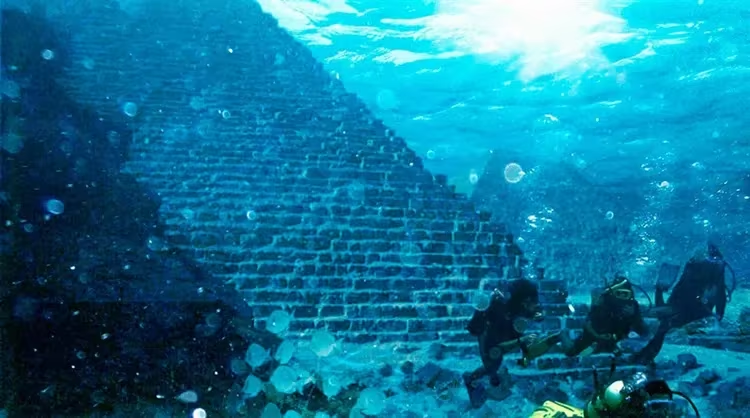
Another researcher of underwater structures, Shoch, does not exclude that the natural stone formation used by ancient people as a site for building a city can serve as the basis. At first, he generally ruled out the participation of people in the formation of an underwater monument, but changed his mind under the influence of the facts presented by the Japanese professor.
Evidence of human involvement in the creation of the pyramids
During the expeditions, finds were discovered confirming Kimura's theory of the man-made origin of the underwater pyramids. At a depth of 15 meters, a sculpture carved from stone was found, on which you can see long arms resembling the arms of the Egyptian Sphinx; headdress. According to the professor, the sculpture resembles the statue of the ancient king of Okinawa.
Scuba divers swimming around the platform saw carvings on the rocks that looked like ancient hieroglyphs; embossed images of animals. The researchers found stone tablets with symbols printed on them, reminiscent of Egyptian letters, which have not yet been deciphered. Scientists believe that these tables contain historical information about a possibly sunken city. Long-term study of underwater ruins by Kimura revealed a number of similarities with ancient excavations on land: the semicircular vault in the underwater platform exactly corresponds to the entrance to the ancient castle of Nakagusuku, belonging to the Ryukyu imperial dynasty, found during excavations in Okinawa.
Professor Kimura's evidence
According to his calculations, these underwater structures are more than 5000 years old, and the professor continues to assert that the objects found are the remains of an ancient city, a whole complex of buildings, including sculptures, castles, a stadium, connected by road infrastructure. As an inquisitive scientist believes, all objects were flooded during a catastrophic earthquake, when huge changes in the earth's crust occurred, a giant tsunami formed, the waves of which buried ancient buildings under them. In support of his version, he studied stalactites and stalagmites of underwater caves, which can form only in surface space for a long time.
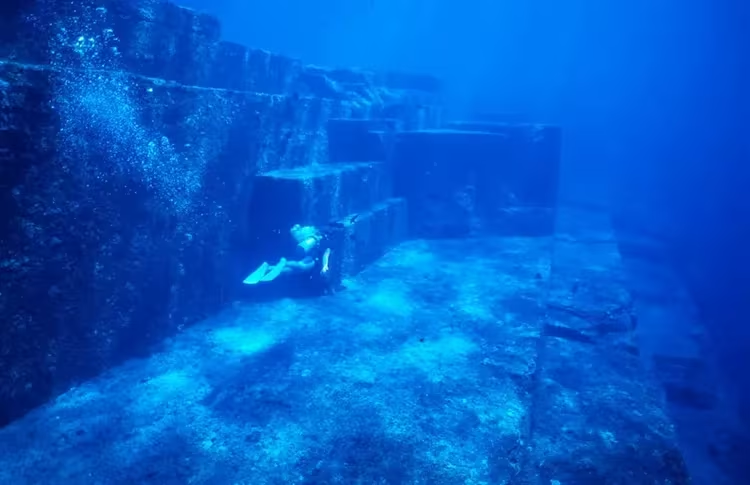
He concludes that they are 5000 years old, and they sank along with stone structures, which are the creation of human hands. So far, no one can draw an unambiguous conclusion, and the mystery of the underwater pyramids will excite the minds and imagination of researchers for a long time to come.
Another interesting place in Japan: Gankajima is a ghost island.