
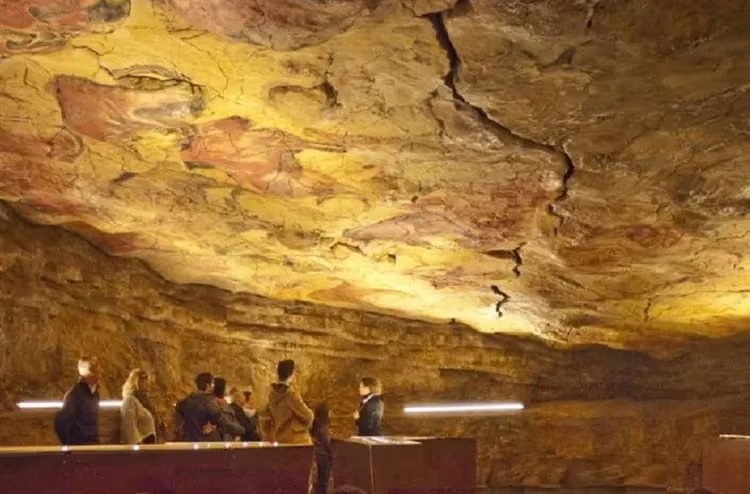
The province of Cantabria, located in the northern part of Spain, is one of the regions richest in archaeological finds from the Paleolithic era. Among the many prehistoric caves found in this area, the Altamira Cave, located near the largest center of the province, the city of Santander, occupies a special place.
History of the cave
The history of Altamira dates back to the archaeological finds of French scientists, presented at the World Exhibition in Paris, held in 1878. By chance, the exhibition was visited by amateur archaeologist Marcelino Sanz de Sautuole from Spain. After seeing the ancient exhibits at the exhibition, Sautuola decided to thoroughly explore the inconspicuous cave he accidentally discovered on the territory of his own possessions.
Returning to Spain, Sautuola immediately began to search for artifacts confirming the possible stay of an ancient man in the dark and gloomy halls of Altamira. The search continued for quite some time. One day, he decided to explore the underground corridors with his nine-year-old daughter Maria. Looking with interest at the vaults in the main hall of the cave, Maria accidentally saw at first the image of a bison, and upon closer inspection, drawings of other animals were also found.
Sautuola immediately began to study the ancient petroglyphs, and soon described them in detail in “Brief Notes on Some Historical Monuments of the Province of Santander”. Despite the refusal of the editors of a reputable scientific journal to publish on their pages the materials of the brochure published by them, the discovery of traces of the presence of an ancient man in the cave of Altamira soon started talking throughout Spain.
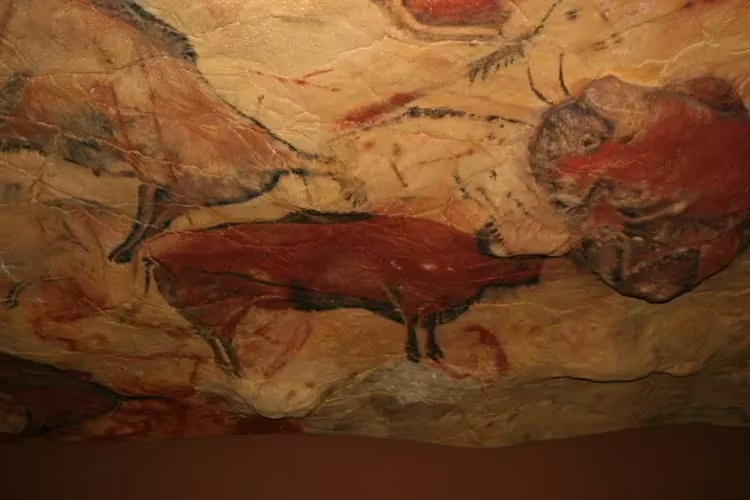
Rock paintings in a cave
Many volunteered to visit the cave and see firsthand the creations of the Ice Age man. The drawings of the ancient artist became interested in the professor of the University of Madrid, don Juan Vilanova i Piera, as well as the king of Spain, Alfonso XII. They were the first to visit the Paleolithic underground gallery of Altamira. The venerable professor was personally convinced of the true origin of the drawings and devoted a number of lectures to them at the university.
However, the professor's support for the discovery of Sautuola met with fierce rejection from the leading archaeologists of the time, Professor Cartagliaca and his teacher Gabriel de Mortillet. Without even trying to visit the cave and thoroughly examine the discovered artifacts, pundits showered Sautuola and Vilanova, who supported him, with ridicule and ironic remarks.
From the time of the discovery of this cave until the beginning of the 20th century, the authenticity of the rock paintings was questioned in many scientific circles. Therefore, the history of the discovery of ancient drawings in Altamira is associated with a long rejection of the new, which is beyond the scope of ordinary knowledge, furious disputes between scientists, caustic mockery of authoritative archaeologists and bitter disappointments. Sadly, Sautuola never lived to see his remarkable discovery recognized. Only many years later, at the entrance to the cave of Altamira, a monument was erected to the discoverer of rock paintings as a sign of gratitude to mankind for his invaluable contribution to archeology.
It took venerable archaeologists as much as twenty years after the discovery of the Ice Age drawings in Altamira to recognize the authenticity of the petroglyphs after similar finds in the caves of La Mut, Marsula and Shabo. For a long time, archaeologists of that era could not come to terms with the idea that an ancient man, not obeying the universal laws of evolution, was able to create real masterpieces on the walls of caves even without access to sunlight.
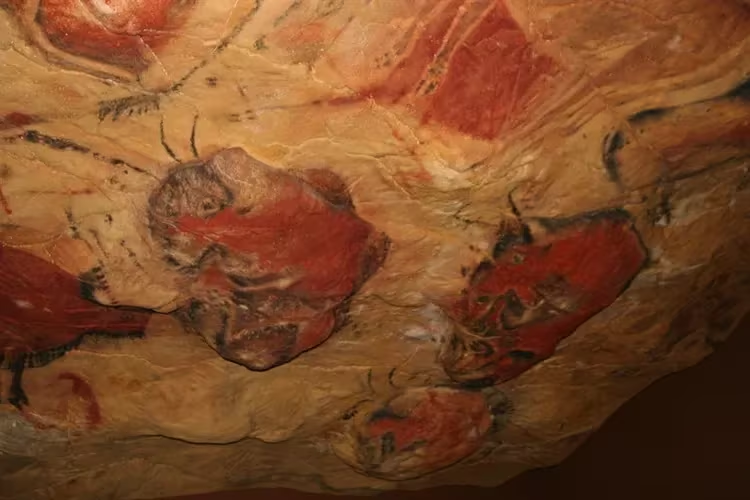
The rock paintings, which caused a lot of controversy among archaeologists, still arouse genuine interest among specialists and admiration of visitors to this day. The images of wild and domesticated animals made by an ancient man during the Ice Age are striking in their authenticity and the illusion of movement created with the help of natural colors and uneven surface of the cave walls.
The feeling of movement of animals painted with ocher, charcoal and hematite is enhanced by the flickering flame. It remains a mystery not only the skill of the ancient artist, who managed to depict animals and even capture the image of an ancient man, but also his work in that section of the cave where the rays of the sun could not penetrate at all. In addition to painted animals, there are lines drawn with fingers, strange figures and incomprehensible symbols indicated by dots and strokes. Similar images exist in many caves in different countries, and each of them is carefully studied by specialists.
The study of the cave and its petroglyphs allowed scientists to conclude that it is of incomparable value. And in 1985, Altamira was awarded the title of UNESCO World Heritage Site.
Double cave – Altamira-2
As soon as the true origin of the petroglyphs was no longer doubted, the crowds wishing to visit the Altamira cave and see the creations of an ancient man with their own eyes increased every year, which began to negatively affect the state of the cave and its petroglyphs. The mold that appeared due to changes in the microclimate in the cave began to cover and destroy ancient drawings.
Specialists who monitor the state of Altamira and its petroglyphs first decided to limit the number of visitors. However, the situation remained critical and the petroglyphs continued to deteriorate. The original decision, made in the early 90s, to build a twin of Altamira with an appearance absolutely identical to the natural cave changed the situation for the better. This is how Altamira-2 appeared.
Using paints from natural raw materials, like people of the Paleolithic era, modern artists Pedro Saura and Mathilde Muskis managed to create copies of ancient rock masterpieces. Marcelino's daughter Maria turned out to be a worthy successor to her father's ideas. Being married to a wealthy man, she, together with her husband, organized a fund, thanks to which it became possible to create a copy of the existing Altamira. And history repeated itself again. Only the new King of Spain and his Queen were the first to visit Altamira-2.
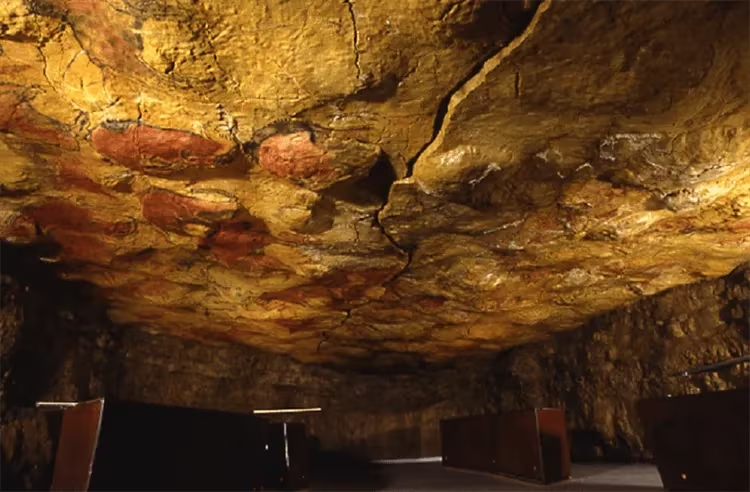
Altamira-2 was created specifically for visiting tourists. Getting into an artificially equipped cave, none of them feel that it was created by human hands. Altamira-1 serves science. The results of petroglyph studies show that the rock paintings are more than 14 thousand years old, and some images are more than 16 thousand years old. Experts were able to prove that red horses were depicted earlier than bison, and murals and mysterious signs appeared much later. The rock paintings of Altamira are so popular that copies of them are kept in many museums around the world, including the Madrid National Archaeological Museum.
Recommended reading Interesting facts about Spain.